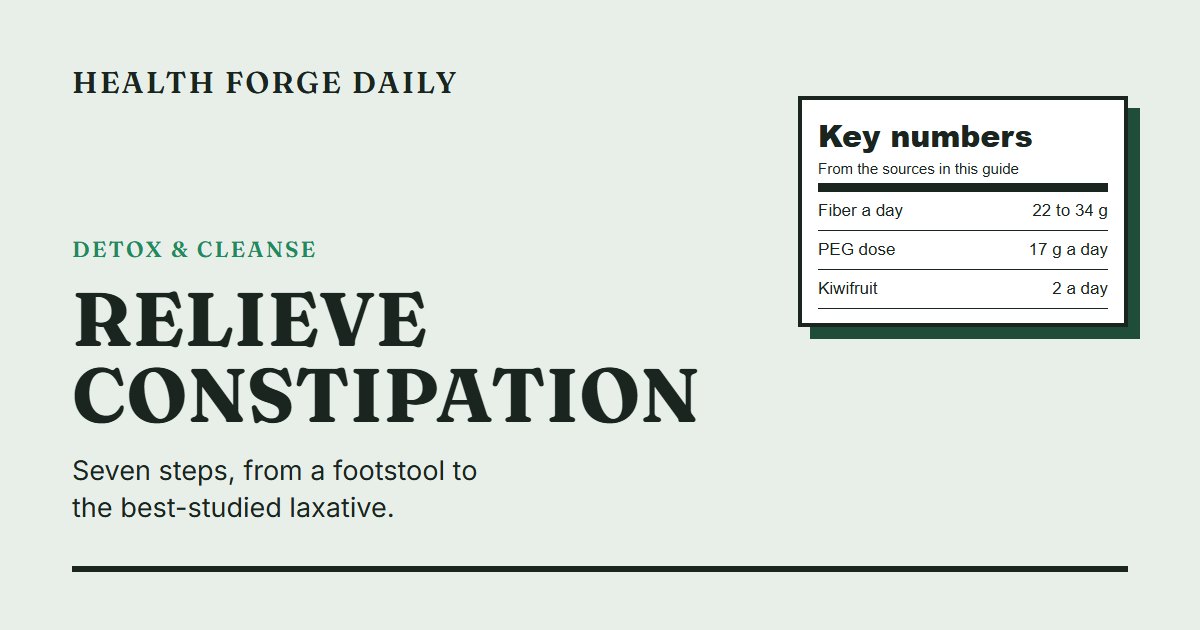
To relieve constipation, add fiber slowly toward 22 to 34 grams a day, drink more liquid, and sit on the toilet after breakfast with your feet on a footstool. Kiwifruit and prunes can help within days. If that fails, polyethylene glycol at 17 grams a day has the strongest guideline support. Save stimulant laxatives for occasional use, and see a doctor for bleeding or severe pain.
This guide explains how to relieve constipation, starting with steps that work within hours and moving to the habits that keep it from coming back. We read the NIDDK constipation pages, MedlinePlus, the 2023 AGA-ACG laxative guideline, a 2025 dietary guideline and five trials and reviews. Our review process explains how we choose and check sources.
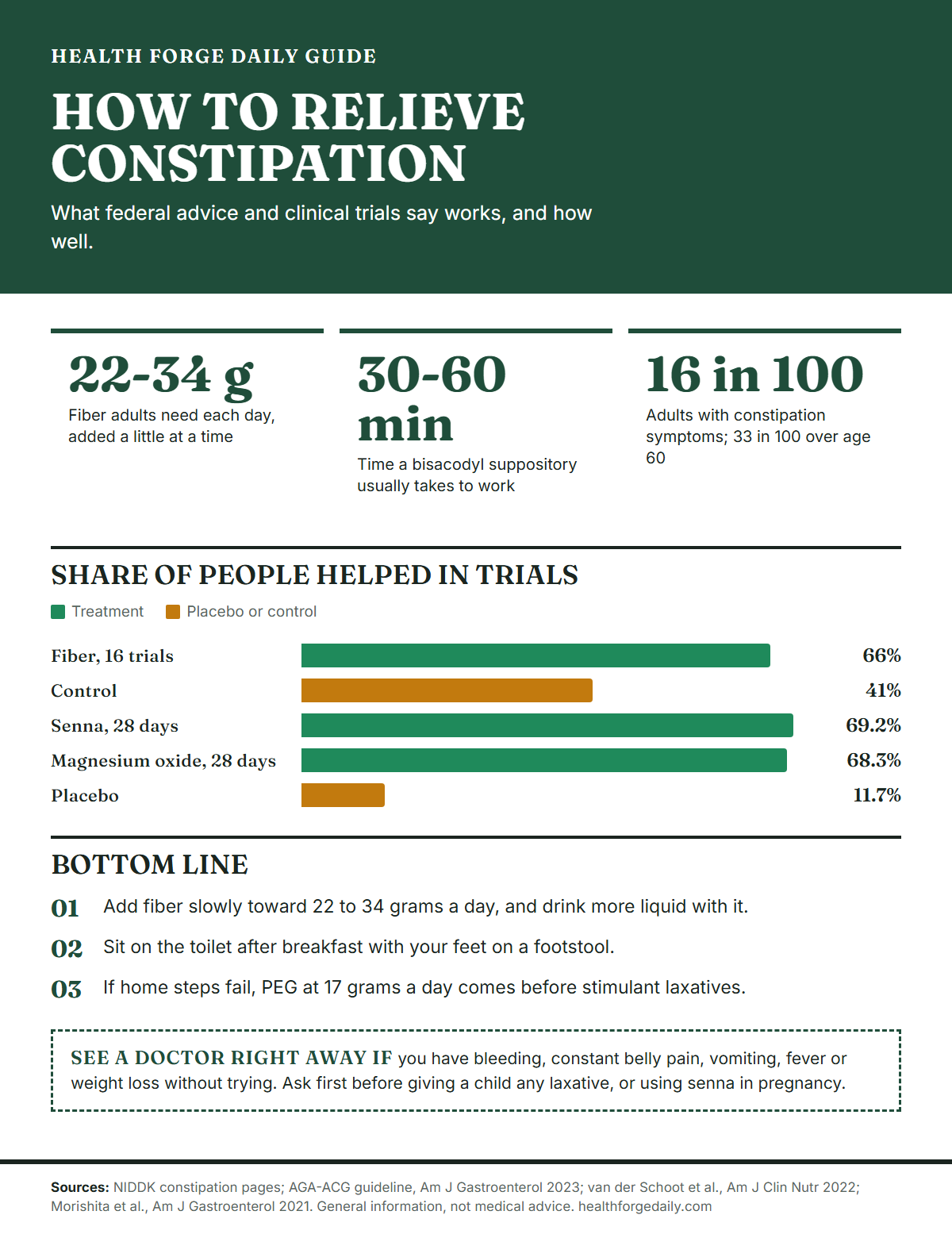
The short answer: add fiber slowly toward 22 to 34 grams a day with plenty of liquid, use a footstool on the toilet, and if that is not enough, try an over-the-counter osmotic laxative such as polyethylene glycol at 17 grams a day[1][6].
| What it is | Fewer than three bowel movements a week, or stools that are hard, dry or painful to pass[2]. |
|---|---|
| How common | About 16 in 100 adults, and 33 in 100 adults aged 60 and older[4]. |
| First step | Fiber at 22 to 34 grams a day for adults, added a little at a time, with more liquids[1][3]. |
| Fastest over-the-counter option | A bisacodyl suppository usually works within 30 to 60 minutes; the tablet takes 6 to 12 hours[6]. |
| Best evidence | Polyethylene glycol (PEG) and psyllium both beat placebo in guideline reviews[6]. |
| Who should be careful | People with kidney disease (magnesium), pregnant women (senna), and children, who should not get laxatives without a doctor[6][13]. |
How to relieve constipation fast: 7 steps
The fastest way to relieve constipation is to combine a toilet routine, better posture and fluids with a gentle laxative if needed. Most cases are short and not serious, so home steps are a sensible start[5]. Work down this list in order, and stop when your bowels move comfortably again.
- Drink a glass of water or other liquid now, and keep drinking through the day, since liquid helps fiber work[3].
- Sit on the toilet 15 to 45 minutes after breakfast, when eating naturally gets the colon moving[1].
- Put your feet on a footstool so your knees sit above your hips[1][12].
- Go as soon as you feel the urge, and give yourself enough time[1].
- Eat two kiwifruit or a serving of prunes with breakfast[9][10].
- If nothing happens by the next day, take polyethylene glycol 17 grams in a full glass of liquid[6].
- If you still need quick relief, a bisacodyl suppository usually works within 30 to 60 minutes[6].
Steps 6 and 7 are short-term tools. If you need them often, talk with your doctor about the cause.
What can you do on the toilet to relieve constipation immediately?
Raising your feet on a footstool is the simplest on-the-toilet change with trial support. It changes the angle of the rectum, which can make stool easier to pass. NIDDK also suggests relaxing your muscles and not rushing[1]. Avoid hard straining, which tends to make things worse.
A 2019 study followed 52 healthy adults through 1,119 bowel movements over four weeks[12]. With a footstool, people were more likely to feel fully emptied (odds ratio 3.64) and less likely to strain (odds ratio 0.23). Without it, bowel movements took 1.25 times longer[12].
NIDDK also suggests sitting at a set time each day, ideally after a meal, with enough time that you are not rushed[1]. If you have been holding stool in because you were busy or away from home, that habit itself can cause constipation[2].
If you need relief within the hour, the AGA-ACG guideline notes that a bisacodyl suppository usually acts within 30 to 60 minutes[6]. Use it only now and then, and follow the label.
How to relieve constipation naturally at home?
Natural relief rests on more fiber, more liquid and regular activity. NIDDK says adults should get 22 to 34 grams of fiber a day, depending on age and sex, and should add it slowly so the body adjusts[1][3]. Liquids help fiber soften stool, so drink more as you add it.
A 2025 British Dietetic Association guideline graded the trials on diet and constipation[7]. It found support for psyllium supplements, kiwifruit, rye bread, magnesium oxide and high-mineral water for specific symptoms. It made no recommendation on a general high-fiber diet, because trials of whole diets were lacking[7].
Fiber supplements also count as a natural option. A 2022 meta-analysis of 16 trials with 1,251 people found that 66% responded to fiber compared with 41% on control[8]. Psyllium worked best, especially at more than 10 grams a day for at least four weeks[7][8]. Our guide to psyllium husk benefits for digestion covers dosing in more detail.
Take each fiber dose with 8 to 10 ounces of fluid[6]. If you are not sure how much to drink overall, see our guide on how much water to drink a day. Regular physical activity is also on the NIDDK list, though no trial we read put a number on its effect[1].
What foods relieve constipation?
Kiwifruit, prunes and high-fiber plant foods have the best support for relieving constipation. In a 2021 US trial, two kiwifruit a day, prunes and psyllium all improved bowel movements over four weeks, and kiwifruit caused the fewest side effects[9]. NIDDK lists whole grains, beans, fruit, vegetables and nuts as good fiber sources[3].
| Food | Amount studied | What happened |
|---|---|---|
| Green kiwifruit | 2 to 3 a day for 4 weeks | Better bowel movements, fewest side effects[7][9] |
| Prunes | 50 g twice a day for 3 weeks | Beat psyllium for frequency and stool softness[10] |
| Beans, lentils, whole grains | Toward 22 to 34 g fiber a day | Standard NIDDK advice[3] |
| Chips, fast food, processed meals | Limit | Little to no fiber[3] |
The prune trial was small, with 40 adults, and the kiwifruit trial randomized 79[9][10]. Both studies were small. For more ideas, our list of high fiber foods and easy meals shows how to reach your daily target.
What medicine relieves constipation?
Polyethylene glycol (PEG, sold as MiraLAX) is the over-the-counter laxative with the strongest guideline backing. The 2023 AGA-ACG guideline gave strong recommendations to PEG and to bisacodyl, and conditional ones to fiber, senna, magnesium oxide and lactulose[6]. PEG is cheap and sold without a prescription[6].
| Type | Example and dose | Speed and notes |
|---|---|---|
| Bulk fiber | Psyllium, over 10 g a day | Works over days; 391 more people per 1,000 got relief[6][7] |
| Osmotic | PEG 17 g a day | 312 more responders per 1,000 than placebo[6] |
| Osmotic | Magnesium oxide | Avoid with kidney problems[6] |
| Stimulant | Senna 8.6 to 17.2 mg a day; bisacodyl | Bisacodyl tablet 6 to 12 hours, suppository 30 to 60 minutes[6] |
NIDDK advises using stimulants only if constipation is severe or other treatments have not worked[1]. At 10 mg, bisacodyl caused diarrhea in 53.4% of people compared with 1.7% on placebo, so many doctors start at 5 mg[6].
What the trials show
These are the studies behind the advice above. Most were short, and many of the laxative trials are decades old, according to the AGA-ACG panel[6]. The guideline rated the certainty of the fiber evidence as low. Small sample sizes mean the exact percentages could shift with larger trials, so treat them as a rough guide[6][8].
| Study | People and length | Result |
|---|---|---|
| Fiber meta-analysis, 2022 | 16 trials, 1,251 people | 66% responded vs 41% on control[8] |
| Senna vs magnesium oxide, 2021 | 90 patients, 28 days | Senna 69.2%, MgO 68.3%, placebo 11.7% improved[11] |
| Kiwifruit vs prunes vs psyllium, 2021 | 79 adults, 4 weeks | All three helped; kiwifruit had fewest side effects[9] |
| Footstool study, 2019 | 52 adults, 4 weeks | Fuller emptying, less straining[12] |
How do you relieve constipation in babies and toddlers?
For children, NIDDK starts with food, fluids and toilet habits, not laxatives. Give more high-fiber foods and plenty of water and other liquids. Do not give a child a laxative unless a doctor tells you to[13]. For babies under one year, there is no fiber guideline, so ask your pediatrician first[14].
Children need 14 to 31 grams of fiber a day, depending on age and sex[14]. Good choices include oatmeal, whole wheat bread, beans, berries, pears, apples with the skin on, and carrots. Naturally sweetened fruit juice and clear soups also count toward liquids[14].
For toddlers, NIDDK also suggests asking a potty-trained child to sit on the toilet after meals, using a reward system for regular bowel movements, and pausing potty training until the constipation stops[13].
For infants, the doctor can advise whether to change formula or adjust breast milk feeding[14]. Mineral oil is only for children aged 2 or older, and only when a doctor recommends it[13].
How can you relieve constipation during pregnancy?
In pregnancy, start with fiber, fluids, activity and a regular toilet time, and ask your doctor before any laxative. NIDDK lists pregnancy among the routine changes that can slow bowel movements[2]. The same diet steps that help other adults are the safest first choice[1][3].
The AGA-ACG guideline says senna products are not recommended in pregnant women, because similar substances showed weak genetic effects in animal studies[6]. Check with your doctor or midwife before you buy any laxative.
Iron supplements, which many pregnant women take, are a known cause of constipation[2]. Do not stop a prescribed iron pill on your own, but ask whether a different dose or form would be easier on your bowels.
A footstool, kiwifruit or prunes, and a fiber supplement taken with enough fluid are all gentle options to raise at a prenatal visit[1][6][9]. Add fiber slowly, as NIDDK advises for everyone, to limit gas and bloating[3].
When should you see a doctor for constipation?
See a doctor if self-care does not help, or if you have a family history of colon or rectal cancer. NIDDK lists warning signs that need prompt care, and MedlinePlus advises laxatives only when a provider says so[2][5]. Constipation affects 33 in 100 adults over 60, so older adults should mention it at checkups[4].
See a doctor right away if you have constipation and any of these signs:
- bleeding from your rectum or blood in your stool[2]
- constant belly pain, or you cannot pass gas[2]
- vomiting or fever[2]
- lower back pain[2]
- weight loss without trying[2]
These signs can point to a blockage or another condition that needs testing, so do not wait for home remedies to work[2].
Safety and what doctors use first
Doctors usually start by reviewing your medicines, since narcotic pain relievers, iron, some antidepressants and antacids with aluminum or calcium can all cause constipation[2]. Next come diet changes, bowel training and over-the-counter laxatives, then prescription drugs such as linaclotide or prucalopride, or biofeedback[1][6].
Magnesium oxide is not for people with kidney problems, and senna has no long-term safety studies[6]. If you rely on laxatives, NIDDK suggests working with your doctor to taper slowly[1].
Constipation relief checklist
Work through these items roughly in order. Start with the cheap habit changes and give them a few weeks. Keep notes, so you can tell your doctor what you have already tried. The later items matter most if constipation keeps coming back or you take a medicine that slows the bowel.
- Count your fiber for three days and compare it with 22 to 34 grams[1].
- Add one high-fiber food at a time, and drink more with it[3].
- Try two kiwifruit a day for four weeks[7].
- Keep a footstool by the toilet[12].
- Sit at the same time each day, after breakfast[1].
- Ask your pharmacist whether any medicine you take causes constipation[2][5].
- Keep stimulant laxatives for occasional use[1].
Probiotics come up often for gut problems; our review of whether probiotics work for gut health covers the evidence. Browse related guides in our detox and cleanse section.
Bottom line
Most constipation is short-lived and responds to simple changes: more fiber added slowly, enough liquid, a regular toilet time and a footstool[1][5][12]. Kiwifruit and prunes are food-based options with small trials behind them[9][10].
For most adults, a fiber supplement such as psyllium is the better first step, and PEG is the sensible backup because it is cheap and well studied[6][8]. Stimulants are for occasional use. If warning signs appear, or nothing works after a few weeks, see a doctor instead of trying another product[2].
Sources
- Treatment for Constipation. NIDDK, NIH
- Symptoms and Causes of Constipation. NIDDK, NIH
- Eating, Diet, and Nutrition for Constipation. NIDDK, NIH
- Definition and Facts for Constipation. NIDDK, NIH
- Constipation. MedlinePlus, National Library of Medicine
- AGA-ACG Clinical Practice Guideline: Pharmacological Management of Chronic Idiopathic Constipation (Chang et al.). American Journal of Gastroenterology, 2023
- British Dietetic Association Guidelines for the Dietary Management of Chronic Constipation in Adults (Dimidi et al.). Neurogastroenterology and Motility, 2025
- Effects of fiber supplementation on chronic constipation: a systematic review and meta-analysis (van der Schoot et al.). American Journal of Clinical Nutrition, 2022
- Exploratory comparative effectiveness trial of green kiwifruit, psyllium, or prunes in US patients with chronic constipation (Chey et al.). American Journal of Gastroenterology, 2021
- Randomised clinical trial: dried plums (prunes) vs. psyllium for constipation (Attaluri et al.). Alimentary Pharmacology and Therapeutics, 2011
- Effect of magnesium oxide and senna on constipation: a randomized controlled trial (Morishita et al.). American Journal of Gastroenterology, 2021
- Implementation of a defecation posture modification device (Modi et al.). Journal of Clinical Gastroenterology, 2019
- Treatment for Constipation in Children. NIDDK, NIH
- Eating, Diet, and Nutrition for Constipation in Children. NIDDK, NIH
Frequently asked questions
How do you relieve constipation naturally and quickly?
Drink a glass of water, eat two kiwifruit or some prunes, then sit on the toilet after breakfast with your feet on a footstool. These steps can work within a day. Fiber changes take longer, so build up slowly over a few weeks.
What can I do to ease my constipation tonight?
An over-the-counter bisacodyl tablet taken at bedtime usually works in 6 to 12 hours, so it often acts by morning. Use it only now and then. If you need it often, or have pain or bleeding, see a doctor instead.
Can you manually relieve constipation?
We found no guidance from NIH sources on removing stool by hand at home, so we do not suggest it. If stool feels stuck and home steps fail, see a doctor, who can treat a blockage safely in the office.
How long should constipation last before I see a doctor?
See a doctor if self-care has not helped after a few weeks, or right away if you have bleeding, constant belly pain, vomiting, fever or weight loss without trying. A family history of colon cancer is another reason to get checked.
Is it safe to take a laxative every day?
PEG was tested daily for 6 months in a 304-person trial. Stimulants such as senna have no long-term safety studies, and NIDDK advises keeping them for severe cases. Ask your doctor before daily use of any laxative.

Grace Whitaker is the health editor at Health Forge Daily. She reads supplement labels line by line, checks each ingredient and dose against published research, and tracks refund policies and customer complaints before a product gets a verdict. She is not a doctor, so every review points readers back to their own physician for medical decisions.
This article is for general information and is not medical advice. Supplements are not evaluated by the FDA and are not intended to diagnose, treat, cure or prevent any disease. Check with your doctor before you start any supplement.