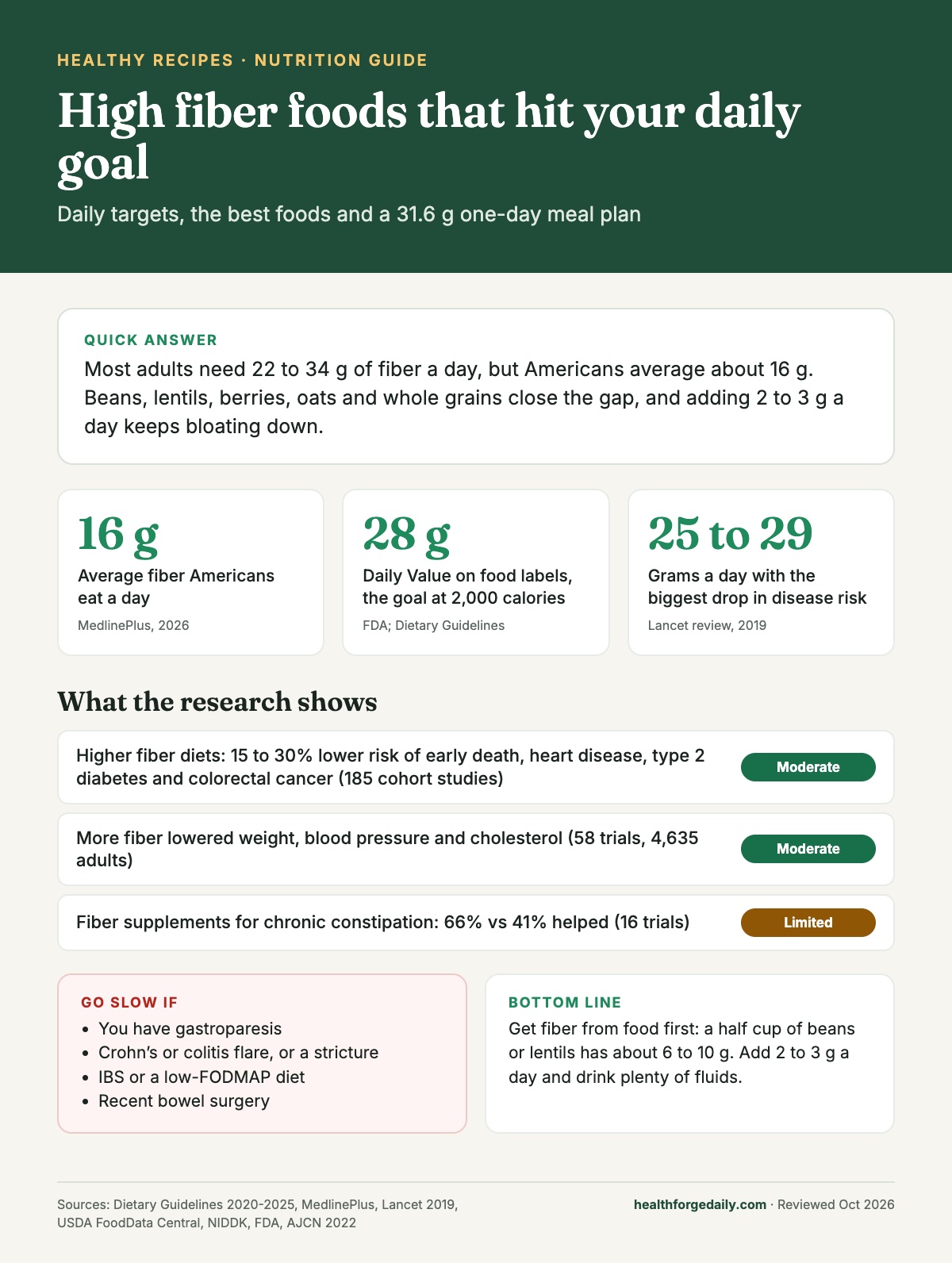
Most adults need 22 to 34 grams of fiber a day, set at 14 grams per 1,000 calories, but Americans average about 16. Beans, lentils and split peas give about 6 to 10 grams per half cup. Higher fiber intake is linked to lower rates of heart disease, type 2 diabetes and colorectal cancer. Add 2 to 3 grams a day to limit bloating.
Fiber is the nutrient most Americans fall short on without noticing. We read the fiber goals in the Dietary Guidelines for Americans, the MedlinePlus and NIDDK pages on fiber and digestion, and the 2019 Lancet review of fiber and long-term health, then pulled grams per serving for common foods from USDA FoodData Central.
Most adults need 22 to 34 grams of fiber a day, depending on age and sex, and the average American eats about 16. Beans, lentils, berries, oats and whole grains close that gap quickly. Adding fiber a few grams at a time keeps gas and bloating down.[2][6][10]
| Daily goal | 14 grams per 1,000 calories; 22 to 34 grams for most adults[1][10] |
|---|---|
| What Americans eat | About 16 grams a day on average[2] |
| Richest everyday foods | Beans, lentils and split peas (about 6 to 10 grams per half cup), berries, chia seeds[5] |
| Best evidence | 185 cohort studies and 58 trials: higher fiber intake linked to 15 to 30% lower risk of early death, heart disease, type 2 diabetes and colorectal cancer[4] |
| Side effects | Gas, bloating and cramps when fiber is added too fast[2] |
| Go slow or ask first | Gastroparesis, a flare or stricture from Crohn’s disease or ulcerative colitis, IBS[6][7][8] |
How much fiber should you have daily?
Most adults should aim for 22 to 34 grams a day, depending on age and sex. The Dietary Guidelines set fiber at 14 grams for every 1,000 calories you eat, based on the Institute of Medicine’s Dietary Reference Intakes. The goals reflect levels observed to lower the risk of coronary heart disease.[1]
The goal scales with calories, so younger adults and men have higher targets. Appendix 1 of the 2020-2025 Dietary Guidelines lists them by age and sex.[1]
| Age | Women and girls | Men and boys |
|---|---|---|
| 2 to 3 | 14 g (both sexes)[1] | |
| 4 to 8 | 17 g | 20 g[1] |
| 9 to 13 | 22 g | 25 g[1] |
| 14 to 18 | 25 g | 31 g[1] |
| 19 to 30 | 28 g | 34 g[1] |
| 31 to 50 | 25 g | 31 g[1] |
| 51 and older | 22 g | 28 g[1] |
During pregnancy the goal runs from 25 to 36 grams a day depending on age and trimester, and while breastfeeding it is 31 to 34 grams.[1] MedlinePlus gives the overall range for older children, teens and adults as 21 to 38 grams a day.[2]
If you eat about 2,000 calories a day, your target is 28 grams, which is also the Daily Value printed on Nutrition Facts labels.[1][12]
How much fiber do most Americans actually eat?
About half of what they need. MedlinePlus puts the average US intake at about 16 grams a day.[2] The Dietary Guidelines report that more than 90% of women and 97% of men do not meet the recommended intake.[1]
Fiber comes only from plants, and more than 85% of adults eat too little fruit, vegetables and whole grains.[1][2] Refined grains account for much of the shortfall: a slice of white bread has 0.8 grams of fiber against 1.9 grams in whole-wheat bread, and a cup of white rice has 0.6 grams against 3.2 grams in brown rice.[5]
| Group | Fiber | Source |
|---|---|---|
| Goal: women 19 to 30 | 28 g a day | [1] |
| Goal: women 31 to 50 | 25 g a day | [1] |
| Goal: women 51 and older | 22 g a day | [1] |
| Goal: men 19 to 30 | 34 g a day | [1] |
| Goal: men 31 to 50 | 31 g a day | [1] |
| Goal: men 51 and older | 28 g a day | [1] |
| What Americans eat on average | 16 g a day | [2] |
| Our one-day meal plan below | 31.6 g a day | [5] |
What is the difference between soluble and insoluble fiber?
Soluble fiber turns to gel and slows digestion; insoluble fiber adds bulk and speeds things along. Soluble fiber attracts water and becomes a gel during digestion. It is found in oat bran, barley, nuts, seeds, beans, lentils, peas, some fruits and vegetables, and the supplement psyllium. Research shows it helps lower cholesterol.[3]
Insoluble fiber does not dissolve in water. It is found in wheat bran, vegetables and whole grains, and it adds bulk to stool and helps food move more quickly through the stomach and intestines.[2][3]
You do not need to track the two types separately. Most high-fiber foods contain both, in different proportions, which is why MedlinePlus advises eating a variety of vegetables, fruits, whole grains, legumes and beans.[2] Fiber also counts for fewer calories than other carbohydrates: about half of the 4 calories per gram that other carbs provide.[2]
What does fiber do for your health?
People who eat the most fiber have lower rates of several major diseases, and trials show modest improvements in weight, blood pressure and cholesterol. The best single summary is a 2019 series of systematic reviews in The Lancet, partly funded by the World Health Organization.[4]
The authors pooled 185 prospective studies, covering just under 135 million person-years, and 58 clinical trials with 4,635 adults. Comparing the highest fiber eaters with the lowest, the cohort studies found a 15 to 30% lower rate of death from any cause and from heart disease, and of coronary heart disease, stroke, type 2 diabetes and colorectal cancer.[4]
In the trials, higher fiber intake led to lower body weight, systolic blood pressure and total cholesterol. The biggest risk reductions came at 25 to 29 grams a day, and the dose-response data suggested more could be better still. The authors rated the certainty of the fiber evidence as moderate.[4]
The review has two limits. Most of its disease data come from observational studies, which can show a link but cannot prove cause, although the authors argued the dose-response pattern points toward a causal effect. It also excluded trials of fiber supplements and people with existing chronic disease, so its findings apply to fiber from food in the general population.[4]
What do the main studies and guidelines show?
| Question | Best evidence | Result | What it means |
|---|---|---|---|
| Long-term disease risk | Lancet 2019, 185 cohort studies[4] | 15 to 30% lower risk, highest vs lowest intake | Moderate-certainty link, not proof of cause |
| Weight, blood pressure, cholesterol | Lancet 2019, 58 trials, 4,635 adults[4] | All lower with more fiber | Trial evidence of modest benefit |
| How much is enough | Lancet 2019 dose-response[4] | Largest benefit at 25 to 29 g a day | Matches the US goals for most adults |
| Cholesterol by fiber type | MedlinePlus[3] | Soluble fiber helps lower cholesterol | Oats, barley and beans are good picks |
| Fiber supplements for constipation | 2022 meta-analysis, 16 trials, 1,251 adults[13] | 66% vs 41% responded | Helps, but trials varied a lot |
| Adding fiber without gas | NIDDK[6] | Increase 2 to 3 g a day | Go slowly, drink fluids |
Which foods are highest in fiber?
Beans, lentils and split peas lead, followed by berries, chia seeds and some vegetables and whole grains. We calculated the values below from USDA FoodData Central, using its fiber content per 100 grams and USDA’s own portion weights.[5] Cooked beans and grains are measured cooked; oats are measured dry.
| Food | Serving | Fiber |
|---|---|---|
| Navy beans, cooked | 1/2 cup | 9.6 g[5] |
| Chia seeds | 1 oz | 9.8 g[5] |
| Split peas, cooked | 1/2 cup | 8.1 g[5] |
| Raspberries | 1 cup | 8.0 g[5] |
| Lentils, cooked | 1/2 cup | 7.8 g[5] |
| Blackberries | 1 cup | 7.6 g[5] |
| Black beans, cooked | 1/2 cup | 7.5 g[5] |
| Artichoke, cooked | 1 medium | 6.8 g[5] |
| Avocado | 1/2 fruit | 6.7 g[5] |
| Chickpeas, cooked | 1/2 cup | 6.2 g[5] |
| Barley, pearled, cooked | 1 cup | 6.0 g[5] |
| Pear, with skin | 1 medium | 5.5 g[5] |
| Whole-wheat spaghetti, cooked | 1 cup | 4.6 g[5] |
| Apple, with skin | 1 medium | 4.4 g[5] |
| Rolled oats, dry | 1/2 cup | 4.1 g[5] |
| Sweet potato, baked | 1 medium | 3.8 g[5] |
| Green peas, cooked | 1/2 cup | 3.6 g[5] |
| Almonds | 1 oz | 3.5 g[5] |
| Popcorn, air-popped | 3 cups | 3.5 g[5] |
| Brown rice, cooked | 1 cup | 3.2 g[5] |
| Broccoli, cooked | 1/2 cup | 2.6 g[5] |
| Whole-wheat bread | 1 slice | 1.9 g[5] |
| Ground flaxseed | 1 tbsp | 1.9 g[5] |
A half cup of cooked beans or lentils gives a quarter of a 28-gram day or more, and MedlinePlus notes that peeling fruits and vegetables lowers the fiber you get.[2][5]
What does a 30-gram fiber day look like?
Four simple meals built on oats, beans, whole grains and fruit reach about 31.6 grams. That covers the goals in the table above for every group except men aged 19 to 30, who would add one more serving, such as a pear.[1][5] Fiber totals below count only the listed foods, using the FoodData Central values in the table above.[5]
| Meal | What goes in | Fiber |
|---|---|---|
| Breakfast: berry overnight oats | 1/2 cup rolled oats (4.1 g), 1 tbsp ground flaxseed (1.9 g), 1/2 cup raspberries (4.0 g) | 10.0 g[5] |
| Lunch: smashed chickpea sandwich | 2 slices whole-wheat bread (3.8 g), 1/2 cup chickpeas (6.2 g) | 10.0 g[5] |
| Snack | 1 medium apple with skin | 4.4 g[5] |
| Dinner: whole-wheat pasta with broccoli | 1 cup cooked whole-wheat spaghetti (4.6 g), 1/2 cup cooked broccoli (2.6 g) | 7.2 g[5] |
| Total | 31.6 g[5] |
Berry overnight oats. The night before, stir 1/2 cup rolled oats and 1 tablespoon ground flaxseed into a jar with milk or a fortified soy drink. Refrigerate overnight and top with 1/2 cup raspberries in the morning.
Smashed chickpea sandwich. Drain and rinse 1/2 cup canned chickpeas, mash them with a fork, and mix in a spoon of plain yogurt or hummus, lemon juice, mustard and chopped celery. Spread on 2 slices of whole-wheat bread.
Whole-wheat pasta with broccoli. Boil 1 cup (cooked) of whole-wheat spaghetti, adding chopped broccoli to the pot for the last few minutes. Drain and toss with olive oil, garlic and a little grated cheese.
To swap meals, a lunch of 1/2 cup lentils in soup (7.8 g) or a bowl of 1/2 cup black beans (7.5 g) over brown rice (3.2 g) lands in the same range.[5] For more plant-forward meal ideas, see our anti-inflammatory diet guide and the rest of our healthy recipes.
What are the easiest high-fiber swaps?
Change the grain, keep the skin, and add a bean. All values are from USDA FoodData Central.[5]
- White bread to whole-wheat: 0.8 g to 1.9 g per slice.[5]
- White rice to brown rice: 0.6 g to 3.2 g per cup.[5] Barley gives 6.0 g per cup.[5]
- Chips to popcorn: 3 cups of air-popped popcorn have 3.5 g.[5]
- Juice to whole fruit: the Dietary Guidelines note that fruit juice is lower in fiber than whole fruit.[1] A medium pear has 5.5 g.[5]
- Add a half cup of beans to soup, salad, tacos or pasta sauce for 6 to 10 g.[5]
- Seeds: 1 tablespoon of ground flaxseed adds 1.9 g to oatmeal or yogurt.[5]
How do you add fiber without bloating?
Go up slowly and drink more fluids. Eating a lot of fiber in a short time can cause gas, bloating and cramps. MedlinePlus says this often goes away once your gut bacteria get used to the change.[2]
- Add 2 to 3 grams a day. NIDDK says increasing fiber by 2 to 3 grams a day may help prevent gas and bloating.[6]
- Spread it over several weeks if you need to. MedlinePlus advises adding fiber gradually over a few weeks.[2]
- Drink plenty of fluids, about 8 glasses of water or other noncaloric drinks a day, since water helps fiber move through the gut.[2] NIDDK also advises plenty of liquids when you eat more fiber or take a fiber supplement.[10]
- Watch your own triggers. NIDDK notes that some people get more gas with too much fiber.[11]
Very high intakes can also slightly reduce absorption of iron, zinc, magnesium and calcium, but MedlinePlus says this is usually not a concern because high-fiber foods tend to be rich in minerals.[2]
Who should be careful with high-fiber foods?
People with gastroparesis, a flare or stricture from inflammatory bowel disease, or IBS may need less fiber, or a different kind, for a while. If any of these apply, follow your doctor or dietitian rather than a general target.
Gastroparesis. NIDDK says doctors may recommend low-fiber foods and five or six small meals a day, and advises avoiding foods and drinks high in fiber.[7]
Crohn’s disease and ulcerative colitis. MedlinePlus says a provider may recommend a temporary low-fiber diet during a flare-up, often with a limit such as 10 to 15 grams a day. People with an intestinal stricture or obstruction may need less fiber long-term. You do not need a low-fiber diet for inflammatory bowel disease unless you have a flare or a history of stricture.[8] For Crohn’s symptoms, MedlinePlus lists avoiding bran, beans, nuts, seeds and popcorn as one way to ease diarrhea and gas.[9] NIDDK notes that no specific food has been found to cause or worsen Crohn’s disease, and suggests a food diary.[15]
IBS and low-FODMAP diets. NIDDK says fiber may improve constipation in IBS and that soluble fiber appears more helpful for symptoms. A doctor may also suggest a low-FODMAP diet for a few weeks, then slowly adding foods back.[6] NIDDK’s list of FODMAP foods includes several high-fiber staples: apples, pears, blackberries, artichokes, beans, lentils and wheat products.[6] If you follow that diet, plan your fiber with your care team.
After some bowel surgery. A low-fiber diet is sometimes used for a time after surgery such as an ileostomy or colostomy.[8] Ask your surgical team when to add fiber back.
For more on gut health, see our review of whether probiotics work.
When should you see a doctor?
A change in bowel habits that does not settle with diet needs a check. NIDDK says to see a doctor if constipation does not go away with self-care or you have a family history of colon or rectal cancer.[16] See a doctor right away if you have constipation with any of these:[16]
- Bleeding from the rectum or blood in your stool
- Constant pain in your abdomen, or being unable to pass gas
- Vomiting or fever
- Lower back pain
- Losing weight without trying
Standard care for constipation starts with self-care such as more high-fiber foods and more liquids. Over-the-counter fiber supplements are an option, and if self-care does not work, a doctor may prescribe a medicine.[10]
Do you need a fiber supplement?
Most people can reach their goal with food, and food is what the long-term research studied. The Lancet review excluded supplement trials, so its findings on heart disease, diabetes and cancer apply to fiber from food.[4]
Supplements have a role in constipation. NIDDK lists fiber supplements such as Citrucel, FiberCon and Metamucil among the over-the-counter options for constipation.[10] A 2022 meta-analysis of 16 trials with 1,251 adults found 66% of people given fiber supplements responded, compared with 41% in control groups. Psyllium worked best, doses above 10 grams a day did better, and gas was more common.[13]
Take any fiber supplement with plenty of liquid.[10] Tell your doctor first if you have difficulty swallowing or have had an intestinal blockage.[14] People with Crohn’s disease should ask before using fiber supplements.[9] Our psyllium husk guide has the details.
How do you check fiber on a food label?
- Find Dietary Fiber on the Nutrition Facts label. The Daily Value is 28 grams, and the FDA says to aim for at least that much on most days.[12]
- Use the %DV. 20% DV or more per serving is high; 5% DV or less is low.[12] A food with 20% DV has about 5.6 grams per serving.[12]
- Check the serving size before comparing two products, since %DV is per serving.[12]
- Prefer whole fruit to juice and whole grains to refined ones.[1]
- Keep the skins on fruits and vegetables when you can.[2]
- Raise your intake by 2 to 3 grams a day and drink more fluids as you go.[2][6]
- For supplements, skip products that promise to cure disease and check the label basics in how to read a Supplement Facts label.
Our verdict: how should you get more fiber?
Most adults need 22 to 34 grams of fiber a day and eat about 16. The strongest research, a 2019 Lancet review of 185 cohort studies and 58 trials, links higher fiber intake from food with lower rates of early death, heart disease, type 2 diabetes and colorectal cancer, with the largest benefit at 25 to 29 grams a day.[2][4][10]
The easiest route is beans or lentils most days, whole grains instead of refined ones, and whole fruit with the skin on. Add fiber slowly, drink fluids, and if you have gastroparesis, an IBD flare or stricture, or IBS, follow your care team’s plan instead. See how we review health topics and more in nutrition and diet.[6][7][8]
Sources
- Dietary Guidelines for Americans, 2020-2025 (Appendix 1: Nutritional Goals for Age-Sex Groups). US Department of Agriculture and US Department of Health and Human Services, December 2020.
- Dietary fiber. MedlinePlus Medical Encyclopedia, reviewed July 2026.
- Soluble vs. insoluble fiber. MedlinePlus Medical Encyclopedia, reviewed August 2026.
- Carbohydrate quality and human health: a series of systematic reviews and meta-analyses. Reynolds A et al., The Lancet, 2019.
- FoodData Central, SR Legacy dataset (per-serving values computed from grams per 100 g and USDA portion weights). US Department of Agriculture, Agricultural Research Service, April 2018 release.
- Eating, Diet, & Nutrition for Irritable Bowel Syndrome. NIDDK, National Institutes of Health, reviewed November 2017.
- Eating, Diet, & Nutrition for Gastroparesis. NIDDK, National Institutes of Health, reviewed January 2018.
- Low-fiber diet. MedlinePlus Medical Encyclopedia, reviewed July 2024.
- Crohn disease. MedlinePlus Medical Encyclopedia, reviewed January 2025.
- Treatment for Constipation. NIDDK, National Institutes of Health, reviewed May 2018.
- Eating, Diet, & Nutrition for Gas in the Digestive Tract. NIDDK, National Institutes of Health, reviewed June 2021.
- How to Understand and Use the Nutrition Facts Label. US Food and Drug Administration, content current as of March 2024.
- The effect of fiber supplementation on chronic constipation in adults: an updated systematic review and meta-analysis of randomized controlled trials. van der Schoot A et al., American Journal of Clinical Nutrition, 2022.
- Psyllium. MedlinePlus, US National Library of Medicine, last revised June 2024.
- Eating, Diet, & Nutrition for Crohn’s Disease. NIDDK, National Institutes of Health, reviewed July 2024.
- Symptoms & Causes of Constipation. NIDDK, National Institutes of Health, reviewed May 2018.
Frequently asked questions
How much fiber should you have daily?
The Dietary Guidelines set fiber at 14 grams per 1,000 calories. That works out to 22 to 34 grams a day for most adults: 28 grams for women 19 to 30, 25 for women 31 to 50 and 34 for men 19 to 30.
How much fiber per day do most Americans eat?
About 16 grams, according to MedlinePlus. The Dietary Guidelines report that more than 90% of women and 97% of men do not reach the recommended amount, mostly because they eat too few fruits, vegetables and whole grains.
What foods are highest in fiber?
Cooked beans, lentils and split peas give about 6 to 10 grams per half cup in USDA data. Chia seeds, raspberries, blackberries, artichokes, avocado, barley, pears and apples with the skin are also high. Whole grains beat refined grains.
Why does fiber make me bloated?
Adding a lot of fiber quickly can cause gas, bloating and cramps while your gut bacteria adjust. NIDDK suggests increasing fiber by 2 to 3 grams a day, and MedlinePlus advises drinking plenty of fluids as you go.
Is it better to get fiber from food or supplements?
Food is what the long-term research studied. The 2019 Lancet review linking fiber to lower disease risk excluded supplement trials. Fiber supplements can help constipation, and should be taken with plenty of liquid.
Who should not eat a high-fiber diet?
People with gastroparesis are often advised to eat low-fiber foods. A low-fiber diet may also be used during a Crohn’s or ulcerative colitis flare, with an intestinal stricture, or after some bowel surgery. Follow your doctor or dietitian.

Grace Whitaker is the health editor at Health Forge Daily. She reads supplement labels line by line, checks each ingredient and dose against published research, and tracks refund policies and customer complaints before a product gets a verdict. She is not a doctor, so every review points readers back to their own physician for medical decisions.
This article is for general information and is not medical advice. Supplements are not evaluated by the FDA and are not intended to diagnose, treat, cure or prevent any disease. Check with your doctor before you start any supplement.