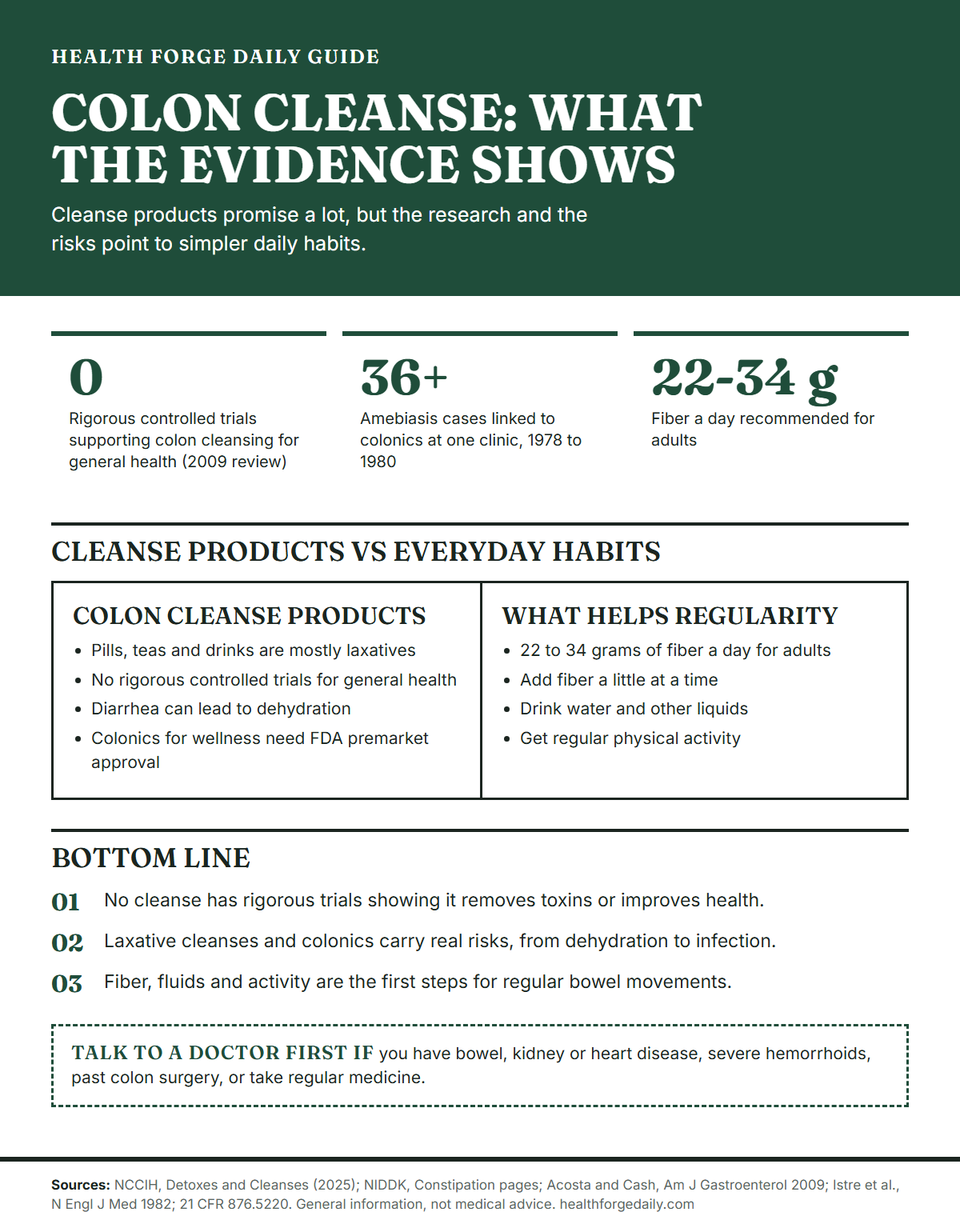
A colon cleanse has no proven health benefit. A 2009 systematic review found no rigorous controlled trials supporting colon cleansing for general health, and many reports of harm, from dehydration to colitis. Pills and teas are mostly laxatives, and colonics carry infection risk. For regular bowel movements, aim for 22 to 34 grams of fiber a day, drink fluids and stay active.
A colon cleanse is any product or procedure meant to flush stool and supposed toxins out of the large intestine, from pills and teas to water pumped in through a tube. We read the NCCIH fact sheet on detoxes, the federal rule on colonic irrigation devices, four NIDDK pages, two MedlinePlus pages, two research reviews, a randomized trial and three reports of harm. Our review and sourcing process explains how we choose and check sources.
The short answer: a 2009 systematic review found no rigorous controlled trials showing that colon cleansing improves general health, but it did find many reports of harm[2].
| What it is | Clearing the colon with enemas, laxatives or colon hydrotherapy, also called colonic irrigation or colonics[1]. |
|---|---|
| Claimed uses | Removing toxins, losing weight and promoting general health. A 2015 review found no compelling research for toxin removal or weight control[1][3]. |
| Best evidence | A 2009 systematic review found no methodologically rigorous controlled trials supporting colon cleansing for general health[2]. |
| Common side effects | Laxatives can cause diarrhea, which can lead to dehydration. Water and tea fasts can upset electrolytes[1]. |
| Who should avoid it | People with gastrointestinal disease, past colon surgery, severe hemorrhoids, kidney disease or heart disease[1]. |
| What helps instead | Fiber, fluids and activity. Adults should get 22 to 34 grams of fiber a day[9][10]. |
What is a colon cleanse?
A colon cleanse is a “detox” method that tries to empty the large intestine using enemas, laxatives or colon hydrotherapy. NCCIH lists it alongside juice fasts, special diets and sauna sessions as one of many detox approaches. These programs are sold online, offered at health centers and used in naturopathic care[1].
The idea behind colon cleansing is that waste builds up in the colon and harms the rest of the body. Your digestive system already handles that job. The large intestine absorbs water, and what is left of digested food becomes stool[8]. Bacteria living in the large intestine also break down some of the food that reaches them[8].
A cleanse only speeds up or forces out what the colon would pass anyway. Toxins carried in the blood are handled mainly by the liver, which is covered in our guide to what your liver needs for detox.
What does the research say about colon cleansing?
The research on colon cleansing is thin and mostly negative. A 2009 systematic review in the American Journal of Gastroenterology found no methodologically rigorous controlled trials supporting it for general health, while case reports of side effects were common. The authors concluded the practice cannot be recommended[2].
Wider detox research looks much the same. A 2015 review called the clinical evidence very little, and said existing studies had flawed methods and small samples[3]. NCCIH adds that there have been no studies on the long-term effects of detox programs[1].
| Study | What was looked at | Size or length | Result |
|---|---|---|---|
| Acosta and Cash, 2009[2] | Systematic review of colonic cleansing for general health | Published literature, all study types | No rigorous controlled trials; many reports of harm |
| Klein and Kiat, 2015[3] | Critical review of detox diets | Human and animal studies | No randomized trials of commercial detox diets in humans |
| Istre et al., 1982[5] | Outbreak at a clinic offering colonic irrigation | At least 36 cases, 1978 to 1980 | Amebic infection spread by a contaminated machine |
| Mehershahi et al., 2021[6] | Case report, colon-cleansing agent | 1 man, age 35 | Colitis with bloody diarrhea, improved over 10 days |
| Attaluri et al., 2011[15] | Prunes vs psyllium for constipation | 40 adults, 3 weeks each | Prunes raised complete bowel movements more |
What is a colon cleanse good for?
For general health, a colon cleanse has no proven benefit. Sellers claim it removes toxins, aids weight loss and boosts energy, but a 2015 review found no compelling research for removing toxins or managing weight. Any quick drop on the scale is mostly water and stool, then fades[1][3].
NCCIH notes a 2017 review that found juicing and detox diets cause early weight loss because people eat few calories. Once they return to normal eating, weight tends to come back[1]. A few small studies reported changes in weight, insulin resistance or blood pressure, but NCCIH rates those studies as low quality[1].
There is one real medical use for clearing the bowel. Doctors prescribe a bowel prep before a colonoscopy so they can see the colon lining clearly[12]. Your doctor picks the product and the timing for that test, which makes it quite different from a wellness cleanse you pick yourself.
What happens in a colon cleanse procedure?
In a colon hydrotherapy session, water is sent into the colon through a nozzle placed in the rectum, then drained out. Federal rules call the machine a colonic irrigation system. When it is used for general well-being rather than a medical reason, it falls into the strictest device class, Class III, which requires premarket approval[4].
The same machine is Class II when it is used for a medical reason, such as clearing the bowel before an imaging test or an endoscopy[4]. NCCIH says the FDA and FTC have acted against companies whose colon-cleansing devices were marketed for unapproved uses[1].
If you search for a colon cleanse near me, keep in mind that NCCIH finds limited clinical evidence for colonic irrigation[1]. Clinic hygiene has also failed. In a Colorado outbreak from 1978 to 1980, at least 36 people caught amebiasis after colonics at one clinic. Ten needed surgery to remove the colon, and the machine still held fecal bacteria after routine cleaning[5].
Do colon cleanse pills, teas and supplements work?
No trial shows that colon cleanse pills, tablets, teas or drinks remove toxins or improve health. Most of these products are laxatives with a wellness label. They make you pass stool, which can feel like a result, but the 2015 review found no randomized trials of commercial detox products in humans[3].
NCCIH also reports that federal agencies have acted against detox and cleanse sellers whose products held hidden ingredients or made false claims about treating serious disease[1]. Laxatives in these blends can cause diarrhea, and acute diarrhea can lead to dehydration and poor absorption of nutrients[1].
A 2021 case report describes a 35-year-old man with irritable bowel syndrome who used a colon-cleansing product for constipation. He developed abdominal pain and a week of bloody diarrhea, and a colonoscopy showed inflammation from the rectum up to the descending colon[6]. He recovered over 10 days, and the authors advised people with IBS to ask a doctor before trying such products[6].
Is a colon cleanse with MiraLAX and Dulcolax safe?
MiraLAX is an osmotic laxative and Dulcolax is a stimulant laxative, and both are meant for short-term use. NIDDK says a health care professional may suggest a laxative for a short time, and that stimulants belong only to severe constipation or cases where other treatments failed. Using them as a routine flush falls outside that advice[10].
Bowel preps for colonoscopy do combine pill, liquid or powder laxatives, and some people drink a large amount of liquid laxative the night before and the morning of the test[12]. That plan comes from your doctor, who picks the prep that suits your health[12]. Copying it at home for a “reset” brings the same diarrhea without the medical reason.
Stronger preps have caused harm. A report on oral sodium phosphate, another colon cleansing agent, described shifts in body fluid and low calcium, and found four patients with adverse events. Three had other health problems or took higher doses than recommended[7]. If you have relied on laxatives for a long time, NIDDK advises asking a doctor how to taper off slowly[10].
What colon cleanse is safe, and who should avoid one?
No colon cleanse is proven safe for routine use, and some people face higher risk. NCCIH says harmful effects are more likely in people with a history of gastrointestinal disease, colon surgery, severe hemorrhoids, kidney disease or heart disease. People in those groups should not start a cleanse without their doctor[1].
Other common side effects and risks from detox programs include[1]:
- Diarrhea and dehydration from laxatives[1].
- Dangerous electrolyte changes from days of only water or herbal tea[1].
- Headaches, fainting and weakness during fasting[1].
- Illness from unpasteurized juices, which is more serious in children, older adults and people with weak immune systems[1].
- Kidney stone risk from high-oxalate juices such as beet or leafy green blends[1].
If you have diabetes, talk with your care team before any major change in eating[1]. If you are pregnant or take regular medicines, ask before starting any laxative product, since medicines and supplements can affect your bowels[11].
See a doctor right away if
NIDDK lists these warning signs alongside constipation: bleeding from the rectum, blood in the stool, constant belly pain, being unable to pass gas, vomiting, fever, lower back pain or weight loss without trying[11]. Any of these needs medical care before anything else.
The same goes for symptoms that start during a cleanse. Bloody diarrhea and belly pain were the first signs of colitis in the 2021 case report, and he needed a colonoscopy to find the cause[6]. Dizziness, fainting or severe weakness during a fast also call for prompt care[1].
How to do a colon cleanse naturally at home
The safest “natural colon cleanse” is the routine NIDDK recommends for regular bowel movements: more fiber, more fluids and regular movement. It will not flush toxins, though it keeps stool soft and regular, which is usually what people want from a cleanse[9][10].
Here is a step-by-step plan built from federal advice:
- Track your fiber for three days and compare it with the 22 to 34 grams a day adults need[9].
- Add fiber a little at a time, since a fast jump can cause gas, bloating and cramps[9][14]. Our list of high fiber foods for easy meals can help.
- Drink water, clear soups and naturally sweetened juices so the extra fiber works better[9].
- Try a fiber-rich fruit. In a 2011 crossover trial of 40 adults with constipation, 50 grams of prunes twice a day beat psyllium for complete bowel movements[15].
- If you prefer a supplement, a fiber product is the first laxative type NIDDK lists. See our guide to psyllium husk benefits for digestion[10].
- Get regular physical activity[10].
- Try for a bowel movement 15 to 45 minutes after breakfast, and go as soon as you feel the urge[10].
- Cut back on chips, fast food, meat and processed foods with little fiber[9].
A daily bowel movement is not required. MedlinePlus says what matters is a change in your usual habits[13].
What do doctors use first for constipation and bloating?
Doctors start with diet, fluids, activity and a review of your medicines, not a cleanse. Low fiber, too little liquid and too little activity are common causes of constipation, and so are some medicines and supplements, such as iron, certain antacids and narcotic pain medicines[11]. Changing these often fixes the problem[10].
If self-care does not work, a doctor may recommend a short course of an over-the-counter laxative or prescribe medicines such as lubiprostone, linaclotide, plecanatide or prucalopride[10]. Biofeedback can retrain the muscles that control bowel movements[10]. MedlinePlus advises using laxatives only when your provider says you should[13].
Some people take probiotics for gut comfort. The evidence is mixed and depends on the strain, as our guide to whether probiotics work for gut health explains. You should also see a doctor if constipation lasts despite self-care or you have a family history of colon or rectal cancer[11].
Colon cleanse checklist
Before you buy a colon cleanse product or book a session, check what it contains, what it claims and whether your health history makes it risky. Federal agencies have acted against cleanse sellers over hidden ingredients and false disease claims, so the label and the sales page both deserve a close read[1].
- Ask what problem you want to fix. If it is constipation, start with fiber, fluids and activity[10].
- Read the label for stimulant laxatives such as the one in Dulcolax, and plan for short-term use only[10].
- Be wary of any product sold with disease claims. The FDA and FTC have acted against sellers making them[1].
- Skip any plan that has you drink only water or tea for days[1].
- For colonics, ask how the equipment is cleaned between clients[5].
- Check with your doctor first if you have bowel, kidney or heart disease, or past colon surgery[1].
- Stop and seek care for blood in the stool, fever, vomiting or constant belly pain[11].
More guides on cleanses and detox claims are in our colon cleanse and detox section.
Bottom line
Colon cleansing has no rigorous trials behind it for general health, and reviews of detox products found little or no real evidence[2][3]. The harms are documented, from dehydration to colitis and, in one outbreak, infection spread by a dirty machine[1][5][6].
For most people, a few weeks of steady fiber, fluids and activity is the better first step, because it matches federal advice and works with the colon you already have[9][10]. If you need a full clean-out for a colonoscopy, use the prep your doctor prescribes.
Sources
- “Detoxes” and “Cleanses”: What You Need To Know. NCCIH, NIH, 2025
- Clinical effects of colonic cleansing for general health promotion: a systematic review (Acosta and Cash). American Journal of Gastroenterology, 2009
- Detox diets for toxin elimination and weight management: a critical review of the evidence (Klein and Kiat). Journal of Human Nutrition and Dietetics, 2015
- 21 CFR 876.5220 Colonic irrigation system. Electronic Code of Federal Regulations, FDA device rule
- An outbreak of amebiasis spread by colonic irrigation at a chiropractic clinic (Istre et al.). New England Journal of Medicine, 1982
- Colitis Induced by Colon-Cleansing Agent (Mehershahi et al.). Case Reports in Gastroenterology, 2021
- Recognizing the clinical contraindications to the use of oral sodium phosphate for colon cleansing (Hookey and Vanner). Canadian Journal of Gastroenterology, 2004
- Your Digestive System and How It Works. NIDDK, NIH
- Eating, Diet, and Nutrition for Constipation. NIDDK, NIH
- Treatment for Constipation. NIDDK, NIH
- Symptoms and Causes of Constipation. NIDDK, NIH
- Colonoscopy. NIDDK, NIH
- Constipation. MedlinePlus, National Library of Medicine
- Dietary Fiber. MedlinePlus, National Library of Medicine
- Randomised clinical trial: dried plums (prunes) vs. psyllium for constipation (Attaluri et al.). Alimentary Pharmacology and Therapeutics, 2011
Frequently asked questions
Does a colon cleanse help you lose weight?
Not in a lasting way. Detox diets can cause early weight loss because people eat few calories, but a review cited by NCCIH found the weight tends to return once normal eating resumes. Laxatives mostly remove water and stool.
What is a colon cleanse flush?
A flush usually means a large dose of laxatives, or days of only water and tea, meant to empty the bowels fast. It causes diarrhea, which can lead to dehydration and electrolyte problems. No trial shows that it removes toxins or improves health.
Is a colon cleanse the same as colonoscopy prep?
No. Colonoscopy prep clears the bowel so a doctor can see the colon lining, and your doctor chooses the laxatives and timing. A wellness cleanse has no such medical purpose and no proven benefit for general health.
What colon cleanse is best for constipation?
For constipation, NIDDK advice comes first: more fiber, more fluids and regular activity. If those fail, a doctor may suggest a short course of a fiber supplement or another laxative. Stimulant laxatives are reserved for severe cases.
How often can you safely do a colon cleanse?
There is no safe schedule backed by research, because no rigorous trials support routine colon cleansing. Long-term laxative use can make it hard to have a bowel movement without them, so talk with a doctor about tapering off.

Grace Whitaker is the health editor at Health Forge Daily. She reads supplement labels line by line, checks each ingredient and dose against published research, and tracks refund policies and customer complaints before a product gets a verdict. She is not a doctor, so every review points readers back to their own physician for medical decisions.
This article is for general information and is not medical advice. Supplements are not evaluated by the FDA and are not intended to diagnose, treat, cure or prevent any disease. Check with your doctor before you start any supplement.

