The National Academies set an Adequate Intake of about 3.7 liters (125 ounces) of total water a day for men and 2.7 liters (91 ounces) for women. About 20% comes from food, so from drinks that is roughly 13 cups for men and 9 for women. Thirst and drinks with meals cover most healthy adults; heat, exercise, illness, pregnancy and breastfeeding raise needs.
“How much water should I drink?” is one of the most searched health questions, and most answers repeat the 8-glasses rule. We read the National Academies water report, the CDC and MedlinePlus guidance, the review that traced the 8-glasses rule, and the trials on coffee, weight loss and marathon runners before writing this.
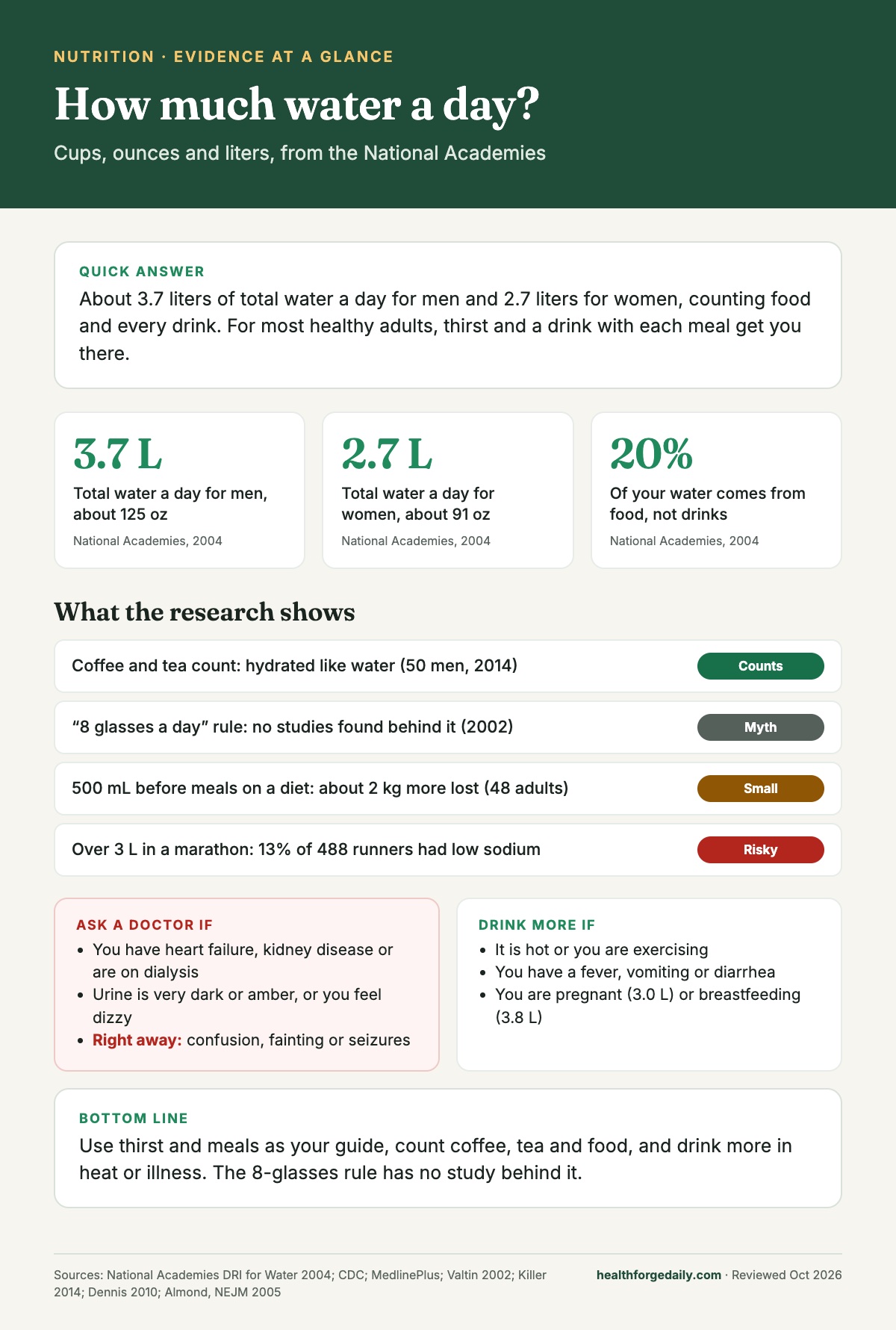
The National Academies set an Adequate Intake of about 3.7 liters (125 ounces) of total water a day for men and 2.7 liters (91 ounces) for women. That counts water from food, which supplies about 20%, and from every drink, not just plain water.[1][2]
| Men, total water | About 3.7 liters (125 ounces) a day from drinks and food[2] |
|---|---|
| Women, total water | About 2.7 liters (91 ounces) a day from drinks and food[2] |
| From drinks alone | About 3.0 liters (13 cups) for men and 2.2 liters (9 cups) for women[1] |
| From food | About 20% of total water[2] |
| Drink more when | It is hot, you are more active, you have a fever, diarrhea or vomiting, or you are pregnant or breastfeeding[1][4] |
| Too much at once | Healthy kidneys can clear at most about 0.7 to 1.0 liter an hour[1] |
| Ask a doctor first | Heart failure, later-stage kidney disease or dialysis, where fluid may need to be limited[14][15][16] |
How much water should you drink a day?
Most healthy adults do well with about 2.7 liters (women) to 3.7 liters (men) of total water a day, and thirst plus drinks with meals usually gets them there. These are Adequate Intakes set by the Institute of Medicine of the National Academies in its 2004 water report.[1][2]
The panel did not set an exact requirement, because water needs swing too much with heat and activity. Instead it used the median intake of healthy Americans in national survey data.[1] The figures cover “healthy, sedentary people in temperate climates.”[2]
Total water means everything: plain water, coffee, tea, milk, juice, soup and the water inside food. About 80% comes from drinks and about 20% from food.[2] MedlinePlus states the same range as 91 to 125 fluid ounces a day for adults and says drinking when thirsty and with meals should keep you hydrated.[3]
The panel said people get enough water from normal drinking habits “and by letting their thirst guide them.”[2]
How many ounces and cups of water a day is that?
From drinks alone, it works out to about 101 ounces (13 cups) for men and 74 ounces (9 cups) for women. In the survey data behind the guideline, drinks supplied about 3.0 liters a day for men aged 19 to 30 and 2.2 liters for women, around 81% of their total water.[1]
The report’s own conversions are 1 liter = 33.8 fluid ounces and 1 cup = 8 fluid ounces.[1] Using them, the full totals are 125 ounces (about 15.6 cups) for men and 91 ounces (about 11.4 cups) for women, but roughly a fifth of that arrives in food, so you do not drink it all.[1][2]
Here are the Adequate Intakes by age and life stage. Children and teens need less because they are smaller, and the values rise as body size rises.[1] Treat them as a reference point: a larger or very active adult may need more, and a small, inactive one may need less.[1][2]
| Group | Total water | From drinks | Drinks in ounces and cups |
|---|---|---|---|
| Children 1 to 3 | 1.3 L | 0.9 L | 30 oz, about 4 cups |
| Children 4 to 8 | 1.7 L | 1.2 L | 41 oz, about 5 cups |
| Boys 9 to 13 | 2.4 L | 1.8 L | 61 oz, about 8 cups |
| Girls 9 to 13 | 2.1 L | 1.6 L | 54 oz, about 7 cups |
| Boys 14 to 18 | 3.3 L | 2.6 L | 88 oz, about 11 cups |
| Girls 14 to 18 | 2.3 L | 1.8 L | 61 oz, about 8 cups |
| Men 19 and older | 3.7 L | 3.0 L | 101 oz, about 13 cups |
| Women 19 and older | 2.7 L | 2.2 L | 74 oz, about 9 cups |
| Pregnant | 3.0 L | 2.3 L | 78 oz, about 10 cups |
| Breastfeeding | 3.8 L | 3.1 L | 105 oz, about 13 cups |
Source: Institute of Medicine Table S-2; ounces and cups calculated with the report’s conversion factors.[1]
| Group | From drinks | From food | Total |
|---|---|---|---|
| Men, 19 and older | 3.0 L | 0.7 L | 3.7 L (125 oz) |
| Women, 19 and older | 2.2 L | 0.5 L | 2.7 L (91 oz) |
| Pregnant | 2.3 L | 0.7 L | 3.0 L (101 oz) |
| Breastfeeding | 3.1 L | 0.7 L | 3.8 L (128 oz) |
| Boys, 14 to 18 | 2.6 L | 0.7 L | 3.3 L (112 oz) |
| Girls, 14 to 18 | 1.8 L | 0.5 L | 2.3 L (78 oz) |
Where did the 8 glasses a day rule come from?
No one knows for sure, and no study supports it as a rule for everyone. In 2002 Heinz Valtin, a physiologist at Dartmouth Medical School, searched the literature and asked nutrition experts for the evidence behind “8 x 8,” eight 8-ounce glasses a day. He reported that “no scientific studies were found in support of 8 x 8.”[5]
He found two likely origins. In 1945 the Food and Nutrition Board suggested about 2.5 liters a day for adults, then added that “most of this quantity is contained in prepared foods.” That last sentence seems to have been forgotten.[5]
The other is a 1974 nutrition book that suggested “6 to 8 glasses per 24 hours” for the average adult and said this could come from coffee, tea, milk, soft drinks and even beer.[5]
Valtin stressed two limits to his conclusion. It applies to healthy adults in a temperate climate who are mostly sedentary, and larger intakes are wise for some medical conditions and for hard work or exercise, especially in heat.[5]
What raises how much water you need?
Heat, physical activity, illness, pregnancy and breastfeeding all push needs up. CDC lists hot climates, being more physically active, running a fever and having diarrhea or vomiting as times your body needs more water.[4]
- Heat and hard work: very active people who are continually exposed to hot weather often need 6 liters or more of total water a day.[2] Not drinking enough on hot days while active makes a heat emergency more likely.[13]
- Exercise: sweat losses add to daily needs. MedlinePlus suggests that people doing vigorous activity drink fluids such as sports drinks with electrolytes to keep blood sodium in a healthy range.[7]
- Illness: fever, vomiting and diarrhea drain fluid. MedlinePlus advises anyone with these to drink plenty of fluids and to watch children and older adults closely.[6]
- Pregnancy: the Adequate Intake rises to 3.0 liters of total water a day, about 2.3 liters from drinks.[1]
- Breastfeeding: the Adequate Intake is 3.8 liters a day, about 3.1 liters from drinks, the highest of any group.[1]
Some medicines raise needs too. Diuretics (water pills) make you urinate more, and uncontrolled diabetes can do the same, both of which raise the risk of dehydration.[6]
Why do older adults need to watch their water intake?
Thirst becomes a less reliable signal with age, so older adults can fall behind without feeling it. MedlinePlus notes that thirst may change as you get older and that older adults are at higher risk of dehydration.[3][6]
A classic 1984 study in the New England Journal of Medicine went without water for 24 hours in seven healthy men aged 67 to 75 and seven men aged 20 to 31. Afterward the older men were less thirsty and drank less, even though their blood had become more concentrated than the younger men’s.[9]
That was a small study, but its point has held up: for many older people, waiting until thirsty is not enough. Practical habits help, such as serving water with every meal and keeping a reusable bottle within reach.[4] Older adults with heart or kidney conditions should agree on a daily amount with their doctor, because more is not always safer for them.[14][15]
What are the signs of dehydration?
Thirst, a dry mouth, little urine and darker yellow urine are the early signs. MedlinePlus lists these signs of mild to moderate dehydration:[6]
- Thirst and a dry or sticky mouth
- Not urinating much, and darker yellow urine
- Dry, cool skin
- Headache and muscle cramps
Severe dehydration looks different: no urine or very dark yellow or amber urine, confusion or irritability, dizziness, a rapid heartbeat, rapid breathing and sunken eyes.[6] Severe dehydration is a life-threatening emergency.[6]
Urine color is a simple everyday check. If yours is darker than usual, drink more and recheck later. Pair the check with the other signs above, such as thirst and how often you urinate.[6]
Can you drink too much water?
Yes. Drinking far more than your kidneys can clear dilutes the sodium in your blood, a condition called hyponatremia. The National Academies did not set an upper limit for water, but noted that healthy kidneys can excrete at most about 0.7 to 1.0 liter an hour.[1]
When blood sodium drops, water moves into cells and they swell. Brain cells are especially sensitive, which causes many of the symptoms: headache, nausea, vomiting, confusion, fatigue, muscle cramps and, in severe cases, seizures.[7] Normal blood sodium is 136 to 144 mEq/L.[7]
The classic setting is endurance sport. At the 2002 Boston Marathon, 13% of 488 runners tested at the finish had hyponatremia and 0.6% had a critical level. Risk was tied to gaining weight during the race, drinking more than 3 liters of fluid on the course, and finishing in more than 4 hours.[8]
The National Academies report adds that exercise-linked hyponatremia is typically seen after more than 6 hours of prolonged hard exercise.[1] For long events, drink to thirst rather than forcing fluids at every stop, and treat weight gain during a race as a warning sign: it was one of the strongest risk factors in the Boston study.[8]
Who should limit how much water they drink?
People with heart failure, later-stage kidney disease or kidney failure on dialysis may need a fluid limit set by their care team. For them, the general advice above does not apply.
Heart failure: a weak heart lets fluid build up, which shows as swelling, weight gain and shortness of breath. MedlinePlus says your provider may advise you to change what fluids or how much fluid you drink, and to weigh yourself regularly to catch fluid buildup.[14]
Kidney disease: in the early stages of chronic kidney disease you usually do not need to limit fluid. As it worsens, or once you are on dialysis, you will need to watch how much you take in, because most people on dialysis urinate very little.[15]
Dialysis: NIDDK says limiting water and other liquids, including liquid in foods, helps keep too much fluid from building up between treatments.[16]
Low blood sodium can also be caused by heart failure, kidney disease, liver cirrhosis and diuretics.[7] If you have any of these, ask your doctor for a personal daily fluid target instead of following a general number.
Do coffee and tea count toward your daily water?
Yes. Caffeinated drinks count toward your total about as much as other drinks. The National Academies panel found that caffeine’s effect on urine may be short-lived and that there is no convincing evidence it causes a lasting water deficit, so caffeinated drinks “can contribute as much as noncaffeinated options.”[2]
A 2014 crossover trial tested this directly in 50 men who already drank 3 to 6 cups of coffee a day. For 3 days each, they drank four 200 mL servings of coffee or of water. There were no differences in any blood or urine hydration marker, and 24-hour urine was 2,409 mL with coffee and 2,428 mL with water.[10] One author worked for PepsiCo.[10]
A 2016 trial had 72 men drink 1 liter of one of 13 drinks. Urine output over 4 hours after coffee, tea, cola, juice and a sports drink was not different from water. Milk and an oral rehydration solution were held in the body longer than water.[11]
CDC lists plain coffee and tea as low-calorie choices and says up to 400 mg of caffeine a day, about 3 to 5 cups of plain coffee, can be part of a healthy diet.[4] Sugary sodas, fruit drinks and sweetened coffee and tea count as fluid, but they add calories with little nutrition.[4]
Does drinking more water help you lose weight?
It may help a little when it is part of a lower-calorie diet, mostly by replacing other drinks and taking the edge off meals. The best-known trial is small.
In a 2010 trial, 48 adults aged 55 to 75 with overweight or obesity followed a low-calorie diet for 12 weeks. Half also drank 500 mL (about 17 ounces) of water before each of three daily meals. The water group lost about 2 kg (about 4.4 pounds) more, a 44% greater decline in weight.[12]
At the start, people ate fewer calories at a test meal after drinking water first, but that difference had faded by week 12.[12] This was one short trial in older adults, so it does not show that water alone causes weight loss.
Swapping drinks is a more reliable approach. Water has no calories, and CDC notes that replacing sugary drinks with plain water can help reduce calorie intake.[4] For the wider picture, see our review of whether weight loss supplements work.
What do the main studies show?
| Question | Study | Result | What it means |
|---|---|---|---|
| Is 8 glasses a rule? | Valtin review, 2002[5] | No studies found in support | Thirst and meals cover most healthy adults |
| Does thirst fade with age? | NEJM 1984, 7 older vs 7 young men[9] | Older men less thirsty, drank less | Older adults should drink by habit |
| Does coffee dehydrate? | PLoS One 2014, 50 men, 3 days[10] | No difference from water | Moderate coffee counts |
| Which drinks hydrate? | AJCN 2016, 72 men, 13 drinks[11] | Coffee, tea, cola similar to water | Most drinks count |
| Water for weight loss? | Obesity 2010, 48 adults, 12 weeks[12] | About 2 kg more lost with diet | Small, one trial |
| Can you overdrink? | NEJM 2005, 488 marathon runners[8] | 13% had low blood sodium | Do not force fluids in long events |
When should you see a doctor?
Get help for signs of severe dehydration, heat illness or low blood sodium. For mild dehydration, MedlinePlus suggests sipping water or sucking on ice cubes; severe dehydration may need fluids through a vein in the hospital.[6] Call 911 or your local emergency number right away if:[6][13]
- The person faints, becomes confused or has a seizure
- A fever is above 102°F (38.8°C) with signs of dehydration
- Body temperature is above 104°F (40°C) in the heat, with confusion or slurred speech
- Lips and fingernails turn bluish, or alertness drops
Call your provider right away if you have symptoms of low blood sodium, such as headache, nausea, vomiting or confusion after drinking large amounts.[7] Also call your provider if you think you or a family member may become dehydrated, or if you have heart failure and notice swelling, weight gain or shortness of breath.[6][14]
What is a simple daily water plan?
- Start with thirst and meals. Drink when thirsty and have a drink with each meal; for most healthy adults that is enough.[2][3]
- Use the numbers as a check, not a quota. About 13 cups of drinks a day for men and 9 for women is typical.[1]
- Carry a reusable bottle and order water when eating out.[4]
- Count coffee, tea and milk. Keep caffeine to about 400 mg a day.[4]
- Swap sugary drinks for water; add lemon or lime for flavor.[4]
- Add more for heat, exercise, fever, vomiting or diarrhea.[4]
- Watch your urine. Darker yellow urine is an early sign to drink more.[6]
- Do not force fluids in long races; drinking more than 3 liters during a marathon was linked to low blood sodium.[8]
- Follow your care team’s limit if you have heart failure or kidney disease.[14][15]
Eating plenty of fruits and vegetables adds water too.[4] See our guides to high-fiber foods and the anti-inflammatory diet, or browse more in nutrition and diet and healthy living.
Our verdict: how much water should you drink a day?
For most healthy adults, about 2.7 liters (91 ounces) of total water a day for women and 3.7 liters (125 ounces) for men, counting food and every drink. From drinks alone that is about 9 cups for women and 13 for men, and thirst plus drinks at meals usually covers it. The 8-glasses rule has no study behind it.[1][2][5]
Drink more in heat, during hard exercise, when sick, and while pregnant or breastfeeding. Older adults should drink by habit, not only by thirst. Do not force large amounts in long events, and if you have heart failure or kidney disease, follow the limit your care team sets.[1][4][8][9][14][15] See how we review health information.
Sources
- Dietary Reference Intakes for Water, Potassium, Sodium, Chloride, and Sulfate: Summary. Institute of Medicine of the National Academies, National Academies Press, 2005.
- Report sets dietary intake levels for water, salt, and potassium to maintain health and reduce chronic disease risk. National Academies news release, February 2004.
- Water in diet. MedlinePlus, US National Library of Medicine, reviewed July 2025.
- About Water and Healthier Drinks. Centers for Disease Control and Prevention.
- “Drink at least eight glasses of water a day.” Really? Is there scientific evidence for “8 x 8”?. Valtin H, American Journal of Physiology, 2002.
- Dehydration. MedlinePlus, US National Library of Medicine, reviewed July 2025.
- Low blood sodium. MedlinePlus, US National Library of Medicine, reviewed May 2025.
- Hyponatremia among runners in the Boston Marathon. Almond CS et al., New England Journal of Medicine, 2005.
- Reduced thirst after water deprivation in healthy elderly men. Phillips PA et al., New England Journal of Medicine, 1984.
- No evidence of dehydration with moderate daily coffee intake: a counterbalanced cross-over study in a free-living population. Killer SC et al., PLoS One, 2014.
- A randomized trial to assess the potential of different beverages to affect hydration status: development of a beverage hydration index. Maughan RJ et al., American Journal of Clinical Nutrition, 2016.
- Water consumption increases weight loss during a hypocaloric diet intervention in middle-aged and older adults. Dennis EA et al., Obesity, 2010.
- Heat emergencies. MedlinePlus, US National Library of Medicine, reviewed October 2025.
- Heart failure: fluids and diuretics. MedlinePlus, US National Library of Medicine, reviewed July 2024.
- Diet: chronic kidney disease. MedlinePlus, US National Library of Medicine, reviewed September 2025.
- Hemodialysis. NIDDK, National Institutes of Health.
Frequently asked questions
How many ounces of water should I drink a day?
From drinks, about 101 ounces (13 cups) for men and 74 ounces (9 cups) for women is typical. Total water including food is about 125 ounces for men and 91 for women. Heat, exercise, illness, pregnancy and breastfeeding raise the amount.
Is 8 glasses of water a day enough?
For many healthy women it is close to typical drink intake, and for many men it is a little low. But no study supports 8 glasses as a rule for everyone. Coffee, tea, milk and food all count, and thirst is a good guide for most healthy adults.
Does coffee count toward my water intake?
Yes. The National Academies concluded caffeinated drinks contribute as much as other drinks. In a 2014 trial in 50 regular coffee drinkers, moderate coffee hydrated about as well as water. CDC says up to 400 mg of caffeine a day, about 3 to 5 cups, is fine for most adults.
Can drinking too much water be dangerous?
Yes. Drinking far more than your kidneys can clear, at most about 0.7 to 1.0 liter an hour, can dilute blood sodium. At the 2002 Boston Marathon, 13% of runners tested had low blood sodium, linked to drinking more than 3 liters during the race.
How much water should I drink when pregnant or breastfeeding?
The National Academies Adequate Intake is about 3.0 liters of total water a day in pregnancy, with about 2.3 liters from drinks, and 3.8 liters while breastfeeding, with about 3.1 liters from drinks. Ask your provider if you have swelling or a medical condition.
Does drinking water help you lose weight?
A little, at best, alongside a lower-calorie diet. In a 12-week trial of 48 adults aged 55 to 75, drinking 500 mL of water before meals added about 2 kg of weight loss. Swapping sugary drinks for water also cuts calories.

Grace Whitaker is the health editor at Health Forge Daily. She reads supplement labels line by line, checks each ingredient and dose against published research, and tracks refund policies and customer complaints before a product gets a verdict. She is not a doctor, so every review points readers back to their own physician for medical decisions.
This article is for general information and is not medical advice. Supplements are not evaluated by the FDA and are not intended to diagnose, treat, cure or prevent any disease. Check with your doctor before you start any supplement.