This article contains affiliate links. If you buy through them we may earn a commission at no extra cost to you. It never changes what we report. How we make money.
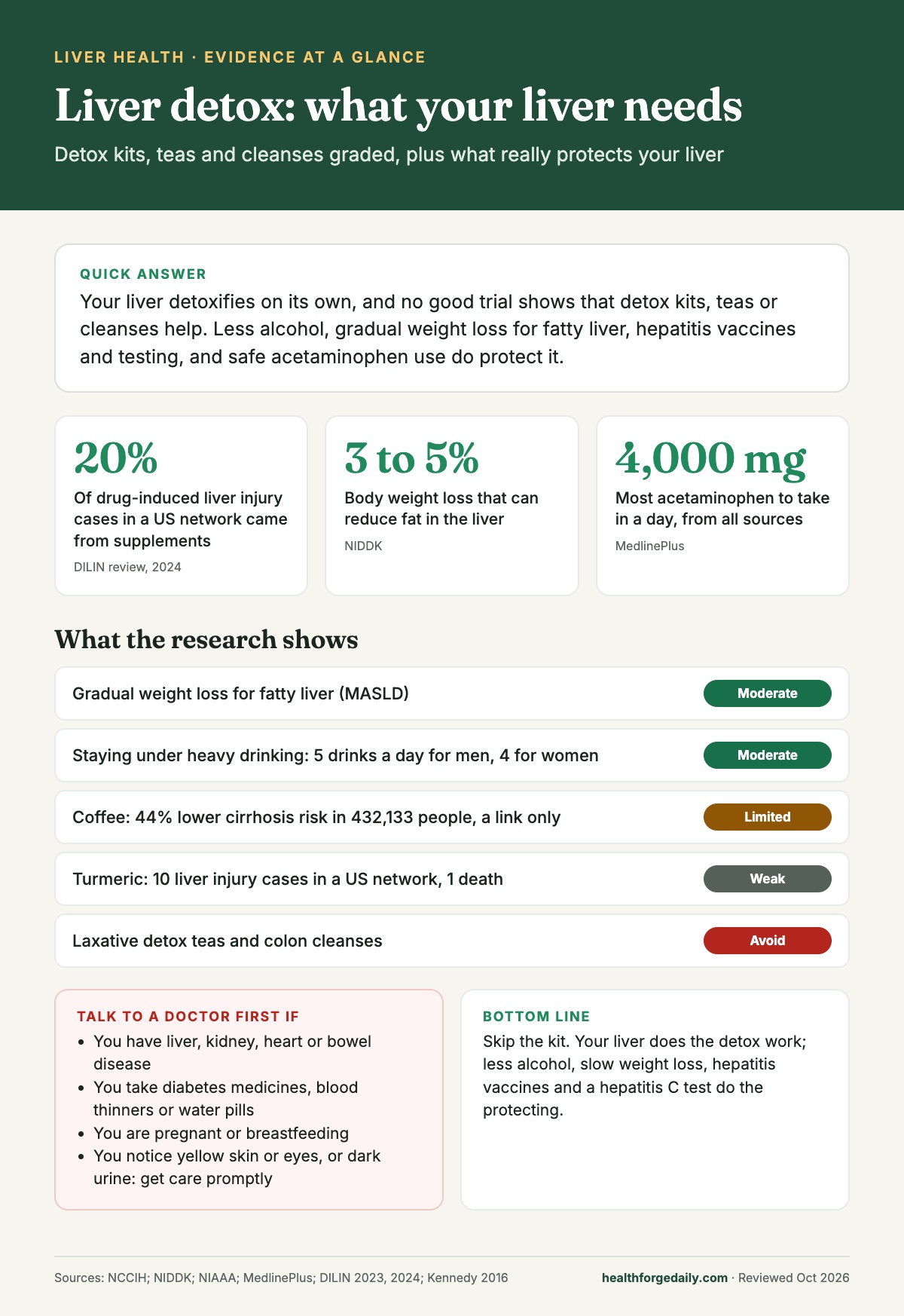
Your liver already does its own detox. No good trial shows that detox kits, teas or cleanses help, and many rely on laxatives. Supplements now cause about 1 in 5 drug-induced liver injury cases in a US network. Your liver is better protected by less alcohol, gradual weight loss for fatty liver, hepatitis vaccines and testing, and safe acetaminophen use.

| # | Pick | Best for | Evidence |
|---|---|---|---|
| 1 | Gradual weight loss | Reducing fat in a fatty liver | Moderate |
| 2 | Cutting back on alcohol | Everyone who drinks heavily | Moderate |
| 3 | Hepatitis vaccines and C test | Preventing or curing viral hepatitis | Moderate |
| 4 | Coffee | Existing drinkers; link, not proof | Limited |
| 5 | Artichoke leaf extract | One 2-month pilot trial | Limited |
| 6 | Turmeric and curcumin | Unclear benefit, liver injury reports | Weak |
| 7 | NAC | Hospital antidote, animal data only | Weak |
| 8 | Dandelion root | No compelling evidence | Weak |
| 9 | Milk thistle | No benefit over placebo | Weak |
| 10 | Juice cleanses and fasts | Short-lived weight loss | Weak |
| 11 | Laxative teas and colon cleanses | Never for the liver | Avoid |
| 12 | Green tea extract pills | Linked to liver injury | Avoid |
We read the NCCIH page on detoxes and cleanses, the MedlinePlus and NIDDK liver pages, the FTC case against a detox tea seller, the US Drug-Induced Liver Injury Network studies and the trials behind common detox ingredients, then graded each product and habit.
A healthy liver detoxifies on its own, and no good trial shows that a detox kit, tea or cleanse helps it.[1][2][5] What protects your liver is less alcohol, gradual weight loss if you have fatty liver, hepatitis vaccines and testing, and careful use of medicines and supplements.[14][19][21][22][24]
| Question | What the evidence says |
|---|---|
| Do you need a detox? | No. Your liver already helps remove poisons[5] |
| Best detox evidence | None from good trials; no randomized trials of commercial detox diets[2] |
| Common kit contents | Laxatives, herbs, supplements, juices, enemas[1] |
| Main harm | Diarrhea, dehydration, electrolyte problems[1] |
| Supplement liver injury | About 20% of drug-induced liver injury cases in a US network[10] |
| Fatty liver | Losing 3% to 5% of body weight can reduce liver fat[19] |
| Acetaminophen limit | No more than 4,000 mg a day from all sources[14] |
| Who should test for hepatitis C | All adults 18 to 79, once[24] |
| Red flags | Yellow skin or eyes, dark urine, belly swelling[16] |
How does your liver detox on its own?
Your liver breaks down and clears waste all day without any help. It is the largest organ inside your body, and it helps you digest food, store energy and remove poisons.[5]
Scientists describe the work in phases. The goal is to turn substances that dissolve in fat into ones that dissolve in water, so they can leave the body.[4]
- Phase 1: enzymes chemically modify the substance, a step called functionalization.[4]
- Phase 2: the liver attaches another molecule to that spot, a step called conjugation. The result is easier to get rid of.[4]
- Phase 3: transporters move the finished product out through the liver, gut, kidneys or lungs.[4]
No detox kit has been shown in a randomized trial to make these phases work better.[2] Avoiding liver damage does far more, so the habits later in this guide count for more than any kit.
What is inside liver detox kits, teas and cleanses?
Mostly laxatives, herbs and restrictive eating plans. NCCIH lists the usual methods: fasting, drinking only juices, eating only certain foods, dietary supplements, herbs, and cleaning the colon with enemas, laxatives or colon hydrotherapy.[1]
Labels for “liver detox” blends often name the ingredients we grade below: dandelion, artichoke, milk thistle, turmeric, N-acetylcysteine (NAC) and green tea extract. Loose stools from a laxative can feel like proof of cleansing, yet they tell you nothing about your liver.[1]
NCCIH notes that the FDA and FTC have acted against detox sellers whose products had hidden ingredients, made false claims to treat serious diseases, or were colon cleansing devices sold for unapproved uses.[1] In 2020 the FTC said Teami claimed, without reliable evidence, that its 30 Day Detox Pack caused weight loss. The order carried a $15.2 million judgment, suspended after a $1 million payment.[3]
Does a liver detox or cleanse actually work?
No good evidence says it does. NCCIH found only a small number of human studies on detox programs, of low quality, with few participants or no peer review.[1] A 2015 critical review found no randomized controlled trials of commercial detox diets in humans.[2]
Any quick weight loss is from eating fewer calories. A 2017 review cited by NCCIH found juicing and detox diets tend to lead to weight gain once a normal diet resumes.[1]
Milk thistle, the most common liver herb, did no better than placebo in the best trials in hepatitis C and fatty liver disease. We cover those trials in our milk thistle for liver health review.
Medical detox does exist, but it means hospital treatment for poisoning, such as chelation therapy for toxic metals, and it is not sold as a wellness product.[1]
Can detox supplements harm your liver?
Yes, and the share of liver injury from supplements has grown. The US Drug-Induced Liver Injury Network (DILIN) studies people whose livers were hurt by a medicine or supplement. From 2004 to 2013, supplements caused 130 of 839 cases, or 15.5%, and their share rose from 7% to 20%.[9]
Injury from supplements other than bodybuilding products was more severe. It led to death or a liver transplant in 13% of cases, against 3% for medicines.[9] A 2024 review put supplements at 20% of the network’s cases and named green tea extract, garcinia, kratom, ashwagandha, turmeric and multi-ingredient products among the main culprits.[10]
The same review notes that no regulator checks supplement ingredients or safety before sale, so a blend is hard to trust.[10]
| Period | Share of liver injury cases from supplements |
|---|---|
| Early years of the study (from 2004) | 7% |
| Whole study, 2004 to 2013 | 15.5% |
| Final years of the study (to 2013) | 20% |
| 2024 review of the network | 20% |
How did we grade each detox product and habit?
Each item gets one of four grades, based on the size, quality and independence of the research:
- Moderate: the top grade on our scale here, backed by federal guidance or large pooled studies.
- Limited: some studies show a benefit, but they are small, short or observational.
- Weak: lab or animal studies only, or reviews that found no real benefit.
- Avoid: no good evidence plus a real safety problem.
A grade tells you how much research supports an item, not that it is safe for you. Read our full review method.
1. Gradual weight loss: does it reverse fatty liver?
Evidence: Moderate
It is the treatment doctors recommend for fatty liver. About 24% of US adults have nonalcoholic fatty liver disease, now also called MASLD, and it is present in up to 75% of people who are overweight.[20]
NIDDK says losing at least 3% to 5% of body weight can reduce liver fat, and 7% to 10% may be needed to reduce inflammation and scarring. Physical activity helps even without weight loss.[19]
Go slowly. Rapid weight loss and malnutrition can make liver disease worse, which is one more reason to skip crash cleanses.[19] Our anti-inflammatory diet and high-fiber foods guides cover eating patterns that support steady loss.
2. Cutting back on alcohol: how much is too much?
Evidence: Moderate
Staying under heavy drinking levels is one of the clearest things you can do. NIAAA defines heavy drinking as 5 or more drinks on any day or 15 or more a week for men, and 4 or more on any day or 8 or more a week for women.[21]
A standard drink holds 14 grams of pure alcohol.[21] MedlinePlus lists too much alcohol among the causes of liver disease.[5]
3. Hepatitis vaccines and hepatitis C testing
Evidence: Moderate
Viral hepatitis is preventable or curable for most people. CDC recommends hepatitis B vaccine for all adults 19 to 59, and for adults 60 and older with risk factors.[22] It recommends hepatitis A vaccine for all children 12 to 23 months and for adults at higher risk, such as international travelers.[23]
There is no hepatitis C vaccine, so testing matters. The USPSTF recommends screening all adults 18 to 79. Treatment is usually 8 to 12 weeks of pills, and in trials the virus was cleared in 95.5% to 98.9% of people.[24]
4. Coffee: is it good for your liver?
Evidence: Limited
It is linked to less cirrhosis, but the studies cannot prove cause. A 2016 meta-analysis of 9 studies with 432,133 people found that 2 more cups a day went with a 44% lower risk of cirrhosis.[25]
These were observational studies, so coffee drinkers may differ in other ways. If you already drink coffee, there is no liver reason to stop, and no liver reason to start.
5. Artichoke leaf extract: does it help fatty liver?
Evidence: Limited
One small pilot trial looked positive. In Iran, 100 adults with fatty liver took 600 mg of artichoke leaf extract or placebo daily for 2 months. ALT and AST liver enzymes fell more with the extract, and no side effects were reported.[11]
Only 90 people finished, the trial was short, and no larger group has repeated it yet.[11]
6. Turmeric and curcumin: liver helper or liver risk?
Evidence: Weak
The benefit is unclear and the liver risk is real. NCCIH says early research suggests turmeric might improve some fatty liver measures, but it is unclear which ones.[7] It warns that highly absorbable curcumin products may harm the liver.[7]
DILIN found 10 cases of turmeric liver injury from 2004 to 2022, all since 2011. Five people were hospitalized and one died of liver failure. Injury appeared 1 to 4 months after starting, and 3 of the 7 products tested also had black pepper extract (piperine).[8] See our full turmeric benefits review.
7. N-acetylcysteine (NAC): does it protect the liver?
Evidence: Weak
NAC is a hospital antidote, not a proven daily liver supplement. Doctors give it to counteract an acetaminophen overdose.[13] That emergency use says nothing about whether a capsule helps a healthy liver.
For fatty liver, a 2023 meta-analysis pooled 13 studies, all in animals, and called for human trials.[12]
8. Dandelion root: does it cleanse the liver?
Evidence: Weak
NCCIH says there is no compelling evidence for dandelion for any health condition. Amounts found in food are likely safe, but less is known about larger amounts.[6]
It might interact with diabetes medicines, blood thinners and water pills, and little is known about its safety in pregnancy.[6]
9. Milk thistle: the classic liver herb
Evidence: Weak
The best trials found no benefit over placebo. Our milk thistle review covers the hepatitis C and fatty liver trials in detail.
10. Juice cleanses and detox fasts
Evidence: Weak
Any weight you lose tends to come back. Detox diets cause early weight loss from low calories, then weight gain after.[1]
Unpasteurized juices can carry harmful bacteria, which is serious for children, older adults and people with weak immune systems. Juices made from high-oxalate foods such as leafy greens and beets can be a risk for people prone to kidney stones.[1]
11. Laxative detox teas and colon cleanses
Evidence: Avoid
They work on your bowel, not your liver. Laxatives in detox programs can cause diarrhea, which can lead to dehydration and poor absorption of nutrients.[1]
Colon cleansing has limited evidence and can have serious side effects. Harm is more likely if you have bowel disease, past colon surgery, severe hemorrhoids, kidney disease or heart disease.[1] The FTC case against Teami shows how detox tea claims can outrun the science.[3]
12. Green tea extract pills in detox blends
Evidence: Avoid
Concentrated green tea pills carry a liver risk that brewed tea does not. A 2018 safety review of 159 human studies, written by authors from a supplement company, found liver side effects with concentrated extracts taken in large doses, but not with brewed tea.[26]
It set a safe intake of 338 mg of EGCG a day for pill or powder doses.[26] Green tea extract is also one of the most common supplements in US liver injury cases.[10]
What do ALT and AST on a liver test mean?
They are enzymes that leak into your blood when liver cells are damaged. A liver panel measures albumin, bilirubin and several enzymes, including ALT, AST, ALP and GGT.[16]
- ALT is found mainly in the liver, so it is the more specific sign of liver damage.[17]
- AST is also found in the heart, muscles and other tissues, so it can rise with heart problems, pancreatitis, burns or seizures.[18]
A high result does not always mean disease. Age, sex, weight, medicines, dietary supplements, intense exercise and even the menstrual cycle can affect ALT.[17] The ALT level also does not tell you how much damage there is.[17]
Liver tests alone usually cannot diagnose a specific disease, and abnormal results after a recent illness may be temporary.[16] If your doctor flags a number, the next step is finding its cause, and a detox kit will not “fix” it.
How much acetaminophen is safe for your liver?
No more than 4,000 mg a day from all sources, and less if you drink. MedlinePlus says not to take more than one product containing acetaminophen at a time, and not to take it at all if you have 3 or more alcoholic drinks every day.[14]
Acetaminophen is a bigger liver risk than any herb. In a US study of 662 people with acute liver failure at 22 hospitals, 42% of cases came from acetaminophen, and its share rose from 28% in 1998 to 51% in 2003.[15]
About half of those overdoses were unintentional, and 38% of those people had taken 2 or more acetaminophen products at once.[15]
Who should avoid liver detox products?
Talk to your doctor or pharmacist first, or skip them entirely, if you:
- have liver disease, since some herbal remedies can damage the liver[19]
- have bowel disease, past colon surgery, severe hemorrhoids, kidney disease or heart disease (colon cleanses)[1]
- have diabetes, since fasting and juice plans change your eating sharply[1]
- take diabetes medicines, blood thinners or water pills (dandelion)[6]
- are prone to kidney stones (high-oxalate juices)[1]
- are pregnant or breastfeeding, since safety of larger herbal amounts is unknown[6]
When should you see a doctor right away?
Yellow skin or eyes, dark urine or pale stools need a prompt medical visit, not a cleanse. MedlinePlus lists these signs of liver disease or damage:[16]
- jaundice, a yellowing of the skin and eyes
- dark urine and light-colored stools
- swelling or pain in the belly, or swelling in the ankles and legs
- nausea, vomiting, lack of appetite, fatigue, weakness and frequent itching
If any of these start after a new supplement, stop it and call your doctor. NCCIH gives the same advice for turmeric.[7] Suspected acetaminophen overdose is an emergency: without rapid treatment, a very large overdose can cause liver failure and death within days.[13]
What do doctors use for liver problems?
Tests to find the cause, then treatment aimed at that cause. Your doctor compares the pattern of liver test results and may order more tests to pinpoint the problem.[16]
- Fatty liver: gradual weight loss, healthy food choices, portion control and physical activity.[19]
- Hepatitis C: direct-acting antiviral pills for 8 to 12 weeks.[24]
- Hepatitis A and B: vaccination for prevention.[22][23]
- Liver failure or liver cancer: some people need a liver transplant.[19]
Fatty liver also raises heart risk; cardiovascular disease is the most common cause of death in people with it.[20] Our prediabetes and A1C guide covers the blood sugar side of the same metabolic problem.
If you still want to buy a liver detox product, what should the label show?
- Tell your doctor first, especially if you have liver disease or take any medicine.[19]
- No laxatives listed as a main ingredient, and no “flush” or colon cleanse claims.[1]
- No proprietary blend hiding doses. Multi-ingredient products are a leading cause of supplement liver injury.[10] See how to read a Supplement Facts label.
- No high-absorption curcumin or added piperine if you already take other supplements.[7][8]
- Green tea extract with EGCG stated, and under 338 mg a day if listed.[26]
- No disease claims such as “repairs your liver” or “removes toxins.”[1][3]
- A quality seal, which shows what is in the bottle, not that it works.
Be just as wary of weight loss pills sold next to cleanses; see do weight loss supplements work.
Our verdict: do you need a liver detox?
No. Your liver detoxifies on its own through a chain of enzyme steps, and no good trial shows that a kit, tea or cleanse helps. Many rely on laxatives, and supplements now account for about 1 in 5 drug-induced liver injury cases in a large US network.[2][4][10]
Spend the money and effort on what has evidence: keep alcohol under heavy drinking levels, lose weight slowly if you have fatty liver, get hepatitis vaccines and a one-time hepatitis C test, and respect the acetaminophen limit. See a doctor for jaundice or dark urine. More in our liver health and detox and cleanse sections.[14][16][19][21][22][24]
Sources
- Detoxes and Cleanses: What You Need To Know. NCCIH, National Institutes of Health, updated March 2025.
- Detox diets for toxin elimination and weight management: a critical review of the evidence. Klein AV, Kiat H, Journal of Human Nutrition and Dietetics, 2015.
- Tea Marketer Misled Consumers, Didn’t Adequately Disclose Payments to Well-Known Influencers, FTC Alleges. Federal Trade Commission, March 2020.
- Drug Metabolism in the Liver. Almazroo OA et al., Clinics in Liver Disease, 2017.
- Liver Diseases. MedlinePlus, National Library of Medicine.
- Dandelion. NCCIH, National Institutes of Health, updated November 2024.
- Turmeric. NCCIH, National Institutes of Health.
- Liver Injury Associated with Turmeric: A Growing Problem. Ten Cases from the Drug-Induced Liver Injury Network. Halegoua-DeMarzio D et al., American Journal of Medicine, 2023.
- Liver injury from herbals and dietary supplements in the U.S. Drug-Induced Liver Injury Network. Navarro VJ et al., Hepatology, 2014.
- Challenges in herbal-induced liver injury identification and prevention. Halegoua-DeMarzio D, Navarro V, Liver International, 2024.
- Efficacy of artichoke leaf extract in non-alcoholic fatty liver disease: a pilot double-blind randomized controlled trial. Panahi Y et al., Phytotherapy Research, 2018.
- Comprehensive transcriptomic analysis and meta-analysis identify therapeutic effects of N-acetylcysteine in nonalcoholic fatty liver disease. Yang K et al., Frontiers in Pharmacology, 2023.
- Acetaminophen overdose. MedlinePlus Medical Encyclopedia.
- Acetaminophen. MedlinePlus Drug Information.
- Acetaminophen-induced acute liver failure: results of a United States multicenter, prospective study. Larson AM et al., Hepatology, 2005.
- Liver Function Tests. MedlinePlus Medical Tests.
- ALT Blood Test. MedlinePlus Medical Tests.
- AST Test. MedlinePlus Medical Tests.
- Treatment for NAFLD and NASH. NIDDK, National Institutes of Health.
- Definition and Facts of NAFLD and NASH. NIDDK, National Institutes of Health.
- Understanding Alcohol Drinking Patterns. National Institute on Alcohol Abuse and Alcoholism, updated January 2026.
- Hepatitis B Vaccination. Centers for Disease Control and Prevention, 2025.
- Hepatitis A Vaccination. Centers for Disease Control and Prevention, 2025.
- Hepatitis C Virus Infection in Adolescents and Adults: Screening. US Preventive Services Task Force, March 2020.
- Systematic review with meta-analysis: coffee consumption and the risk of cirrhosis. Kennedy OJ et al., Alimentary Pharmacology and Therapeutics, 2016.
- The safety of green tea and green tea extract consumption in adults: results of a systematic review. Hu J et al., Regulatory Toxicology and Pharmacology, 2018.
Frequently asked questions
Does a liver detox actually work?
No good trial shows it does. NCCIH found detox studies few and low quality, and a 2015 review found no randomized trials of commercial detox diets in humans. A healthy liver already breaks down and removes waste on its own.
How can I detox my liver naturally?
Help the detox your liver already does. Keep alcohol under heavy drinking levels, lose weight gradually if you have fatty liver, get hepatitis A and B vaccines and a hepatitis C test, and never exceed 4,000 mg of acetaminophen a day.
Can you reverse fatty liver?
Often, with weight loss. NIDDK says losing 3% to 5% of body weight can reduce liver fat, and 7% to 10% may reduce inflammation and scarring. Physical activity helps even without weight loss. Lose weight gradually, since rapid loss can worsen liver disease.
Are detox teas bad for your liver?
Many rely on laxatives, which act on the bowel and can cause diarrhea and dehydration. Some liver detox blends add green tea extract or turmeric, both linked to liver injury reports. In 2020 the FTC acted against one detox tea seller over unsupported claims.
What do high ALT and AST levels mean?
They can mean liver cells are damaged, from causes such as hepatitis, cirrhosis, alcohol or certain medicines. AST also comes from heart and muscle. A high result is not always disease, and it does not show how much damage there is. Your doctor looks for the cause.
What are the warning signs of liver damage?
Yellow skin or eyes, dark urine, pale stools, belly swelling or pain, ankle swelling, frequent itching, nausea, poor appetite and fatigue. See a doctor promptly. If symptoms start after a new supplement, stop it and tell your doctor.

Grace Whitaker is the health editor at Health Forge Daily. She reads supplement labels line by line, checks each ingredient and dose against published research, and tracks refund policies and customer complaints before a product gets a verdict. She is not a doctor, so every review points readers back to their own physician for medical decisions.
This article is for general information and is not medical advice. Supplements are not evaluated by the FDA and are not intended to diagnose, treat, cure or prevent any disease. Check with your doctor before you start any supplement.