Detox tea is an herbal blend, often with senna or caffeine, sold to flush toxins and speed weight loss. No trial shows it removes toxins, and laxative purging cut calorie absorption by only about 12%, so lost weight is mostly water. Short-term use can cause cramps and diarrhea. Longer use risks dehydration, laxative dependence and, rarely, liver injury or low sodium.

Detox tea is sold as a quick way to flush toxins and drop weight, and this guide checks those claims against the research. We read the NCCIH page on detoxes and cleanses, the NIH LiverTox and MedlinePlus entries on senna, a Cochrane review of green tea, an FTC case against a detox tea seller and three published case reports. Our review process explains how we pick and check sources.
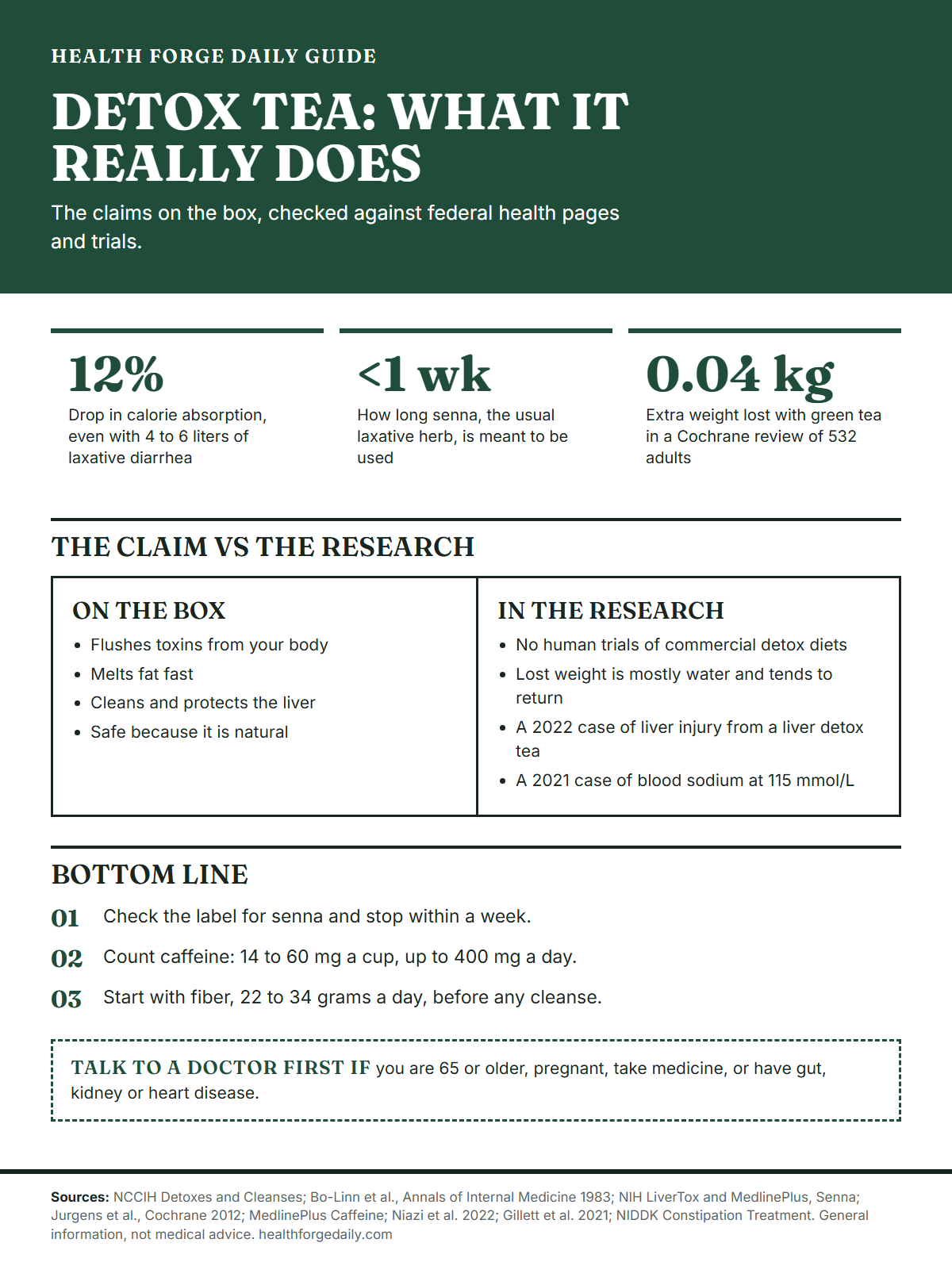
The short answer: no trial shows that a commercial detox product removes toxins from people[2], and even extreme laxative purging cut calorie absorption by only about 12%[3].
| What it is | An herbal or green tea blend sold to cleanse the body. Many blends contain senna, a stimulant laxative[4]. |
|---|---|
| Sold for | Weight loss, a flatter stomach and liver or colon cleansing. A 2015 review found no compelling research for weight control or toxin removal[1]. |
| Typical use | Senna is meant for short-term use of less than one week[4][5]. |
| Best evidence | A Cochrane review of green tea: 532 adults outside Japan lost 0.04 kg more than controls on average[7]. |
| Main risks | Cramps, diarrhea, dehydration and electrolyte imbalance[1][4]. Rare cases of liver injury and very low blood sodium[12][13]. |
| Who should avoid it | People with gut, kidney or heart disease, severe hemorrhoids or past colon surgery[1], and adults 65 and older using senna long term[5]. |
What is detox tea?
Detox tea is an herbal or green tea blend marketed to flush toxins, ease bloating or speed weight loss. Most blends rely on a laxative herb such as senna, a caffeine source, or a plant said to make you urinate more. None has been shown to remove toxins from a healthy body[2].
In medicine, detox means treating poisoning or withdrawal under a doctor’s care. Tea sellers use the word loosely. NCCIH notes that detox programs may use herbs, laxatives, enemas, fasting or juices, and that only a small number of studies have tested them in people, mostly of low quality[1].
Your body already has organs for this job. MedlinePlus describes the liver as the largest organ inside the body, one that helps digest food, store energy and remove poisons[15]. A tea mainly changes how often you use the bathroom.
Klein and Kiat reviewed the field in 2015. They found no randomized controlled trials of commercial detox diets in humans, and the few other studies had flawed methods and small samples[2].
What are common detox tea ingredients?
Most detox tea ingredients fall into a few groups: stimulant laxatives, caffeine sources and herbs sold as water pills. Senna is the laxative listed most often, green or black tea adds caffeine, and dandelion is the classic water herb. Each acts on the bowel or bladder, and none targets toxins[4][8][9].
| Ingredient | What it does | What the evidence says |
|---|---|---|
| Senna leaf or pod | Stimulant laxative; a bowel movement usually follows in 6 to 12 hours[5] | LiverTox says it is included in several herbal teas used for purging and weight loss, for short-term use only[4] |
| Green or black tea | Caffeine, 14 to 60 mg in an 8-ounce cup[8] | Caffeine is a diuretic[8]; green tea showed no meaningful weight loss in a Cochrane review[7] |
| Dandelion leaf or root | Sold as a natural water pill | One 17-person pilot of a leaf extract raised urination for a day[10]; NCCIH finds no compelling evidence for any condition[9] |
| Burdock, nettle and other liver herbs | Sold for liver support | Little human research; a 2022 report linked a six-herb liver tea to liver injury[13] |
Many labels list a proprietary blend without amounts, so you cannot tell how much senna is in each bag. That matters because the senna limit is about time: MedlinePlus says not to take it for more than 1 week without talking to your doctor[5].
Does detox tea work for weight loss?
Detox tea for weight loss mainly removes water and stool, which the scale counts as lost weight. In a 1983 study of 7 women, purging that produced 4 to 6 liters of diarrhea cut calorie absorption by only about 12%[3]. Detox weight loss tends to return once normal eating resumes[1].
The authors of that study, Bo-Linn and colleagues, concluded that the theory behind taking laxatives for weight control is unsound[3]. NCCIH cites a 2017 review that reached a similar point: detox diets can cause early weight loss because people eat fewer calories, then tend to lead to weight gain afterward[1].
In March 2020 the FTC said Teami claimed, without reliable scientific evidence, that its 30 Day Detox Pack would help people lose weight. The order set a $15.2 million judgment, suspended after a $1 million payment[11]. For a wider view of pills and powders, see our guide on whether weight loss supplements work.
What the studies found
| Study | Who and how long | What was tested | Result |
|---|---|---|---|
| Bo-Linn et al., 1983[3] | 2 patients with bulimia and 5 healthy women; one day | Laxative or saline purge | Calorie absorption fell by only about 12% |
| Jurgens et al., Cochrane, 2012[7] | 532 adults in 6 trials outside Japan; 12 to 13 weeks | Green tea preparations | 0.04 kg more weight lost than controls, not significant |
| Clare et al., 2009[10] | 17 adults; one day | Dandelion leaf extract, 8 mL three times | More urination after the first dose; the third dose changed nothing |
| Klein and Kiat, 2015[2] | Review of detox diet research | Commercial detox programs | No randomized controlled trials in humans |
Is detox green tea any better?
Green tea is a safe drink for most adults, but it is not a proven weight loss tool. NCCIH reports no safety concerns for green tea consumed as a beverage by adults, and a Cochrane review of 532 adults found an average extra loss of only 0.04 kg[6][7].
The Cochrane authors called the effect small, not statistically significant and unlikely to be clinically important. Green tea also did not help people keep weight off[7]. Trials in Japan showed losses of 0.2 to 3.5 kg, but they were too different from each other to pool[7].
Liver injury, though uncommon, has been reported mainly with green tea extracts in tablets or capsules, not with brewed tea[6]. High doses of green tea can lower blood levels of nadolol, a beta-blocker for blood pressure[6].
An 8-ounce cup of tea has 14 to 60 mg, and up to 400 mg a day is not harmful for most people[8]. Several cups of a caffeinated detox blend on top of coffee can push you past that.
Is detox tea good for your liver?
No detox tea has been shown to help a healthy liver work better. The liver already removes poisons, and some liver teas have caused harm[15]. A 2022 case report described a 36-year-old woman who developed acute liver injury from an over-the-counter herbal liver detox tea[13].
That tea contained burdock root, stinging nettle leaf, cleavers, dandelion root, lemon peel and lemon myrtle leaf. The authors said it was the first reported case linking these ingredients to liver harm[13]. A single case cannot show how often this happens. It does show that an herbal liver tea can injure the liver it is sold to help.
LiverTox also describes senna cases of liver injury with higher doses or long use, usually after 3 to 5 months[4]. Long-term laxative abuse can also cause a damaged, sluggish colon with diarrhea, cramps and weight loss[4].
Our guide to liver detox and what your liver needs covers the habits that matter, and our review of milk thistle for liver health looks at the best-studied liver herb.
What are the side effects of detox tea?
The most common detox tea side effects are stomach cramps, diarrhea and dehydration. Senna can also cause nausea, faintness and brown urine, and frequent use can make your bowels depend on laxatives. Heavy use has also been linked to dangerously low blood sodium in rare cases[1][5][12].
NCCIH warns that laxatives cause diarrhea, which can lead to dehydration and malabsorption. Drinking large amounts of water and herbal tea without eating for days can cause dangerous electrolyte imbalances[1].
In a 2021 case, a healthy 51-year-old woman reached a blood sodium of 115 mmol/L and needed intensive care after regular detox tea use. The authors described a growing number of similar reports[12]. Too much caffeine adds restlessness, shakiness and insomnia[8].
Who should avoid detox tea
- People with gut disease, past colon surgery, severe hemorrhoids, kidney disease or heart disease[1].
- Adults 65 and older, who should not usually take senna over a long period[5].
- People who are pregnant or breastfeeding, who should keep caffeine moderate and ask a doctor before senna[5][6].
- Anyone taking nadolol or other daily medicines, since tea compounds can change drug levels[6].
- People allergic to ragweed, chrysanthemums, marigolds or daisies, if the blend contains dandelion[9].
See a doctor right away if
Stop the tea and get medical help the same day if any of these signs appear. Bring the package so the care team can see every ingredient.
- You notice rectal bleeding while using a senna tea[5].
- You feel confused, unsteady, achy or headachy after drinking a lot of tea and water, as in the low-sodium case[12].
- Your skin or eyes turn yellow, or your urine or stool changes color[15].
- Diarrhea lasts and you feel faint or dizzy[1][5].
What do doctors suggest instead of detox tea?
For constipation and bloating, doctors start with fiber, fluids and activity before any cleanse. NIDDK says adults should get 22 to 34 grams of fiber a day, and that stimulant laxatives are for severe constipation or when other treatments have not worked[14].
If you need a laxative, a clinician can pick the type for a short time: fiber, osmotic agents, stool softeners, lubricants or stimulants[14]. People who cannot have a bowel movement without a laxative after long use should ask a doctor how to stop slowly[14].
If food alone is not enough, a fiber supplement is a gentler option than senna. Our guide to psyllium husk benefits for digestion covers the best-studied one.
For liver worries, the useful step is a blood test. MedlinePlus notes that imaging and liver function tests can check for liver damage, and that liver disease sometimes causes no symptoms[15]. For weight, the evidence points back to steady eating habits, since detox weight loss tends to return[1].
How do you check a detox tea label before you buy?
Read the ingredient list for laxative herbs, caffeine and disease claims before you drink any detox tea. Senna means a stimulant laxative meant for less than one week. Tea leaves mean caffeine. Promises to melt fat or fix health problems are claims regulators have acted on[5][8][11].
| If the label shows | What it means | What to do |
|---|---|---|
| Senna or sennosides | A stimulant laxative[4] | Use for less than one week; if you are 65 or older, ask your doctor first[5] |
| Green or black tea | 14 to 60 mg of caffeine a cup[8] | Count it toward the 400 mg daily limit[8] |
| Dandelion | A herb sold as a water pill[10] | Skip it with a ragweed allergy or if you take water pills[9] |
| Disease claims or fat-burning promises | Claims the FDA and FTC have acted on[1][11] | Treat the product as a warning sign |
Practical checklist
- Find senna on the label and plan to stop within a week[5].
- Add up caffeine from tea, coffee and soda for the day[8].
- Keep eating normal meals; do not swap food for tea and water[1].
- Tell your doctor or pharmacist about any tea you drink with medicines[6].
- Stop and get checked for yellow skin, dark urine or rectal bleeding[5][15].
Browse more of our colon cleanse and detox guides.
Bottom line
Detox tea does not remove toxins, and any quick drop on the scale is mostly water and stool[2][3]. Plain green tea is a safe drink for most adults, while senna blends carry real risks with frequent use[5][6].
For most people, more fiber and fluids is the better first step for bloating or sluggish bowels, because it matches NIDDK advice and avoids laxative dependence[5][14]. If you still want a detox tea, choose one without senna and keep it to a cup or two.
Sources
- Detoxes and Cleanses: What You Need To Know. NCCIH, NIH
- Detox diets for toxin elimination and weight management: a critical review of the evidence (Klein and Kiat). Journal of Human Nutrition and Dietetics, 2015
- Purging and calorie absorption in bulimic patients and normal women (Bo-Linn et al.). Annals of Internal Medicine, 1983
- LiverTox: Senna. NIDDK, NIH
- Senna. MedlinePlus, National Library of Medicine
- Green Tea: Usefulness and Safety. NCCIH, NIH
- Green tea for weight loss and weight maintenance in overweight or obese adults (Jurgens et al.). Cochrane Database of Systematic Reviews, 2012
- Caffeine. MedlinePlus, National Library of Medicine
- Dandelion: Usefulness and Safety. NCCIH, NIH
- The diuretic effect in human subjects of an extract of Taraxacum officinale folium over a single day (Clare et al.). Journal of Alternative and Complementary Medicine, 2009
- Tea marketer misled consumers, didn't adequately disclose payments to well-known influencers, FTC alleges. Federal Trade Commission, 2020
- Acute Severe Hyponatremia Following Use of Detox Tea (Gillett et al.). Cureus, 2021
- Drug-Induced Liver Injury from Herbal Liver Detoxification Tea (Niazi et al.). Case Reports in Gastroenterology, 2022
- Treatment for Constipation. NIDDK, NIH
- Liver Diseases. MedlinePlus, National Library of Medicine
Frequently asked questions
How do you make detox tea at home?
A home detox tea is simply herbal tea. Steep plain green tea or a caffeine-free herb in hot water, and leave out senna unless a doctor suggested it. No home recipe removes toxins, because your liver and kidneys already do that work.
Is it safe to drink detox tea bags every day?
Not if they contain senna. MedlinePlus says not to take senna for more than one week without a doctor, and frequent use can make you dependent on laxatives. A plain green tea with no laxative is a safer daily drink.
Does detox tea help smokers clear their lungs?
We found no study showing that any detox tea clears smoke, tar or nicotine from the lungs or blood. Research on detox products in general is small and of low quality. Quitting smoking, with support from your doctor, is the step that protects your lungs.
Are detox tea reviews a good guide to what works?
Treat them with caution. In 2020 the FTC said Teami did not properly disclose payments to influencers and made weight loss claims without reliable evidence. Star ratings cannot tell you whether lost weight was only water or whether a tea is safe.
What does detox mean?
In medicine, detox means treating poisoning or withdrawal from alcohol or drugs under medical care. In tea marketing it is a loose word for flushing toxins, and no trial has shown that commercial detox products remove toxins from people.

Grace Whitaker is the health editor at Health Forge Daily. She reads supplement labels line by line, checks each ingredient and dose against published research, and tracks refund policies and customer complaints before a product gets a verdict. She is not a doctor, so every review points readers back to their own physician for medical decisions.
This article is for general information and is not medical advice. Supplements are not evaluated by the FDA and are not intended to diagnose, treat, cure or prevent any disease. Check with your doctor before you start any supplement.