You usually cannot raise a low GFR, but you can slow the loss. Control blood pressure, keep sodium under 2,300 mg a day, aim for 150 minutes of activity a week, avoid regular NSAIDs and ask about an ACE inhibitor, ARB or SGLT2 inhibitor. In trials of 4,304 and 6,609 people, SGLT2 drugs lowered serious kidney events.
This guide covers how to improve kidney function, or more exactly how to protect the function you have, using the steps with the best evidence. We read nine NIH pages, the KDIGO 2024 kidney guideline, three large drug trials and two research reviews, and we followed our editorial review process for every claim.
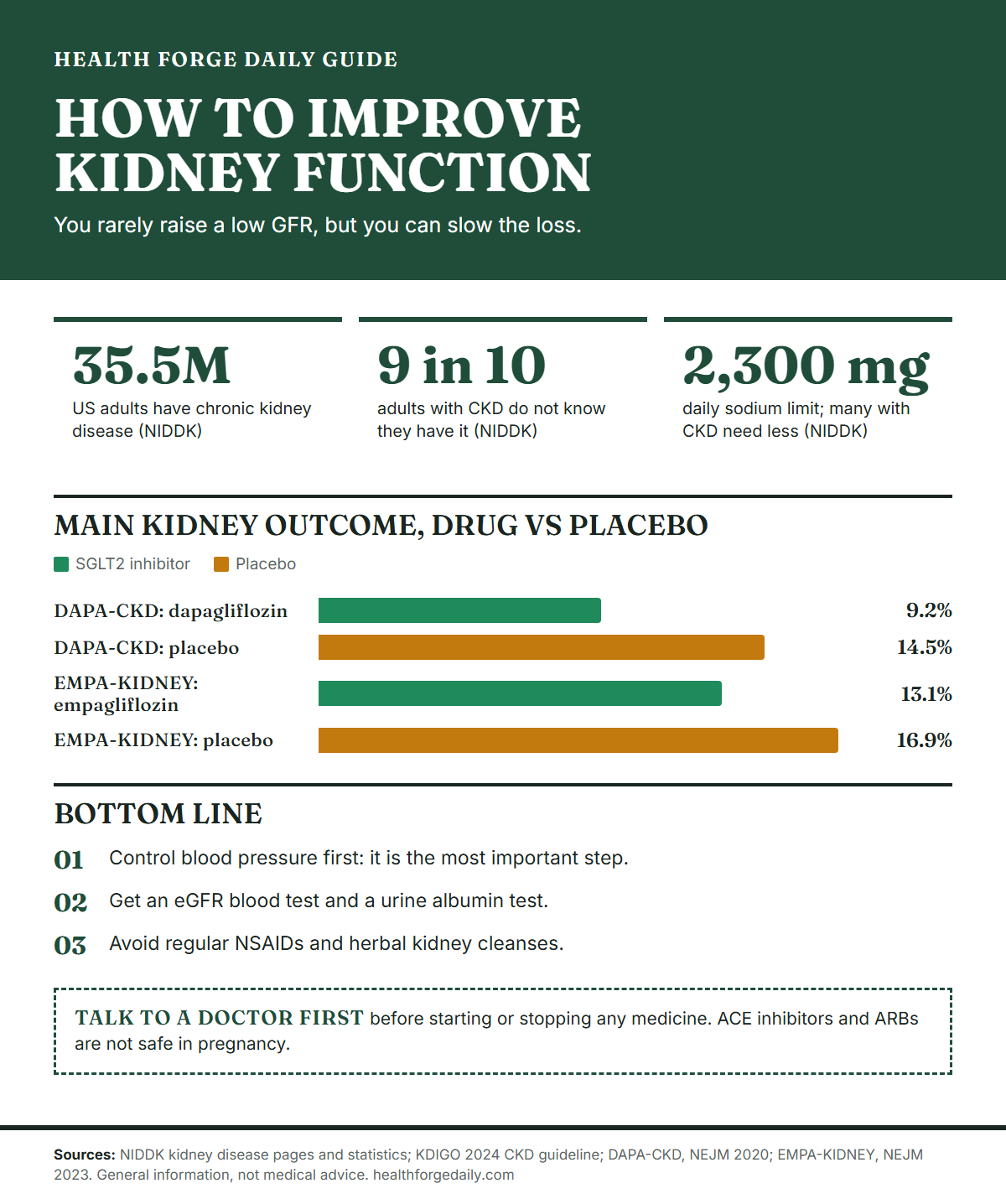
The short answer: you usually cannot raise a low GFR, but blood pressure control, less sodium, the right medicines and avoiding kidney-harming drugs can slow the loss, and in one large trial a kidney drug lowered serious kidney events from 14.5% to 9.2% of patients.[4][9]
| What it means | Keeping your GFR from falling and your urine albumin the same or lower, since advanced CKD typically can’t be reversed[1][2] |
|---|---|
| How common CKD is | About 35.5 million US adults, and as many as 9 in 10 of them do not know it[6] |
| Most important step | Blood pressure control; KDIGO suggests a systolic target under 120 when tolerated[2][8] |
| Daily habits | Sodium under 2,300 mg, about 150 minutes of activity a week, 7 to 8 hours of sleep, no smoking[3][8][2] |
| Best evidence | SGLT2 inhibitor trials in 4,304 and 6,609 people, plus ACE inhibitors or ARBs[9][10][2] |
| Safety | NSAIDs such as ibuprofen and naproxen, and some herbal remedies, can damage kidneys[2][14] |
| Who needs a plan first | People with diabetes, high blood pressure, a family history of kidney failure, or age over 65[6][1] |
How to improve kidney function: 8 steps that protect your kidneys
To protect kidney function, start with your blood pressure, then cut sodium, move more, review your medicines and get tested on a schedule. NIDDK calls blood pressure control the most important step you can take to treat kidney disease.[2] Work through them roughly in this order.
- Ask for two tests: a blood test for eGFR and a urine test for albumin (UACR). They are the only way to know how your kidneys are doing.[4][7]
- Get your blood pressure to the goal your doctor sets. NIDDK uses under 140/90 for most people, and KDIGO suggests a systolic reading under 120 when you can tolerate it.[2][8]
- If you have diabetes, aim for the A1C goal you agree with your doctor, often below 7%.[13]
- Keep sodium under 2,300 mg a day, or under 2 g if your care team advises it.[3][8]
- Build up to at least 150 minutes a week of moderate activity, such as brisk walking or cycling.[8][12]
- Stop smoking, sleep 7 to 8 hours, and aim for a healthy weight.[2]
- Avoid regular NSAID use and show your pharmacist every supplement you take.[2][5]
- Ask whether an ACE inhibitor, an ARB or an SGLT2 inhibitor fits your case.[2][8]
Steps 2 and 8 have the strongest trial support. The habit steps help you hit your blood pressure and glucose goals, which is how they protect the kidneys.[12][13]
Can kidney function improve?
Sometimes, but rarely by much once the damage is long-standing. NIDDK says advanced, long-lasting CKD typically can’t be reversed, and that you can’t raise your GFR, but you can try to keep it from going lower.[1][4] For most people the realistic goal is to keep the numbers steady.
Some changes in lab numbers do bounce back. Acute kidney injury is a sudden loss of function caused by illness, injury or certain medicines, and it differs from slow, long-term CKD.[1] A short dip in eGFR also happens when someone starts an SGLT2 inhibitor. KDIGO describes that dip as reversible and says it is not a reason to stop the drug.[8]
MedlinePlus puts it plainly: treatments cannot cure kidney disease, but they may slow it.[7] If a product promises to restore normal kidney function, treat that as a warning sign.
How to improve kidney function naturally
The natural steps that help are ordinary habits that lower blood pressure and blood glucose. NIDDK lists physical activity, a healthy weight, enough sleep, quitting smoking and managing stress as part of managing CKD.[2] None of them raises GFR on its own, but each makes your main targets easier to reach.
- Activity: KDIGO recommends at least 150 minutes a week of moderate activity for people with CKD, or as much as your heart and body allow.[8] NIDDK suggests 30 minutes or more on most days.[2]
- Weight: extra weight makes your kidneys work harder. For people with high blood pressure, NIDDK suggests losing 7 to 10% of body weight in the first year.[2][12]
- Sleep: aim for 7 to 8 hours a night, which helps with blood pressure and glucose goals.[2]
- Alcohol: keep to one drink a day for women and two for men.[5]
- Smoking: it makes kidney damage worse, so quitting counts.[2]
Drinking extra water is not on NIDDK’s list. People with CKD may in fact need to limit liquids, because damaged kidneys can’t remove extra fluid.[3] Our guide to how much water to drink a day covers healthy adults; with CKD, ask your care team for your own number.
What foods improve kidney function?
No single food improves kidney function, but your overall eating pattern can lower blood pressure and the load on your kidneys. NIDDK says medical nutrition therapy from a dietitian can help delay CKD progression, and Medicare covers it for people with CKD.[3] Lower sodium and the right amount of protein matter most.
| Nutrient | What to aim for | Practical move |
|---|---|---|
| Sodium | Under 2,300 mg a day; KDIGO suggests under 2 g in CKD[3][8] | Cook at home, choose low-sodium canned foods |
| Protein | 0.8 g per kg a day in CKD stages 3 to 5; avoid more than 1.3 g per kg[8] | Moderate portions of meat, fish, eggs or beans |
| Phosphorus | Limit added phosphate[3] | Skip foods with “PHOS” in the ingredient list |
| Potassium | Some people need to limit it[3] | Ask before using salt substitutes, which can be high in potassium |
| Fruits and vegetables | Plenty, as part of a heart-healthy pattern[3] | Fresh, frozen or drained canned, without added salt |
The DASH eating plan may help lower blood pressure, which is one reason dietitians often start there.[5] If you use electrolyte drinks or powders, check them with your dietitian, since potassium needs vary by stage.
How do you improve kidney function numbers like eGFR?
You improve your kidney numbers mainly by keeping them from getting worse. GFR, or glomerular filtration rate, measures how well your kidneys filter, and 60 or more is in the normal range.[4] A urine albumin result (UACR) of 30 mg/g or less is normal, and a stable or lower UACR is the goal.[4][2]
KDIGO groups eGFR into stages. Knowing your stage tells you which steps matter most.[8]
| Stage | eGFR | Focus |
|---|---|---|
| G1 and G2 | 60 or higher[8] | Blood pressure, glucose and regular blood and urine tests[2][4] |
| G3a | 45 to 59[8] | Add a dietitian; protein near 0.8 g per kg[8] |
| G3b | 30 to 44[8] | Ask about an SGLT2 inhibitor and medicine doses[8] |
| G4 | 15 to 29[8] | A nephrologist referral is likely when disease is advanced[2] |
| G5 | Under 15[8] | Kidney failure; dialysis or transplant planning[4] |
One abnormal result is not a diagnosis on its own. If albumin shows up in your urine, your provider may repeat the test one or two more times to confirm it, so wait for the repeat before drawing conclusions.[4]
How do you improve kidney function with diabetes?
With diabetes, the best way to protect your kidneys is to reach your blood glucose and blood pressure goals. About 1 in 3 people with diabetes have kidney disease, and diabetes is the leading cause of kidney failure in the US.[6][12] NIDDK names an A1C below 7% and blood pressure below 140/90 as common goals.[13]
Our page on normal blood sugar levels and A1C targets explains the glucose side. For the kidneys, three drug classes have strong data:
- ACE inhibitors and ARBs slow kidney damage in people with diabetes, high blood pressure and kidney disease.[13]
- SGLT2 inhibitors worked with or without diabetes in DAPA-CKD and EMPA-KIDNEY.[9][10]
- Semaglutide lowered major kidney events by 24% in the FLOW trial of 3,533 people with type 2 diabetes and CKD.[11]
NIDDK advises a kidney check every year if you have diabetes.[4] Ask for both the eGFR blood test and the urine albumin test, since each one shows a different side of kidney health.[4]
How do you improve kidney function in the elderly?
In older adults, the aim is to protect function without overtreating. CKD affects about 34% of US adults aged 65 and older, compared with 12% of those aged 45 to 64.[6] Some of that reflects normal aging: in healthy kidney donors, GFR fell about 6.3 mL/min per decade.[15]
That slow drop has led researchers to worry that some older people are labeled with CKD when their kidneys are aging normally.[15] Older kidneys also have less reserve and a higher risk of sudden injury, which makes regular NSAID use riskier.[15][2]
Targets often shift with age. KDIGO advises a less intensive blood pressure target for people who are frail, prone to falls or dizzy on standing.[8] For older adults with frailty or muscle loss, it suggests considering higher protein and calorie targets than the usual 0.8 g per kg.[8] Too little protein can lead to malnutrition, so this is a choice to make with a dietitian.[3]
Which medicines help protect kidney function?
Prescription drugs have the strongest proof of slowing kidney decline. SGLT2 inhibitors are a class of pills that lower the risk of kidney failure, and KDIGO gives them its top grade for many adults with CKD.[8] ACE inhibitors and ARBs may slow kidney disease even in people without high blood pressure.[2]
| Trial | Who and how many | Drug and length | Result |
|---|---|---|---|
| DAPA-CKD, 2020 | 4,304 adults with eGFR 25 to 75, with or without diabetes[9] | Dapagliflozin 10 mg, median 2.4 years[9] | Main outcome in 9.2% vs 14.5% on placebo[9] |
| EMPA-KIDNEY, 2023 | 6,609 adults with CKD[10] | Empagliflozin 10 mg, median 2.0 years[10] | Main outcome in 13.1% vs 16.9% on placebo[10] |
| FLOW, 2024 | 3,533 adults with type 2 diabetes and CKD[11] | Semaglutide 1.0 mg weekly, median 3.4 years[11] | Major kidney events 24% lower; eGFR fell 1.16 mL/min less per year[11] |
The drug makers funded all three trials, which is common for large drug studies.[9][10][11] The results were still consistent across trials, and KDIGO built them into its 2024 advice.[8] In these trials the drugs slowed the decline; none of them restored function already lost.
Which supplements and medicines can harm your kidneys?
Several common products can make kidney function worse. NSAIDs, which include ibuprofen and naproxen, can damage the kidneys and lead to acute kidney injury, especially with kidney disease, diabetes or high blood pressure.[2] KDIGO tells clinicians to review and limit over-the-counter medicines and herbal remedies in CKD.[8]
Herbal “kidney cleanse” products can do harm. A 2018 review found kidney damage from herbal products containing aristolochic acids and other plant alkaloids, plus harm from adulteration and heavy metal contamination.[14] The authors note that such harm is easy to miss because people believe herbs are harmless.[14] We found no trial showing that any supplement raises GFR.
Other cautions:
- ACE inhibitors and ARBs are not safe in pregnancy.[13]
- Salt substitutes can be high in potassium.[3]
- Untreated urinary tract infections can damage the kidneys.[5]
See a doctor right away if you have signs of a urinary tract infection, new swelling in your legs, feet or ankles, or chest pain or shortness of breath.[5][1]
What do doctors use first to protect kidney function?
Doctors start with testing and blood pressure, then add medicines matched to your stage and albumin level. KDIGO recommends an ACE inhibitor or ARB when albumin is raised, and an SGLT2 inhibitor for many adults with an eGFR of 20 or more.[8] Many people need two or more blood pressure medicines to reach goal.[12]
Your care team may refer you to a dietitian for medical nutrition therapy, and to a nephrologist if your kidney disease is advanced or getting worse quickly.[3][2] Supplements are not part of standard kidney care. Bring every bottle to your appointment so your pharmacist can check it.[2]
Your kidney protection checklist
Use this list before your next appointment. The two tests that track kidney health are the eGFR blood test and the urine albumin test, so every plan starts with knowing those results.[4] The rest of the list covers the daily habits and medicine questions with the best support in NIH and KDIGO guidance.[2][8]
- Write down your latest eGFR and UACR results and the test dates.[4]
- Check your blood pressure at home and log it for your doctor.[12]
- Read sodium on labels and keep the daily total under 2,300 mg.[3]
- Look for “PHOS” in ingredient lists and choose foods without it.[3]
- Swap ibuprofen or naproxen for a pain reliever your pharmacist approves.[2]
- Plan 150 minutes of activity across the week.[8]
- Ask about an SGLT2 inhibitor, an ACE inhibitor or an ARB.[8]
- Ask for a dietitian referral; Medicare covers it with CKD.[3]
More guides on kidneys and bladder health sit in our kidney and bladder section.
Bottom line
Improving kidney function mostly means keeping the function you have and slowing any further loss. Blood pressure control, less sodium, regular activity and avoiding NSAIDs slow the decline, and SGLT2 inhibitors and similar drugs cut serious kidney events in large trials.[2][3][9][10]
For most people, the better first step is a simple pair of tests, eGFR and urine albumin, followed by a talk about blood pressure medicine, because those two moves have the best proof behind them. Supplements and cleanses come last, if at all, since some can harm the kidneys they claim to help.[4][8][14]
Sources
- What Is Chronic Kidney Disease in Adults?. NIDDK, National Institutes of Health
- Managing Chronic Kidney Disease. NIDDK, National Institutes of Health
- Healthy Eating for Adults with Chronic Kidney Disease. NIDDK, National Institutes of Health
- Chronic Kidney Disease Tests and Diagnosis. NIDDK, National Institutes of Health
- Preventing Chronic Kidney Disease. NIDDK, National Institutes of Health
- Kidney Disease Statistics for the United States. NIDDK, National Institutes of Health
- Chronic Kidney Disease. MedlinePlus, National Library of Medicine
- KDIGO 2024 Clinical Practice Guideline for the Evaluation and Management of Chronic Kidney Disease. KDIGO, Kidney International, 2024
- Dapagliflozin in Patients with Chronic Kidney Disease (DAPA-CKD). Heerspink et al., New England Journal of Medicine, 2020
- Empagliflozin in Patients with Chronic Kidney Disease (EMPA-KIDNEY). EMPA-KIDNEY Collaborative Group, New England Journal of Medicine, 2023
- Effects of Semaglutide on Chronic Kidney Disease in Patients with Type 2 Diabetes (FLOW). Perkovic et al., New England Journal of Medicine, 2024
- High Blood Pressure and Kidney Disease. NIDDK, National Institutes of Health
- Diabetic Kidney Disease. NIDDK, National Institutes of Health
- Nephrotoxicity and Chinese Herbal Medicine. Yang et al., Clinical Journal of the American Society of Nephrology, 2018
- Structural and Functional Changes With the Aging Kidney. Denic, Glassock and Rule, Advances in Chronic Kidney Disease, 2016
Frequently asked questions
How can I improve kidney function quickly?
There is no quick way to raise a low GFR. What you can change fast is risk: stop regular NSAID use, cut sodium, take blood pressure medicine as prescribed and treat any urinary infection promptly. Lab numbers usually need months of steady care to settle.
Can you improve kidney function with stage 3 CKD?
Stage 3 means an eGFR of 30 to 59. Function rarely climbs back to normal, but blood pressure control, a dietitian plan with about 0.8 g of protein per kg, and an SGLT2 inhibitor when suitable can slow further loss.
How can I improve kidney function to avoid dialysis?
Slowing decline is the way to delay or avoid dialysis. In DAPA-CKD, an SGLT2 inhibitor cut major eGFR loss, kidney failure, or death from kidney or heart causes from 14.5% to 9.2% of patients. Pair it with blood pressure control and less sodium.
What can I do at home to improve kidney function?
Check your blood pressure at home, cook with less salt, walk most days, sleep 7 to 8 hours and stop smoking. Keep a list of every medicine and supplement, and avoid ibuprofen or naproxen unless your doctor approves them.
How do you protect kidney function during pregnancy?
Tell your obstetrician about any kidney disease, high blood pressure or diabetes before or early in pregnancy. Some kidney-protecting drugs, including ACE inhibitors and ARBs, are not safe in pregnancy, so never stop or switch medicine without your care team.

Grace Whitaker is the health editor at Health Forge Daily. She reads supplement labels line by line, checks each ingredient and dose against published research, and tracks refund policies and customer complaints before a product gets a verdict. She is not a doctor, so every review points readers back to their own physician for medical decisions.
This article is for general information and is not medical advice. Supplements are not evaluated by the FDA and are not intended to diagnose, treat, cure or prevent any disease. Check with your doctor before you start any supplement.