Normal blood sugar for an adult without diabetes is a fasting glucose of 99 mg/dL or below, an A1C below 5.7%, and 139 mg/dL or below two hours into a glucose tolerance test. These cutoffs do not change with age, though healthy people over 60 average slightly higher, about 104 mg/dL on a monitor. A second lab test confirms any high result.
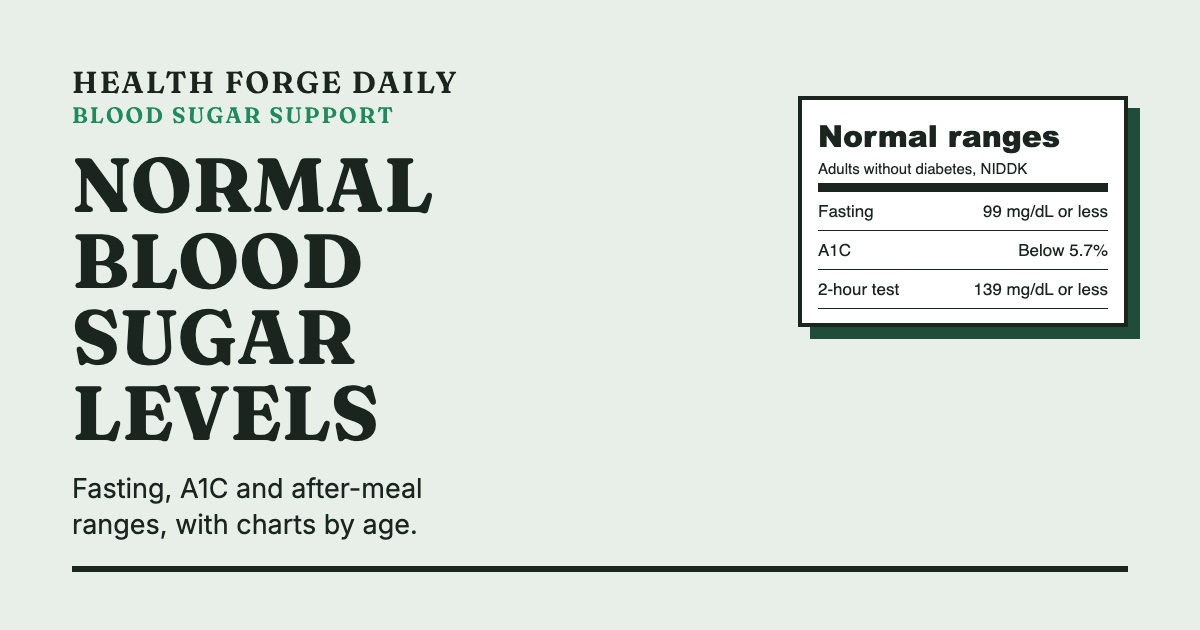
Normal blood sugar levels for an adult without diabetes are a fasting reading of 99 mg/dL or below, an A1C below 5.7%, and a reading of 139 mg/dL or below two hours into a glucose tolerance test.[1] We read the NIDDK and MedlinePlus test pages, four sections of the American Diabetes Association’s 2026 Standards of Care, and three studies that measured glucose in people without diabetes, then built the charts below from them.
The short answer: a healthy fasting number sits between about 70 and 99 mg/dL, and continuous monitors show healthy people stay between 70 and 140 mg/dL about 96% of the day.[1][5] This guide sits in our blood sugar support section and follows our review method.
| Normal fasting glucose | 99 mg/dL or below after at least 8 hours without food[1] |
|---|---|
| Normal A1C | Below 5.7%, an average of the past two to three months[3] |
| Normal 2-hour glucose tolerance test | 139 mg/dL or below[1] |
| Typical all-day average (CGM) | 98 to 99 mg/dL in healthy people under 60, 104 mg/dL at 60 and over[5] |
| Low blood sugar line | Below 70 mg/dL for many people with diabetes[11] |
| Diabetes range | Fasting 126 mg/dL or above, or A1C 6.5% or above, confirmed by a second test[1] |

What are normal blood sugar levels?
Normal blood sugar levels are the ranges a doctor uses to rule out prediabetes and diabetes: fasting glucose of 99 mg/dL or below, A1C below 5.7%, and a 2-hour tolerance result of 139 mg/dL or below.[1] Each test measures something different, which is why doctors often look at more than one.
A fasting test shows your glucose at one moment after an overnight fast.[1] An A1C shows the share of hemoglobin coated with glucose, which reflects your average over the past two to three months.[3] A tolerance test shows how fast your body clears a sugar drink.[1]
MedlinePlus adds a caution worth keeping in mind. It says what counts as normal for you “depends on your health, age, and other factors,” so treat the ranges as a guide.[3] Doctors usually confirm a high result with a second test before naming a diagnosis.[1]
What does a blood sugar levels chart show?
A standard blood sugar levels chart puts each test result into one of three bands: normal, prediabetes or diabetes. The cutoffs below come from the NIDDK, which takes them from the American Diabetes Association, and they apply to adults who are not pregnant.[1]
| Result | A1C | Fasting glucose | 2-hour tolerance test |
|---|---|---|---|
| Normal | Below 5.7% | 99 mg/dL or below | 139 mg/dL or below |
| Prediabetes | 5.7% to 6.4% | 100 to 125 mg/dL | 140 to 199 mg/dL |
| Diabetes | 6.5% or above | 126 mg/dL or above | 200 mg/dL or above |
A random plasma glucose of 200 mg/dL or above also points to diabetes when someone has symptoms such as thirst and frequent urination.[1] A random test can be done at any time of day, which is why there is no “normal” random cutoff in the table.[1]
If your numbers land in the middle band, our guide to the prediabetes A1C range and how to lower it covers the next steps.
What is a normal fasting blood sugar?
A normal fasting blood sugar is 99 mg/dL or below, measured in the morning after at least 8 hours with nothing to eat or drink except sips of water.[1] A result of 100 to 125 mg/dL is the prediabetes range, and 126 mg/dL or above on two tests points to diabetes.[1]
In healthy people, fasting numbers do not usually fall much below 70 mg/dL. MedlinePlus notes that low blood glucose is not common in people without diabetes, and when it does happen it can be linked to liver or kidney disease, hormone problems, malnutrition, certain medicines or alcohol use disorder.[2]
High readings can come from more than diabetes. MedlinePlus lists an overactive thyroid, pancreas problems, adrenal disorders, certain medicines, and “stress from surgery, very serious illness, or trauma” as other causes.[2] That is one reason a single high fasting number is repeated before anyone draws a conclusion.[1]
What is the normal A1C range?
The normal A1C range is below 5.7%; 5.7% to 6.4% is prediabetes and 6.5% or higher is diabetes.[3] You can eat before an A1C test, because it reflects your average glucose over two to three months, not the last meal.[3]
A1C can mislead in some people. MedlinePlus says anemia or another red blood cell disorder can make the result inaccurate, and the test is not used to diagnose gestational diabetes.[3] In pregnancy, the ADA notes that A1C runs slightly lower because red blood cells turn over faster.[9]
The A1C also maps to an average glucose. The ADAG study followed 507 people, including 80 without diabetes, and collected about 2,700 glucose readings from each over 3 months.[10] It found estimated average glucose (mg/dL) equals 28.7 times the A1C, minus 46.7, with a correlation (R squared) of 0.84.[10]
A1C to average glucose: a worked conversion
Using the ADAG formula, here is what common A1C values mean in everyday meter units. We did the arithmetic; the formula is from the study.[10]
| A1C | Estimated average glucose | Where it falls |
|---|---|---|
| 5% | About 97 mg/dL | Normal |
| 5.7% | About 117 mg/dL | Start of prediabetes |
| 6% | About 126 mg/dL | Prediabetes |
| 6.5% | About 140 mg/dL | Diabetes threshold |
| 7% | About 154 mg/dL | Common treatment goal in diabetes |
| 8% | About 183 mg/dL | Goal for some older adults with complex health |
What are normal blood sugar levels by age?
The diagnostic cutoffs for normal blood sugar levels are the same at every adult age, but healthy people do drift a little higher as they get older. No official chart sets a different “normal” fasting number for a 30-year-old and a 70-year-old.[1][6]
Two studies show the drift. In 2019, Shah and colleagues fitted 153 healthy people aged 7 to 80 with a continuous glucose monitor for up to 10 days.[5] Average glucose was 98 to 99 mg/dL in every age group under 60, and 104 mg/dL in people 60 and older.[5]
In 2008, Pani and colleagues looked at A1C in 2,473 Framingham and 3,270 NHANES adults without diabetes.[6] A1C rose about 0.014 and 0.010 points per year of age. The top 2.5% of people under 40 had A1C values up to 6.0% and 5.6%, compared with 6.6% and 6.2% at age 70 and over.[6] The authors said more study is needed before age-specific cutoffs are used.[6]
| Age group | People | Average glucose | Time between 70 and 140 mg/dL |
|---|---|---|---|
| 6 to 11 | 27 | 99 mg/dL | 97% |
| 12 to 17 | 30 | 98 mg/dL | 97% |
| 18 to 24 | 29 | 98 mg/dL | 95% |
| 25 to 59 | 41 | 99 mg/dL | 97% |
| 60 and over | 26 | 104 mg/dL | 93% |
Source for the table: Shah 2019, median time in range by age group.[5]
What blood glucose levels are normal after eating?
In healthy people, glucose rises after a meal but rarely passes 140 mg/dL; the Shah study found readings above 140 mg/dL took up only 2.1% of the day, about 30 minutes.[5] Readings above 180 mg/dL were uncommon in that group.[5]
The lab version of this question is the 2-hour oral glucose tolerance test. You drink a measured sugar solution, and a result of 139 mg/dL or below two hours later is normal.[1]
Healthy people also dip below 70 mg/dL now and then. In the same study, time below 70 mg/dL averaged 1.1% of the day, about 15 minutes, and 28% of participants had at least one short low event.[5] Short dips like these in healthy people are a separate issue from the lows that people on insulin can have.[11]
Fiber at meals can slow how fast glucose rises. Our list of high fiber foods and easy meals shows how to reach a daily target.
What are normal blood sugar levels for people with diabetes?
People with diabetes work toward goals, not the normal range: for many adults, the ADA sets A1C below 7%, 80 to 130 mg/dL before meals, and below 180 mg/dL at the peak after meals.[4] These goals are wider than the normal range on purpose, because pushing too low raises the risk of dangerous lows.[4]
Goals shift by group. The table pulls them from four ADA 2026 sections.
| Group | A1C goal | Glucose goals | Source |
|---|---|---|---|
| Most nonpregnant adults with diabetes | Below 7% | 80 to 130 before meals; below 180 after meals | ADA section 6[4] |
| Healthy older adults | Below 7.0% to 7.5% | Fasting 80 to 130; bedtime 80 to 180 | ADA section 13[7] |
| Older adults with complex health | Below 8.0% | Fasting 90 to 150; bedtime 100 to 180 | ADA section 13[7] |
| Children with type 1 diabetes | Below 7%, or below 6.5% if safe | Set with the care team | ADA section 14[8] |
| Pregnancy with diabetes | Below 6% if safe | Fasting below 95; 1 hour after meals below 140 or 2 hours below 120 | ADA section 15[9] |
For people who wear a continuous monitor, the ADA goal for most adults is more than 70% of the day between 70 and 180 mg/dL, with less than 4% below 70 mg/dL.[4]
What blood sugar level is too low?
For many people with diabetes, a reading below 70 mg/dL counts as low blood glucose, and below 54 mg/dL needs action right away.[11][4] Your own threshold may differ, so ask your care team which number they want you to treat.[11]
Common signs include feeling shaky, sweaty, hungry, dizzy or confused, and a fast heartbeat.[11] The ADA notes that below 54 mg/dL is the level where brain-related symptoms begin.[4]
How do the main studies on normal glucose compare?
Three studies anchor what “normal” looks like outside the diagnostic chart: one on all-day monitor data, one on A1C and age, and one linking A1C to average glucose. All three are observational, so they describe healthy patterns and do not test any treatment.
| Study | Who and how many | Method | Main finding |
|---|---|---|---|
| Shah, 2019[5] | 153 healthy people aged 7 to 80 | Blinded monitor for up to 10 days | Average 98 to 99 mg/dL under 60, 104 mg/dL at 60 and over; 96% of time between 70 and 140 |
| Pani, 2008[6] | 2,473 Framingham and 3,270 NHANES adults | Cross-sectional A1C by age | A1C rose 0.010 to 0.014 points per year |
| Nathan (ADAG), 2008[10] | 507 people, 80 without diabetes | About 2,700 readings each over 3 months | Average glucose equals 28.7 times A1C minus 46.7 |
Can supplements bring blood sugar back to normal?
No supplement has been shown to return blood sugar to the normal range; the NCCIH says there is only “weak evidence of a possible benefit” for chromium, cinnamon and berberine.[12] The FDA has warned about products sold as a “natural diabetes cure,” which are marketed illegally.[12]
If you are curious about one option, our look at berberine for blood sugar and who should avoid it covers the trials and the drug interaction risks. The NCCIH is clear that supplements should never replace medical treatment.[12]
When should you see a doctor about your glucose levels?
See a doctor if a fasting reading is 100 mg/dL or higher, an A1C is 5.7% or higher, or you have symptoms such as strong thirst and frequent urination.[1] A home meter cannot diagnose diabetes, so any worrying number needs a lab test.[1]
Get help right away if:
- A reading is below 54 mg/dL, or below 70 mg/dL with confusion or shaking.[4][11]
- Someone with diabetes cannot eat or drink, or becomes hard to wake.[11]
- You get low readings without having diabetes, since this is uncommon and can signal liver, kidney or hormone problems.[2]
- You are pregnant and your fasting reading is 95 mg/dL or above.[9]
What do doctors use first?
Doctors start with lab tests: a fasting plasma glucose, an A1C or an oral glucose tolerance test, usually repeated to confirm.[1] If you already have diabetes, the plan centers on personal glucose goals, medicine where needed, and regular A1C checks.[4]
For people with diabetes who use insulin, home meters and continuous monitors are the daily tools for staying in range.[2][4]
Practical checklist for reading your numbers
- Fast for at least 8 hours before a fasting test, with only sips of water.[1]
- Compare your result to the right column: fasting, A1C and tolerance tests use different cutoffs.[1]
- Ask for a repeat test before accepting a single high result.[1]
- Tell your doctor about anemia or a blood disorder, which can skew A1C.[3]
- If you are 60 or over, expect averages a few points higher and ask how your doctor reads them.[5][6]
- Read supplement labels for “cure” or “replaces medicine” claims and skip those products.[12]
Bottom line
Normal means a fasting glucose of 99 mg/dL or below, an A1C below 5.7%, and a 2-hour tolerance result of 139 mg/dL or below, at any adult age.[1] Healthy people average close to 100 mg/dL across the day, with small rises after meals.[5]
For most people with a borderline result, the better first step is a repeat lab test and a talk with a doctor. Only a lab test can confirm what the number means, and a home meter or a supplement cannot.[1]
Sources
- Diabetes Tests and Diagnosis. NIDDK, NIH
- Blood Glucose Test. MedlinePlus, National Library of Medicine
- Hemoglobin A1C (HbA1c) Test. MedlinePlus, National Library of Medicine
- 6. Glycemic Goals, Hypoglycemia, and Hyperglycemic Crises: Standards of Care in Diabetes 2026. American Diabetes Association, Diabetes Care, 2026
- Continuous Glucose Monitoring Profiles in Healthy Nondiabetic Participants. Shah et al., J Clin Endocrinol Metab, 2019
- Effect of aging on A1C levels in individuals without diabetes. Pani et al., Diabetes Care, 2008
- 13. Older Adults: Standards of Care in Diabetes 2026. American Diabetes Association, Diabetes Care, 2026
- 14. Children and Adolescents: Standards of Care in Diabetes 2026. American Diabetes Association, Diabetes Care, 2026
- 15. Management of Diabetes in Pregnancy: Standards of Care in Diabetes 2026. American Diabetes Association, Diabetes Care, 2026
- Translating the A1C assay into estimated average glucose values. Nathan et al., ADAG Study Group, Diabetes Care, 2008
- Low Blood Glucose (Hypoglycemia). NIDDK, NIH
- Diabetes and Dietary Supplements. NCCIH, NIH
Frequently asked questions
Does blood sugar go up with age?
Slightly. In a 2019 monitor study, healthy people 60 and older averaged 104 mg/dL against 98 to 99 mg/dL in younger groups, and A1C rose about 0.01 points per year in large cohorts. The diagnostic cutoffs stay the same.
What is normal blood sugar in mmol/L?
Healthy people in the Shah study averaged 5.4 to 5.5 mmol/L, which equals 98 to 99 mg/dL. The low blood sugar line of 70 mg/dL is 3.9 mmol/L, and 140 mg/dL is 7.8 mmol/L.
Is a blood sugar of 140 after eating normal?
In healthy people, readings above 140 mg/dL are brief, about 30 minutes a day in one monitor study. On a 2-hour glucose tolerance test, 140 mg/dL or higher falls in the prediabetes range, so ask your doctor about testing.
What is a normal random blood sugar?
There is no single normal cutoff for a random test because it depends on when you last ate. Doctors use a random reading of 200 mg/dL or higher, with symptoms such as thirst, as a sign of diabetes.
Can a home glucose meter tell me if my levels are normal?
A meter shows your glucose at one moment, which is useful for tracking. The NIDDK says over-the-counter meters cannot diagnose diabetes, so a lab test such as fasting glucose or A1C is needed to confirm.

Grace Whitaker is the health editor at Health Forge Daily. She reads supplement labels line by line, checks each ingredient and dose against published research, and tracks refund policies and customer complaints before a product gets a verdict. She is not a doctor, so every review points readers back to their own physician for medical decisions.
This article is for general information and is not medical advice. Supplements are not evaluated by the FDA and are not intended to diagnose, treat, cure or prevent any disease. Check with your doctor before you start any supplement.