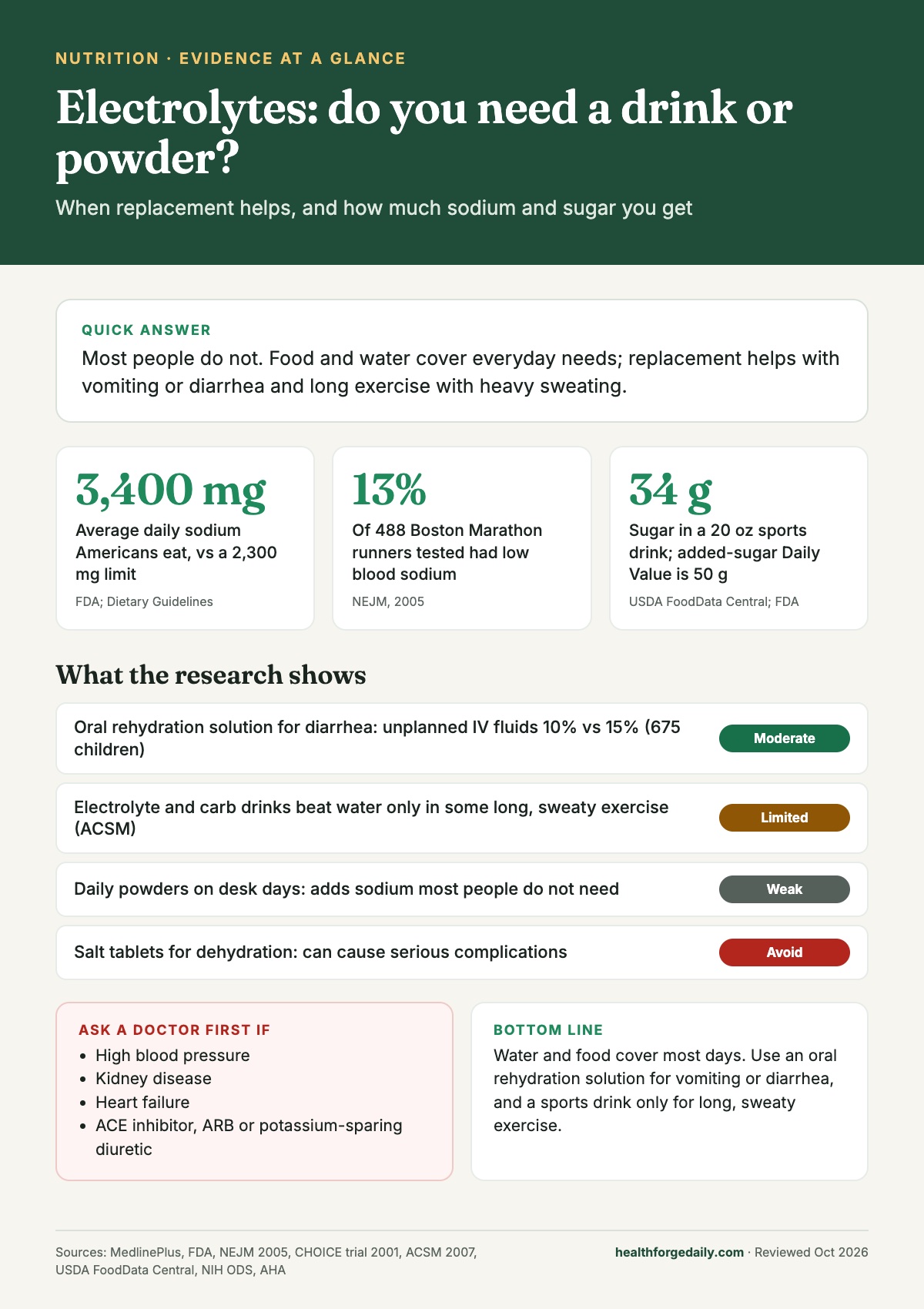
Most people do not need electrolyte drinks or powders. Food supplies sodium, potassium and other electrolytes, and Americans already average about 3,400 mg of sodium a day against a 2,300 mg limit. Replacement helps in specific cases: vomiting or diarrhea, where an oral rehydration solution is standard, and long exercise with heavy sweating. People with high blood pressure, kidney disease or heart failure should ask a doctor first.

Electrolyte drinks and powders are now sold for office days as well as for sport. We read the MedlinePlus pages on electrolytes and lab ranges, the American College of Sports Medicine fluid position stand, the World Health Organization oral rehydration formula, FDA and American Heart Association sodium guidance, and USDA label data for popular products before writing this.
Most people get enough electrolytes from food, and many already eat far more sodium than they need. Replacement matters in a few situations: long, sweaty exercise, heavy sweating in heat, and vomiting or diarrhea, where an oral rehydration solution is the standard choice.[9][13][18]
| What they are | Minerals that carry an electric charge in body fluids: sodium, potassium, chloride, bicarbonate, calcium, magnesium and phosphate[1] |
|---|---|
| What they do | Balance body water and pH, support nerves and muscles, keep heart rhythm and blood pressure steady[1] |
| Normal blood sodium | 135 to 145 mEq/L[3] |
| Daily sodium limit | Less than 2,300 mg; Americans average about 3,400 mg[18] |
| When replacement helps | Vomiting or diarrhea; long exercise with heavy sweating, especially in heat[1][9][13] |
| Main risk of overdoing water | Low blood sodium (hyponatremia): 13% of Boston Marathon runners tested[10] |
| Ask a doctor first if | High blood pressure, kidney disease, heart failure, or taking an ACE inhibitor or ARB[19][26][28] |
What are electrolytes?
Electrolytes are minerals that carry an electric charge when they dissolve in water or body fluids, including blood. They are in your blood, urine, tissues and other fluids, and you get them from the foods you eat and the fluids you drink.[1]
MedlinePlus lists the main ones as bicarbonate, calcium, chloride, magnesium, phosphate, potassium and sodium. Together they help balance the amount of water in your body and its acid-base (pH) level, move nutrients into cells and wastes out, support muscle and nerve function, and keep your heart rhythm and blood pressure steady.[1]
A standard electrolyte panel blood test measures sodium, chloride, potassium and bicarbonate.[2] Calcium and magnesium have their own tests.[7][8]
What are normal electrolyte levels in blood?
Most healthy people sit inside these ranges without trying, because the kidneys help keep them in range.[6][19][26] These are the typical ranges MedlinePlus gives. Labs vary slightly, so read your own report against its reference range.[3][4]
| Electrolyte | Typical normal range | Main job |
|---|---|---|
| Sodium | 135 to 145 mEq/L[3] | Controls fluid balance; nerves and muscles[2] |
| Potassium | 3.7 to 5.2 mEq/L[4] | Heart rhythm, muscles, nerves[1] |
| Chloride | 98 to 107 mEq/L[5] | Fluid balance, blood volume and pressure[2] |
| Bicarbonate (CO2) | 23 to 29 mEq/L[6] | Acid-base balance[1] |
| Calcium | 8.8 to 10.3 mg/dL[7] | Bones, teeth, muscles, nerves[1] |
| Magnesium | 1.7 to 2.2 mg/dL[8] | Muscles, nerves, heart rhythm[1] |
An imbalance means one or more of these is too low or too high. It usually happens when the amount of water in your body changes, from too little water (dehydration) or too much (overhydration).[1]
Do you need electrolyte drinks every day?
For most people sitting at a desk, no. Food already supplies electrolytes, and the one most powders are built around, sodium, is the one Americans overeat. The average American eats about 3,400 mg of sodium a day, while the Dietary Guidelines advise less than 2,300 mg.[1][18]
The body needs only a small amount of sodium, less than 500 mg a day, and healthy kidneys hold on to what you need.[19] The American Heart Association recommends no more than 2,300 mg a day and an ideal limit of 1,500 mg for most adults. For most people, cutting back by 1,000 mg a day can improve blood pressure.[19]
So a daily stick with 500 to 1,000 mg of sodium mostly adds to an intake that is already too high. For plain daily hydration, water and food are enough; our guide to how much water you need per day covers the targets.
The AHA notes one real exception: its 1,500 mg goal may not apply to people who lose large amounts of sodium in sweat, such as competitive athletes and workers exposed to major heat stress, like foundry workers and firefighters.[19]
When do you need electrolytes during exercise?
Mainly during long, hard sessions with heavy sweating, especially in hot weather. MedlinePlus lists not drinking enough during intense exercise or very hot weather among the common causes of a water and electrolyte imbalance.[1]
The American College of Sports Medicine (ACSM) position stand sets the goal of drinking during exercise as preventing excessive dehydration, defined as losing more than 2% of body weight from water loss, and avoiding large shifts in electrolytes.[9]
Sweat rates and the amount of salt in sweat vary a lot between people, so ACSM recommends a personal plan. You can estimate your own sweat loss by weighing yourself before and after exercise.[9]
ACSM says drinks with electrolytes and carbohydrates can give benefits over water alone “under certain circumstances.” After exercise, the goal is to replace any fluid and electrolyte deficit, and how fast depends on how big the loss is and when you exercise next.[9]
A short walk or a gym session in air conditioning is not that situation. A long run or bike ride in summer heat, where you finish soaked and noticeably lighter, can be.
What should you drink for vomiting or diarrhea?
Water plus an oral rehydration solution, a drink with a measured mix of glucose and electrolytes. NIDDK advises replacing lost fluids and electrolytes with water and liquids such as broths and sports drinks, and says you can also use oral rehydration solutions, sold where medicines or baby supplies are sold.[13]
The World Health Organization says diarrhea should be treated with oral rehydration solution (ORS), a solution of clean water, sugar and salt.[17] Since 2003, WHO and UNICEF have recommended a newer, lower-concentration formula.[16]
That reduced-osmolarity formula contains, per liter, 75 mmol of sodium, 20 mmol of potassium, 65 mmol of chloride, 10 mmol of citrate and 75 mmol of glucose.[14]
In the CHOICE trial of 675 dehydrated children aged 1 to 24 months, 10% on the new formula needed unplanned IV fluids, compared with 15% on the older WHO formula.[14] A Cochrane review of children in the hospital found the new formula led to fewer IV infusions, less stool output and less vomiting, with no added risk of low sodium.[15]
NIDDK says older adults, people with a weak immune system, and people with diabetes, kidney disease or other health conditions should talk with their doctor before drinking oral rehydration solutions.[13] MedlinePlus also warns: do not take salt tablets for dehydration, because they can cause serious complications.[12]
What do the main studies and guidelines show?
| Question | Best evidence | Result | What it means |
|---|---|---|---|
| ORS for child diarrhea | CHOICE trial, 675 children, 5 countries[14] | Unplanned IV fluids 10% vs 15% | Moderate: the reduced-osmolarity formula works better |
| ORS formula comparison | Cochrane review, 2002[15] | Fewer IV infusions, less vomiting | Supports the current WHO formula |
| Sports drinks vs water in exercise | ACSM position stand, 2007[9] | Benefit “under certain circumstances” | Limited: long, sweaty sessions, not every workout |
| Overdrinking in a marathon | Boston Marathon study, 488 runners[10] | 13% had low blood sodium | Drinking too much is a real risk |
| Daily powders for desk days | FDA and AHA sodium guidance[18][19] | Average intake already about 3,400 mg | Weak case: most people need less sodium, not more |
How much sodium and sugar is in electrolyte drinks and powders?
It ranges from about 200 mg to over 1,000 mg of sodium per serving, and from zero to 34 grams of sugar. We looked up six common product types in USDA FoodData Central and on the maker’s page, then worked out sodium per serving against the 2,300 mg limit.[18][21][23][24]
| Product type | Sodium | Share of 2,300 mg | Sugar |
|---|---|---|---|
| Electrolyte water packet (Propel) | 210 mg | 9% | 0 g sugar |
| Sports drink, 20 oz bottle (Gatorade) | 272 mg | 12% | 34 g sugar |
| Hydration stick (Liquid I.V.) | 499 mg | 22% | 11 g sugar |
| High-sodium stick (LMNT) | 1,000 mg | 43% | 0 g sugar |
| Oral rehydration drink, 1 liter (Pedialyte) | 1,030 mg | 45% | 25 g sugar |
| WHO oral rehydration solution, 1 liter | 1,724 mg | 75% | 13.5 g glucose |
A 20-ounce bottle of Gatorade Thirst Quencher works out to about 272 mg of sodium and 34 grams of sugar.[21] For scale, the FDA Daily Value for added sugars is 50 grams a day on a 2,000-calorie diet.[20]
A Liquid I.V. Hydration Multiplier stick has about 499 mg of sodium, 370 mg of potassium and 11 grams of sugar.[23] An LMNT stick lists 1,000 mg of sodium, 200 mg of potassium, 60 mg of magnesium and no sugar.[24] Two LMNT sticks alone come to 2,000 mg of sodium, close to the full daily limit.[18][24]
Unflavored Pedialyte has about 1,030 mg of sodium, 780 mg of potassium and 25 grams of sugar per liter.[25] The WHO solution works out to about 1,724 mg of sodium per liter.[14] Those levels make sense when diarrhea is draining salt; they make less sense as a daily habit.
Can you drink too much water during endurance events?
Yes, and it can be dangerous. When sodium in the fluid outside cells drops too low, water moves into cells and they swell. Brain cells are especially sensitive, which causes many of the symptoms.[11]
In a study of the 2002 Boston Marathon, 13% of the 488 runners who gave a blood sample at the finish had hyponatremia, a blood sodium of 135 mmol/L or less. 0.6% had critical hyponatremia, at 120 mmol/L or less.[10]
The biggest risk factor was weight gain during the race, a sign of drinking more than you sweat out. Drinking more than 3 liters during the race, drinking at every mile and finishing in over 4 hours were also linked to it.[10]
The type of fluid runners drank, sports drink or water, was not linked to hyponatremia.[10] An electrolyte drink does not make overdrinking safe. Symptoms of low sodium include headache, nausea and vomiting, confusion, fatigue, muscle cramps and seizures.[11]
Who should be careful with electrolyte drinks?
Anyone told to limit sodium, fluid or potassium should check with a doctor before using electrolyte products.
- High blood pressure: the AHA links lower sodium intake to better blood pressure, and a 1,000 mg stick can use up nearly half the daily limit.[18][19]
- Heart failure: too much sodium can cause fluid retention, with swelling and weight gain, so doctors often limit both salt and fluids.[28]
- Kidney disease: people with chronic kidney disease may not clear potassium well, and even intakes below the usual target can cause high potassium.[26] NIDDK also asks people with kidney disease to talk with a doctor before using oral rehydration solutions.[13]
- ACE inhibitors, ARBs or potassium-sparing diuretics: these blood pressure drugs reduce potassium loss in urine and can lead to high potassium.[26] The MedlinePlus lisinopril page says to talk to your doctor before using salt substitutes containing potassium.[29]
- Water pills (diuretics): some increase sodium loss in urine and are a known cause of low blood sodium, so ask before changing your fluid or salt intake.[11]
Magnesium in some powders is usually modest, but supplemental magnesium has an upper limit of 350 mg a day for adults.[27] If you also take a magnesium supplement, count both. Our magnesium glycinate guide covers that form.
How can you increase electrolytes in your body with food?
Eat potassium- and magnesium-rich whole foods, and get your sodium from normal meals. The Adequate Intake for potassium is 3,400 mg a day for men and 2,600 mg for women.[26]
Good potassium sources, per the NIH Office of Dietary Supplements:[26]
- Dried apricots, half a cup: 755 mg
- Cooked lentils, 1 cup: 731 mg
- Baked potato, 1 medium: 610 mg
- Canned kidney beans, 1 cup: 607 mg
- Orange juice, 1 cup: 496 mg
- Banana, 1 medium: 422 mg
- 1% milk, 1 cup: 366 mg
For magnesium, pumpkin seeds have 156 mg per ounce, chia seeds 111 mg, almonds 80 mg and boiled spinach 78 mg per half cup.[27] Milk and fruit yogurt add potassium too, about 366 mg and 330 mg a serving.[26] Many of these foods are also part of an anti-inflammatory diet.
Potassium-only supplements mostly contain up to 99 mg, a small fraction of what a potato provides.[26]
When should you see a doctor?
Get help fast when dehydration or an imbalance affects alertness, or when fluids are not staying down. MedlinePlus says to call 911 or your local emergency number if a dehydrated person:[12]
- Loses consciousness at any time
- Shows any change in alertness, such as confusion or seizures
- Has a fever over 102°F (38.8°C)
- Has signs of heatstroke, such as a rapid pulse or rapid breathing
- Does not improve, or gets worse, despite treatment
Severe dehydration may need IV fluids in a hospital.[12] Talk to a doctor sooner if you are older, have a weak immune system, diabetes or kidney disease and are losing fluids from diarrhea.[13]
Ongoing muscle weakness, cramps, confusion or an irregular heartbeat can point to an electrolyte problem that needs a blood test, not a powder.[1][2][11]
How do you choose an electrolyte drink or powder?
- Match the product to the job. Diarrhea or vomiting: an oral rehydration solution. Long, sweaty exercise: a sports drink or electrolyte mix. Desk day: water.[9][13]
- Check sodium per serving against 2,300 mg. In the chart above, one serving ranges from 9% to 75% of the daily limit.[14][18][22]
- Check total and added sugar. A 20-ounce sports drink can carry 34 grams of sugar; the added-sugar Daily Value is 50 grams.[20][21]
- Look at potassium if you have kidney disease or take an ACE inhibitor, ARB or potassium-sparing diuretic.[26]
- Add up magnesium from the drink and any supplement; stay under 350 mg a day from supplements.[27]
- Skip salt tablets unless a doctor tells you otherwise.[12]
- Ignore claims to cure or treat disease, and read the full Supplement Facts or Nutrition Facts panel. See how to read a label.
Our verdict: do you need electrolyte drinks or powders?
Most people do not. Food and water cover everyday needs, and the average American already eats about 3,400 mg of sodium a day, well over the 2,300 mg limit. A daily powder mostly adds sodium and, often, sugar.[18][21]
They earn their place in three situations: vomiting or diarrhea, where an oral rehydration solution is the standard; long exercise with heavy sweating, especially in heat; and work in serious heat stress. Do not overdrink in endurance events, and ask a doctor first if you have high blood pressure, kidney disease or heart failure, or take ACE inhibitors or ARBs.[9][10][13][19][26] See how we review for our method.
Sources
- Fluid and Electrolyte Balance. MedlinePlus, National Library of Medicine.
- Electrolyte Panel. MedlinePlus, National Library of Medicine.
- Sodium blood test. MedlinePlus Medical Encyclopedia.
- Potassium test. MedlinePlus Medical Encyclopedia.
- Chloride test, blood. MedlinePlus Medical Encyclopedia.
- CO2 blood test (bicarbonate). MedlinePlus Medical Encyclopedia.
- Calcium blood test. MedlinePlus Medical Encyclopedia.
- Magnesium blood test. MedlinePlus Medical Encyclopedia.
- American College of Sports Medicine position stand: Exercise and fluid replacement. Sawka MN et al., Medicine and Science in Sports and Exercise, 2007.
- Hyponatremia among runners in the Boston Marathon. Almond CS et al., New England Journal of Medicine, 2005.
- Low blood sodium. MedlinePlus Medical Encyclopedia.
- Dehydration. MedlinePlus Medical Encyclopedia, reviewed July 2025.
- Treatment of Diarrhea. NIDDK, National Institutes of Health.
- Multicenter, randomized, double-blind clinical trial to evaluate the efficacy and safety of a reduced osmolarity oral rehydration salts solution in children with acute watery diarrhea. CHOICE Study Group, Pediatrics, 2001.
- Reduced osmolarity oral rehydration solution for treating dehydration caused by acute diarrhoea in children. Hahn S et al., Cochrane Database of Systematic Reviews, 2002.
- Oral rehydration salts: production of the new ORS. World Health Organization, 2006.
- Diarrhoeal disease fact sheet. World Health Organization.
- Sodium in Your Diet. US Food and Drug Administration.
- How much sodium should I eat per day?. American Heart Association.
- Added Sugars on the Nutrition Facts Label. US Food and Drug Administration.
- Gatorade Thirst Quencher, orange (branded food record). USDA FoodData Central, read October 2026.
- Propel zero sugar electrolyte water beverage mix (branded food record). USDA FoodData Central, read October 2026.
- Liquid I.V. Hydration Multiplier drink mix, lemon lime (branded food record). USDA FoodData Central, read October 2026.
- LMNT Recharge electrolyte drink mix, product page. LMNT, read October 2026.
- Pedialyte unflavored, 1 liter (branded food record). USDA FoodData Central, read October 2026.
- Potassium: Fact Sheet for Health Professionals. NIH Office of Dietary Supplements.
- Magnesium: Fact Sheet for Health Professionals. NIH Office of Dietary Supplements.
- Heart failure: fluids and diuretics. MedlinePlus Medical Encyclopedia.
- Lisinopril. MedlinePlus Drug Information.
Frequently asked questions
What are electrolytes?
Electrolytes are minerals that carry an electric charge in body fluids. The main ones are sodium, potassium, chloride, bicarbonate, calcium, magnesium and phosphate. They balance body water and pH, support nerves and muscles, and keep heart rhythm and blood pressure steady.
Do I need electrolyte drinks every day?
Most people do not. Food supplies electrolytes, and Americans already average about 3,400 mg of sodium a day against a 2,300 mg limit. Replacement helps mainly with vomiting or diarrhea, or long exercise with heavy sweating, especially in heat.
What is the best drink for diarrhea or vomiting?
Water plus an oral rehydration solution, which contains measured glucose and electrolytes. NIDDK also lists broths and sports drinks. Older adults and people with diabetes, kidney disease or a weak immune system should ask a doctor first. Do not use salt tablets.
How much sodium is in electrolyte powders?
It varies widely. In products we checked, a serving ranged from about 210 mg in a Propel packet to 1,000 mg in an LMNT stick, and about 1,030 mg in a liter of Pedialyte. The daily limit is 2,300 mg.
Can you drink too much water during a marathon?
Yes. In a Boston Marathon study, 13% of 488 runners tested had low blood sodium at the finish. Weight gain during the race, drinking over 3 liters and finishing in over 4 hours raised the risk. Sports drinks did not prevent it.
How can I increase electrolytes naturally?
Eat potassium and magnesium rich foods such as dried apricots, lentils, potatoes, beans, bananas, milk, pumpkin seeds, almonds and spinach. Adults need 2,600 to 3,400 mg of potassium a day, and normal meals already supply plenty of sodium.

Grace Whitaker is the health editor at Health Forge Daily. She reads supplement labels line by line, checks each ingredient and dose against published research, and tracks refund policies and customer complaints before a product gets a verdict. She is not a doctor, so every review points readers back to their own physician for medical decisions.
This article is for general information and is not medical advice. Supplements are not evaluated by the FDA and are not intended to diagnose, treat, cure or prevent any disease. Check with your doctor before you start any supplement.