To prevent kidney stones, drink enough liquid, mainly water, to pass at least 2 liters of urine a day. Keep calcium from food normal, keep sodium under 2,300 mg, and eat less animal protein. In a 5-year trial, extra water cut repeat stones from 27% to 12%. After a stone, get it tested, since its type guides diet and medicine.

This guide explains how to prevent kidney stones using the steps with the best evidence behind them. We read four NIDDK and MedlinePlus pages, two NIH fact sheets, the American College of Physicians (ACP) guideline and eight trials or large cohort studies, following our review process.
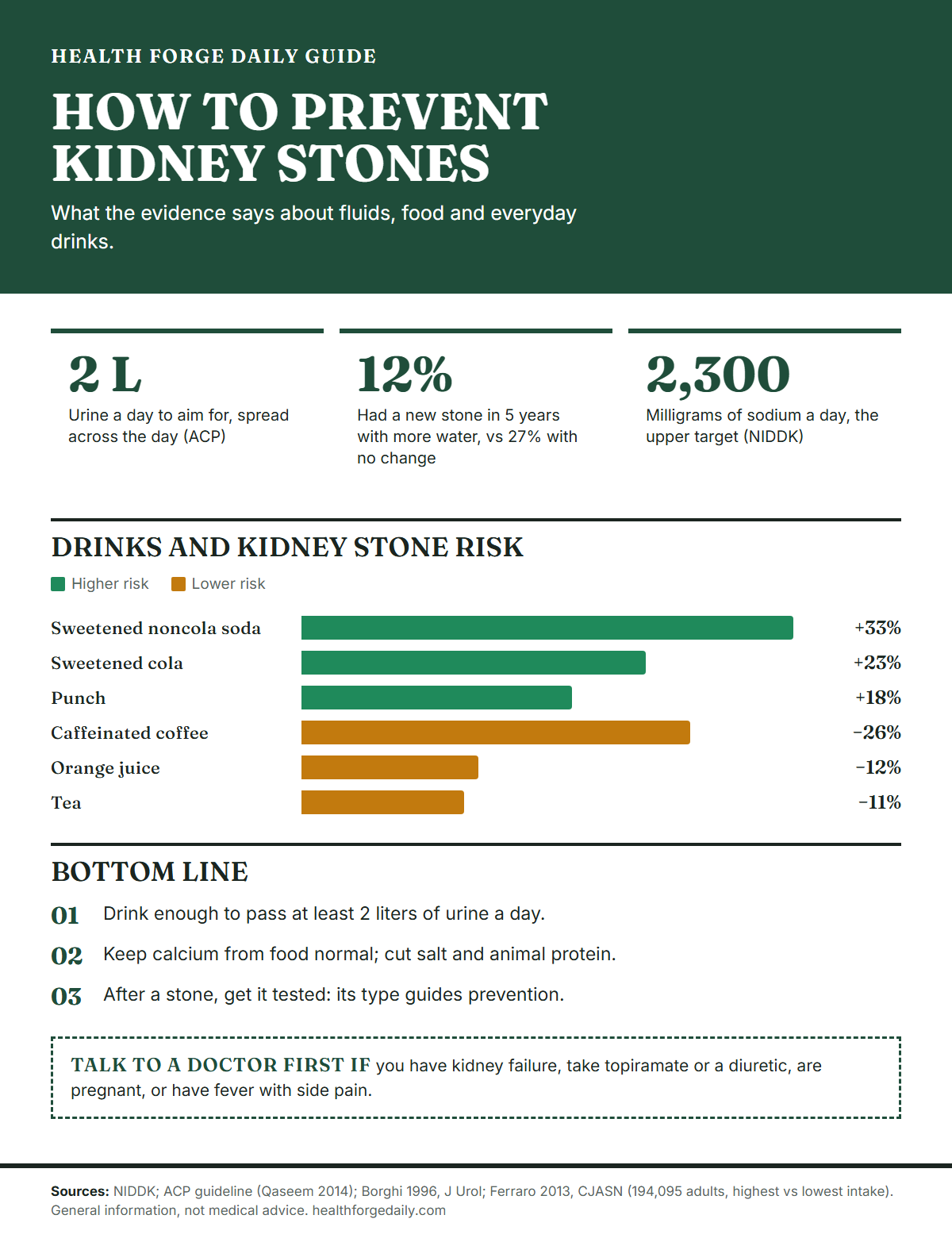
The short answer: drink enough to make at least 2 liters of urine a day, keep calcium from food normal, and eat less salt and animal protein. In a 5-year trial, extra water alone cut repeat stones from 27% to 12%.[7][8]
| What a stone is | A hard mass that forms from minerals in urine; calcium stones are the most common of four main types[3] |
|---|---|
| How common | About 11% of US men and 6% of US women have a kidney stone at least once[3] |
| Most important step | Enough liquid, mainly water: six to eight 8-ounce glasses a day for most people, or enough to pass 2 liters of urine[1][7] |
| Diet basics | Normal calcium from food, sodium under 2,300 mg a day, less animal protein, a DASH-style pattern[1][11] |
| Best trial evidence | More water: 12 of 99 people had a new stone over 5 years, against 27 of 100 who made no change[8] |
| If habits are not enough | A doctor may add a thiazide diuretic, citrate or allopurinol[7] |
| Who should be careful | People with kidney failure (ask before raising fluids), and people taking topiramate, diuretics or calcium-based antacids[2][3] |
How to prevent kidney stones: 8 steps that work
Most stones can be headed off with steady daily habits. Drinking enough liquid, mainly water, is the most important thing you can do to prevent kidney stones, according to the NIDDK.[1] The other steps adjust your food to the stone type you had, and a prescribed medicine comes in when habits are not enough.[2]
- Drink enough to pass at least 2 liters of urine a day. For most people that means six to eight 8-ounce glasses or more.[7][1]
- Spread your drinks across the day, and drink more in hot weather or when you sweat.[7][2]
- Keep calcium from food at normal levels. Do not cut dairy or other calcium foods on your own.[1][9]
- Keep sodium under 2,300 mg a day. One teaspoon of table salt holds 2,325 mg.[1]
- Eat less animal protein, such as meat, organ meat, fish, shellfish and eggs.[1]
- Eat in a DASH style, with plenty of fruit, vegetables, nuts and legumes, low-fat dairy and whole grains.[11]
- If you had calcium oxalate stones, go easy on spinach, rhubarb, nuts, peanuts and wheat bran.[1]
- After any stone, ask for a lab test of the stone and a 24-hour urine test.[2]
Steps 1 and 2 help nearly everyone. Steps 3 to 7 matter most for calcium stones, the most common type.[3]
How do you prevent kidney stones from forming?
Stones form when urine carries more minerals than it can keep dissolved. The simplest way to stop them forming is to make more, and more dilute, urine every day.[2] Liquids flush minerals out before they clump, and citrate in citrus drinks stops crystals from turning into stones.[2]
The best test of this idea is a 5-year Italian trial of 199 people after their first calcium stone. Of those told to drink a lot of water, 12 of 99 formed a new stone. Of those who made no change, 27 of 100 did.[8] The water group also went longer before a relapse, about 39 months against 25.[8]
At the start, men with stones in that study made about 1,057 ml of urine a day, against 1,401 ml in men without stones.[8] The ACP sets the target at 2 liters of urine a day.[7] Sweat takes fluid that would otherwise become urine, so people who work or exercise in heat need more.[2] Our guide to how much water to drink per day covers general fluid needs.
What diet helps prevent kidney stones?
The best-tested diet keeps calcium normal and cuts salt and animal protein. In a 5-year trial in 120 men with repeat calcium oxalate stones, that diet roughly halved relapses compared with a low-calcium diet (relative risk 0.49).[9] Twelve of 60 men had a new stone on it, against 23 of 60 on low calcium.[9]
The trial diet held animal protein to 52 g a day. On the low-calcium diet, urine oxalate rose; on the normal-calcium diet, it fell.[9] NIDDK agrees that calcium from food does not raise the chance of calcium oxalate stones.[3]
Large cohort studies point the same way. Among 45,619 men followed for 4 years, those eating the most food calcium had a lower stone risk than those eating the least (relative risk 0.56), while the most animal protein went with a higher one (1.33).[10] In more than 240,000 adults, those whose meals were closest to the DASH diet had relative risks of 0.55 to 0.60.[11] These are observational links, not proof.
Weight matters too. Being overweight raises stone risk, and losing weight is especially important after uric acid stones.[1]
Which foods and drinks help prevent kidney stones?
Water comes first, and a few other drinks look helpful. In three US cohorts with 194,095 people, coffee, tea and orange juice were linked to fewer stones, while sugar-sweetened soda and punch were linked to more.[13] These links come from questionnaires, so treat them as hints rather than rules.[13]
| Food or drink | What the research found |
|---|---|
| Water | The most important liquid for preventing stones[1] |
| Calcium foods (dairy, fortified juice, cereal, bread) | Higher food calcium linked to lower risk[10][1] |
| Caffeinated coffee | 26% lower risk at the highest intake[13] |
| Tea | 11% lower risk[13] |
| Orange juice | 12% lower risk[13] |
| Sugar-sweetened cola | 23% higher risk[13] |
| Sugar-sweetened noncola soda | 33% higher risk[13] |
| Punch | 18% higher risk[13] |
| Spinach, rhubarb, nuts, peanuts, wheat bran | High in oxalate; limit after calcium oxalate stones[1] |
| Canned, packaged and fast foods | Often high in sodium, which raises risk[1] |
Beans, dried peas and lentils are a good swap for some meat, since they are high in protein and low in oxalate.[1] If you use sports drinks or electrolyte drinks and powders, check the sodium line: 5% Daily Value or less is low, and 20% or more is high.[1]
How do you prevent kidney stones from recurring?
Prevention after a first stone starts with a lab result. Once you have had one kidney stone, you are more likely to form another, so the type of stone guides what you change.[3] Ask for the stone to be analyzed and for a 24-hour urine test, which measures your urine volume and mineral levels.[2]
| Stone type | Main diet steps | Medicines a doctor may use |
|---|---|---|
| Calcium oxalate | Fluids, normal food calcium, less sodium and animal protein, fewer high-oxalate foods[1] | Potassium citrate, thiazide-type diuretics[2] |
| Calcium phosphate | Fluids, normal food calcium, less sodium and animal protein[1] | Potassium citrate, diuretics[2] |
| Uric acid | Less animal protein; lose weight if overweight[1] | Allopurinol, potassium citrate[2] |
| Struvite | Prompt care for urinary tract infections, since these stones follow them[3] | Antibiotics, acetohydroxamic acid[2] |
| Cystine | Even more liquid than usual[1][2] | Tiopronin, potassium citrate[2] |
A dietitian who specializes in kidney stones can turn these steps into a meal plan.[1] If urine tests show low volume, the first fix is usually more fluid.[2]
How do you prevent kidney stones in women and men?
The core steps are the same for everyone. About 11% of US men and 6% of US women have a kidney stone at least once in their lives.[3] What differs is a few risk points: supplements and pregnancy for many women, and a higher starting risk for men.[3][5]
Pregnancy brings its own advice, covered in the FAQ below. Everything else in this guide applies to both sexes, and the 8 steps at the top of the page are the place to start for anyone.
Women
Calcium supplements are worth a second look. In the Women’s Health Initiative, 1,000 mg of supplemental calcium a day for 7 years was linked to more stones, though two later reviews in more than 8,000 adults found no such link.[5] If you need calcium for bone health, ask whether food can cover more of it. Plant foods such as fortified juices, cereals and breads are low-oxalate options NIDDK suggests.[1] The DASH pattern was linked to lower risk in older women (0.58) and younger women (0.60).[11]
Men
Much of the evidence comes from men. The diet trial enrolled only men, and the calcium cohort followed men aged 40 to 75.[9][10] The water trial included both sexes, and stone formers of both sexes started with low urine volume.[8] In men, total vitamin C of 1,000 mg a day or more was tied to a higher risk (hazard ratio 1.43); the link did not show up in women.[12] Men also carry the higher lifetime risk, so the fluid and diet steps matter even before a first stone.[3]
Can you prevent kidney stones naturally?
For many people, yes, because the best-proven steps involve drinks and food. The habits with real evidence are natural ones: more fluid, less salt, less animal protein and enough calcium from food.[1] Supplements are less clear-cut, and two popular ones may raise oxalate or stone risk at high doses.[5][6]
Lemonade and orange juice contain citrate, and NIDDK notes that some studies show citrus drinks protect against stones.[2] We found no source setting a dose of lemon juice, and nothing shows lemon water dissolves a stone. Potassium citrate tablets are a prescription medicine that a doctor doses and monitors.[2]
High vitamin C intake can raise oxalate in urine.[6] The adult upper limit is 2,000 mg a day, and the stone link in men appeared at half that amount.[6][12] Supplemental calcium, unlike food calcium, might raise stone risk.[5] If you take either, tell your doctor after a stone.
How can you prevent kidney stones while taking Topamax?
Keep taking it as prescribed and talk to your prescriber. Topiramate, sold as Topamax, is one of the medicines NIDDK lists as raising the chance of kidney stones when taken over a long period.[3] Fluids and the diet steps above still apply, and your doctor can weigh the dose against your stone risk.
A 2025 study of more than 1.1 million insured adults looked at topiramate and zonisamide. Between 3 months and 3 years after the first prescription, 2.9% of users in the commercial group had a stone event that needed an emergency visit, a hospital stay or surgery, against 1.2% of nonusers.[14] After adjustment, the hazard was 1.58 times higher in that group and 1.22 times higher in Medicare, and it rose with higher topiramate doses.[14] It was a retrospective study, so other differences between users and nonusers may explain part of it.[14]
NIDDK’s risk list also includes diuretics, calcium-based antacids and indinavir.[3] Diuretics also appear on its list of stone-prevention medicines, which is one more reason to review every medicine with your doctor.[2]
What does the research on kidney stone prevention show?
The evidence is solid on fluids and calcium, thinner elsewhere. Of the studies below, only two were randomized trials, and both came from one research group in Parma, Italy.[8][9] The rest are large cohorts, which show links but not cause and effect. The ACP rated its own fluid advice as weak, based on low-quality evidence.[7]
| Study | Who and how long | What was tested | Result |
|---|---|---|---|
| Borghi, 1996[8] | 199 adults after a first calcium stone; 5 years | High water intake vs no change | 12 of 99 vs 27 of 100 had a new stone |
| Borghi, 2002[9] | 120 men with repeat calcium oxalate stones; 5 years | Normal calcium, low salt and animal protein vs low calcium | 12 vs 23 of 60 relapsed; relative risk 0.49 |
| Curhan, 1993[10] | 45,619 men; 4 years | Food calcium intake | Relative risk 0.56, highest vs lowest fifth |
| Taylor, 2009[11] | Three cohorts, over 240,000 adults | DASH-style eating | Relative risk 0.55 to 0.60 |
| Ferraro, 2013[13] | 194,095 adults; over 8 years | Everyday drinks | Sweetened soda 23 to 33% higher risk; coffee 26% lower |
| Ferraro, 2016[12] | 197,271 adults; about 11 years | Vitamin C intake | Men at 1,000 mg or more: hazard ratio 1.43 |
Who should be careful, and when should you see a doctor?
Some people need a doctor’s input before changing fluids or diet. See a doctor right away if you have extreme back or side pain that will not go away, blood in your urine, fever and chills, or vomiting.[4] Untreated stones can lead to kidney infections and loss of kidney function.[3]
Get care promptly if you have:
- extreme pain in your back or side that will not go away[4]
- blood in your urine[4]
- fever and chills, or vomiting[4]
- urine that smells bad or looks cloudy[4]
- a burning feeling when you urinate[4]
Ask before raising fluids if you have kidney failure, urinary incontinence or frequent urination.[2] Stone medicines can have minor to serious side effects, which are more likely at higher doses and with longer use.[2] If you are pregnant, your obstetric team should guide both prevention and any pain workup.[15]
What do doctors use first to prevent kidney stones?
Doctors start with fluids, then add medicine only if stones keep forming. The ACP recommends drinking enough, spread through the day, to make at least 2 liters of urine daily.[7] If that fails, it suggests one medicine: a thiazide diuretic, citrate or allopurinol, chosen with your stone type and urine results.[7][2]
Potassium citrate raises citrate and pH in urine and may be taken 1 to 3 times a day for months or longer.[2] Allopurinol lowers high uric acid.[2] Struvite stones call for antibiotics, sometimes for 1 to 6 weeks or longer.[2] People with hyperparathyroidism may need surgery on the gland, which can prevent further calcium stones.[2] No supplement replaces any of these.
Your kidney stone prevention checklist
Most of the work happens in daily habits. Fluids and food changes do most of the work, and a lab test of your stone tells you which food changes matter.[1][2] Bring the list to your next visit if you have had a stone.
- Find out your stone type and ask about a 24-hour urine test.[2]
- Keep a water bottle nearby and refill it through the day.[7]
- Drink more on hot days and after exercise.[2]
- Check the sodium line on labels: 5% Daily Value or less is low.[1]
- Keep dairy or other calcium foods in your meals.[1]
- Swap some meat for beans, dried peas or lentils.[1]
- Cut back on sugar-sweetened soda and punch.[13]
- List your medicines and supplements, including calcium and vitamin C, for your doctor.[3][5][6]
Bottom line
Kidney stone prevention rests on a few habits kept up for years: enough fluid to pass 2 liters of urine a day, normal calcium from food, and less salt and animal protein.[7][1] After a stone, lab tests tell you which of the other steps matter for you.[2]
For most people, the better first step is a full water bottle carried all day rather than any supplement, because water is the one change with a 5-year trial behind it. You can find more guides like this in our kidney and bladder health section.[8]
Sources
- Eating, Diet, & Nutrition for Kidney Stones. NIDDK, National Institutes of Health
- Treatment for Kidney Stones. NIDDK, National Institutes of Health
- Definition & Facts for Kidney Stones. NIDDK, National Institutes of Health
- Kidney Stones. MedlinePlus, National Library of Medicine
- Calcium: Fact Sheet for Health Professionals. NIH Office of Dietary Supplements
- Vitamin C: Fact Sheet for Health Professionals. NIH Office of Dietary Supplements
- Dietary and pharmacologic management to prevent recurrent nephrolithiasis in adults: a clinical practice guideline from the American College of Physicians. Qaseem et al., Annals of Internal Medicine, 2014
- Urinary volume, water and recurrences in idiopathic calcium nephrolithiasis: a 5-year randomized prospective study. Borghi et al., Journal of Urology, 1996
- Comparison of two diets for the prevention of recurrent stones in idiopathic hypercalciuria. Borghi et al., New England Journal of Medicine, 2002
- A prospective study of dietary calcium and other nutrients and the risk of symptomatic kidney stones. Curhan et al., New England Journal of Medicine, 1993
- DASH-style diet associates with reduced risk for kidney stones. Taylor et al., Journal of the American Society of Nephrology, 2009
- Total, dietary, and supplemental vitamin C intake and risk of incident kidney stones. Ferraro et al., American Journal of Kidney Diseases, 2016
- Soda and other beverages and the risk of kidney stones. Ferraro et al., Clinical Journal of the American Society of Nephrology, 2013
- Associations of topiramate and zonisamide use with kidney stones: a retrospective cohort study. Salka et al., American Journal of Kidney Diseases, 2025
- Management of nephrolithiasis in pregnancy: multi-disciplinary guidelines from an academic medical center. Lee et al., Frontiers in Surgery, 2021
Frequently asked questions
How do you prevent kidney stones in pregnancy?
Keep drinking enough and keep calcium from food, and ask your obstetric team before changing your diet or starting any supplement. If stone pain starts, ultrasound is the first test in pregnancy, and an estimated 50 to 80% of stones pass on their own.
How do older men prevent kidney stones?
The same steps apply: more fluid, normal calcium from food, and less salt and animal protein. Men get stones more often than women, and in men, total vitamin C of 1,000 mg a day or more was linked to a higher risk.
How do you stop a kidney stone that has already formed?
Most small stones pass without a doctor's help. Larger or stuck stones may need shock wave treatment, a thin scope passed through the urethra, or surgery. Get care right away for fever, vomiting or side pain that will not ease.
How do you prevent chronic kidney stones?
People who keep forming stones need tests, not just general tips. Ask for a stone analysis and a 24-hour urine test. If more fluid does not stop new stones, the ACP guideline supports one medicine: a thiazide diuretic, citrate or allopurinol.

Grace Whitaker is the health editor at Health Forge Daily. She reads supplement labels line by line, checks each ingredient and dose against published research, and tracks refund policies and customer complaints before a product gets a verdict. She is not a doctor, so every review points readers back to their own physician for medical decisions.
This article is for general information and is not medical advice. Supplements are not evaluated by the FDA and are not intended to diagnose, treat, cure or prevent any disease. Check with your doctor before you start any supplement.
