To lower triglycerides, cut back on alcohol, added sugar and white flour, lose some weight if you carry extra, and get aerobic exercise most days. Each kilogram lost drops levels about 8 mg/dL, exercise trims 10% to 20%, and heavy drinkers who stop can see drops up to 80%. The adult target is under 150 mg/dL on a fasting test.
This guide explains how to lower triglycerides, using what we read in the NHLBI page on high blood triglycerides, the MedlinePlus test guide, a 2020 clinical review in the European Heart Journal, the American Heart Association’s 2019 omega-3 advisory and two large omega-3 outcome trials. Our process is on the how we review health topics page.
The short answer: cut back on alcohol, sugar and refined starch, lose some weight if you carry extra, and move most days, because a fasting level under 150 mg/dL is the healthy target for adults [1].
| What they are | The most common type of fat in the body; extra calories are stored as triglycerides in fat cells [1] |
|---|---|
| Healthy level | Below 150 mg/dL for adults and below 90 mg/dL for ages 10 to 19 [1] |
| How common | Up to one in four adults have high levels [1] |
| Biggest lifestyle levers | Less alcohol, weight loss, aerobic exercise, fewer refined carbs and sugars [3] |
| Main medicines | Fibrates, prescription omega-3s, statins and ezetimibe [1] |
| Main danger | Heart disease and stroke; above 500 mg/dL, acute pancreatitis [1] |
| Fish oil pills | Not FDA-approved to treat high triglycerides; prescription forms are a separate product [1] |
How to lower triglycerides: 7 steps that work
The fastest way to bring triglycerides down is to remove what pushes them up: alcohol, sugar, refined starch and extra calories. A 2020 review in the European Heart Journal ranks these changes first and puts reducing total calories at the top of the diet advice [3]. Medicine comes in when lifestyle changes are not enough or levels are very high [1].
We ordered the steps by the size of each effect in the research:
- Cut alcohol, or stop it. In people with high triglycerides who drink heavily, stopping alcohol lowered levels by up to 80% [3]. NHLBI says your doctor may advise stopping completely if your level is very high [1].
- Swap sugar and white flour for fiber-rich foods. Table sugar, fructose and refined starch raise triglycerides much more than fiber-rich, low glycemic index foods [3]. Our list of high fiber foods and easy meals is a good place to start.
- Lose some weight if you carry extra. Each kilogram (about 2.2 pounds) of weight loss lowers triglycerides by roughly 8 mg/dL [3].
- Do aerobic exercise most days. Regular aerobic activity lowered triglycerides by 10% to 20% [3]. Ask your provider what level is right for you first [1].
- Eat oily fish twice a week. Omega-3 fats from fish and flaxseed lowered triglycerides by 10% to 15% [3].
- Replace butter and fatty meat with olive oil and nuts. Swap saturated fat for unsaturated fats, and avoid trans fats [3].
- Treat the cause and recheck. Get diabetes, thyroid and kidney problems under control, review your medicines, quit smoking and sleep well, then repeat the blood test [1][2].
If your level stays above 500 mg/dL, lifestyle changes alone are usually not enough, and more than one medicine may be needed [1].
What do high triglycerides mean?
High triglycerides mean there is more fat circulating in your blood than your body needs, a level of 150 mg/dL or higher on a fasting test. Triglycerides come from the fats you eat and from extra calories your body stores for later [1]. Some are needed for energy. Too many raise the risk of heart disease and stroke [1][2].
| Category | Fasting level | What it means |
|---|---|---|
| Healthy | Below 150 mg/dL | Keep up current habits [1][2] |
| Borderline high | 150 to 199 mg/dL | Lifestyle changes are the first step [1] |
| High | 200 to 499 mg/dL | Higher heart and stroke risk; your provider may discuss medicine [1][2] |
| Very high | 500 mg/dL and above | Risk of acute pancreatitis [1][2] |
High triglycerides rarely cause symptoms, so a blood test is the only way to know [1][2]. NHLBI advises a lipid profile every 5 years for healthy adults, and more often for older adults, people with diabetes and those with a family history of heart disease [1]. Nonfasting levels that stay above 175 mg/dL for a long time also raise heart risk [1].
At the far end, levels above 1,500 mg/dL can cause multifactorial chylomicronemia syndrome, with stomach pain, a swollen liver and spleen, and memory problems [1]. The European review notes that a level above 885 mg/dL can trigger pancreatitis on its own [3].
How much can lifestyle changes lower triglycerides?
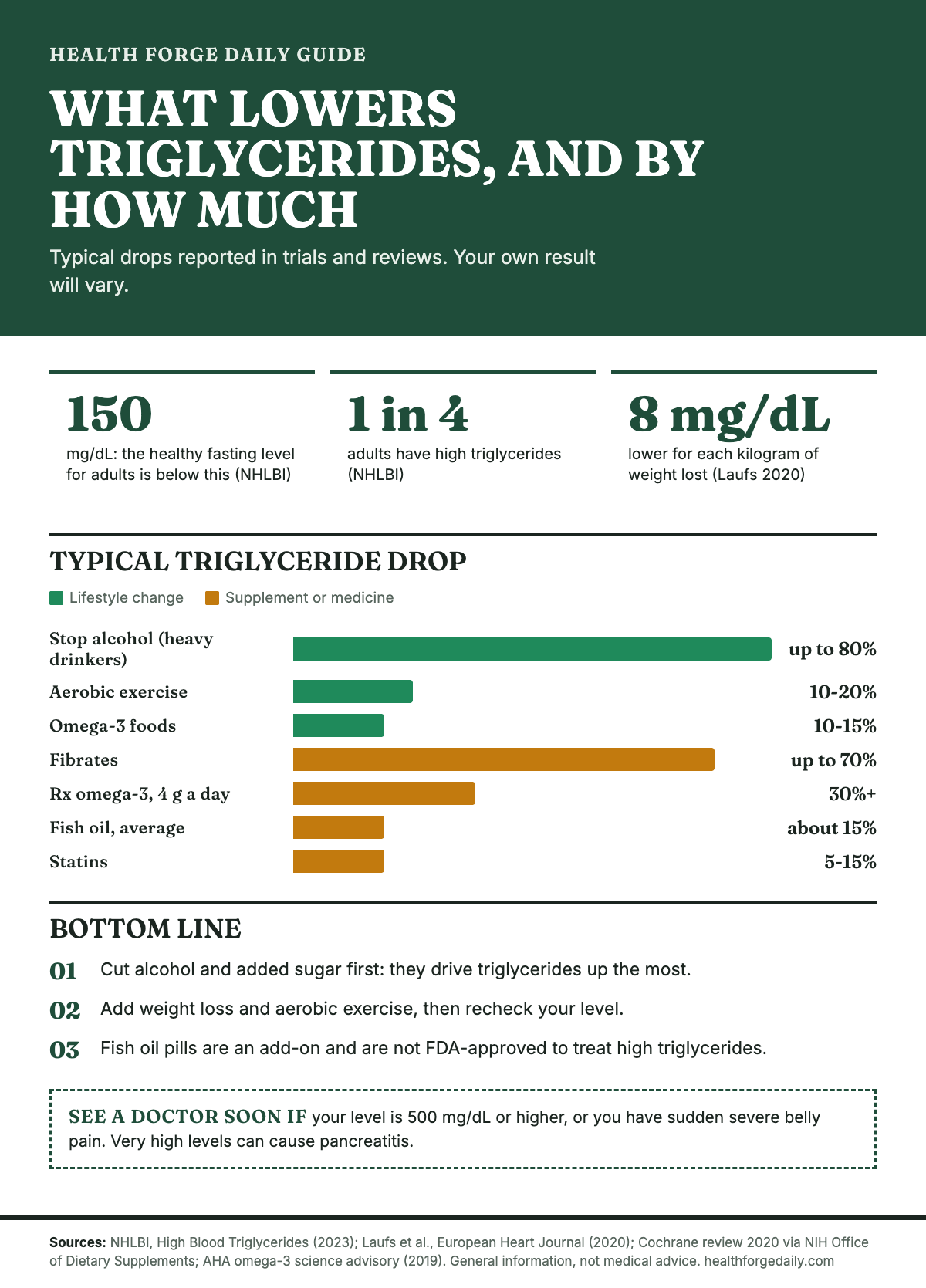
Lifestyle changes can lower triglycerides by about 10% to 20% for exercise, and by up to 80% when a heavy drinker stops alcohol. These estimates come from a table of effect sizes in the 2020 European Heart Journal review, which pulled the numbers from published trials [3]. Results vary a lot from person to person.
| Change | Typical drop | Who sees the most | Source |
|---|---|---|---|
| Stopping alcohol | Up to 80% | People with high triglycerides and heavy intake | Laufs 2020 [3] |
| Weight loss | About 8 mg/dL per kg lost | People with overweight or obesity | Laufs 2020 [3] |
| Aerobic exercise | 10% to 20% | Inactive adults | Laufs 2020 [3] |
| Omega-3 foods (fish, flaxseed) | 10% to 15% | People who eat little fish | Laufs 2020 [3] |
| Long-chain omega-3 from food or pills | About 15% | 86 trials, 162,796 people | Cochrane 2020, via NIH [5] |
The same review puts the effect of statins and ezetimibe on triglycerides at a modest 5% to 15%. Fibrates and high-dose omega-3s reach 25% to 45% [3]. So for a level in the borderline or high range, the lifestyle steps above can match a drug.
A person who loses 5 kg (11 pounds) could expect a drop of about 40 mg/dL, based on the 8 mg/dL per kg estimate [3]. For someone at 210 mg/dL, that is the difference between high and borderline. Insulin resistance and diabetes also raise triglycerides, so the work overlaps with lowering your A1C in prediabetes [3].
What foods lower triglycerides?
Oily fish, fiber-rich whole foods and unsaturated oils are the foods most linked to lower triglycerides. The 2020 review advises swapping saturated fat (fatty or processed meat, butter, cream, tropical oils, sweets) for vegetables, whole grains, fish, extra virgin olive oil and nontropical vegetable oils [3]. Reducing total calories matters most of all [3].
Fish is the richest source of EPA and DHA, the omega-3 fats tied to lower triglycerides. NIH data show how much a 3-ounce cooked serving gives [5]:
| Fish | DHA (g) | EPA (g) |
|---|---|---|
| Salmon, Atlantic, farmed | 1.24 | 0.59 |
| Herring, Atlantic | 0.94 | 0.77 |
| Sardines, canned in tomato sauce | 0.74 | 0.45 |
| Mackerel, Atlantic | 0.59 | 0.43 |
| Trout, rainbow, wild | 0.44 | 0.40 |
| Tuna, light, canned in water | 0.17 | 0.02 |
A pooled analysis of 58 trials found that each extra gram a day of long-chain omega-3 lowered triglycerides by 5.9 mg/dL, with a bigger drop in people who started higher [5]. Two servings of salmon a week will not match a prescription dose, but it helps alongside the other steps.
Plant foods help in a different way. Fiber-rich, low glycemic index foods such as beans, oats, vegetables and whole grains raise triglycerides far less than white bread or sweets [3]. Flaxseed adds plant omega-3 [3].
What foods should you avoid with high triglycerides?
The foods to avoid with high triglycerides are alcohol, added sugar, sweet drinks and refined starches made with white flour. MedlinePlus names foods high in fat and sugar, and simple carbohydrates like white flour, among the common causes [2]. The European review adds that sucrose and fructose raise triglycerides much more than fiber-rich foods do [3].
Foods that raise triglycerides most:
- Beer, wine and spirits, especially more than 2 drinks a day for men or 1 for women [3]
- Soda, sweet tea, juice drinks and desserts made with sugar or fructose [3]
- White bread, white pasta, pastries and other white flour foods [2]
- Butter, cream, fatty or processed meat and tropical oils [3]
- Any food with trans fats [3]
- Large portions that add up to more calories than you burn [1][3]
One US standard drink holds about 14 grams of pure alcohol: a 12-ounce beer at 5%, a 5-ounce glass of wine at 12%, or a 1.5-ounce shot of 40% spirits [9]. A 12-ounce craft beer at 10% counts as two [9]. If your level is very high, NHLBI says your provider may tell you to stop drinking entirely [1].
Do fish oil supplements lower triglycerides?
Fish oil supplements lower triglycerides by about 15% on average, but they are not FDA-approved to treat high triglycerides. A 2020 Cochrane review of 86 trials with 162,796 people found that long-chain omega-3s cut triglycerides by about 15% [5]. NCCIH reports a similar 15% drop from a separate 2020 review of 23 studies [6].
Prescription omega-3 drugs are made differently and come at higher doses [1]. The American Heart Association’s 2019 advisory found that 4 grams a day of prescription EPA plus DHA lowered very high triglycerides by 30% or more [4]. It called 4 grams a day a safe and effective option on its own or with a statin [4].
Two big trials disagreed on whether a lower level leads to fewer heart attacks:
| Trial | Who and how many | Dose and length | Result |
|---|---|---|---|
| REDUCE-IT, NEJM 2019 | 8,179 statin users with high triglycerides | 2 g icosapent ethyl (EPA) twice daily, median 4.9 years | Heart events 17.2% vs 22.0% on placebo; drug-maker funded [7] |
| STRENGTH, JAMA 2020 | 13,078 statin users at high heart risk | 4 g EPA plus DHA daily vs corn oil | No difference: 12.0% vs 12.2%; stopped early [8] |
Both trials used prescription products, not store-bought capsules. A drugstore supplement is a reasonable add-on to discuss with your doctor, and our review of fish oil for heart health covers label doses in more detail. A supplement should not replace the steps above or a prescribed medicine [1][6].
Who should be careful, and when should you see a doctor?
See a doctor if your triglycerides are 500 mg/dL or higher, or if you have sudden severe belly pain, because very high levels can cause acute pancreatitis. NHLBI lists pancreatitis, changes in the eye’s blood vessels and skin damage as possible effects of very high levels [1].
Several health problems and medicines can raise triglycerides, so ask your provider to check for them:
- Diabetes, kidney disease, liver disease, thyroid disease and obesity [1]
- Diuretics (water pills) and some medicines for breast cancer and HIV [1][2]
- Corticosteroids, oral estrogen, tamoxifen and some beta-blockers [3]
- Bile acid sequestrants such as colesevelam, a cholesterol drug group; tell your doctor about high triglycerides before starting one [3][10]
- Pregnancy, especially the third trimester [3]
People of South Asian ancestry living in the US, people with HIV and people with inherited lipid disorders have a higher risk [1]. Genetic testing may be suggested if you had pancreatitis or very high levels without diabetes or obesity [1].
For high-dose fish oil, the 4 gram daily dose in large trials slightly raised the risk of atrial fibrillation [5]. In REDUCE-IT, 3.1% were hospitalized for it versus 2.1% on placebo [7]. STRENGTH saw more stomach side effects, 24.7% versus 14.7% [8]. Fish oil may also lengthen clotting time in people taking warfarin [5].
Do not stop a prescribed medicine to try lifestyle changes alone. Talk to your provider first.
What do doctors use first for high triglycerides?
Doctors start with heart-healthy lifestyle changes and add medicine when levels stay high or heart risk is high. NHLBI lists heart-healthy eating, regular activity, a healthy weight, stress control, quitting smoking, good sleep and limiting alcohol as the first steps [1]. The European review agrees that lifestyle comes first [3].
When medicine is needed, NHLBI lists these options [1]:
- Fibrates, which can lower triglycerides by up to 70%, though the response varies widely [3]
- Prescription omega-3s for levels of 150 mg/dL or above [1]
- Statins, mainly for cholesterol, with a modest 5% to 15% triglyceride drop [3]
- Ezetimibe, paired with a healthy diet [1]
LDL cholesterol stays the main treatment target in heart guidelines, so a statin is often the first drug even when triglycerides are the number that caught your eye [3]. Very high levels may need more than one medicine [1].
A quick checklist before your next lipid test
- Ask whether you should fast, and for how many hours [1]
- Count your drinks for a week using the standard drink sizes [9]
- Read labels for added sugars and white flour, and swap one sweet drink a day for water [2][3]
- Plan two fish meals a week from the table above [5]
- Write down every medicine and supplement you take for your provider [1][10]
- If you buy fish oil, check the EPA and DHA per serving on the label, not just the total fish oil
Bottom line
For most people with borderline or high triglycerides, the better first step is cutting alcohol and sugar, because those changes act on the main drivers and cost nothing [3]. Add weight loss and aerobic exercise, and recheck your level with your provider [1].
Fish oil capsules can shave off about 15% [5], and they work best as an add-on to those changes. If your level is 500 mg/dL or higher, see a doctor soon, since medicine is often needed [1]. More guides like this live in our cholesterol and heart health section.
Sources
- High Blood Triglycerides. National Heart, Lung, and Blood Institute, NIH, 2023
- Triglycerides Test. MedlinePlus, National Library of Medicine
- Clinical review on triglycerides. Laufs U et al., European Heart Journal, 2020
- Omega-3 Fatty Acids for the Management of Hypertriglyceridemia: A Science Advisory From the American Heart Association. Skulas-Ray AC et al., Circulation, 2019
- Omega-3 Fatty Acids: Fact Sheet for Health Professionals. NIH Office of Dietary Supplements
- Omega-3 Supplements: What You Need To Know. National Center for Complementary and Integrative Health
- Cardiovascular Risk Reduction with Icosapent Ethyl for Hypertriglyceridemia (REDUCE-IT). Bhatt DL et al., New England Journal of Medicine, 2019
- Effect of High-Dose Omega-3 Fatty Acids vs Corn Oil on Major Adverse Cardiovascular Events (STRENGTH). Nicholls SJ et al., JAMA, 2020
- What Is a Standard Drink?. National Institute on Alcohol Abuse and Alcoholism
- Colesevelam. MedlinePlus Drug Information, National Library of Medicine
Frequently asked questions
What is a dangerous triglyceride level?
Levels of 500 mg/dL and above are called very high and raise the risk of acute pancreatitis. Above 1,500 mg/dL, the body can stop breaking down fats properly, a condition called multifactorial chylomicronemia syndrome. Both need prompt medical care.
Can you have high triglycerides at a normal weight?
Yes. Genes, alcohol, diabetes, thyroid or kidney disease and some medicines can raise triglycerides in people of any size. NHLBI also notes a higher risk in people of South Asian ancestry living in the US and in people with HIV.
Do you need to fast before a triglycerides test?
Often, yes. Your provider may ask you not to eat for several hours before the blood draw, because a recent meal raises triglycerides. Some labs test without fasting, and nonfasting levels that stay above 175 mg/dL still matter for heart risk.
How fast can you lower triglycerides?
There is no proven overnight fix. Triglycerides respond to changes in alcohol, sugar, weight and activity, but the research gives no single timeline and results vary. Ask your provider when to repeat the test after you change your habits.
Are triglycerides the same as cholesterol?
No. Triglycerides are a type of fat used for energy, while cholesterol is a waxy substance found in all cells. A lipid panel measures both. Heart guidelines still treat LDL cholesterol as the main target, with triglycerides as a second marker.

Grace Whitaker is the health editor at Health Forge Daily. She reads supplement labels line by line, checks each ingredient and dose against published research, and tracks refund policies and customer complaints before a product gets a verdict. She is not a doctor, so every review points readers back to their own physician for medical decisions.
This article is for general information and is not medical advice. Supplements are not evaluated by the FDA and are not intended to diagnose, treat, cure or prevent any disease. Check with your doctor before you start any supplement.