Prediabetes means an A1C of 5.7% to 6.4%, a fasting glucose of 100 to 125 mg/dL or a 2-hour glucose test of 140 to 199 mg/dL. It usually causes no symptoms, and 8 in 10 people with it do not know. In the Diabetes Prevention Program, aiming for 7% weight loss and 150 minutes of weekly activity cut diabetes rates by 58%.
Prediabetes is common, silent and, for many people, reversible. We read the American Diabetes Association (ADA) 2026 Standards of Care, the CDC and NIH pages on prediabetes, and the Diabetes Prevention Program (DPP) trial with its long-term follow-up before writing this.
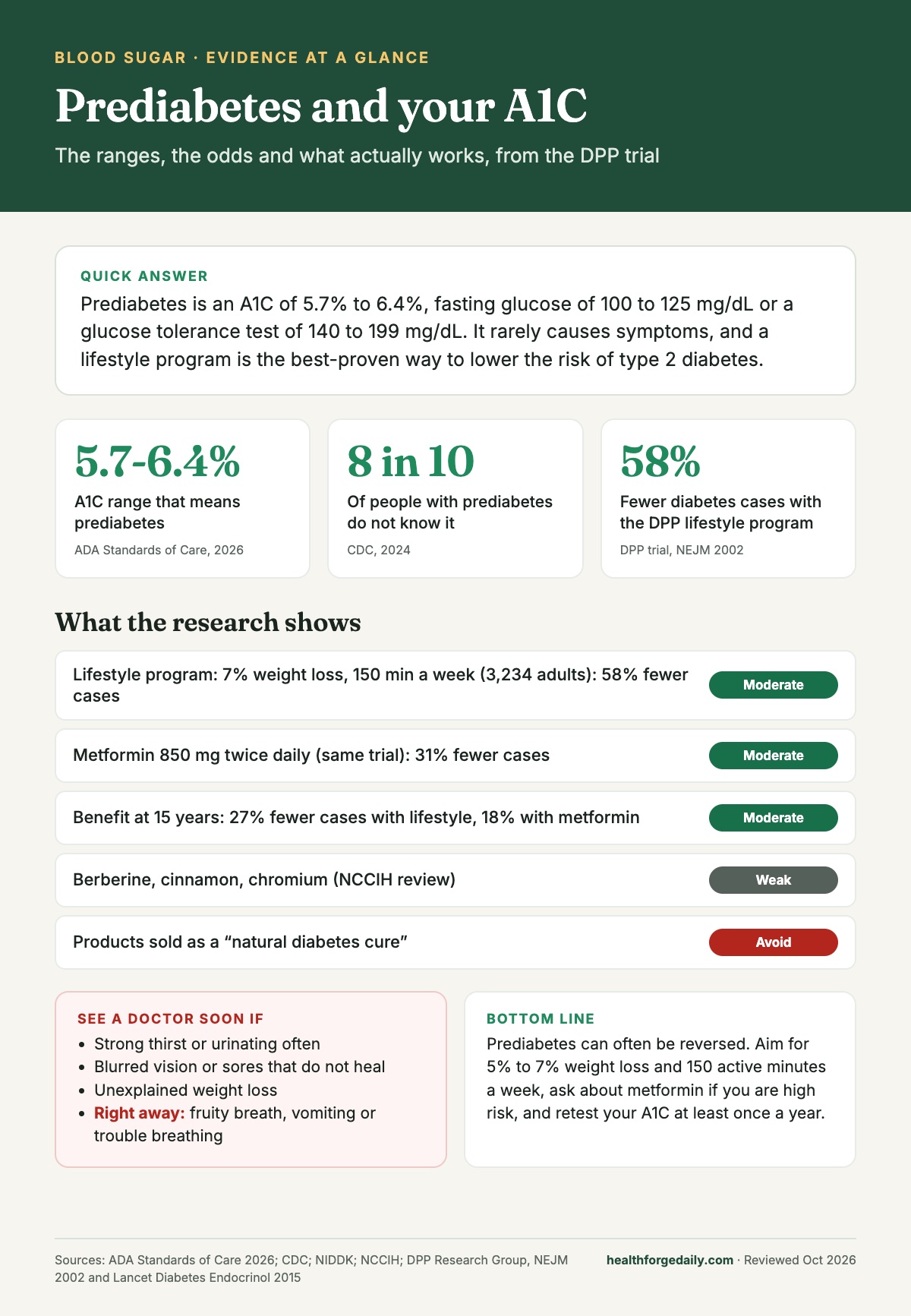
Prediabetes means an A1C of 5.7% to 6.4%, a fasting glucose of 100 to 125 mg/dL, or a 2-hour glucose tolerance result of 140 to 199 mg/dL. In the DPP, a structured lifestyle program cut the rate of type 2 diabetes by 58% and the drug metformin cut it by 31%.[11][13]
| What it is | Blood sugar higher than normal but not high enough for a type 2 diabetes diagnosis[6] |
|---|---|
| A1C range | 5.7% to 6.4%; 6.5% or higher is the diabetes range[4][11] |
| Fasting glucose | 100 to 125 mg/dL[11] |
| 2-hour glucose test (OGTT) | 140 to 199 mg/dL[11] |
| How common | 115.2 million US adults; 8 in 10 people with it do not know[2][3] |
| Symptoms | Usually none[6][10] |
| Best evidence | DPP lifestyle program: 58% lower rate of type 2 diabetes[13] |
| Retest | At least once a year[11][12] |
What is prediabetes?
Prediabetes means your blood sugar is higher than normal but not high enough to be called type 2 diabetes. It usually starts with insulin resistance: cells in your muscles, fat and liver stop responding well to insulin, the hormone that moves sugar out of the blood.[6]
Your pancreas makes extra insulin to compensate until it cannot keep up.[1][6] Prediabetes raises the risk of type 2 diabetes, heart disease and stroke, and is linked to fatty liver disease and unhealthy cholesterol.[1][6] CDC says prediabetes can often be reversed.[2]
What A1C range means prediabetes?
An A1C of 5.7% to 6.4% is prediabetes. Below 5.7% is normal, and 6.5% or higher is in the diabetes range. The A1C test measures how much sugar is stuck to hemoglobin in your red blood cells, which reflects your average blood sugar over the past 3 months. You do not need to fast for it.[4]
| Test | Prediabetes | Diabetes |
|---|---|---|
| A1C | 5.7% to 6.4% | 6.5% or higher[4][11] |
| Fasting plasma glucose (after 8 hours without food) | 100 to 125 mg/dL | 126 mg/dL or higher[7][11] |
| 2-hour glucose after a 75 g sugar drink (OGTT) | 140 to 199 mg/dL | 200 mg/dL or higher[11] |
For a sense of scale, an A1C of 6% matches an estimated average glucose of about 126 mg/dL.[4] The ADA notes that risk is continuous: it rises below the cutoff and climbs faster toward the top of each range.[11]
Some conditions make A1C read falsely high or low, including severe anemia, kidney failure, liver disease, sickle cell trait or thalassemia, recent blood loss or transfusion, and early or late pregnancy.[4] If your A1C and glucose results do not match, your doctor may rely on a different test.[7]
How many Americans have prediabetes, and how many know?
About 115.2 million US adults have prediabetes, and most of them do not know it. That figure comes from the CDC’s National Diabetes Statistics Report, updated in September 2026. Among people aged 65 and older, 31.3 million, or 52.1%, have it.[3]
CDC puts it another way: more than 2 in 5 US adults have prediabetes, and 8 in 10 of them do not know they have it.[2]
CDC warns that without action, many people with prediabetes could develop type 2 diabetes within 5 years.[2] NIDDK describes a high chance of type 2 diabetes within 5 to 10 years.[6]
What are the symptoms of prediabetes?
Usually there are none. NIDDK and MedlinePlus both say most people with prediabetes have no symptoms, which is why so many go undiagnosed.[6][10] CDC notes that you can have prediabetes for years without clear signs.[1]
The skin can give a visible clue. MedlinePlus says some people with prediabetes have darkened skin in the armpit or on the back and sides of the neck, sometimes with many small skin growths in the same areas.[10]
Strong thirst, urinating often or blurred vision are symptoms of diabetes, not prediabetes, and need a test soon.[8]
Who is at risk for prediabetes?
The main risk factors are weight, age, family history and inactivity. CDC and NIDDK list these risk factors:[1][5][6]
- Overweight, obesity or a large waist
- Age 45 or older (CDC) or 35 or older (NIDDK)
- A parent, brother or sister with type 2 diabetes
- Being physically active less than 3 times a week
- Gestational diabetes, or giving birth to a baby over 9 pounds
- Polycystic ovary syndrome (PCOS), fatty liver disease or sleep apnea
- Smoking, including e-cigarettes
- Long-term use of glucocorticoids, some antipsychotics or some HIV medicines
- Being African American, Hispanic or Latino, American Indian, Alaska Native, Pacific Islander or Asian American
Sleep counts too. The ADA notes that sleeping less than 6 hours or more than 9 hours is linked to up to a 50% higher risk of type 2 diabetes.[12] If PCOS applies to you, see our guide to inositol for PCOS.
Does prediabetes always turn into diabetes?
No. Many people do progress, but not everyone, and the odds depend on your numbers and age. NIDDK says not everyone with prediabetes develops type 2 diabetes.[6]
In the DPP, which enrolled high-risk adults with overweight and raised glucose, 29% of the placebo group developed diabetes within 3 years.[12] The ADA flags higher risk with a BMI of 35 or more, fasting glucose of 110 to 125 mg/dL, an A1C of 6.0% or higher, or past gestational diabetes.[12]
Older adults differ. In a community study with a mean age of 75, only 9% with A1C-defined prediabetes and 8% with high fasting glucose developed diabetes over 6 years.[12]
What did the Diabetes Prevention Program show?
It showed that a lifestyle program beat both placebo and metformin at preventing or delaying type 2 diabetes. The DPP randomly assigned 3,234 adults with raised glucose to placebo, metformin 850 mg twice a day, or an intensive lifestyle program. Their average age was 51 and average BMI was 34.0.[13]
The lifestyle goals were at least 7% weight loss and at least 150 minutes of physical activity a week.[13] Study staff met with each participant at least 16 times in the first 24 weeks.[9]
Over an average of 2.8 years, new diabetes cases ran at 11.0 per 100 person-years with placebo, 7.8 with metformin and 4.8 with the lifestyle program. That is a 58% reduction with lifestyle and 31% with metformin.[13] The lifestyle program cut risk by 71% in people aged 60 and older.[9]
About 7 people needed the lifestyle program, and about 14 needed metformin, to prevent one case over 3 years.[13]
| Study | Who and how long | Lifestyle result | Metformin result |
|---|---|---|---|
| DPP trial, 2002[13] | 3,234 adults, 2.8 years | 58% fewer cases | 31% fewer cases |
| DPPOS 10-year, 2009[14] | 2,766 adults, 10 years | 34% fewer cases | 18% fewer cases |
| DPPOS 15-year, 2015[15] | 2,776 adults, 15 years | 27% fewer cases | 18% fewer cases |
| DPPOS 21-year, cited by ADA 2026[12] | Same cohort, 21 years | 24% fewer cases; 3.5 more years diabetes-free | 2.5 more years diabetes-free |
| Weight analysis, 2006[16] | 1,079 lifestyle participants, 3.2 years | 16% lower risk per kg lost | Not studied |
| Time point | Lifestyle program | Metformin |
|---|---|---|
| About 3 years (DPP trial) | 58% | 31% |
| 10 years after joining | 34% | 18% |
| 15 years after joining | 27% | 18% |
Does the benefit last after the program ends?
Yes, though it shrinks over time. After the trial, every group was offered a group lifestyle program, so the placebo group caught up somewhat.[14]
At 10 years, diabetes rates were still 34% lower in the original lifestyle group and 18% lower in the metformin group than with placebo.[14] NIDDK says that meant diabetes developed about 4 years later with lifestyle and about 2 years later with metformin.[9]
At 15 years the reductions were 27% and 18%. Cumulative diabetes rates were 55% in the lifestyle group, 56% with metformin and 62% with placebo.[15]
At 21 years, the ADA reports a 24% lower rate with lifestyle, and a gain in median diabetes-free time of 3.5 years with lifestyle and 2.5 years with metformin. Major heart events did not differ between groups, possibly because many participants later took statins and blood pressure drugs.[12] Those years without diabetes still count: people who did not develop diabetes had 28% fewer small blood vessel complications at 15 years.[15]
How much weight do you need to lose to lower your A1C?
Aim for 5% to 7% of your body weight if you have overweight. That is the ADA target for people at high risk, and for a 200-pound person it works out to about 10 to 14 pounds.[1][12]
Weight loss was the strongest driver of the DPP result. In an analysis of 1,079 lifestyle participants, each kilogram lost (about 2.2 pounds) cut diabetes risk by 16%, after accounting for diet and activity changes.[16]
The sources give no specific A1C drop for a given amount of weight loss, but in the DPP, losing more weight brought more benefit.[12]
NIDDK lists weight-loss medicines and surgery as options to discuss with your care team.[6] We review the supplement side of weight loss in do weight loss supplements work.
How much exercise helps lower prediabetes numbers?
At least 150 minutes a week of moderate activity, such as brisk walking. That is the ADA and CDC target. Split evenly, it is 30 minutes a day, 5 days a week.[1][12]
Activity helps even when weight loss is small. Among 495 DPP lifestyle participants who missed the weight goal after a year, those who met the activity goal had 44% lower diabetes incidence.[16]
Strength training counts. In the DPP, up to 75 minutes of strength work could go toward the 150-minute weekly goal.[12]
What should you eat if you have prediabetes?
The ADA recommends an evidence-based eating pattern, naming Mediterranean and low-carbohydrate styles as examples. In the DPP, the plan was a reduced-calorie diet with less fat, tailored to each person.[9][12]
A registered dietitian can help: the ADA says dietitian counseling has helped people with prediabetes reach 7% to 10% weight loss.[12]
For practical ideas, see our guides to high-fiber foods, psyllium husk and the anti-inflammatory diet, which overlaps heavily with the Mediterranean pattern.
What is the CDC National Diabetes Prevention Program?
It is a yearlong lifestyle change program based on the DPP, led by a trained lifestyle coach and offered in person or online. It is designed for people who have prediabetes or are at risk for type 2 diabetes.[20]
The DPP model starts with a 16-session core course in the first 6 months, covering calories, activity, self-monitoring and motivation, followed by 6 months of maintenance.[12] CDC says the program can lower your risk of type 2 diabetes by 58%, or 71% if you are over 60.[1]
To join, you generally need a BMI in the overweight range plus a prediabetes blood test, past gestational diabetes or a positive CDC risk test.[12] Medicare covers the program for people with a BMI over 25 (over 23 for people who identify as Asian) and a prediabetes-range test in the past year.[12] Ask your doctor or use CDC’s program finder.[1]
Should you take metformin for prediabetes?
For some high-risk adults, yes, as an add-on to lifestyle changes. Talk to your doctor. The ADA says metformin should be considered for adults at high risk, especially those aged 25 to 59 with a BMI of 35 or more, fasting glucose of 110 mg/dL or higher, an A1C of 6.0% or higher, or past gestational diabetes.[12]
Metformin has the strongest data of any drug for diabetes prevention; the ADA says no other drug has long-term data for that sole purpose. It was less effective than lifestyle change overall in the DPP. It matched lifestyle in people with a BMI of 35 or more and in those aged 25 to 44. In women with past gestational diabetes, both cut risk by about 50%.[12]
Common side effects include diarrhea, nausea, stomach discomfort and gas. Rarely, metformin causes a serious condition called lactic acidosis.[18] Long-term use can lower vitamin B12, so the ADA suggests periodic B12 checks, especially at 1,500 mg a day or more or after 4 to 5 years.[12]
Can supplements lower A1C in prediabetes?
Not reliably. NCCIH rates the evidence for berberine, cinnamon and chromium as weak evidence of a possible benefit. The berberine research, for example, comes from a 2021 review of 46 studies with 4,158 participants, mostly in Chinese patients with type 2 diabetes, and some studies were of poor quality.[19] We cover it in detail in berberine for blood sugar.
Vitamin D was tested in three trials of high-risk prediabetes with 511, 2,423 and 1,256 participants, 4,190 people in all. Each showed a small trend toward fewer diabetes cases, but none was statistically significant, and the ADA does not recommend widespread vitamin D for this purpose.[12] More in our vitamin D guide.
Be wary of any product sold as a fix. The FDA has warned about products claiming to be a “natural diabetes cure” or to “replace your diabetes medicine.”[19]
How often should you retest your A1C?
At least once a year if you have prediabetes. The ADA and NIDDK both advise yearly testing for type 2 diabetes once prediabetes is found.[6][11][12] CDC says your doctor will likely repeat your A1C every 1 to 2 years.[4]
- Result close to the diabetes cutoff: the ADA suggests repeating the test in 3 to 6 months.[11]
- Normal result with risk factors: retest at least every 3 years.[7][11]
- Past gestational diabetes: test at least every 1 to 3 years.[11]
- Everyone else: the ADA says testing should start at age 35. The USPSTF recommends screening adults aged 35 to 70 who have overweight or obesity.[11][17]
A1C reflects about 3 months of blood sugar, so earlier retests miss the full effect of changes.[4] Home glucose meters cannot diagnose diabetes, and the ADA says there is not enough evidence to use continuous glucose monitors for diagnosis.[7][11]
When does prediabetes become diabetes, and when should you see a doctor?
A repeat A1C of 6.5% or more, fasting glucose of 126 mg/dL or more, or a 2-hour value of 200 mg/dL or more points to diabetes. With classic symptoms, a random glucose of 200 mg/dL or more can be enough.[11] See your doctor soon if you notice:[8][11]
- Urinating more often or feeling very thirsty
- Feeling very hungry, even after eating
- Blurred vision or unusual tiredness
- Sores that do not heal, or frequent urinary, skin or yeast infections
- Pain, numbness or tingling in your feet or hands (see alpha-lipoic acid for neuropathy)
- Weight loss you cannot explain
Get care right away for signs of diabetic ketoacidosis (DKA), which NIDDK calls a medical emergency: trouble breathing, fruity-smelling breath, belly pain with nausea or vomiting, extreme tiredness or fainting.[8]
Your prediabetes action checklist
- Write down your numbers: A1C, fasting glucose or OGTT result, and the date.[11]
- Ask about a CDC-recognized lifestyle program, in person or online.[1][20]
- Set a weight goal of 5% to 7% if you have overweight.[12]
- Build to 150 minutes of brisk activity a week; strength work can count toward it.[12]
- Pick an eating pattern you can keep, such as Mediterranean or lower carbohydrate.[12]
- Ask whether metformin fits you if your BMI is 35 or higher, your A1C is 6.0% or higher, or you had gestational diabetes.[12]
- Book your retest for no later than 12 months from now.[12]
- If you try a supplement, tell your doctor, skip any product promising a cure, and check the label using our label guide.[19]
Our verdict: can you reverse prediabetes?
Often, yes. The best-tested tool is a structured lifestyle program: one aimed at 5% to 7% weight loss and 150 minutes of weekly activity cut diabetes rates by 58% in the DPP, and the benefit was still visible 21 years later. Metformin is a reasonable add-on for higher-risk adults.[12][13]
Prediabetes rarely announces itself, so the most important step is getting tested and retesting every year. Supplements have weak evidence and are no substitute for the steps above. See how we review and more in prediabetes and diabetes and blood sugar.
Sources
- Prediabetes: Your Chance to Prevent Type 2 Diabetes. Centers for Disease Control and Prevention, December 2024.
- About Prediabetes and Type 2 Diabetes. Centers for Disease Control and Prevention, May 2024.
- National Diabetes Statistics Report. Centers for Disease Control and Prevention, updated September 2026.
- A1C Test for Diabetes and Prediabetes. Centers for Disease Control and Prevention, May 2024.
- Diabetes Risk Factors. Centers for Disease Control and Prevention, May 2024.
- Insulin Resistance and Prediabetes. NIDDK, National Institutes of Health, reviewed March 2025.
- Diabetes Tests and Diagnosis. NIDDK, National Institutes of Health, reviewed July 2022.
- Symptoms and Causes of Diabetes. NIDDK, National Institutes of Health, reviewed October 2024.
- Diabetes Prevention Program (DPP). NIDDK, National Institutes of Health, reviewed August 2021.
- Prediabetes. MedlinePlus, National Library of Medicine.
- 2. Diagnosis and Classification of Diabetes: Standards of Care in Diabetes 2026. American Diabetes Association Professional Practice Committee, Diabetes Care, 2026.
- 3. Prevention or Delay of Diabetes and Associated Comorbidities: Standards of Care in Diabetes 2026. American Diabetes Association Professional Practice Committee, Diabetes Care, 2026.
- Reduction in the incidence of type 2 diabetes with lifestyle intervention or metformin. Diabetes Prevention Program Research Group, New England Journal of Medicine, 2002.
- 10-year follow-up of diabetes incidence and weight loss in the Diabetes Prevention Program Outcomes Study. Diabetes Prevention Program Research Group, Lancet, 2009.
- Long-term effects of lifestyle intervention or metformin on diabetes development and microvascular complications over 15-year follow-up. Diabetes Prevention Program Research Group, Lancet Diabetes and Endocrinology, 2015.
- Effect of weight loss with lifestyle intervention on risk of diabetes. Hamman RF et al., Diabetes Care, 2006.
- Screening for Prediabetes and Type 2 Diabetes. US Preventive Services Task Force, August 2021.
- Metformin. MedlinePlus, National Library of Medicine.
- Diabetes and Dietary Supplements. NCCIH, National Institutes of Health, updated November 2023.
- Preventing Type 2 Diabetes with the Lifestyle Change Program. Centers for Disease Control and Prevention, May 2024.
Frequently asked questions
What A1C level is prediabetes?
An A1C of 5.7% to 6.4% is the prediabetes range used by the ADA and CDC. Below 5.7% is normal, and 6.5% or higher is in the diabetes range. A diagnosis usually needs a repeat test unless you have clear symptoms of high blood sugar.
Can prediabetes be reversed?
Often, yes. CDC says prediabetes can often be reversed. In the Diabetes Prevention Program, a lifestyle program aiming for 7% weight loss and 150 minutes of weekly activity lowered the rate of type 2 diabetes by 58% over about 3 years.
How fast can I lower my A1C?
A1C reflects your average blood sugar over about 3 months, so changes take that long to show fully. There is no guaranteed drop. The ADA advises yearly testing for people with prediabetes, and a retest in 3 to 6 months if you are close to the diabetes cutoff.
Does prediabetes cause symptoms?
Usually not. NIDDK and MedlinePlus say most people have no symptoms, which is why 8 in 10 do not know they have it. Some notice darkened skin on the neck or armpits. Strong thirst, frequent urination or blurred vision suggest diabetes and need a test.
Is metformin used for prediabetes?
Sometimes. The ADA says metformin should be considered for high-risk adults, especially those aged 25 to 59 with a BMI of 35 or more, higher glucose or A1C, or past gestational diabetes. In the DPP it lowered diabetes rates by 31%, less than lifestyle change.
Can supplements like berberine lower A1C in prediabetes?
The evidence is weak. NCCIH rates berberine, cinnamon and chromium as weak evidence of a possible benefit, mostly from studies in people who already had diabetes. No supplement has results close to the lifestyle program in the Diabetes Prevention Program.

Grace Whitaker is the health editor at Health Forge Daily. She reads supplement labels line by line, checks each ingredient and dose against published research, and tracks refund policies and customer complaints before a product gets a verdict. She is not a doctor, so every review points readers back to their own physician for medical decisions.
This article is for general information and is not medical advice. Supplements are not evaluated by the FDA and are not intended to diagnose, treat, cure or prevent any disease. Check with your doctor before you start any supplement.