The most reliable way to lower cholesterol naturally is to combine several changes: cut saturated fat, eat about 3 g of oat beta-glucan a day, add a handful of tree nuts, use plant sterol foods and lose 3% to 5% of your weight if needed. Combined diets lowered LDL by about 17% in trials. A low-dose statin lowers it about twice as much.
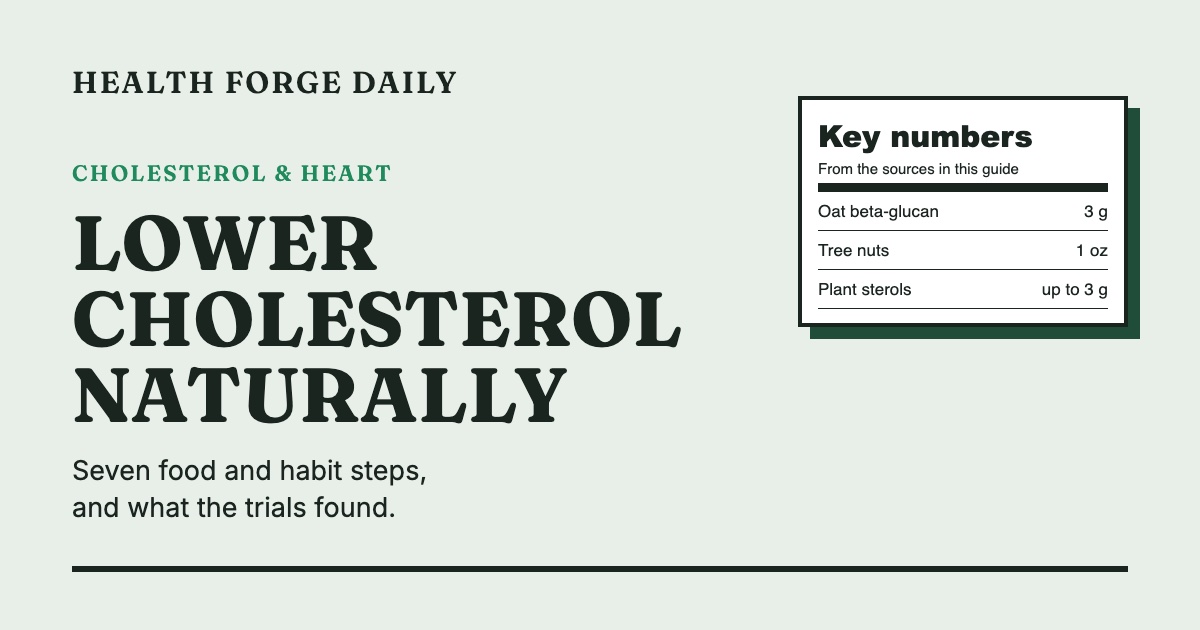
This guide explains how to lower cholesterol naturally, using the methods that have trial data behind them. We read the MedlinePlus and NHLBI guidance, the NCCIH review of natural products and nine studies and reviews, including a Cochrane review and a head-to-head diet versus statin trial.
The short answer: stack several food changes at once. In 7 controlled trials, a combined plant-based eating pattern cut LDL by about 17% [9], which is far more than any single food or pill on its own.
| Main target | LDL (“bad”) cholesterol. Most adults should aim for under 100 mg/dL [2]. |
|---|---|
| First-line care | Heart-healthy eating, weight control and physical activity, with medicine if those are not enough [1] |
| Biggest single diet change | Cutting saturated fat, which lowered combined heart events by 21% in long trials [8] |
| Foods with the best data | Oats (3 g beta-glucan a day), tree nuts, plant sterols, soy foods [5][6][7][4] |
| Realistic drop | About 17% with a combined diet, versus about 35% with a low-dose statin [9][12] |
| Safety | Food changes are low risk. Red yeast rice can act like a prescription statin [4]. |
| Who needs a doctor first | Adults 30 or older with LDL of 160 mg/dL or higher, or a strong family history [2] |

How to lower cholesterol naturally, step by step?
The natural way to lower LDL cholesterol is to cut saturated fat, add foods that block cholesterol absorption, and lose a little weight if you carry extra. MedlinePlus lists heart-healthy eating, a healthy weight, regular activity, less stress, no smoking and 7 to 9 hours of sleep as the core changes [1]. The order below puts the biggest effects first.
- Get a baseline lipid panel. You need your LDL, HDL, non-HDL and triglycerides before you change anything, so you can tell what worked [2].
- Swap saturated fat out. Trade fatty meat, butter, full-fat dairy and fried food for fish, beans, nuts and vegetable oils [2][8].
- Add 3 g of oat beta-glucan a day. That is roughly what oat-based health claims are built on, and it lowered LDL in 28 trials [5].
- Eat a handful of tree nuts daily. Each 1-ounce serving lowered LDL by 4.8 mg/dL in pooled trials [6].
- Use plant sterol foods with meals. Intakes of 0.6 to 3.3 g a day lowered LDL by 6% to 12% [7].
- Lose 3% to 5% of your weight if you are overweight. NHLBI says even that much can lower LDL and raise HDL [3].
- Move most days, sleep 7 to 9 hours, skip cigarettes and limit alcohol. These help HDL, triglycerides and overall heart risk [1][3].
Retest after a few months to see what worked. Our review method page explains how we pick and grade the studies behind steps like these.
What foods lower LDL cholesterol the most?
The foods with the strongest trial data are oats and barley, tree nuts, soy foods and foods with added plant sterols. Each one lowers LDL by a modest amount on its own. The gains add up when you eat several of them together, which is the idea behind the Portfolio diet [9].
| Food | Daily amount studied | Average LDL effect | Strength of evidence |
|---|---|---|---|
| Oat beta-glucan | 3 g or more | Down 0.25 mmol/L (about 10 mg/dL) | 28 trials [5] |
| Tree nuts | 1 ounce (28 g) | Down 4.8 mg/dL per serving | 61 trials, 2,582 people [6] |
| Plant sterols or stanols | 0.6 to 3.3 g | Down 6% to 12% | 124 studies, industry-led [7] |
| Soy foods | In place of animal protein | Small drop | Foods work better than soy pills [4] |
Oats work through soluble fiber. In the 2014 meta-analysis, a larger dose did not give a larger effect within the 3 to 12.4 g range tested, and people who started with higher LDL saw bigger drops [5]. If oats are hard to fit in, our guide to psyllium husk for cholesterol covers another soluble fiber, and our list of high fiber foods for every meal shows easy ways to reach your daily target.
For nuts, the type did not matter much. The dose did, with stronger effects at 60 g a day or more [6]. Keep portions in mind, since nuts are high in calories.
What should a low cholesterol diet cut first?
Saturated fat is the first thing to cut, because it raises blood cholesterol more than cholesterol in food does. MedlinePlus says saturated fat is the main problem, though dietary cholesterol also matters [2]. The high cholesterol foods to limit are red meat, full-fat dairy, some baked goods and many fried and processed foods [2].
The best long-term evidence comes from a 2020 Cochrane review of 15 randomized trials with about 59,000 people. Cutting saturated fat for at least two years lowered combined heart and stroke events by 21% [8]. The review found little or no change in overall deaths, and the effect was larger when people cut more [8].
What you eat in place of saturated fat matters too. The review found replacing it with polyunsaturated fat or with carbohydrate both looked useful [8]. In practice that means cooking with vegetable oils, choosing fish or beans over fatty cuts, and picking whole grains over sweets. NHLBI’s TLC and DASH plans follow the same pattern, with less salt and more fruit, vegetables and nuts [3].
How much can exercise and weight loss lower LDL?
Exercise on its own does less for LDL than diet does, but weight loss helps both LDL and HDL. A meta-analysis of 6 randomized trials in 788 adults found aerobic exercise alone mainly lowered triglycerides. Diet, or diet plus exercise, lowered total and LDL cholesterol more [11].
Exercise still helps. NHLBI notes that physical activity can lower LDL and triglycerides and raise HDL, and that resistance training lowered cholesterol in postmenopausal women [3]. Ask your provider what level of activity is safe for you before you start [1].
Weight is where many people get the most return. NHLBI says adults with overweight or obesity can improve LDL and HDL by losing only 3% to 5% of their weight [3]. MedlinePlus suggests at least 5%, which is 10 pounds for a 200-pound person [2].
Can you lower cholesterol without medication, and by how much?
Yes, diet alone lowered LDL by about 17% on average in pooled trials, but results vary and some people still need medicine. The biggest effects came from combining several cholesterol-lowering foods, not from any one change. Statins remain stronger and more predictable [9][10][12].
| Study | Who and how long | What was tested | LDL result |
|---|---|---|---|
| Jenkins, JAMA 2003 | 46 adults with high cholesterol, 1 month | Portfolio diet vs lovastatin 20 mg vs low saturated fat diet | Down 28.6% vs 30.9% vs 8.0% [10] |
| Chiavaroli, 2018 meta-analysis | 7 trial comparisons, 439 people | Portfolio diet on top of a low-fat diet | Down about 17%, high certainty [9] |
| Laffin, JACC 2023 | 190 adults at raised risk, 28 days | Rosuvastatin 5 mg vs placebo vs 6 supplements | Statin down 35.2% vs placebo; no supplement beat placebo [12] |
| Hooper, Cochrane 2020 | 15 trials, about 59,000 people, 2+ years | Less saturated fat | Small LDL drop; 21% fewer heart events [8] |
The 2003 trial was small and short, and people ate carefully planned meals. The pooled 17% figure from longer trials is a more realistic target for daily life [9]. MedlinePlus is clear that if lifestyle changes alone do not lower cholesterol enough, medicine may be needed, and lifestyle changes still continue alongside it [1].
Do supplements lower cholesterol?
A few supplements show small effects in some studies, but none matched a low-dose statin when tested head to head. In the 2023 SPORT trial, fish oil, cinnamon, garlic, turmeric, plant sterols and red yeast rice did not lower LDL more than placebo after 28 days [12]. That trial was funded by a statin maker, so it is worth reading alongside other reviews.
NCCIH’s summary gives a more mixed picture [4]:
- Plant sterol or stanol supplements taken with meals can reduce cholesterol, though food sources have more evidence.
- Garlic lowered total and LDL cholesterol by about 10% in people with mildly high levels who took it for more than 2 months.
- Green tea was linked to small drops of 2% to 5%.
- Whole flaxseed may help. Flaxseed oil does not.
- Soy foods help more than soy protein pills or isoflavones.
Red yeast rice is a special case. Products with more than trace monacolin K contain the same chemical as the drug lovastatin, and the FDA treats them as unapproved drugs [4]. Fish oil did not lower LDL in the SPORT trial [12]; see our review of fish oil and omega-3 trials for heart health before you buy it for LDL. If you do try a supplement, check the supplement label for the dose and form used in trials.
Is it safe to lower cholesterol naturally on your own?
Food changes are safe for most people, but supplements and some situations call for a doctor’s input first. Very high LDL can be inherited, and familial hypercholesterolemia often needs medicine or other treatment that diet cannot replace [1][3].
Things to watch for:
- Plant sterols can cause diarrhea or fat in the stool. People with sitosterolemia should avoid them [4].
- Garlic supplements may raise bleeding risk and can interfere with some drugs, including the HIV drug saquinavir [4].
- Concentrated green tea extract has been linked to rare liver problems, and green tea can lower levels of the beta-blocker nadolol [4].
- Red yeast rice can cause the same side effects and drug interactions as lovastatin, and some products contain citrinin, which may harm the kidneys [4].
- Flaxseed should be avoided in pregnancy and taken with plenty of water [4].
Never stop a prescribed cholesterol medicine to try a natural approach without talking to your doctor. MedlinePlus advises checking with your provider before you take any supplement [1].
What do doctors use first for high cholesterol?
Doctors start with lifestyle changes for everyone and add a statin when risk is high enough. Statins are the most common medicine for high cholesterol. They reduce the amount of cholesterol the liver makes and lower the risk of heart attack and stroke in people with high LDL [3].
MedlinePlus says you may need a statin if you are 30 or older with an LDL of 160 mg/dL or higher, or if you have a strong family history of heart disease [2]. LDL goals get stricter as risk rises: 70 mg/dL or below for people at high risk, and 55 mg/dL or below for some people who already have heart disease [2].
If statins cause side effects or do not lower LDL enough, other options include ezetimibe, bempedoic acid, bile acid sequestrants and injectable PCSK9 inhibitors [3]. Even on medicine, the diet changes above still matter [1].
Bottom line: how to lower cholesterol naturally and when to get help
The best results come from combining several food changes and retesting in a few months. Use this checklist to get started.
- Book a lipid panel and write down your LDL, HDL and triglycerides [2].
- Cut fatty meat, butter, full-fat dairy and fried food [2].
- Eat oats or barley daily to reach about 3 g of beta-glucan [5].
- Add a handful of tree nuts most days [6].
- Choose soy foods over soy pills [4].
- Read the label on any sterol product or supplement for the dose per serving.
- Aim to lose 3% to 5% of your weight if you are overweight [3].
- Sleep 7 to 9 hours and do not smoke [1].
Most people can expect a real but modest drop from diet alone, and the Portfolio trials suggest about 17% is a fair goal [9]. Some people reach their target that way. Others will still need medicine, with the diet changes kept up alongside it.
For most people, cutting saturated fat and adding oats and nuts is the better first step than buying a supplement, because the food evidence is larger and the safety record is cleaner [8][5][6]. If your LDL is 160 mg/dL or higher, or heart disease runs in your family, see a doctor before you rely on diet alone [2]. More guides like this live in our cholesterol and heart health section.
Sources
- How to Lower Cholesterol. MedlinePlus, National Library of Medicine
- Cholesterol Levels: What You Need to Know. MedlinePlus, National Library of Medicine
- Blood Cholesterol: Treatment. NHLBI, 2024
- High Cholesterol and Natural Products: What the Science Says. NCCIH, 2024
- Cholesterol-lowering effects of oat beta-glucan: a meta-analysis of randomized controlled trials. Whitehead et al., Am J Clin Nutr, 2014
- Effects of tree nuts on blood lipids, apolipoproteins, and blood pressure. Del Gobbo et al., Am J Clin Nutr, 2015
- LDL-cholesterol-lowering effect of plant sterols and stanols across different dose ranges. Ras et al., Br J Nutr, 2014
- Reduction in saturated fat intake for cardiovascular disease. Hooper et al., Cochrane Database Syst Rev, 2020
- Portfolio Dietary Pattern and Cardiovascular Disease: A Systematic Review and Meta-analysis. Chiavaroli et al., Prog Cardiovasc Dis, 2018
- Effects of a dietary portfolio of cholesterol-lowering foods vs lovastatin. Jenkins et al., JAMA, 2003
- Comparison of aerobic exercise, diet or both on lipids and lipoproteins in adults. Kelley et al., Clin Nutr, 2012
- Comparative Effects of Low-Dose Rosuvastatin, Placebo, and Dietary Supplements on Lipids. Laffin et al., J Am Coll Cardiol, 2023
Frequently asked questions
How to lower cholesterol naturally for women after menopause?
The same steps apply: less saturated fat, more oats, nuts and soy foods, and regular activity. Risk rises after menopause as hormone levels fall. NHLBI notes resistance training lowered cholesterol in postmenopausal women, and HDL under 50 mg/dL counts as low for women.
Are eggs and other high cholesterol foods bad for you?
MedlinePlus says saturated fat in food raises blood cholesterol the most, though cholesterol in food also matters. Red meat, full-fat dairy, baked goods and fried foods are the main ones to limit. Talk to your provider about how many eggs suit your own numbers.
What drink lowers cholesterol?
No drink replaces diet changes. NCCIH reports green tea was linked to small drops of 2% to 5% in total and LDL cholesterol. Oat-based drinks can add soluble fiber. NHLBI also advises limiting alcohol as part of a heart-healthy plan.
How often should I get my cholesterol checked?
MedlinePlus says adults aged 21 to 65 should be tested every 5 years. Men aged 45 to 65 and women aged 55 to 65 should test every 1 to 2 years, and people over 65 every year. Retest a few months after changing your diet.
Can stress and poor sleep raise cholesterol?
Yes, they can play a part. MedlinePlus and NHLBI say chronic stress can sometimes raise LDL and lower HDL. Getting 7 to 9 hours of good sleep a night is linked to a lower risk of high LDL and total cholesterol.

Grace Whitaker is the health editor at Health Forge Daily. She reads supplement labels line by line, checks each ingredient and dose against published research, and tracks refund policies and customer complaints before a product gets a verdict. She is not a doctor, so every review points readers back to their own physician for medical decisions.
This article is for general information and is not medical advice. Supplements are not evaluated by the FDA and are not intended to diagnose, treat, cure or prevent any disease. Check with your doctor before you start any supplement.