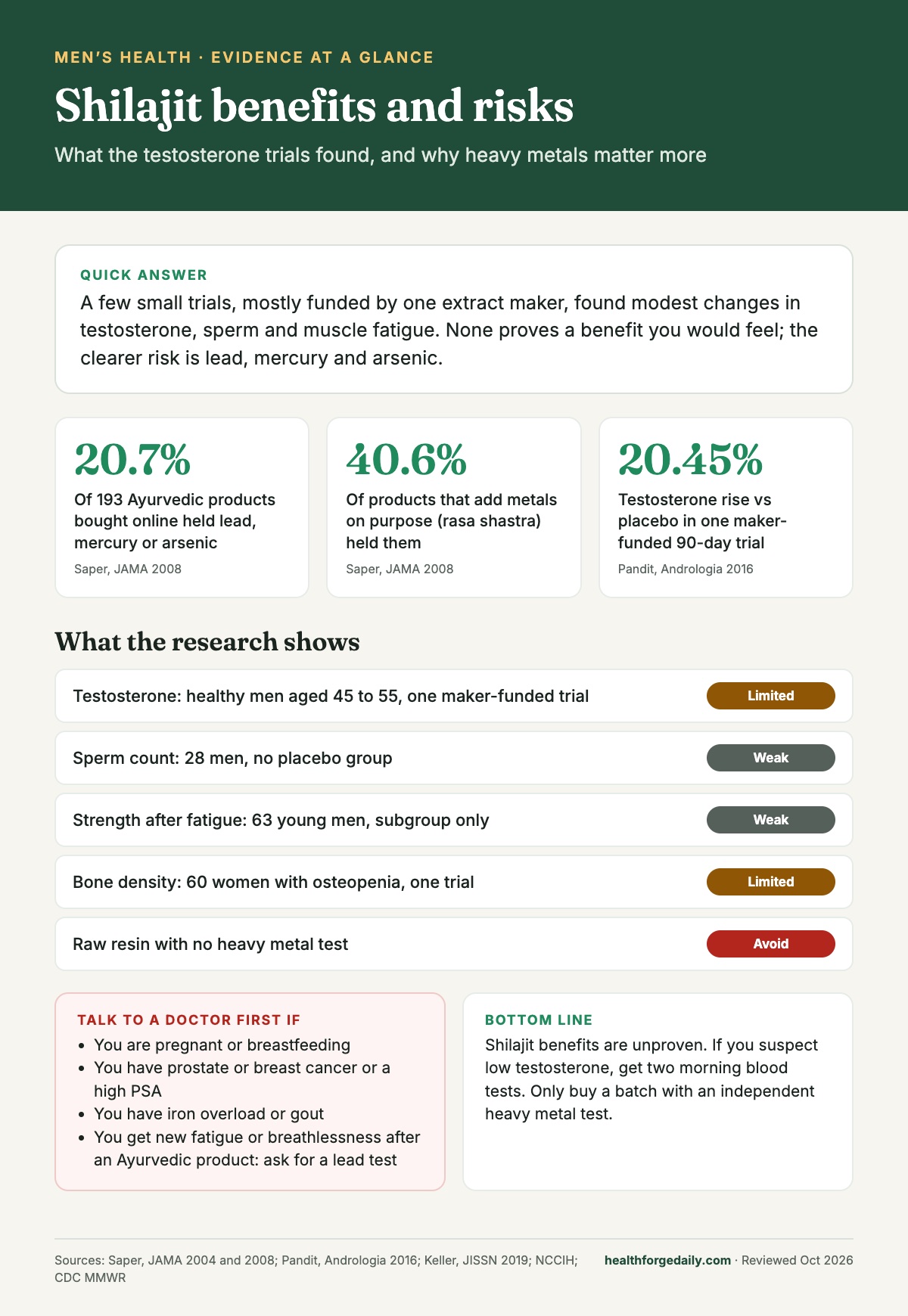
Shilajit benefits are mostly unproven. A few small trials, mostly funded by one extract maker, found a modest testosterone rise in healthy men aged 45 to 55, higher sperm counts in a study with no placebo group and less strength loss in a subgroup. The clearer issue is safety: about one in five Ayurvedic products tested contained lead, mercury or arsenic.
Shilajit is a sticky, tar-like substance from mountain rock that is sold online as a testosterone and energy booster. We read the human trials behind those claims, checked who paid for them, and read the JAMA studies and CDC reports on heavy metals in Ayurvedic products before writing this.
A few small trials, most funded by one supplier, found modest changes in testosterone, sperm counts and muscle fatigue. None proves a benefit you would feel. The clearer risk is contamination with lead, mercury and arsenic.[1][2][4][10]
| What it is | A mineral pitch that oozes from Himalayan rocks, rich in fulvic acid[4][5] |
|---|---|
| Sold for | Testosterone, fertility, energy, fatigue and exercise recovery[8] |
| Doses studied | 200 to 1,000 mg a day of purified extract for 8 to 48 weeks[1][3][6][7] |
| Best evidence | One placebo-controlled trial in men aged 45 to 55 found higher testosterone after 90 days; it was funded by the extract’s maker[1][2] |
| Main risk | Lead, mercury and arsenic: 20.7% of Ayurvedic products bought online contained at least one[10] |
| Avoid or ask a doctor first | Pregnancy, prostate or breast cancer, iron overload, gout, children[13][15][17][20] |
What is shilajit?
Shilajit is a mineral pitch, a dark resin that seeps out of rocks in the Himalayas and other mountain ranges. It is also sold as mumie or moomiyo, and it has a long history in Ayurveda, the traditional medicine of India, where it is classed as a “rasayana,” or rejuvenator.[1][5][8]
Its main components are fulvic acids, compounds called dibenzo-alpha-pyrones, proteins and minerals.[4] Researchers believe fulvic acid and the dibenzo-alpha-pyrones drive most of its effects in lab and animal studies.[8]
Because shilajit forms in rock, it also carries whatever minerals are in that rock. A 2022 analysis of shilajit from India and Pakistan found calcium, potassium and iron alongside lead, arsenic and mercury.[15] That mix is why the purification and testing of a product matter as much as the dose.
In the US, shilajit is sold as a dietary supplement. The FDA is not authorized to review supplements for safety or effectiveness before they go on sale.[18]
What are the claimed shilajit benefits?
Sellers claim a long list; the human evidence covers only a few. A 2014 review lists antioxidant, anti-inflammatory, “adaptogenic” and cholesterol effects, plus better sperm production and less fatigue.[8]
The same review says “relatively few well-controlled human studies” exist, and that most research is in animals and cells.[8] The author called for more well-controlled trials using standardized products.[8]
When a label promises energy, stamina, “male vitality” and cognitive support all at once, most of those claims rest on lab work rather than on people. Human trials exist for four of them: testosterone, sperm, fatigue and strength, and bone.
Does shilajit raise testosterone?
One trial says it may, a little, in middle-aged men, and the extract’s maker paid for it. In a randomized, double-blind, placebo-controlled trial published in 2016, healthy men aged 45 to 55 took 250 mg of purified shilajit or placebo twice a day for 90 days.[1]
Total testosterone, free testosterone and DHEAS (another androgen hormone) rose significantly compared with placebo. The pituitary hormones LH and FSH stayed steady.[1] A later paper summarizing the trial reported increases of 20.45% for total testosterone, 19.14% for free testosterone and 31.35% for DHEAS, from a starting total testosterone of 4.84 ng/mL.[4]
The trial is listed as funded by Natreon Inc, the company that makes the PrimaVie shilajit extract used in most of this research.[2][4] The men were healthy, not diagnosed with low testosterone, and the trial did not report whether they felt any different.[1]
A 2024 systematic review of 52 studies on 27 “testosterone boosters” found most fail to raise total testosterone. It rated purified shilajit extract (PrimaVie) only “possibly effective” for men with late-onset hypogonadism.[9] That is a weak grade built on very little data.
Does shilajit improve sperm count?
One small study without a placebo group reported higher counts. In a 2010 study, researchers assessed 60 infertile men and enrolled 35 with sperm counts below 20 million per mL. They took 100 mg of processed shilajit twice a day after meals for 90 days.[3]
Of the 28 men who finished, total sperm count rose 61.4% and serum testosterone rose 23.5% compared with their own starting values. Liver and kidney tests did not change.[3]
Every man got shilajit, so the study had no comparison group, and 7 of the 35 enrolled men did not finish.[3] A before-and-after rise in 28 men cannot show that shilajit caused it. If you are trying to conceive, a fertility specialist is the right first stop.
Does shilajit help fatigue, strength or exercise?
The results are narrow and mixed. The best trial, from the University of Nebraska in 2019, randomly assigned 63 recreationally active men, about 21 years old, to 250 mg a day, 500 mg a day or placebo for 8 weeks, 21 men per group.[4]
Shilajit did not change strength before exercise, peak leg strength or body weight.[4] The benefit appeared only when researchers split the men by starting strength. In the stronger half, strength fell 8.9% after a fatiguing leg workout on 500 mg, versus 17.0% on 250 mg and 16.0% on placebo. The low dose did no better than placebo.[4]
The study was funded by Natreon Inc.[4] Two related studies, one in overweight adults and one in 35 trained men, measured gene activity and a collagen marker in blood, not strength or energy.[5][6] A 2026 study of 25 men taking 500 mg of shilajit resin a day reported 32.40% lower fatigue scores after 28 days, but it had no placebo group.[19]
Fatigue that is new or lasts for weeks needs a checkup with a doctor. Our guide to vitamin B12 deficiency symptoms covers one common, testable cause.
What about bone and other uses?
One trial in women with thin bones is promising but unconfirmed. In 2022, 60 postmenopausal women aged 45 to 65 with osteopenia took placebo, 250 mg or 500 mg of a shilajit extract daily for 48 weeks.[7]
Bone density in the spine and hip fell in the placebo group and fell less in the shilajit groups, and markers of inflammation and oxidative stress improved.[7] It is a single trial from one center. No study has shown fewer fractures. Our guide to osteoporosis supplements covers the treatments doctors use.
Claims about memory, blood sugar, altitude sickness and “detox” rest mainly on animal and lab studies, not on trials in people.[8]
What do the human studies show?
| Claim | Study | Result | Caveat |
|---|---|---|---|
| Testosterone | 2016 RCT, healthy men 45 to 55, 250 mg twice daily, 90 days[1] | Total testosterone up 20.45% vs placebo[4] | Funded by the extract maker; no symptom data[2] |
| Sperm count | 2010 study, 28 men with low counts, 100 mg twice daily, 90 days[3] | Count up 61.4%, testosterone up 23.5% | No placebo group |
| Strength after fatigue | 2019 RCT, 63 young men, 250 or 500 mg a day, 8 weeks[4] | Less strength loss on 500 mg, stronger half only | Maker-funded; result from a subgroup |
| Collagen marker | 2024 RCT, 35 trained men, 500 or 1,000 mg a day, 8 weeks[6] | Blood marker of collagen rose | Lab marker only; maker-funded |
| Bone density | 2022 RCT, 60 women with osteopenia, 48 weeks[7] | Less bone loss than placebo | Single trial; no fracture data |
| Fatigue scores | 2026 pilot, 25 men, 500 mg resin a day, 28 days[19] | Fatigue score down 32.40% | Open-label, no placebo |
Who pays for shilajit research?
Mostly one company. Natreon Inc, which makes the PrimaVie extract, is listed as the funder of the 2016 testosterone trial, the 2019 strength trial and the 2024 collagen trial.[2][4][6] A Natreon research employee co-authored the 2016 muscle gene study.[5]
Industry funding does not make a result wrong, but the main findings have not been repeated by independent teams, and they apply to one standardized extract.[9] They do not carry over to a jar of raw resin from an online marketplace.
Is shilajit contaminated with heavy metals?
It can be, and this is the biggest safety issue. NCCIH warns that some Ayurvedic preparations contain lead, mercury or arsenic in amounts that can be toxic, and notes that the FDA warns these metals make some Ayurvedic products potentially harmful.[12]
A 2004 JAMA study bought every Ayurvedic product it could find in Boston-area South Asian stores. Of 70 products, 14 (20%) contained lead, mercury or arsenic, and all 14 could push daily intake above safety standards if taken as labeled.[11]
The 2008 follow-up by the same Boston University team, led by Robert Saper, analyzed 193 Ayurvedic products bought online. Overall, 20.7% contained detectable lead, mercury or arsenic. US-made products were no cleaner than Indian ones: 21.7% versus 19.5%.[10]
Of the products with metals, 95% were sold by US websites and 75% claimed to follow Good Manufacturing Practices. Every one exceeded at least one standard for acceptable daily intake.[10]
| Products tested | Contained lead, mercury or arsenic |
|---|---|
| Boston-area stores, 2004 (70 products) | 20% |
| Bought online, 2008: all 193 products | 20.7% |
| Online, made in the US | 21.7% |
| Online, made in India | 19.5% |
| Online, metals added on purpose (rasa shastra) | 40.6% |
| Online, no metals added on purpose | 17.1% |
Shilajit itself has been tested too. The 2022 analysis found lead, arsenic and mercury above permissible limits in Indian and Pakistani samples, with mercury found only in the Indian ones.[15] A 2025 study found the toxic metal thallium in both raw shilajit and shilajit supplements, sometimes at higher levels in the supplements.[16]
NCCIH cites a 2015 survey in which 40% of people using Ayurvedic preparations had elevated blood lead.[12] In Wisconsin in 2015, a 64-year-old woman who bought Ayurvedic products online developed fatigue, shortness of breath and anemia, with a blood lead level of 85.8 µg/dL, and needed chelation treatment.[14]
Is raw shilajit resin safer than purified extract?
Purified extract is the only form tested in most human trials, but “purified” on a label proves nothing on its own. The testosterone, sperm and strength studies used purified or processed extracts, not raw resin.[1][3][4]
Raw shilajit collected from rock carries the rock’s metals; samples from India and Pakistan exceeded limits for several toxic elements.[15] Processing does not guarantee a clean result either: thallium was sometimes higher in finished supplements than in crude shilajit.[16]
NCCIH notes that words like “standardized,” “verified” or “certified” do not guarantee quality or consistency.[18] And 75% of the metal-containing products in the 2008 study claimed good manufacturing.[10] The only useful proof is a recent lab test for heavy metals on the batch you are buying.
Is shilajit safe, and who should avoid it?
Short trials of purified extract reported few problems, but no trial was large or long enough to rule out rare harms. The 2016 muscle study found no change in blood sugar or cholesterol after 12 weeks, and the 2010 sperm study found no change in liver or kidney tests.[3][5] The bigger danger is what an untested product might contain.[10][12]
- Pregnant or breastfeeding: avoid. No trial tested shilajit in pregnancy. In New York City, 6 pregnant women who used Ayurvedic medicines from India had lead poisoning, with blood lead of 16 to 64 µg/dL. Lead exposure before birth can harm brain development and raise the risk of premature birth and miscarriage.[13]
- Prostate or breast cancer, or a high PSA: ask your oncologist first. Shilajit raised testosterone and DHEAS in one trial, and the Endocrine Society advises against testosterone therapy in men with breast or prostate cancer, or a PSA above 4 ng/mL without further evaluation.[1][17]
- Iron overload (hemochromatosis): shilajit contains iron among its minerals.[15] People with hemochromatosis are treated by removing iron from the body, so check with your doctor before taking any mineral-rich supplement.[20]
- Gout: we found no study of shilajit in people with gout or of its effect on uric acid. With no safety data, ask your doctor first.
- Trying to conceive: see a fertility specialist before relying on shilajit; the only sperm study had no placebo group.[3]
- Children: no trial included children. Keep it out of their reach.
Do you actually have low testosterone?
Only a doctor and two morning blood tests can tell you. The Endocrine Society recommends diagnosing low testosterone only in men with symptoms and signs of deficiency plus consistently low levels, measured with a fasting morning blood test that is then repeated.[17]
If the diagnosis is confirmed, doctors look for the cause and discuss prescription testosterone therapy and its risks. The guideline advises against it in men planning to have children soon or with breast or prostate cancer, among other conditions.[17]
Because the diagnosis needs consistently low levels and not symptoms alone, a lab test is a better first step than a supplement.[17] For the herb with the most testosterone trials, see our review of ashwagandha and testosterone. For other men’s health guides, browse our testosterone section.
Get medical help promptly if you have taken shilajit or another Ayurvedic product and develop new fatigue, shortness of breath or signs of anemia, as in the Wisconsin case, and ask for a blood lead test.[14] If you are pregnant and have used one, tell your prenatal care provider.[13]
If you still want to try shilajit, what should the label show?
- A third-party heavy metal test for your batch. Look for a certificate of analysis from an independent lab that lists lead, mercury and arsenic results. A “GMP” claim is not enough.[10]
- A purified, standardized extract with a named form rather than unlabeled raw resin. The human trials used purified extracts.[1][4]
- A dose in the studied range, such as 250 to 500 mg a day. Higher is not proven better; 250 mg a day did no better than placebo in the strength trial.[1][4]
- No promises to cure low testosterone, infertility or fatigue. No shilajit product has proven those claims.[9]
- Be wary of “certified” or “verified” badges that do not name the lab or the test.[18]
- A clear refund policy and a US contact address. See how to read a Supplement Facts label and how we review supplements.
Our verdict: are shilajit benefits real?
Unproven. A few small trials, most funded by one extract maker, found a testosterone rise in healthy middle-aged men, less strength loss in a subgroup of young men and less bone loss in women with osteopenia. None has been repeated independently, and none shows a benefit men would feel.[1][2][4][7]
The risk side is clearer. About one in five Ayurvedic products tested in two JAMA studies contained lead, mercury or arsenic, and shilajit samples have exceeded metal limits.[10][11][15] If you suspect low testosterone, get two morning blood tests. If you still buy shilajit, buy only a batch with an independent heavy metal test, and skip it entirely if you are pregnant.
Sources
- Clinical evaluation of purified Shilajit on testosterone levels in healthy volunteers. Pandit S et al., Andrologia, 2016.
- Clinical evaluation of purified Shilajit on testosterone levels in healthy volunteers (record with grant listing: Natreon Inc). Europe PMC.
- Clinical evaluation of spermatogenic activity of processed Shilajit in oligospermia. Biswas TK et al., Andrologia, 2010.
- The effects of Shilajit supplementation on fatigue-induced decreases in muscular strength and serum hydroxyproline levels. Keller JL et al., Journal of the International Society of Sports Nutrition, 2019.
- The human skeletal muscle transcriptome in response to oral Shilajit supplementation. Das A et al., Journal of Medicinal Food, 2016.
- Effects of 8 weeks of Shilajit supplementation on serum pro-c1α1, a biomarker of type 1 collagen synthesis: a randomized control trial. Neltner TJ et al., Journal of Dietary Supplements, 2024.
- Shilajit extract reduces oxidative stress, inflammation, and bone loss to dose-dependently preserve bone mineral density in postmenopausal women with osteopenia. Pingali U, Nutalapati C, Phytomedicine, 2022.
- Safety and efficacy of shilajit (mumie, moomiyo). Stohs SJ, Phytotherapy Research, 2014.
- Do “testosterone boosters” really increase serum total testosterone? A systematic review. Morgado A et al., International Journal of Impotence Research, 2024.
- Lead, mercury, and arsenic in US- and Indian-manufactured Ayurvedic medicines sold via the Internet. Saper RB et al., JAMA, 2008.
- Heavy metal content of ayurvedic herbal medicine products. Saper RB et al., JAMA, 2004.
- Ayurvedic Medicine: In Depth. NCCIH, National Institutes of Health, updated January 2019.
- Lead poisoning in pregnant women who used Ayurvedic medications from India, New York City, 2011-2012. Centers for Disease Control and Prevention, MMWR, 2012.
- Lead poisoning and anemia associated with use of Ayurvedic medications purchased on the Internet, Wisconsin, 2015. Meiman J et al., MMWR, 2015.
- Rapid determination and quantification of nutritional and poisonous metals in vastly consumed Ayurvedic herbal medicine (rejuvenator Shilajit). Aldakheel RK et al., Biological Trace Element Research, 2022.
- Quantifying of thallium in Shilajit and its supplements to unveil the potential risk of consumption of this popular traditional medicine. Kamgar E et al., BMC Chemistry, 2025.
- Testosterone therapy in men with hypogonadism: an Endocrine Society clinical practice guideline. Bhasin S et al., Journal of Clinical Endocrinology and Metabolism, 2018.
- Using Dietary Supplements Wisely. NCCIH, National Institutes of Health, updated January 2019.
- Safety and efficacy of TruBlk Shilajit resin supplementation on physical performance and blood biomarkers in healthy adults: a 28-day open-label pilot study. Yadav D et al., Cureus, 2026.
- Treatment of Hemochromatosis. NIDDK, National Institutes of Health, reviewed January 2020.
Frequently asked questions
Does shilajit really increase testosterone?
One 2016 placebo-controlled trial in healthy men aged 45 to 55 found higher total and free testosterone after 90 days of 250 mg twice a day. The extract maker funded it, it has not been repeated independently, and no trial tested symptoms.
Is shilajit safe to take?
Short trials of purified extract reported few side effects. The bigger risk is contamination: about one in five Ayurvedic products bought online contained lead, mercury or arsenic, and shilajit samples have exceeded limits for toxic metals. Buy only batch-tested products.
What is shilajit made of?
Shilajit is a mineral pitch that seeps from rocks in the Himalayas. It contains fulvic acids, compounds called dibenzo-alpha-pyrones, proteins and many minerals. Depending on the source, it can also contain toxic metals such as lead, arsenic and mercury.
Is raw shilajit resin better than capsules?
There is no evidence it is better. Most human trials used purified, standardized extracts, not raw resin. Raw samples from India and Pakistan exceeded limits for several toxic metals, so whatever the form, look for an independent heavy metal test.
Who should not take shilajit?
Avoid it in pregnancy and breastfeeding, and do not give it to children. Ask a doctor first if you have prostate or breast cancer, a high PSA, iron overload, gout or are trying to conceive. Pregnant women have been lead-poisoned by Ayurvedic products.
How much shilajit is used in studies?
Trials used purified extract at 200 to 1,000 mg a day, most often 250 mg once or twice a day, for 8 to 48 weeks. In one strength trial, 250 mg a day did no better than placebo, so a dose on a label is no promise of results.

Grace Whitaker is the health editor at Health Forge Daily. She reads supplement labels line by line, checks each ingredient and dose against published research, and tracks refund policies and customer complaints before a product gets a verdict. She is not a doctor, so every review points readers back to their own physician for medical decisions.
This article is for general information and is not medical advice. Supplements are not evaluated by the FDA and are not intended to diagnose, treat, cure or prevent any disease. Check with your doctor before you start any supplement.