The most reliable low testosterone symptoms are sexual: low desire, weaker erections and fewer morning erections. Fatigue, low mood and muscle loss can also happen but have many other causes. Doctors confirm low T only with two fasting blood tests drawn between 7 and 10 AM. Weight loss and better sleep can raise levels, and TRT helps sexual function more than energy.
Low testosterone symptoms are easy to blame on stress, age or a long year, so we checked which ones the evidence actually ties to a low level. We read the Endocrine Society patient guide and its 2018 treatment guideline, the MedlinePlus test page, the FDA label for a common testosterone gel and five large studies, including the TRAVERSE heart safety trial. You can see how we review health evidence on our methods page.
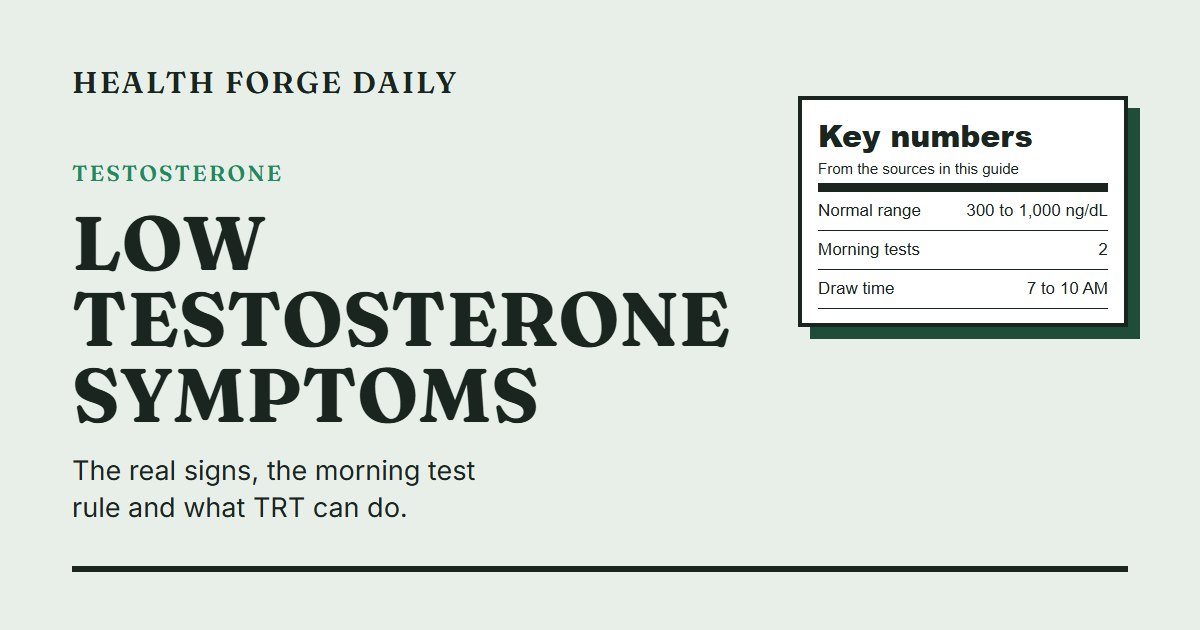
The symptoms most closely tied to low testosterone are sexual ones, and only two early morning blood tests that both come back low, usually under about 300 ng/dL, confirm it.[2][5]
| What it is | Male hypogonadism: the testes make too little testosterone because of a problem in the testes or in the pituitary and brain signals that control them.[2] |
|---|---|
| Most common symptoms | Low sex drive, erection problems, fewer morning erections, low energy, loss of muscle and thinning bones.[1][5] |
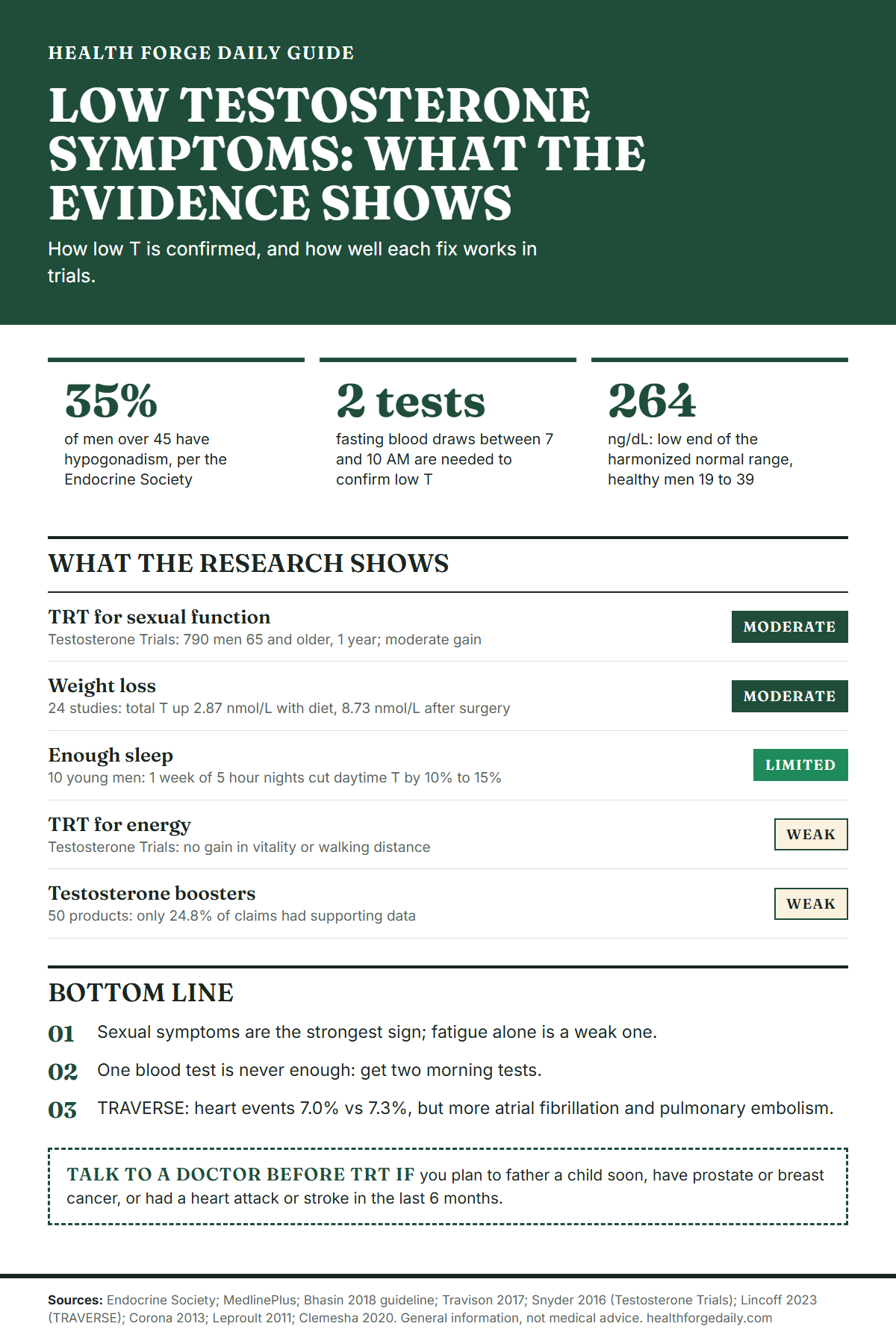
| How common | About 35% of men over 45, and 30% to 50% of men with obesity or type 2 diabetes.[2] |
| Normal range | About 300 to 1,000 ng/dL in adult men, depending on the lab.[2] |
| How it is diagnosed | Symptoms plus at least two fasting blood tests drawn between 7 and 10 AM.[2][3] |
| Best treatment evidence | In a 1 year trial of 790 men aged 65 and older, testosterone improved sexual function but not energy.[6] |
| Who should avoid TRT | Men planning to father a child soon, men with prostate or breast cancer, and men who had a heart attack or stroke in the last 6 months.[3] |
What are low testosterone symptoms in men?
Low testosterone, or male hypogonadism, means the body makes too little of the hormone that supports sex drive, erections, muscle, bone and red blood cells. The clearest symptoms are sexual: lower desire, weaker erections and fewer morning erections. Other signs build slowly and overlap with many common conditions.[1][2]
MedlinePlus lists low sex drive, erectile dysfunction, infertility, enlarged breasts, less face or body hair, loss of muscle mass, and thinning bones or anemia.[1] The Endocrine Society adds reduced energy, trouble concentrating, irritability, depressed mood, hot flashes when levels are very low, and smaller testes.[2]
The European Male Aging Study (EMAS) is the best guide to which symptoms really matter. It studied 3,369 men aged 40 to 79. Only three symptoms tracked closely with low testosterone: poor morning erections, low sexual desire and erectile dysfunction.[5] Fatigue, low mood and trouble with vigorous activity had looser links. The study defined late onset hypogonadism as those three sexual symptoms plus a total testosterone under 11 nmol/L, about 320 ng/dL.[5]
Which symptoms point most clearly to low T?
| Symptom group | Examples | Strength of the link |
|---|---|---|
| Sexual | Low desire, fewer morning erections, erectile dysfunction | Strongest. The only cluster EMAS tied to low testosterone[5] |
| Physical | Less muscle, breast swelling, less body hair, smaller testes | Clear when levels are very low or low for a long time[1][2] |
| Bone and blood | Thinning bones, mild anemia | Usually found on tests rather than felt[1] |
| Energy and mood | Fatigue, low mood, irritability, poor focus | Weak. Many other conditions cause the same feelings[2][5] |
Can low testosterone cause anxiety, fatigue or mood symptoms?
Low testosterone can bring tiredness, irritability, depressed mood and poor concentration, but these are the least specific symptoms on the list. In the EMAS data, fatigue and depression were only loosely tied to testosterone levels, so a man whose main problem is low energy more often has some other cause.[2][5]
Anxiety is a common search term. None of the sources we read measured anxiety as a symptom of low testosterone, though they do describe irritability and low mood.[2] Depression, poor sleep and ordinary stress can feel much the same, and a blood test is the only way to tell them apart from a hormone problem.
In the Testosterone Trials, 790 men aged 65 and older with levels under 275 ng/dL used a testosterone gel or a placebo gel for 1 year. Testosterone gave some benefit for mood but no benefit for vitality, the trial’s measure of energy, so raising testosterone may not help much if tiredness is your main complaint.[6]
How do you know you have low testosterone?
You can only know you have low testosterone when your symptoms line up with two separate early morning blood tests that both come back low. The Endocrine Society asks for at least two tests drawn between 7 and 10 AM, because levels are highest in the morning and shift from day to day.[2][3]
The 2018 Endocrine Society guideline recommends a fasting morning total testosterone test first, then a repeat test to confirm. It advises diagnosing hypogonadism only in men who have symptoms and levels that are clearly and consistently low.[3] MedlinePlus explains the timing: levels are usually at their peak between 7 and 10 AM.[1]
What counts as a low number?
The Endocrine Society patient guide gives a normal adult range of about 300 to 1,000 ng/dL.[2] A 2017 study measured samples from 9,054 men in four cohorts against a CDC reference method. It set a harmonized normal range of 264 to 916 ng/dL for healthy, non-obese men aged 19 to 39, which puts the low end near 264 ng/dL.[4] The senior author of that study also led the 2018 guideline.[3] Labs still differ, so read your result against the range printed on your own report.
What about free testosterone?
Much of the testosterone in blood is bound to a carrier protein called SHBG. The guideline suggests a free testosterone test when total testosterone sits near the lower limit or when a condition is likely to change SHBG.[3] The free level is more useful in those cases.
What do your test results usually mean?
| If this happens | What usually comes next |
|---|---|
| Symptoms, but a normal morning result | Low testosterone is unlikely, so look for other causes[2][3] |
| First test low, second test normal | No diagnosis yet. The first result may have been a short dip[2][3] |
| Two low morning tests plus sexual symptoms | Hypogonadism is likely, and the doctor looks for the cause before treatment[3] |
| Result close to the lower limit | A free testosterone test may settle it[3] |
| Low result from an afternoon blood draw | Repeat it between 7 and 10 AM[1] |
| Low result during a serious illness or a crash diet | Retest after you recover[2] |
What causes low testosterone?
Low testosterone comes either from the testes themselves or from the pituitary and brain signals that tell the testes to make the hormone. In adults, common drivers are obesity, type 2 diabetes, sleep disorders and some medicines, especially opioid pain pills and corticosteroids.[1][2]
The Endocrine Society says about 35% of men over 45 have hypogonadism, and so do 30% to 50% of men with obesity or type 2 diabetes.[2] Testosterone also falls about 1% a year after age 30, so age adds to any other cause.[2]
- Testicular causes: injury, Klinefelter syndrome and other problems in the testes.[1]
- Pituitary and brain causes: pituitary disorders, high prolactin and Kallmann syndrome.[1][2]
- Medicines and drugs: opioid painkillers, corticosteroids and past anabolic steroid use.[2]
- Metabolic causes: obesity, type 2 diabetes and sleep disorders.[2]
- Other illness: liver or kidney disease, alcohol use disorder, HIV and hemochromatosis.[1][2]
Some drops are temporary. Severe illness, poor nutrition, too much exercise and certain medicines can lower levels for a while.[2] That is one reason doctors repeat the test. Do not stop a prescribed medicine on your own; ask the prescriber first.[1]
What are low testosterone symptoms in women?
Women make testosterone too, but there is no agreed blood level that defines low testosterone in women. A 2019 global consensus statement found that no cutoff level separates women with and without sexual problems, so a blood test cannot diagnose low T in women the way it can in men.[12]
MedlinePlus notes that low levels are normal in women, although a very low level may point to an adrenal, pituitary or ovarian problem.[1] The consensus statement says the only use of testosterone in women backed by evidence is for postmenopausal women diagnosed with hypoactive sexual desire disorder, which means low desire that causes distress.[12] It found too little data to support testosterone for younger women, and it does not recommend oral testosterone.[12] For women over 40 or 50 with low desire, a doctor visit that covers menopause and current medicines is a better start than a testosterone test.
How do doctors treat low testosterone, and is TRT safe?
Testosterone replacement therapy (TRT) is the standard treatment for confirmed hypogonadism, and the goal is a level in the middle of the normal range. The Endocrine Society guideline recommends it for men with symptoms and consistently low levels, with regular follow-up tests once treatment starts.[3]
What TRT does depends on the symptom. In the Testosterone Trials, sexual function improved moderately, mood improved a little, and energy and walking distance did not improve.[6] The FDA label for AndroGel 1.62% says its safety and benefit in men with “age-related hypogonadism” have not been established.[8] That means a low level from age alone is a weaker reason to start TRT than a clear medical cause.
What did the TRAVERSE trial find?
TRAVERSE tested heart safety in 5,246 men aged 45 to 80 who had heart disease or a high heart risk and two fasting testosterone levels under 300 ng/dL. Major heart events, such as heart attack and stroke, happened in 7.0% of men on testosterone and 7.3% of men on placebo.[7] That met the trial’s goal of showing testosterone was not worse for the heart.
The same trial found more atrial fibrillation, acute kidney injury and pulmonary embolism in the testosterone group.[7] The AndroGel label reports a 1.5 mm Hg higher systolic blood pressure on testosterone than on placebo in TRAVERSE, and it tells doctors to check blood pressure regularly.[8]
| Study | Who and how many | Design | Main result |
|---|---|---|---|
| EMAS, 2010 | 3,369 men aged 40 to 79 in Europe | Symptom survey plus blood tests | Only 3 sexual symptoms tracked with low testosterone[5] |
| Testosterone Trials, 2016 | 790 men aged 65 and older, testosterone under 275 ng/dL | Gel vs placebo for 1 year | Better sexual function, some mood benefit, no gain in vitality[6] |
| TRAVERSE, 2023 | 5,246 men aged 45 to 80, testosterone under 300 ng/dL | Testosterone vs placebo | Heart events 7.0% vs 7.3%; more atrial fibrillation, kidney injury and pulmonary embolism[7] |
| Corona review, 2013 | 24 weight loss studies | Meta-analysis | Testosterone rose, and more weight lost meant a bigger rise[9] |
| Leproult and Van Cauter, 2011 | 10 healthy young men | 1 week of 5 hour nights | Daytime testosterone fell 10% to 15%[10] |
Who should not take testosterone?
The Endocrine Society guideline advises against TRT for men who:[3]
- plan to father a child in the near term
- have breast or prostate cancer
- have a prostate lump, or a PSA above 4 ng/mL that a urologist has not checked
- have a high hematocrit, meaning too many red blood cells
- have untreated severe obstructive sleep apnea
- have uncontrolled heart failure, or had a heart attack or stroke in the last 6 months
- have a known clotting disorder (thrombophilia)
Testosterone gel can also rub off on others. The AndroGel label carries a boxed warning about children who came into contact with the gel and developed signs of early puberty.[8]
Can weight loss and sleep raise testosterone naturally?
Losing excess weight is the best studied way to raise testosterone without medicine, and more weight lost brings a bigger rise. A 2013 analysis of 24 studies found that total and free testosterone both went up after weight loss.[9]
The size of the rise followed the method. Total testosterone rose by 2.87 nmol/L on average with a low calorie diet and by 8.73 nmol/L after bariatric surgery.[9] The Endocrine Society says low testosterone linked to obesity can be reversible without testosterone therapy.[2]
Short sleep also pulls testosterone down. In a 2011 study, 10 healthy young men slept 5 hours a night for 1 week. Their daytime testosterone dropped by 10% to 15%.[10] The authors note that normal aging lowers testosterone by 1% to 2% a year, so one short week of sleep did as much as several years of aging.[10] Sleep disorders are also on the Endocrine Society list of causes.[2]
Do testosterone boosters work?
Few have good evidence behind them. A 2020 study of 50 testosterone booster products found that 90% claimed to boost testosterone, but only 24.8% of those claims had any supporting data.[11] About 10.1% of the products contained an ingredient with data suggesting it lowers testosterone, and 13 products went over the safe upper limit for zinc, vitamin B3 or magnesium.[11]
Single ingredients get their own research. Our guides cover what trials of ashwagandha and testosterone in men show, shilajit testosterone claims and heavy metal risks and what vitamin D research shows about dosing. No supplement is approved for hypogonadism, and none replaces the two morning tests.[11]
When should you see a doctor about low testosterone?
See a doctor if sexual symptoms, muscle loss or breast swelling last more than a few weeks, or if any testosterone test comes back low. A doctor can order the two morning tests, look for the cause and check for conditions that cause similar symptoms.[2][3]
See a doctor right away if:
- you notice new breast growth or a lump in a testicle[1]
- you are on testosterone and get chest pain, sudden shortness of breath or a painful, swollen leg[7]
- you are on testosterone and feel a racing or irregular heartbeat[7]
- a child in your home shows early body hair, acne or genital growth after contact with your gel[8]
Your low T checklist
- Write down your symptoms, starting with sexual ones, and how long you have had them.
- Book a fasting blood test between 7 and 10 AM, and plan for a second one.[2]
- Bring a list of your medicines, especially opioid pain pills and steroids.[2]
- Ask about weight, blood sugar and sleep apnea, three common causes.[2]
- Tell your doctor if you plan to have children before any treatment starts.[3]
- On TRT, keep follow-up visits for blood pressure and blood tests.[3][8]
- Check any booster label against the upper limits for zinc and vitamin B3.[11]
Find more in our testosterone and men’s health guides.
What is the bottom line on low testosterone symptoms?
The low testosterone symptoms that matter most are sexual, and only repeated morning blood tests can confirm the problem. Fatigue or low mood on its own is a weak signal, and TRT did little for energy in older men.[5][6]
For most men with symptoms and extra weight, losing weight and sleeping longer are the better first step, because they raise testosterone without the heart rhythm, clot and fertility tradeoffs of TRT.[3][7][9][10] If two morning tests are clearly low and a cause is found, TRT is a reasonable option to discuss with your doctor, with the TRAVERSE results in view.[3][7]
Sources
- Testosterone Levels Test. MedlinePlus, National Library of Medicine
- Hypogonadism (Low Testosterone). Endocrine Society
- Testosterone Therapy in Men With Hypogonadism: An Endocrine Society Clinical Practice Guideline. Bhasin et al., J Clin Endocrinol Metab, 2018
- Harmonized Reference Ranges for Circulating Testosterone Levels in Men of Four Cohort Studies. Travison et al., J Clin Endocrinol Metab, 2017
- Identification of Late-Onset Hypogonadism in Middle-Aged and Elderly Men. Wu et al., N Engl J Med, 2010
- Effects of Testosterone Treatment in Older Men. Snyder et al., N Engl J Med, 2016
- Cardiovascular Safety of Testosterone-Replacement Therapy (TRAVERSE). Lincoff et al., N Engl J Med, 2023
- AndroGel 1.62% (testosterone gel) prescribing information. DailyMed, National Library of Medicine
- Body weight loss reverts obesity-associated hypogonadotropic hypogonadism: a systematic review and meta-analysis. Corona et al., Eur J Endocrinol, 2013
- Effect of 1 Week of Sleep Restriction on Testosterone Levels in Young Healthy Men. Leproult and Van Cauter, JAMA, 2011
- Testosterone Boosting Supplements Composition and Claims Are not Supported by the Academic Literature. Clemesha et al., World J Mens Health, 2020
- Global Consensus Position Statement on the Use of Testosterone Therapy for Women. Davis et al., J Clin Endocrinol Metab, 2019
Frequently asked questions
Can low testosterone symptoms come and go?
Yes, to a degree. Testosterone can dip during severe illness, poor nutrition, very heavy exercise, short sleep or with some medicines, then recover. That is why doctors repeat the morning test, and why one low reading during a rough patch does not prove a lasting problem.
Are low testosterone symptoms different in men over 50?
The symptoms are the same, but they become more common with age. Testosterone falls about 1% a year after 30, and about 35% of men over 45 meet the definition of hypogonadism. Weight gain and diabetes, which also rise with age, add to the drop.
Can young men have low testosterone symptoms?
Yes. Men in their 20s and 30s can have low testosterone from a testicular injury, Klinefelter syndrome, pituitary problems, opioid or steroid use, obesity or poor sleep. The same two morning tests apply, and fertility plans matter because TRT is not advised for men hoping to father a child soon.
What are the symptoms of low free testosterone?
They match the symptoms of low total testosterone: low desire, erection problems, fatigue and muscle loss. Doctors usually test free testosterone when total testosterone sits near the lower limit or when the carrier protein SHBG is likely to be abnormal.
What happens if low testosterone is not treated?
Long-term low testosterone is linked to thinning bones, mild anemia, loss of muscle and ongoing sexual symptoms. When obesity is the cause, weight loss can raise levels without medicine. A doctor can help you weigh leaving it alone against the known risks of TRT.

Grace Whitaker is the health editor at Health Forge Daily. She reads supplement labels line by line, checks each ingredient and dose against published research, and tracks refund policies and customer complaints before a product gets a verdict. She is not a doctor, so every review points readers back to their own physician for medical decisions.
This article is for general information and is not medical advice. Supplements are not evaluated by the FDA and are not intended to diagnose, treat, cure or prevent any disease. Check with your doctor before you start any supplement.