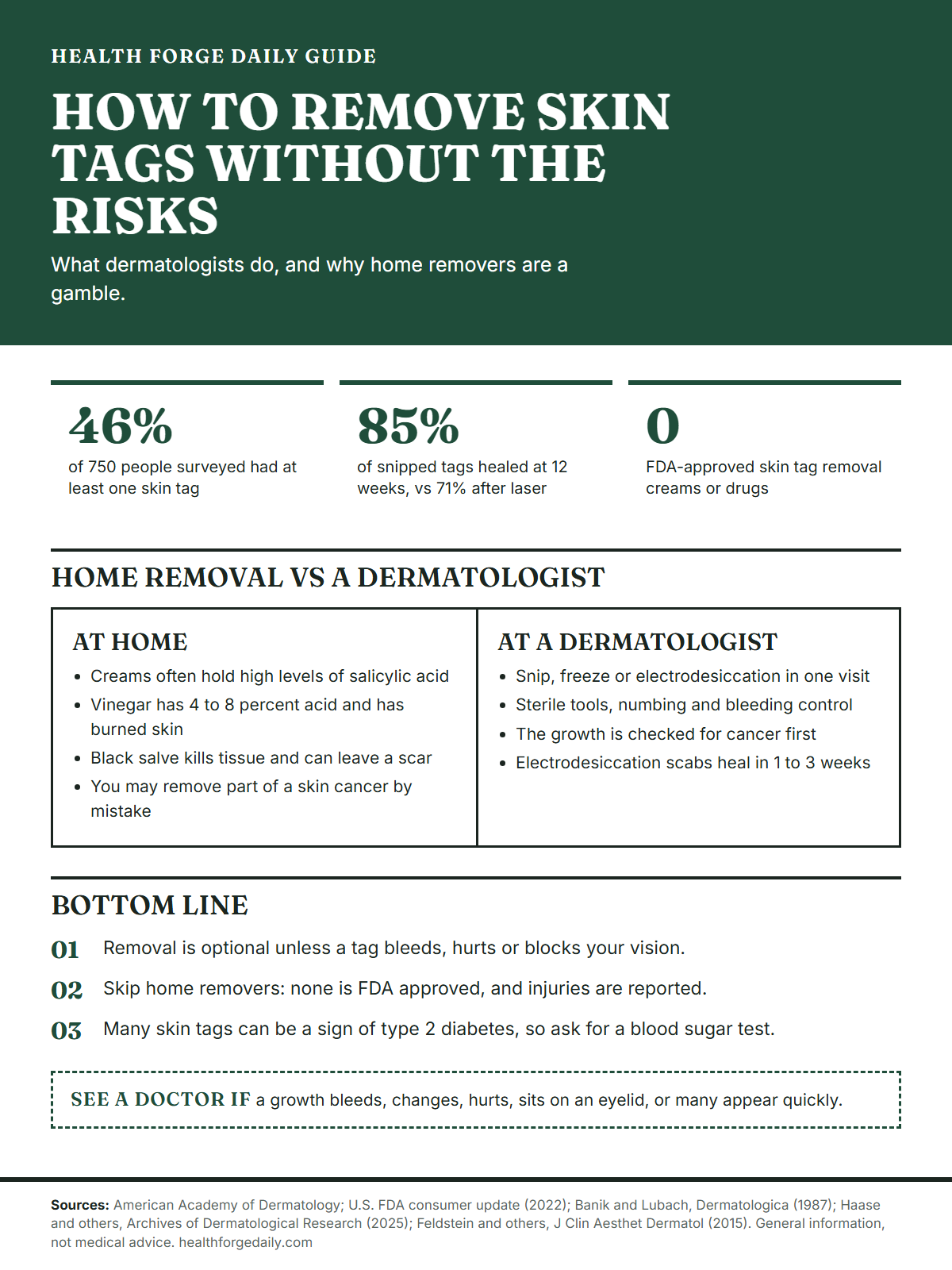
The safest way to remove a skin tag is a quick office visit where a dermatologist snips, freezes or burns it off. In a 2025 trial, 85% of snipped tags had healed by 12 weeks. No home remover is FDA approved, and creams, vinegar and salves have burned and scarred skin. See a doctor for a growth that bleeds, changes or hurts.
To answer how to remove skin tags safely, we read the skin tag and removal guides from the American Academy of Dermatology (AAD), the FDA consumer warning on mole and skin tag removers, a 2025 randomized trial of 1,257 skin tags, and case reports of burns from home remedies. Our review process explains how we choose and check sources.
The safest way to remove a skin tag is a quick office procedure by a dermatologist (snipping, freezing or burning it off), because no home remover has FDA approval and DIY methods have caused burns, infections and scars.[1][2][4]
| What a skin tag is | A harmless, soft growth that often hangs from a small stalk, also called an acrochordon[1] |
|---|---|
| How common | 46% of 750 unselected people in a German survey had at least one[5] |
| Where they grow | Neck creases, armpits, eyelids, groin and under the breasts, where skin rubs[1] |
| Standard removal | Snip excision, cryotherapy (freezing) or electrodesiccation (burning) in a doctor’s office[1][12] |
| Best evidence | A 2025 trial: 85% of snipped tags had healed at 12 weeks vs 71% after laser[6] |
| Home removers | None is FDA approved; the FDA warns of injuries, infection and scarring[4] |
| See a doctor first if | The growth bleeds, hurts, changes, sits on an eyelid, or many appear at once[1][4] |
How to remove skin tags: what are the safe options?
A skin tag is a harmless flap of skin, so removal is optional unless it gets irritated, bleeds, hurts or blocks your vision. If you want one gone, the safe options are the three office methods dermatologists use: snipping, freezing and electrodesiccation. Each usually takes one short visit.[1]
The AAD lists the choices like this:[1]
- Snip excision: the doctor numbs the skin, cuts the tag off with sterile scissors or a blade, then stops the bleeding.
- Cryosurgery: liquid nitrogen freezes the tag. A blister or scab forms, and the tag falls off with it.
- Electrodesiccation: a fine needle carries current that destroys the tag. The scab heals in one to three weeks.
Family doctors also treat skin tags, most often with shave excision or cryotherapy.[12] The method depends on the tag’s size and where it sits.[1] If you have darker skin, ask about lighter patches after freezing or laser, because that risk should be part of the choice.[12]
Check the cost before you book. Insurers treat removal for looks alone as cosmetic and rarely pay for it. A tag that bleeds or gets irritated is a medical reason, so tell the office if yours does.[1]
How to properly remove a skin tag, step by step
Properly removing a skin tag starts with confirming it really is a skin tag, then having it taken off with sterile tools. Warts and some skin cancers can look like skin tags, and the FDA warns that removing a growth yourself can delay a cancer diagnosis.[1][4] These steps follow AAD and FDA advice.
- Look closely. A skin tag is soft, often skin colored or a bit darker, and may hang from a stalk.[1]
- Decide if it needs to go. Removal is only needed for irritation, bleeding, pain or an eyelid tag that affects sight.[1]
- Book a dermatologist or your family doctor, and say if you take blood thinners or have a bleeding problem.[2]
- Agree on the method: snip, freeze or electrodesiccation, based on size and location.[1][12]
- Follow aftercare. That usually means removing the bandage, washing gently and putting on a fresh one.[1]
- Watch the spot. Report spreading redness, pus or bleeding that will not stop.[2]
- Have any new growth that bleeds, changes or hurts checked rather than treating it yourself.[4]
Can you remove skin tags yourself safely at home?
No home method has been shown to be safe, and dermatologists advise against cutting, tying off or burning skin tags yourself. The AAD says that using an at-home product amounts to performing surgery on yourself, which can go wrong fast. Risks include infection, scarring and bleeding that needs an emergency room.[2]
Cutting a tag with household scissors or nail clippers carries the same risks without numbing, sterile tools or a way to stop bleeding. Dermatologists ask about your health and medicines first, in part so they can plan for bleeding that is hard to stop.[2]
Tying a tag off with thread or dental floss, and the stick-on bands sold online, try to cut off its blood supply until it dies and drops. We found no clinical trials testing either method on skin tags, so there is no good data on how well they work or how often they cause infection.
You could also be wrong about what the growth is. Skin tags come in many shapes and sizes, and a wart or even a skin cancer can be mistaken for one.[1] If a skin cancer is only partly removed, the FDA says it can keep growing and may spread.[4] A dermatologist can tell the difference in a single look and remove the growth in the same visit.[1]
How do you remove skin tags naturally?
There is no proven natural way to remove skin tags. We found no clinical trials of apple cider vinegar, tea tree oil, garlic or other home remedies for skin tags. Case reports show the harm vinegar and escharotic salves can do to skin, and the FDA says a product labeled natural or herbal is not automatically safe.[4][10][11]
Apple cider vinegar comes up most often online. In one 2015 case, a 14-year-old girl followed an internet protocol and put apple cider vinegar under bandages on moles on her nose for 3 days. The moles peeled off, but she was left with open sores that needed antibiotic ointment.[10] The doctors noted that household vinegar holds 4 to 8 percent acetic acid, enough to burn skin, especially when covered.[10]
Black salve and other escharotic pastes work by killing tissue. In a 2022 case report, a 55-year-old man left black salve on a neck cyst for 7 days. The skin died and became infected, he needed oral antibiotics, and he was left with a sunken scar.[11]
Can you remove skin tags in one night?
No safe home method removes a skin tag overnight. Products that promise fast results often contain high levels of salicylic acid or other harsh ingredients, and the FDA says they may burn the skin around the tag while failing to remove all of it.[4] An office snip is the quick option: the doctor numbs the skin, cuts the tag off and stops the bleeding in the same visit.[1] If the goal is to be rid of a tag before an event, book that visit instead of trying a cream the night before. A burn or scar from a remover can take far longer to fade than the tag itself.[4]
Do skin tag removal creams and wart removers work?
Skin tag removal creams are not FDA approved, and the FDA tells people to avoid them. There are no approved prescription or over-the-counter drugs for skin tags. Many sold online contain high levels of salicylic acid or other harsh chemicals, even when salicylic acid is not on the label.[4]
On August 4, 2022, the FDA sent warning letters to Amazon.com and two other sellers over mole and skin tag removal products that had never been reviewed for safety or effectiveness. The agency said it had received reports of permanent skin injuries and infections from people who used these products.[4]
The FDA also notes that these products often fail to remove the whole growth. Even when the tag falls off, the cream can leave a scar or discolored patch that is more noticeable than the tag, which matters most on the face.[4]
Wart remover does not work either. The AAD explains that warts are hard and need strong medicine, while skin tags are soft. Putting wart remover on a skin tag can damage the skin and leave scarring or irritation.[1] Be wary of labels such as safe, scar free or zero risk, because the AAD points out that every removal carries some risk.[2]
How do dermatologists remove skin tags on the neck, armpits, face and eyelids?
Dermatologists choose the method by the tag’s size and spot, and snip excision has the strongest trial data for tags on the neck and armpits. In a 2025 randomized trial, 85% of snipped tags had healed at 12 weeks, compared with 71% of tags treated with laser.[1][6]
That German trial treated 68 people with 1,257 skin tags. Each person had scissor snips on one side and a 532 nm laser on the other. The snip side also scored lower for pain, 2.6 vs 3.42, and 63% of patients said they would choose scissors next time. Laser was faster and bloodless, but treated tags could stay on as dead tissue for up to three weeks, with more redness and color change.[6]
Skin tags on the face and eyelids
On the face, the FDA warns that a scar or color change from a remover can look worse than the original tag.[4] An eyelid tag that affects your eyesight is one of the AAD’s reasons to have a tag removed, and it should be done by a doctor rather than at home.[1]
Most removals need no follow-up appointment. Follow the aftercare sheet to prevent infection: keep the area clean and change the bandage as told.[1] With electrodesiccation, expect a scab that heals in one to three weeks.[1]
Why do skin tags appear, and are they linked to diabetes?
Skin tags form where skin rubs against skin, clothing or jewelry, and having many of them is linked with insulin resistance and type 2 diabetes. The AAD says weight gain, pregnancy, diabetes, metabolic syndrome and a family history all raise the odds. The tags themselves are harmless.[1][3]
They are common. A 1987 survey of 750 unselected people found skin tags in 46%, most often in the armpit and then the neck. The odds rose with age until about 50.[5] Children get them too, usually in the armpit, and often alongside extra weight.[9]
What the studies found
The studies below found a link with blood sugar. They are small and observational, so they show an association, not cause.
| Study | Who was studied | What was measured | Result |
|---|---|---|---|
| Banik and Lubach, 1987[5] | 750 unselected people | How many had skin tags | 46% had at least one |
| Rasi and others, 2007[7] | 104 people with 3+ tags vs 94 matched people without | Glucose tolerance test | Diabetes in 23% vs 8.5%; 52% of those with 30+ tags |
| Sudy and others, 2008[8] | Men with 8+ neck tags vs men with few or none | Fasting and after-meal glucose and insulin | Abnormal results in 77% vs 33% |
| Greene and others, 2024[9] | 55 children with skin tags | Weight and metabolic health | 49.5% had obesity |
| Haase and others, 2025[6] | 68 adults, 1,257 neck and armpit tags | Healing at 12 weeks, snip vs laser | 85% vs 71% healed |
The AAD lists many skin tags among the skin signs that can point to type 2 diabetes.[3] If you have a lot of them, a blood sugar test is reasonable. Our guides to normal blood sugar levels by age and the prediabetes A1C range explain what the numbers mean.
When should you see a doctor about a skin tag?
See a doctor if a growth bleeds, hurts, grows or changes, or if many skin tags appear quickly. The FDA advises medical care for any mole or skin tag that is growing, changing, bleeding or painful. The AAD says a sudden crop of skin tags, while rare, can signal something going on inside the body.[1][4]
Book a visit soon if:[1][3][4][6]
- A growth bleeds, changes color or shape, or keeps getting bigger
- A tag hurts suddenly, which can happen when it twists and loses blood flow
- A tag on your eyelid affects your vision
- Many new tags show up over a short time
- You have many tags and have never had your blood sugar checked
Get care the same day if a spot you treated at home will not stop bleeding, or shows spreading redness, warmth or pus. The AAD warns that home removal can cause bleeding that needs an emergency room and infections that need antibiotics.[2]
Checklist before you remove a skin tag
- Confirm with a doctor that the growth is a skin tag and not a wart, mole or skin cancer.[1][4]
- Skip creams, pens and patches sold as skin tag removers; none is FDA approved.[4]
- Do not use wart remover, vinegar or black salve on a skin tag.[1][10][11]
- Tell the doctor about blood thinners and other medicines before removal.[2]
- Ask whether your plan covers the visit, since cosmetic removal is rarely covered.[1]
- Report any harm from a home remover to the FDA’s MedWatch program.[4]
Bottom line
Skin tags are harmless, so leaving them alone is a fine choice. If one bothers you, the quickest and safest fix is a short office visit where a doctor snips, freezes or burns it off. In the best trial we found, scissor snips healed better than laser and hurt less.[1][6]
For most people, a dermatologist visit is the better first step than any home method, because it rules out skin cancer and avoids the injuries reported with creams, vinegar and salves. If you have many skin tags, ask for a blood sugar test at the same visit. You can find more guides in our skincare and anti-aging section.[2][3][4][10]
Sources
- Skin tags: Why they develop, and how to remove them. American Academy of Dermatology, 2023
- 5 reasons to see a dermatologist for mole, skin tag removal. American Academy of Dermatology, 2022
- Diabetes: 12 warning signs that appear on your skin. American Academy of Dermatology
- Products Marketed for Removing Moles and Other Skin Lesions Can Cause Injuries, Scarring. U.S. Food and Drug Administration consumer update, 2022 (archived copy)
- Skin tags: localization and frequencies according to sex and age. Dermatologica, 1987
- Removal of skin tags: scissor excision versus non-ablative 532nm-LBO-laser in a randomized intraindividual controlled observer-blinded clinical trial. Archives of Dermatological Research, 2025
- Skin tag as a cutaneous marker for impaired carbohydrate metabolism: a case-control study. International Journal of Dermatology, 2007
- Screening of glucose/insulin metabolic alterations in men with multiple skin tags on the neck. Journal of the German Society of Dermatology, 2008
- The relationship between acrochordons, obesity, and metabolic syndrome in the pediatric population: A retrospective cohort study. Pediatric Dermatology, 2024
- Chemical Burn from Vinegar Following an Internet-based Protocol for Self-removal of Nevi. Journal of Clinical and Aesthetic Dermatology, 2015
- Black salve: risky escharotic. Scars, Burns and Healing, 2022
- Diagnosing Common Benign Skin Tumors. American Family Physician, 2024
Frequently asked questions
How do you remove skin tags on the neck?
Neck skin tags are usually snipped off or frozen in a doctor's office after the area is numbed. In a 2025 trial on neck and armpit tags, snipping healed 85% of tags by 12 weeks and hurt less than laser. Avoid cutting them at home.
How do you remove skin tags from the armpit?
Armpit tags are removed the same way as other skin tags, by snipping, freezing or electrodesiccation in an office visit. Shaving can nick and irritate them, which is a common reason people want them gone. A doctor can remove several in one visit.
Do skin tags grow back after removal?
Removing a tag does not stop new ones from forming where skin keeps rubbing against skin, clothing or jewelry. Skin tags are more common with extra weight, pregnancy, diabetes and a family history, so some people keep getting new ones over the years.
Are moles and skin tags removed the same way?
Not always. A mole can be a skin cancer, so a doctor may biopsy or cut out a growth that looks unusual or has changed. The FDA warns against home removers for both, because removing part of a cancer can delay diagnosis and treatment.
Is it safe to remove a skin tag while pregnant?
Skin tags often appear in pregnancy because skin rubs more, and they are harmless. Avoid home creams and acids. If a tag bleeds or hurts, ask your doctor or a dermatologist whether to remove it now or wait until after the birth.

Grace Whitaker is the health editor at Health Forge Daily. She reads supplement labels line by line, checks each ingredient and dose against published research, and tracks refund policies and customer complaints before a product gets a verdict. She is not a doctor, so every review points readers back to their own physician for medical decisions.
This article is for general information and is not medical advice. Supplements are not evaluated by the FDA and are not intended to diagnose, treat, cure or prevent any disease. Check with your doctor before you start any supplement.
