Brush for two minutes twice a day with a soft brush and fluoride toothpaste, and clean between your teeth once a day with floss or an interdental brush. That removes soft plaque. Once plaque hardens into tartar, only a dentist or hygienist can remove it. Power brushes help a little; mouthwash, baking soda and oil pulling are optional extras.
If you want to know how to remove plaque from teeth, we read the NIDCR and MedlinePlus pages on gum disease, the American Dental Association’s brushing, flossing and mouthwash advice, and five research reviews on power brushes, floss, mouthwash, baking soda and oil pulling. Our review process explains how we pick sources.
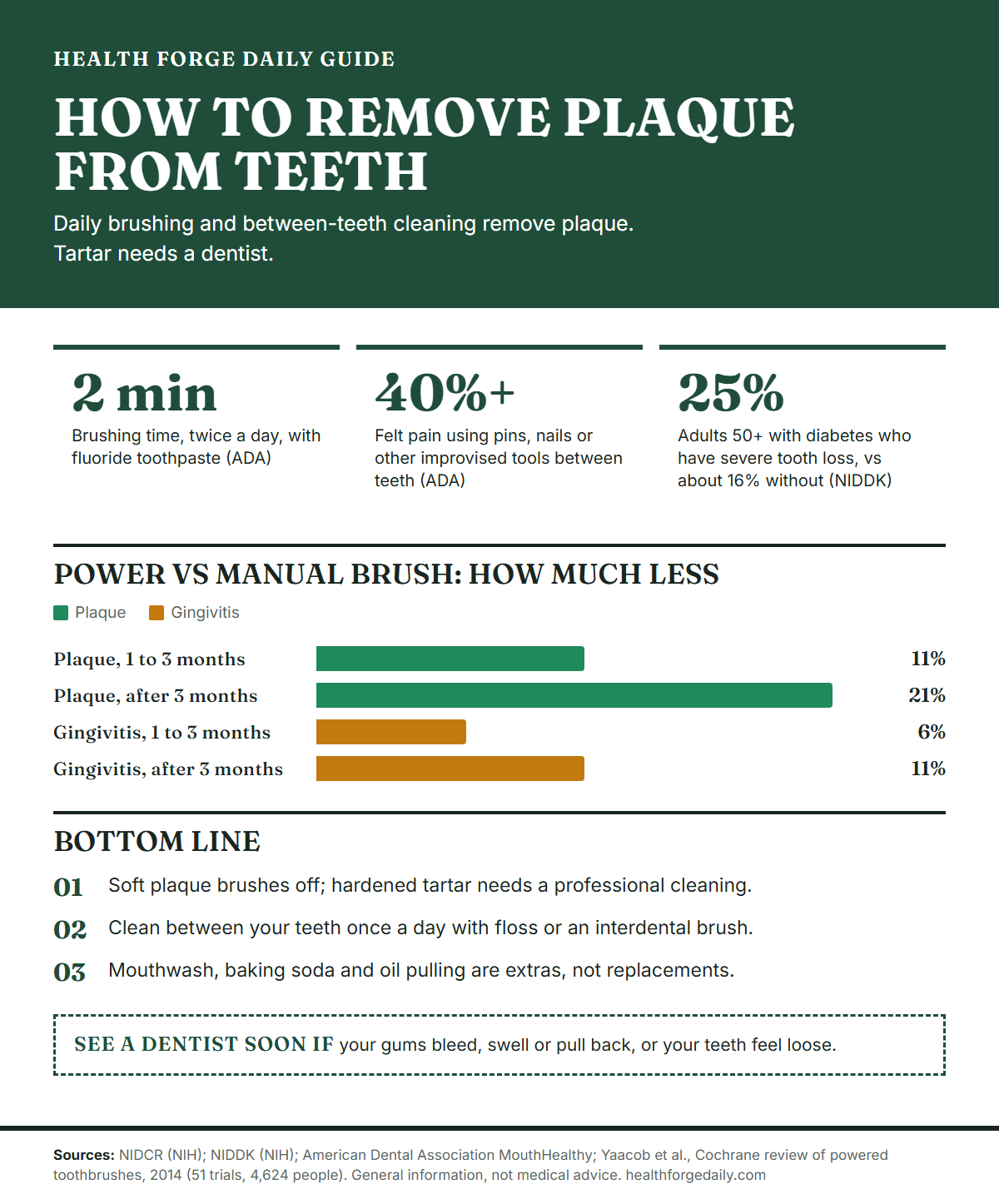
The short answer: brush for two minutes twice a day with fluoride toothpaste and clean between your teeth once a day, because soft plaque comes off with a brush and floss, while hardened tartar can only be removed by a dentist or dental hygienist.[1][6]
| What it is | A sticky, colorless film of bacteria that builds up on teeth[1][2] |
|---|---|
| How to remove it | Brush twice a day for two minutes with a soft brush and fluoride toothpaste[5][6] |
| Between teeth | Floss, interdental brushes, picks or a water flosser once a day[1][6] |
| Best evidence | Cochrane reviews: power brushes and interdental brushes remove somewhat more plaque, with low to moderate certainty[8][9] |
| What home care cannot do | Remove tartar (calculus); that takes a professional cleaning[1][2] |
| See a dentist soon if | Gums bleed, swell or pull back, or teeth feel loose[1][3] |
How to remove plaque from teeth at home, step by step
Plaque is soft, so a toothbrush and a between-the-teeth cleaner remove it every time you use them properly. It keeps forming, though, and plaque that is not removed every day can harden into tartar.[1] That is why the ADA asks for brushing twice daily and cleaning between teeth once daily.[5][6] The steps below follow NIH and ADA guidance.
- Brush twice a day for a full two minutes. A phone timer or a brush with a built-in timer makes this easy.[6]
- Angle a soft brush toward the gumline. The ADA says to hold it at a 45-degree angle and use short, tooth-wide strokes. NIDCR adds that small, gentle circles work and that hard back-and-forth scrubbing should be avoided.[2][5]
- Use fluoride toothpaste. Fluoride strengthens enamel, the hard outer surface that plaque acids attack.[2]
- Clean between your teeth once a day. A brush cannot reach the gaps, so use floss, interdental brushes, picks or a water flosser.[1][6]
- Check your work with disclosing tablets. These drugstore tablets stain leftover plaque so you can see the spots you missed and brush them again.[2]
- Replace your brush every three or four months, or sooner if the bristles fray. A worn brush cleans poorly.[5]
- Cut back on sugary drinks and snacks. Plaque bacteria use sugar to make acid.[5][6]
- Keep regular checkups and cleanings. A hygienist removes any tartar that has already formed.[1]
How to floss so it reaches the plaque
Break off about 18 inches of floss and wind it around your middle fingers. Slide it between two teeth with a gentle rubbing motion, curve it into a C shape against one tooth, and move it up and down along the side of that tooth.[6] Never snap or force floss into the gums, because that can hurt the tissue.[2] Some discomfort is normal at first, but cleaning between teeth should not keep hurting; if it does, ask your dentist.[6]
Can you remove hard plaque from teeth yourself?
Hard plaque is tartar, also called calculus, and only a dentist or dental hygienist can remove it. Daily plaque that is left on the teeth can harden over time. Brushing and flossing will not lift it off once that happens, so the home goal is to stop new tartar from forming.[1][2] When tartar builds up along the gumline it irritates the gums, and that is how gingivitis starts.[2]
The table below helps you sort what you are seeing.
| What you notice | Likely cause | What to do |
|---|---|---|
| A soft, fuzzy film that brushes off | Plaque | Brush and clean between teeth daily[1][6] |
| Stained patches after a disclosing tablet | Plaque you missed | Brush those spots again[2] |
| A hard deposit at the gumline that stays after careful brushing | Possibly tartar | Book a professional cleaning[1][2] |
| Red, swollen gums that bleed easily | Gingivitis | Clean daily and see your dentist[1][3] |
| Gums pulling away or loose teeth | Possible periodontitis | See a dentist soon[1][3] |
Why scraping tartar at home is risky
None of the sources we read support home scraping tools, even though they are easy to buy. NIDCR says only a professional cleaning removes tartar, and it warns that even forcing floss into place can harm the gums.[1][2] In a survey cited by the ADA, more than 40% of people who cleaned between their teeth with improvised objects such as pins or fingernails said it hurt, and the ADA says these objects can be harmful.[6] We found no trials that tested home scalers, so we cannot tell you how often they cause damage.
Before cleaning, a dental team probes the gaps between gums and teeth, which are usually 1 to 3 millimeters deep in a healthy mouth. They can also take x-rays to check for bone loss.[1]
Which tools remove the most plaque?
In a 2014 Cochrane review, power toothbrushes cut plaque 11% more than manual brushes after one to three months and 21% more after three months. The review pooled 51 trials with 4,624 people. The authors rated the evidence moderate and said the clinical importance of the gain is unclear, so a well-used manual brush is still a good tool.[8]
For the spaces between teeth, a 2019 Cochrane review of 35 trials found that floss or interdental brushes added to brushing may reduce gingivitis or plaque more than brushing alone. Interdental brushes may work better than floss. Evidence for water flossers and cleaning sticks was limited and inconsistent.[9]
| Review | Size | What was compared | Main result |
|---|---|---|---|
| Yaacob, Cochrane 2014 | 51 trials, 4,624 people | Power vs manual brush | Plaque 11% lower short term, 21% lower long term; gingivitis 6% and 11% lower[8] |
| Worthington, Cochrane 2019 | 35 trials, 3,929 adults | Floss, interdental brushes, water flossers plus brushing | Floss and interdental brushes may help; low to very low certainty[9] |
| James, Cochrane 2017 | 51 studies, 5,345 people | Chlorhexidine rinse plus brushing | Large plaque reduction; more tooth staining[10] |
| Valkenburg, 2019 | 21 publications | Baking soda toothpaste vs regular | Better in single brushings; only partly confirmed over time[11] |
| Jong, 2024 | 25 trials, 1,184 people | Oil pulling vs mouthwash | Chlorhexidine removed more plaque; very low certainty[12] |
Cleaning plaque around braces
Braces, bridges and other dental work create extra corners where plaque sits. The ADA says a water flosser can help people with braces reach those spots, and small interdental brushes or picks are useful for hard-to-reach areas.[6] Ask your orthodontist which tool fits your appliance.
Does mouthwash remove plaque on teeth?
Mouthwash can help reduce plaque, but the ADA says it does not replace brushing and flossing. Therapeutic rinses contain active ingredients that kill bacteria and can reduce plaque and gingivitis. Cosmetic rinses only freshen breath for a while and do not lower your risk of cavities or gum disease.[7]
Chlorhexidine is the strongest studied rinse. The 2017 Cochrane review found high-quality evidence of a large drop in plaque when people used it alongside brushing, but it also caused a large increase in tooth staining, and some users reported taste changes, mouth soreness or burning.[10] Some therapeutic rinses need a prescription, and your dentist may prescribe one as part of gum treatment.[1][7]
The ADA does not recommend mouthwash for children under 6, since they may swallow it. Look for the ADA Seal of Acceptance on over-the-counter rinses.[7] If your mouth often feels dry, read our guide to dry mouth causes and the medicines that dry you out before adding another rinse.
How to remove plaque from teeth naturally: do baking soda or oil pulling work?
Baking soda toothpaste removed more plaque in single-brushing studies, but the benefit held up only partly in longer trials. A 2019 review of 21 publications also found a small drop in gum bleeding and no difference on the gingival index. The review team had received fees from toothpaste makers in the past.[11]
Oil pulling means swishing an edible oil, often sesame or coconut, around the mouth. A 2024 review of 25 trials with 1,184 people, lasting 7 to 45 days, found chlorhexidine reduced plaque more than oil pulling, and the authors rated the overall evidence very low certainty.[12] Treat it as an extra at most, never as a stand-in for brushing.
There is no natural shortcut that removes plaque instantly. The quickest natural method is still a toothbrush and floss, which clear soft plaque the moment you use them.[6] A fluoride toothpaste that also contains baking soda is a reasonable choice if you like the feel of it.[2][11]
How does sugar make plaque worse?
Plaque bacteria feed on sugar and release acids that attack tooth enamel. The more often you sip sugary drinks or snack on sweets, the more often those acids hit your teeth, which is why the ADA lists limiting sugary beverages and snacks next to brushing and flossing.[5][6]
Blood sugar matters too. NIDDK explains that high glucose levels can raise glucose in saliva, which feeds the bacteria that form plaque, and high glucose raises the risk that gum disease moves from mild to severe.[4] Almost 25% of US adults with diabetes aged 50 and older have severe tooth loss, compared with about 16% of those without diabetes.[4] Our page on normal blood sugar levels shows the target ranges to discuss with your doctor.
NIDDK also lists dry mouth as a sign of mouth problems from diabetes, so mention it to your dentist or doctor if it keeps happening.[4]
What are the warning signs of gum disease?
Red, swollen or bleeding gums are the first sign of gingivitis, the mild stage of gum disease that plaque causes. MedlinePlus says you can usually reverse gingivitis with daily brushing, flossing and regular dental cleanings. Left untreated, it can lead to periodontitis, where gums pull away from the teeth and form infected pockets.[3]
See a dentist soon if
- Your gums bleed easily or look red and swollen[1]
- Your gums are pulling away so teeth look longer[1]
- Teeth feel loose or sensitive, or chewing hurts[1]
- Bad breath does not go away when you brush[1][4]
- You have diabetes and notice any of these changes[4]
Smoking or using tobacco is the most significant risk factor for gum disease, and it also makes treatment less successful. Older age, diabetes and genetics raise the risk as well.[1]
What dentists do first
The dentist or hygienist examines your gums, measures the pockets around each tooth and may take x-rays. Early gum disease often clears with better daily brushing and flossing. Periodontal disease needs professional care, usually scaling and root planing, which is a deep cleaning below the gumline, sometimes with a prescription rinse. Advanced cases may need surgery, and every treatment still depends on good home care.[1]
Daily plaque checklist
Use this list to check your routine against NIH and ADA advice.[1][5][6]
- Brush for two minutes, morning and night, with fluoride toothpaste
- Use a soft brush angled toward the gumline, and replace it every three or four months
- Clean between every tooth once a day with floss or an interdental brush
- Use disclosing tablets now and then to find missed spots
- Choose a mouthwash with the ADA Seal if you use one
- Limit sugary drinks and snacks
- Book a cleaning if you feel hard deposits or see bleeding gums
Browse more teeth and gum health guides for related topics.
Bottom line
When people ask how to remove plaque from teeth, the answer that holds up is the plain routine: two minutes of gentle brushing twice a day with fluoride toothpaste, plus cleaning between the teeth once a day.[5][6] Power brushes and interdental brushes give a modest extra edge, and mouthwash, baking soda and oil pulling are optional extras with weaker or mixed evidence.[8][9][11][12]
For most people, a better between-teeth habit will do more than any new gadget, because the brush cannot reach those gaps at all.[6][9] Once plaque has hardened into tartar, skip the home scraper and book a cleaning.[1]
Sources
- Periodontal (Gum) Disease. National Institute of Dental and Craniofacial Research (NIH)
- Oral Hygiene. National Institute of Dental and Craniofacial Research (NIH)
- Gum Disease. MedlinePlus, National Library of Medicine
- Diabetes, Gum Disease, and Other Dental Problems. NIDDK (NIH)
- Brushing Your Teeth. American Dental Association, MouthHealthy
- Flossing. American Dental Association, MouthHealthy
- Mouthwash. American Dental Association, MouthHealthy
- Powered versus manual toothbrushing for oral health. Yaacob et al., Cochrane Database of Systematic Reviews, 2014
- Home use of interdental cleaning devices, in addition to toothbrushing, for preventing and controlling periodontal diseases and dental caries. Worthington et al., Cochrane Database of Systematic Reviews, 2019
- Chlorhexidine mouthrinse as an adjunctive treatment for gingival health. James et al., Cochrane Database of Systematic Reviews, 2017
- The efficacy of baking soda dentifrice in controlling plaque and gingivitis: a systematic review. Valkenburg et al., International Journal of Dental Hygiene, 2019
- The effect of oil pulling in comparison with chlorhexidine and other mouthwash interventions in promoting oral health: a systematic review and meta-analysis. Jong et al., International Journal of Dental Hygiene, 2024
Frequently asked questions
Can a water flosser remove plaque from teeth?
It can help, but the evidence is thin. A 2019 Cochrane review found water flossers may ease gingivitis at one month, yet they did not clearly remove more plaque than brushing alone. Floss or interdental brushes have somewhat better support.
How to remove plaque from teeth instantly?
Soft plaque comes off as soon as you brush well for two minutes and clean between your teeth. Nothing removes hardened tartar instantly at home. Only a dentist or dental hygienist can take tartar off with a professional cleaning.
How do you remove yellow plaque from teeth?
If a film wipes away with brushing and floss, it is plaque and daily cleaning removes it. If a hard deposit stays at the gumline after careful brushing, it may be tartar, which needs a professional cleaning rather than home scraping.
How to stop plaque building up on teeth?
Brush twice a day with fluoride toothpaste, clean between your teeth once a day, and limit sugary drinks and snacks. Regular dental checkups catch any tartar early, before it irritates the gums and leads to gingivitis.
Can you remove plaque from teeth without brushing?
Not reliably. The ADA says mouthwash is an addition to brushing and flossing, not a replacement. Rinses, baking soda and oil pulling have weaker or mixed evidence, so a toothbrush and floss remain the main way to clear plaque.

Grace Whitaker is the health editor at Health Forge Daily. She reads supplement labels line by line, checks each ingredient and dose against published research, and tracks refund policies and customer complaints before a product gets a verdict. She is not a doctor, so every review points readers back to their own physician for medical decisions.
This article is for general information and is not medical advice. Supplements are not evaluated by the FDA and are not intended to diagnose, treat, cure or prevent any disease. Check with your doctor before you start any supplement.
