Dry mouth, or xerostomia, usually comes from medicines such as some blood pressure, depression and bladder drugs. Sjogren's disease, diabetes, cancer treatment and mouth breathing are other common causes. About 1 in 3 adults over 60 report it, but it is not a normal part of aging. Start with a medicine review, water, sugarless gum and a humidifier, and see a dentist if it lasts.
Dry mouth is most often caused by medicines, followed by conditions such as Sjogren’s disease and diabetes, cancer treatment, and habits like mouth breathing. To write this guide we read the National Institute of Dental and Craniofacial Research (NIDCR) page, MedlinePlus, the American Dental Association, two Cochrane reviews and a 2026 meta-analysis of 174,698 older adults.[1][2][3][8]
If your mouth feels dry most days, look at your medicine list first, because hundreds of medicines can make the salivary glands produce less saliva.[1] About 1 in 3 adults over 60 report the problem.[8]
| What it is | Not enough saliva to keep the mouth wet; the medical term is xerostomia[1] |
|---|---|
| Most common cause | Medicine side effects, including some blood pressure, depression and bladder medicines[1] |
| Other causes | Sjogren’s disease, diabetes, HIV, radiation, chemotherapy, nerve damage, mouth breathing[1][2] |
| How common | 32.4% of adults 60 and older in a 2026 pooled analysis[8] |
| First steps | Water through the day, sugarless gum or candy, less caffeine, no tobacco or alcohol[1] |
| Main risk if ignored | Tooth decay and fungal mouth infections[1] |
| Who to see | A dentist or doctor, who will review your medicines and may test saliva flow[1] |
What is xerostomia, and is it the same as dry mouth?
Xerostomia is the medical term for dry mouth: the feeling of not having enough saliva to keep your mouth wet.[1] The American Dental Association notes that it is a symptom of something else, such as a medical condition or a drug side effect, rather than a disease of its own.[3] Everyone gets a dry mouth now and then, for example when nervous.[2]
Saliva moistens food, washes debris off the teeth, carries calcium and phosphate that keep enamel strong, and contains antibodies that fight mouth and throat infections.[1][2] It also neutralizes acids made by mouth bacteria.[3]
When the mouth stays dry for weeks, low saliva raises the risk of cavities and of fungal infections such as thrush.[1][4] Researchers sometimes separate the feeling of dryness (xerostomia) from a measured drop in flow (hyposalivation). In the 2026 review of older adults, each affected about one third of people.[8]
What causes dry mouth?
The most common cause is medicine; disease, cancer treatment, nerve damage and lifestyle habits make up most of the rest.[1][2] NIDCR and MedlinePlus list the same core group, and the cause usually decides the fix.[1][2]
| Cause | How it dries the mouth | Clue |
|---|---|---|
| Medicines | Signal the salivary glands to make less saliva[1] | Started after a new drug or a dose change |
| Sjogren’s disease | Immune system attacks the glands that make tears and saliva[4] | Dry, gritty eyes as well; often women in their 40s and 50s[4] |
| Diabetes | Linked with dry mouth, thrush and burning mouth[1][9] | Thirst, high blood sugar readings |
| Radiation to the head or neck | Can damage the salivary glands[1][5] | Began during or after cancer treatment |
| Chemotherapy or immunotherapy | Makes saliva thicker[1] | Sticky, stringy saliva |
| Nerve damage | Head or neck injury cuts the signal to the glands[1] | Followed an injury or surgery |
| Mouth breathing, alcohol, tobacco | Dry the mouth tissues[1][2] | Worse in the morning or after drinking |
HIV and other salivary gland disorders are less common causes.[2] If none of these fit, a dentist can look for something less obvious.
Which medicines cause dry mouth?
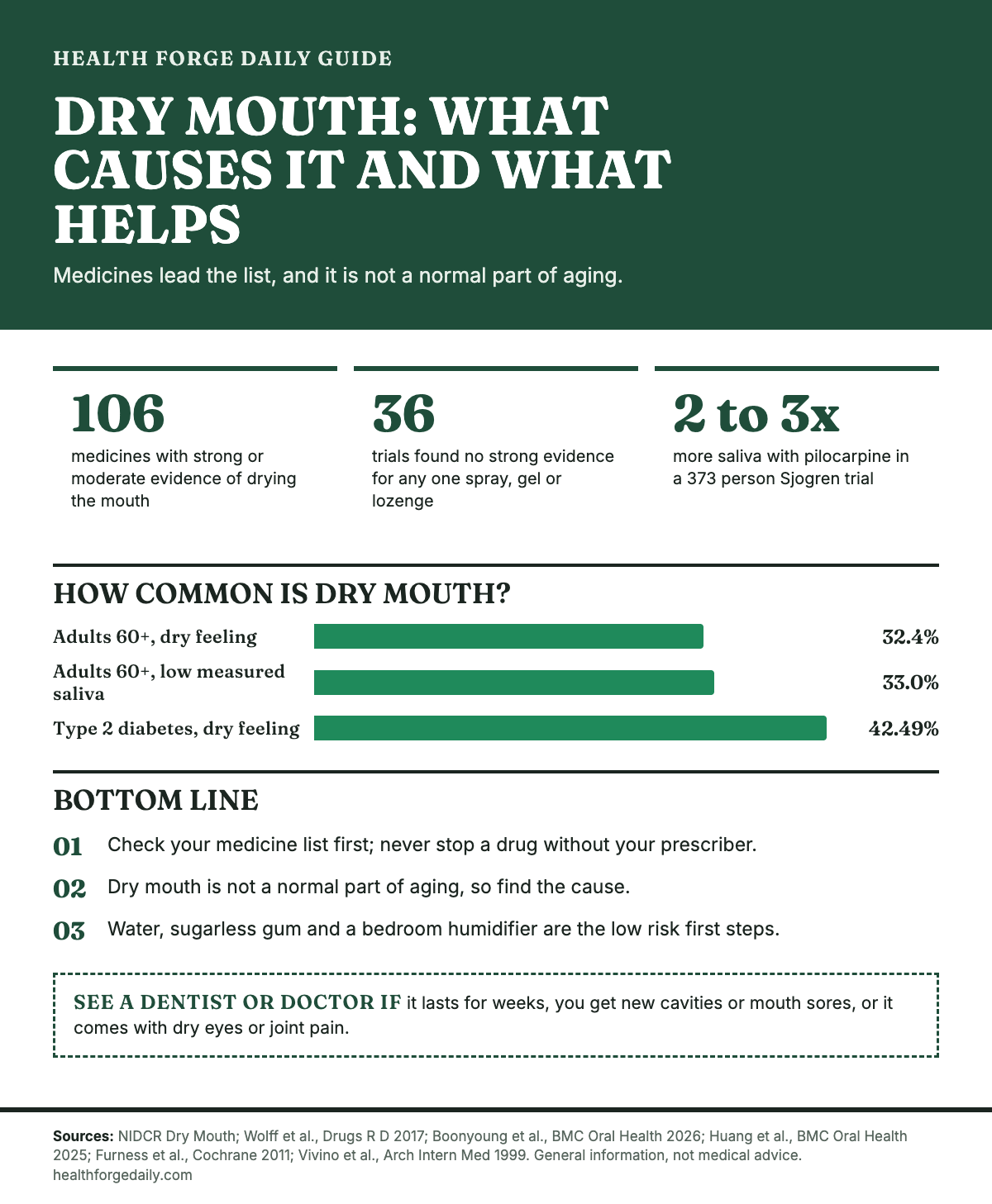
A 2017 systematic review from the World Workshop on Oral Medicine found 56 drugs with strong evidence and 50 more with moderate evidence of drying the mouth, 106 in total.[6] The team screened 3,867 records to build that list.[6] Most of the drugs act on the gut, heart and blood vessels, bladder, nervous system or lungs.[6]
In everyday terms, the groups patients meet most are:
- Blood pressure medicines, including diuretics (water pills)[1][3]
- Antidepressants and other medicines for mood[1]
- Bladder-control medicines for overactive bladder[1]
- Antihistamines and decongestants for allergies and colds[3]
- Pain medicines[3]
The risk adds up when you take several at once. A 2018 review in Drugs and Aging pointed to polypharmacy in older adults as the main driver of medicine-related dryness.[7] The usual approach is to swap to a less drying drug or lower the dose, which only your prescriber should do.[6][7] Never stop a prescription on your own.
What causes dry mouth in older adults?
In older adults the main driver is usually the medicine list, not age itself; NIDCR states plainly that dry mouth is not a normal part of aging.[1] Older people simply take more drugs, and each one can add to the effect.[7]
The 2026 meta-analysis pooled 128 publications with 174,698 people aged 60 and older. It found a pooled rate of 32.4% for the dry feeling and 33.0% for low measured saliva.[8] The authors flagged high variation between studies and a high risk of bias in most, so treat those figures as rough.[8]
Long-term conditions common later in life also play a part. A 2025 review of 23 studies with 2,486 people with type 2 diabetes put the rate of the dry feeling at 42.49%.[9] If your blood sugar has been creeping up, our guide to prediabetes and the A1C range explains the numbers to ask about.
What causes dry mouth at night?
Night-time dryness usually comes from breathing through your mouth while you sleep, a dry bedroom, or medicines taken in the evening.[1][2]
Steps that target the night:
- Run a humidifier in the bedroom, which both NIDCR and MedlinePlus suggest.[1][2]
- Keep water by the bed and sip when you wake.[5]
- Skip alcohol and tobacco in the evening, since both dry the mouth.[1]
- Ask your prescriber whether a drying evening dose could be moved.[6]
MedlinePlus lists mouth breathing as a cause in its own right, so tell your doctor if you wake with your mouth open or your nose often feels blocked.[2]
What does dry mouth feel like?
The classic signs are a sticky, dry feeling in the mouth plus trouble chewing, swallowing, tasting or speaking.[1] People with Sjogren’s often describe a chalky feeling.[4]
Other signs listed by NIDCR and MedlinePlus include:[1][2]
- A burning or itchy feeling in the mouth or throat
- A dry throat, hoarseness or a sore throat that will not settle[3]
- Cracked lips
- A dry, rough or red tongue, sometimes with deep cracks
- Mouth sores and repeat mouth infections
- Bad breath
Bad breath is common here because saliva normally rinses away food and germs. Our fresh breath section covers that problem on its own. A sore or burning tongue can have other causes, and our page on vitamin B12 deficiency symptoms covers one of them.
How do doctors find the cause?
A dentist or doctor will review your medical history and every medicine you take, look in your mouth, and may order blood tests or a test that measures how much saliva you make.[1][2] The goal is to find the cause, since treatment depends on it.[2]
Bring a full list of prescriptions, over-the-counter drugs and supplements to the visit. Mention dry eyes, joint pain or tiredness, because those point toward Sjogren’s disease.[4] Tell them about any past radiation to the head or neck.[5]
What is the best dry mouth treatment?
The best treatment fixes the cause, such as changing a drying medicine, then adds simple relief: water, sugarless gum or candy, and saliva substitutes.[1][2] Your provider may also prescribe artificial saliva or a medicine that helps the glands work.[2]
Over-the-counter options include lozenges, sprays, gels and mouthwashes made for dry mouth.[2][10] The ADA suggests choosing products that carry its Seal of Acceptance.[3]
Evidence for these products is thin: a Cochrane review of 36 trials with 1,597 people found no strong evidence that any topical product works well.[10] One spray type beat a plain electrolyte spray by about 2 points on a 10-point dryness scale.[10] Chewing gum raised saliva in people whose glands still worked, and did as well as substitutes.[10]
A second Cochrane review looked at drug-free methods in 9 studies with 366 people. Acupuncture after radiotherapy did not ease the dry feeling more than sham acupuncture in the 70 people with usable data.[11]
| Option | Studied in | What was found |
|---|---|---|
| Saliva substitutes and stimulants (sprays, gels, lozenges, gum) | 36 trials, 1,597 people[10] | No strong evidence for any one product; gum helps if glands still work[10] |
| Acupuncture after radiotherapy | 2 pooled trials, 70 people[11] | No clear difference from sham for the dry feeling[11] |
| Pilocarpine tablets, Sjogren’s | 1 trial, 373 people, 12 weeks[12] | 5 mg four times daily raised saliva flow 2 to 3 times[12] |
| Water, sugarless gum, humidifier | Standard NIH advice[1] | Low cost, low risk first steps[1] |
Does pilocarpine for dry mouth work?
Pilocarpine is a prescription tablet that stimulates the salivary glands, and it helps people whose glands still produce some saliva.[7][12] In a 1999 trial of 373 people with Sjogren’s, 5 mg taken 4 times a day raised saliva flow 2 to 3 times and improved dryness over 12 weeks.[12] Sweating was the most common side effect.[12]
Pilocarpine and a similar drug, cevimeline, are the most prescribed medicines for this problem.[7] They can also cause nausea, vomiting and narrowing of the airways, so older adults need close follow-up.[7] Only a prescriber can decide whether either drug suits you.
Daily relief plan: what to try first
This is a simple order of steps built from NIDCR, MedlinePlus and NCI advice.[1][2][5]
- Drink water through the day. NIDCR suggests 8 to 12 cups (2 to 3 liters) unless your doctor limits fluids.[1]
- Sip water or a sugarless drink with meals to make chewing and swallowing easier.[1]
- Chew sugarless gum or suck sugarless hard candy; citrus, cinnamon or mint flavors work well, and xylitol versions may help protect teeth.[1]
- Cut back on coffee, tea and caffeinated sodas.[1]
- Avoid tobacco and alcohol, which both dry the mouth.[1][2]
- Go easy on spicy and salty foods, which can sting a dry mouth.[1]
- Run a humidifier at night.[1]
- Use a mouthwash or saliva substitute made for dry mouth, and a lip balm for cracked lips.[2][5]
Safety: when to see a doctor about dry mouth
Most dryness is uncomfortable more than dangerous. Still, if it lasts for weeks, NIDCR advises seeing a dentist or doctor to find out why.[1]
See a doctor or dentist promptly if:
- You cannot eat or drink enough, which can lead to dehydration and poor nutrition[5]
- Dry mouth comes with dry, gritty eyes, joint pain or swollen glands near the face or neck[4]
- You notice white patches, mouth sores or repeat infections[1][9]
- You have new cavities despite good brushing[1]
- It began after a new medicine, so the prescriber can review it[6]
If you have asthma or another lung condition, or already take several prescriptions, ask before trying a prescription saliva stimulant, since these drugs have whole-body side effects.[7]
What do doctors use first?
Standard care starts with the cause. If a medicine is to blame, the doctor or dentist may change it or adjust the dose.[1] Then come artificial saliva, products that keep the mouth moist, and the self-care steps above.[1][2] For Sjogren’s or damage after radiation, a prescription stimulant such as pilocarpine may be added.[7][12]
Protecting the teeth is part of the plan. Brush and floss daily and see a dentist at least twice a year.[2] A supplement is not a substitute for any of this; you can read how we review health evidence for the standards we use.
Dry mouth checklist
- Write down every medicine and supplement you take, with doses.[1]
- Note when the dryness is worst: night, morning, after meals.
- Check for dry eyes, joint pain or thirst and mention them.[4][9]
- Pick sugar-free gum, candy and drinks to protect your teeth.[1]
- Look for the ADA Seal on rinses and sprays.[3]
- Book a dental check if it has lasted more than a few weeks.[1]
Bottom line
A mouth that is dry most of the time is a signal to check your medicines and your health, since aging alone does not explain it.[1] The causes are well known, and about a third of older adults deal with it.[8]
For most people, a medicine review with a doctor or pharmacist is the better first step than buying sprays and lozenges, because the Cochrane evidence for those products is weak while changing a drying drug removes the cause.[6][10] Use water, sugarless gum and a humidifier for comfort while you sort out the reason.
Sources
- Dry Mouth. National Institute of Dental and Craniofacial Research, NIH, reviewed 2024
- Dry Mouth (Xerostomia). MedlinePlus, National Library of Medicine
- Dry Mouth. American Dental Association, MouthHealthy
- Sjogren's Disease. NIAMS, NIH, reviewed 2024
- Mouth and Throat Problems and Cancer Treatment. National Cancer Institute
- A Guide to Medications Inducing Salivary Gland Dysfunction, Xerostomia, and Subjective Sialorrhea. Wolff et al., Drugs R D, 2017
- Medication-Induced Xerostomia and Hyposalivation in the Elderly. Barbe, Drugs and Aging, 2018
- Prevalence of xerostomia and hyposalivation in older adults: a systematic review and meta-analysis. Boonyoung et al., BMC Oral Health, 2026
- Prevalence of xerostomia in patients with type 2 diabetes mellitus: a systematic review and meta-analysis. Huang et al., BMC Oral Health, 2025
- Interventions for the management of dry mouth: topical therapies. Furness et al., Cochrane Database of Systematic Reviews, 2011
- Interventions for the management of dry mouth: non-pharmacological interventions. Furness et al., Cochrane Database of Systematic Reviews, 2013
- Pilocarpine tablets for dry mouth and dry eye symptoms in Sjogren syndrome. Vivino et al., Archives of Internal Medicine, 1999
Frequently asked questions
Is dry mouth a normal part of aging?
No. NIDCR says dry mouth is not a normal part of aging. It is common in older adults mainly because they take more medicines that reduce saliva, so a medicine review is the right first step.
Do dry mouth lozenges and sprays work?
They can ease dryness for a short time, but a Cochrane review of 36 trials found no strong evidence that any one topical product works well. Sugarless gum did about as well as saliva substitutes in people whose glands still work.
Can diabetes cause dry mouth?
Yes. NIDCR lists diabetes as a cause, and a 2025 review of 23 studies found that about 42 percent of people with type 2 diabetes reported a dry mouth. Keeping blood sugar in range is part of managing it.
What is the medical term for dry mouth?
The medical term is xerostomia, which means the feeling of not having enough saliva to keep the mouth wet. A measured drop in saliva flow is called hyposalivation, and the two often occur together.
Which dry mouth mouthwash should I use?
MedlinePlus suggests a mouthwash made for dry mouth rather than a regular rinse. For safe, effective relief, the American Dental Association advises looking for products that carry its Seal of Acceptance.

Grace Whitaker is the health editor at Health Forge Daily. She reads supplement labels line by line, checks each ingredient and dose against published research, and tracks refund policies and customer complaints before a product gets a verdict. She is not a doctor, so every review points readers back to their own physician for medical decisions.
This article is for general information and is not medical advice. Supplements are not evaluated by the FDA and are not intended to diagnose, treat, cure or prevent any disease. Check with your doctor before you start any supplement.