To treat gout, start colchicine, an NSAID or a corticosteroid as early in a flare as you can, and ice, rest and raise the joint. If you get 2 or more flares a year, a daily urate-lowering medicine such as allopurinol, adjusted until uric acid stays under 6 mg/dL, is what stops flares returning. Diet changes help but rarely work alone.
If you want gout pain that does not keep coming back, this guide shows how to treat gout during a painful flare and over the long run. We read the NIAMS gout pages, the MedlinePlus gout summary, the 2020 American College of Rheumatology (ACR) guideline and nine trials on flare medicines, ice, diet and urate-lowering care.[1][3][4]
The short answer: start an anti-inflammatory medicine (colchicine, an NSAID or a steroid) as early in a flare as you can, ice and rest the joint, and if you get 2 or more flares a year, take a daily urate-lowering medicine until your uric acid stays under 6 mg/dL.[2][4]
| What gout is | Inflammatory arthritis caused by needle-shaped urate crystals in and around a joint[1] |
|---|---|
| How long a flare lasts | Usually a week or two, often starting suddenly at night[1] |
| Flare medicines | Colchicine, NSAIDs or corticosteroids, all strongly recommended by the ACR[4] |
| Home care during a flare | Ice, rest and raising the joint[2] |
| Long-term goal | Serum urate below 6 mg/dL with a urate-lowering medicine such as allopurinol[4] |
| Diet role | Helps, but lifestyle changes alone do not control frequent flares or tophi[2] |
| Who should be careful | People with kidney disease, heart disease or stomach ulcers need their doctor to pick the medicine[4][10] |
What is the fastest way to calm a gout flare?
The fastest way to calm a gout flare is to start an anti-inflammatory medicine within the first hours of pain. The ACR strongly recommends colchicine, an NSAID or a corticosteroid as first-line flare treatment, chosen to fit your other health conditions. Ice, rest and raising the joint help on top of the medicine.[4][2]
Timing matters most, so do not wait for the pain to peak. NIAMS notes that colchicine works best when taken as soon as symptoms appear.[2] The ACR patient panel backed a “medicine in your pocket” plan, so people who know the early signs of a flare can start treatment at home without waiting for an appointment.[4]
None of the three drug types clearly beats the others for pain. In a 2008 trial of 120 people, prednisolone 35 mg a day and naproxen 500 mg twice a day for 5 days cut pain by almost the same amount.[6] A larger 2016 emergency room trial of 416 people found prednisolone and indomethacin equal for pain, with fewer minor side effects on prednisolone in the first hours (6% vs 19%).[7]
No medicine ends a flare in minutes. In the AGREE trial, low-dose colchicine halved pain within 24 hours for about 38% of people, and a flare usually settles within a week or two.[5][1]
How to treat gout at home, step by step
At home, treat a gout flare by taking the flare medicine your doctor approved, icing and resting the joint, and keeping it raised. Home care eases pain and swelling, but it does not lower the uric acid that causes gout. These steps follow NIAMS advice and the ACR guideline.[2][4]
- Start your flare medicine at the first twinge. Use the colchicine, NSAID or steroid plan your doctor gave you, at the prescribed dose.[4]
- Ice the joint. Wrap an ice pack in a cloth and apply it for short sessions. The ACR conditionally recommends ice as an add-on to medicine.[4]
- Rest the joint. Stay off a gouty foot or knee as much as you can.[2]
- Raise it. Keep the limb up on pillows when you can to reduce swelling.[2]
- Skip alcohol and sugary drinks. NIAMS lists both, including nonalcoholic beer, as drinks to cut back on.[2]
- Keep taking your urate-lowering pill if you already use one. The ACR even favors starting it during a flare once the decision is made.[4]
- Call your doctor if this is your first flare. A doctor can confirm gout with a joint fluid test or blood test.[3]
How is gout in the big toe and feet treated?
Gout in the big toe or foot is treated the same way as gout anywhere else: an early flare medicine, ice, rest and elevation. The big toe is the most common place for a first gout flare, and the treatment does not change by joint. What changes is how you protect the foot while it heals.[1][2]
MedlinePlus notes that gout usually hits one joint at a time, most often the big toe, but it can also strike other toes, the ankle and the knee.[3] Flares often start suddenly at night, and the pain can be bad enough to wake you up.[1]
Practical foot care during a flare:
- Wear a loose sandal or open shoe so nothing presses on the toe.
- Prop the foot on pillows when sitting or lying down.[2]
- Ice the top and sides of the toe, with a cloth between ice and skin.[4]
- Limit walking until the swelling goes down.[2]
Repeated flares in the feet are a sign that uric acid needs treatment. Left untreated, gout can form tophi, hard crystal lumps that can damage bone and joints.[1]
What helps gout in the knee, ankle or hand?
Gout in the knee, ankle, hand, finger or elbow uses the same flare medicines as gout in the toe. For one large joint such as the knee, a doctor may inject a corticosteroid directly into the joint, which the ACR lists as a first-line option. Ice, rest and elevation still apply.[4][2]
A knee or ankle flare is a good reason to see a doctor in person. NIAMS says a provider may draw fluid from the painful joint and look for urate crystals under a microscope, which confirms the diagnosis.[2] This matters because a related condition, calcium pyrophosphate arthritis (pseudogout), can look the same but has a different cause.[3]
Over years of untreated gout, tophi can form under the skin and around joints, including in the hands.[1] Gout can also inflame bursae, the fluid sacs near joints such as the elbow.[1] For a hand flare, keep the hand raised on a pillow, rest it in a comfortable position and use ice in short sessions.[2]
What medications do doctors use for gout?
Doctors use two groups of gout medicines: flare medicines that calm inflammation, and urate-lowering therapy (ULT) that removes the cause. Allopurinol is the ACR’s preferred first urate-lowering medicine, started at 100 mg a day or less and raised until serum urate is below 6 mg/dL.[4]
Flare medicines include NSAIDs such as ibuprofen or naproxen, colchicine, and corticosteroids by mouth or injection.[3] For colchicine, the ACR strongly prefers the low-dose plan, because it works as well as high doses with fewer side effects.[4]
Urate-lowering options include xanthine oxidase inhibitors (allopurinol, febuxostat), uricosurics that help the kidneys flush urate, and pegloticase, a uricase drug for gout that has not responded to other medicines.[2] When starting ULT, the ACR strongly recommends taking a low-dose flare preventer, such as colchicine, for at least 3 to 6 months, because shorter courses were linked to flares when the preventer stopped.[4]
What the trials found
| Trial | Who and how many | What was tested | Result |
|---|---|---|---|
| AGREE, 2010[5] | 184 people in a gout flare | Colchicine 1.8 mg over 1 hour vs 4.8 mg over 6 hours vs placebo | Pain halved at 24 hours in 37.8% (low dose), 32.7% (high dose), 15.5% (placebo) |
| Janssens, 2008[6] | 120 primary care patients | Prednisolone 35 mg vs naproxen 500 mg twice daily, 5 days | Pain fell 44.7 vs 46.0 mm on a 100 mm scale; equivalent |
| Rainer, 2016[7] | 416 emergency room patients | Prednisolone vs indomethacin | Equal pain relief; fewer early minor side effects with prednisolone |
| Schlesinger, 2002[8] | 19 people in a flare | Ice added to steroid plus colchicine | Pain fell 7.75 vs 4.42 cm on a 10 cm scale; very small trial |
| Doherty, 2018[9] | 517 people with recent flares | Nurse-led treat-to-target ULT vs usual care, 2 years | 95% vs 30% reached urate below 6 mg/dL |
| CARES, 2018[10] | 6,190 people with gout and heart disease | Febuxostat vs allopurinol | Similar heart events, but higher death rates on febuxostat |
Can gout be treated naturally?
You can lower your flare risk with natural steps, but you cannot reliably treat established gout without medicine. NIAMS states that when gout causes frequent flares or tophi, lifestyle changes alone are not sufficient. Diet, weight and drink changes work best alongside urate-lowering medicine.[2]
The ACR conditionally recommends limiting alcohol, purine-rich foods and high-fructose corn syrup, and losing weight if you carry extra pounds.[4] People who limited or stopped alcohol had serum urate about 1.6 mg/dL lower than those who did not.[4] In a DASH feeding trial, the DASH diet lowered urate by 0.25 mg/dL overall and by 0.73 mg/dL in people who started at 8 mg/dL or higher.[11] Our anti-inflammatory diet guide with meal ideas covers a similar way of eating.
Popular remedies have weaker support. Cherry intake was linked to a 35% lower risk of flares in an observational study of 633 people, but the ACR rated this kind of evidence too weak for a recommendation.[12][4] Vitamin C at 500 mg a day lowered urate by only 0.23 mg/dL in 8 weeks, against 1.9 mg/dL for allopurinol.[13] If you are curious about spices, our review of turmeric benefits and side effects explains what curcumin studies show, and none of it replaces gout medicine.
Can gout be cured for good?
Gout cannot be cured in the sense of a one-time fix, but it can be controlled so well that flares stop. NIAMS calls gout one of the most controllable forms of arthritis, and many people become flare free with treatment and lifestyle changes. The key is keeping uric acid low for years.[1]
The ACR strongly recommends urate-lowering therapy for people with tophi, joint damage on X-rays, or 2 or more flares a year.[4] After a first flare, the ACR usually advises waiting, unless you also have kidney disease (stage 3 or worse), urate above 9 mg/dL or kidney stones.[4]
Treat-to-target care has strong trial support. In the 2018 Nottingham trial, 95% of people in nurse-led care reached a urate below 6 mg/dL at 2 years, against 30% with usual care.[9] The ACR also favors staying on ULT long term; in one case series, only 13% of 211 people who stopped ULT stayed flare free over 5 years.[4]
When should you see a doctor for gout?
See a doctor for your first suspected gout flare, and again if flares keep coming back or last longer each time. A joint fluid test is the surest way to confirm gout, because other conditions can look like it. Your doctor can also check kidney function before choosing a medicine.[2][3][4]
Book a visit soon if:
- This is your first flare and you are not sure it is gout.[2]
- Flares are coming more often or lasting longer, which NIAMS says happens when gout goes untreated.[1]
- You see hard lumps under the skin near a joint (possible tophi).[1]
- You have signs of a kidney stone, since high uric acid can cause stones.[1]
- You take a water pill, low-dose aspirin or cyclosporine and keep getting flares.[1]
Who needs extra care with gout medicines
NSAIDs, colchicine and steroids all carry risks, so your doctor matches the drug to your health.[4] High-dose colchicine caused diarrhea in 76.9% of people in the AGREE trial, against 23.0% on the low dose.[5] The ACR suggests HLA-B*5801 gene testing before allopurinol for people of Southeast Asian descent and African American patients.[4]
People with heart disease taking febuxostat may be switched to another medicine, because the CARES trial found higher death rates with it.[10][4] Some medicines raise urate, including diuretics and low-dose aspirin, but the ACR advises against stopping low-dose aspirin you take for your heart.[1][4] Never stop or swap a medicine without your doctor.
Your gout treatment checklist
- Keep a flare plan from your doctor, with the medicine and dose written down.[4]
- Have an ice pack and a pillow ready for elevation.[2]
- Ask for a serum urate test and your target number, usually below 6 mg/dL.[4]
- If you have 2 or more flares a year, ask whether you need urate-lowering therapy.[4]
- Cut back on alcohol, sugary drinks, organ meats and shellfish.[2]
- Drink fluids through the day; see how much water you should drink a day for general targets.
- Bring a list of all your medicines, including water pills and aspirin, to each visit.[1]
More guides on sore joints sit in our joint pain section, and you can read how we review health evidence.
Bottom line
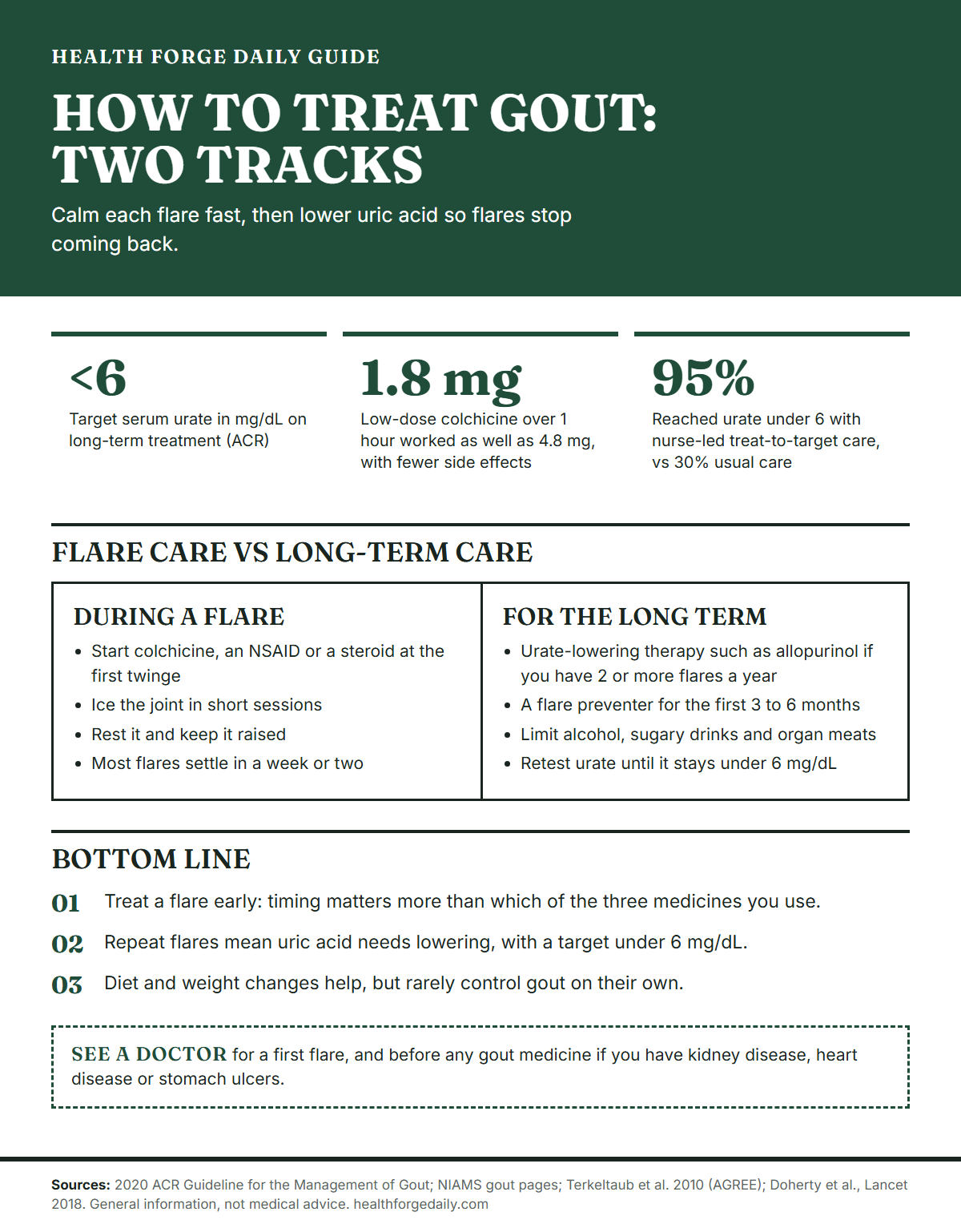
Gout care runs on two tracks. Calm each flare early with colchicine, an NSAID or a steroid plus ice and rest, and if flares keep coming, lower uric acid below 6 mg/dL with a daily medicine such as allopurinol.[4][2]
For most people with repeat flares, the better first step is a urate test and a talk about allopurinol, because diet changes alone move urate only a little. Food and drink changes still help, and a healthy weight and diet also lower the heart risks that often come with gout.[2]
Sources
- Gout: Symptoms, Causes, and Risk Factors. NIAMS, National Institutes of Health
- Gout: Diagnosis, Treatment, and Steps to Take. NIAMS, National Institutes of Health
- Gout. MedlinePlus, National Library of Medicine
- 2020 American College of Rheumatology Guideline for the Management of Gout. American College of Rheumatology, Arthritis Care and Research, 2020
- High versus low dosing of oral colchicine for early acute gout flare (AGREE). Terkeltaub et al., Arthritis and Rheumatism, 2010
- Use of oral prednisolone or naproxen for the treatment of gout arthritis. Janssens et al., The Lancet, 2008
- Oral prednisolone in the treatment of acute gout: a randomized trial. Rainer et al., Annals of Internal Medicine, 2016
- Local ice therapy during bouts of acute gouty arthritis. Schlesinger et al., Journal of Rheumatology, 2002
- Efficacy and cost-effectiveness of nurse-led care for gout. Doherty et al., The Lancet, 2018
- Cardiovascular safety of febuxostat or allopurinol in patients with gout (CARES). White et al., New England Journal of Medicine, 2018
- Effects of dietary patterns on serum urate: results from the DASH trial. Juraschek et al., Arthritis and Rheumatology, 2021
- Cherry consumption and decreased risk of recurrent gout attacks. Zhang et al., Arthritis and Rheumatism, 2012
- Clinically insignificant effect of supplemental vitamin C on serum urate in gout. Stamp et al., Arthritis and Rheumatism, 2013
Frequently asked questions
How long does a gout flare last?
A gout flare usually lasts a week or two and then settles, according to NIAMS. Starting a flare medicine early can shorten the worst of the pain. Between flares most people have no symptoms, though untreated flares tend to come more often over time.
Does ice help gout pain?
Yes, ice helps as an add-on to medicine. In a small trial of 19 people, those who added ice had a larger drop in pain. The ACR conditionally recommends ice during flares. Wrap it in a cloth and use short sessions.
How do you treat gout in the elbow?
Gout in the elbow often inflames the bursa, a fluid sac near the joint. It is treated with the same flare medicines as other joints. A doctor may draw fluid from the swollen bursa to check for urate crystals and confirm the diagnosis.
What foods should you avoid with gout?
NIAMS advises limiting red meat, organ meats such as liver, shellfish, sardines and anchovies, plus alcohol, including nonalcoholic beer, and sugary drinks such as soda. The DASH eating plan, rich in vegetables, fruit and whole grains, may also lower uric acid.
Does gout always start in the big toe?
No. The big toe is the most common first spot, but gout can start in other toes, the ankle, the knee, the hands or the elbow. It usually affects one joint at a time, and treatment is the same whichever joint flares.

Grace Whitaker is the health editor at Health Forge Daily. She reads supplement labels line by line, checks each ingredient and dose against published research, and tracks refund policies and customer complaints before a product gets a verdict. She is not a doctor, so every review points readers back to their own physician for medical decisions.
This article is for general information and is not medical advice. Supplements are not evaluated by the FDA and are not intended to diagnose, treat, cure or prevent any disease. Check with your doctor before you start any supplement.