The best ways to improve memory are regular aerobic exercise, 7 to 9 hours of sleep, testing yourself instead of rereading, and spacing out review. A trial of 120 older adults found a year of walking grew the hippocampus by 2%. Large trials of ginkgo and omega-3 pills found no memory benefit, and a daily multivitamin gave only a small gain.

To work out how to improve memory, we read the National Institute on Aging guidance on brain health, the NCCIH research digest on supplements, and seven trials and reviews on exercise, study methods, diet, multivitamins, ginkgo and omega-3.[1][3] We used our review process and left out anything we could not trace to a source.
The short answer: regular aerobic exercise, 7 to 9 hours of sleep, testing yourself instead of rereading, and spacing out review have the best support, while most memory supplements showed little or no benefit in large trials.[1][6][7][8][11][12]
| What helps most | Aerobic exercise, enough sleep, self-testing and spaced review[1][6][7][8] |
|---|---|
| Sleep target | Generally 7 to 9 hours a night for older adults[1] |
| Best exercise data | A year of walking grew the hippocampus by 2% in 120 older adults[6] |
| Diet | MIND and Mediterranean patterns look good in observational data, but a 3-year trial found no edge over a control diet[4][9] |
| Supplements | One trial of 3,562 adults found a small recall gain from a multivitamin; ginkgo and omega-3 pills showed no benefit[10][11][12] |
| See a doctor if | Memory changes make driving, using the phone or finding your way home hard[2] |
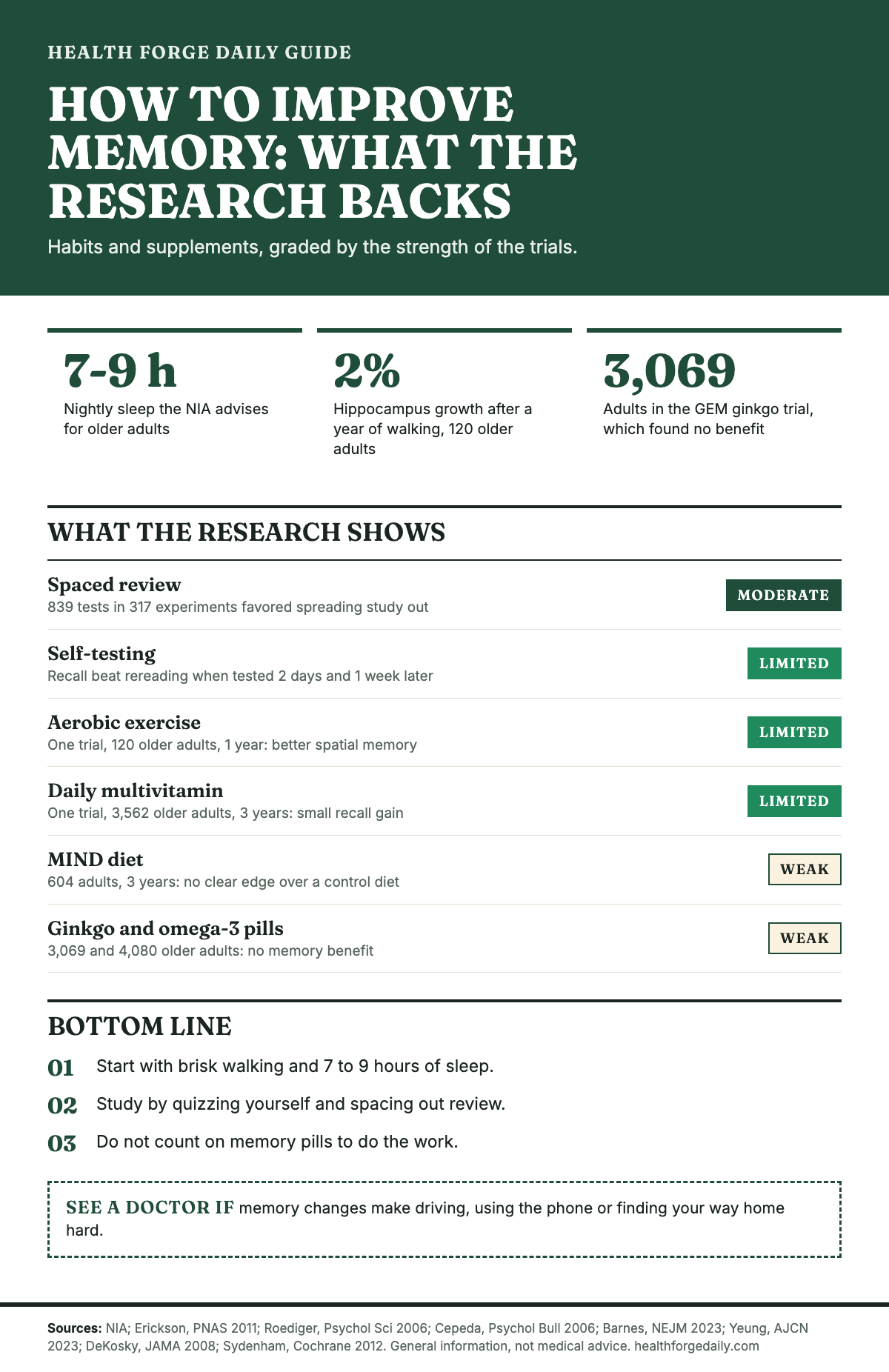
How to improve memory: 8 steps with the best evidence
The habits with the most support are moving your body, sleeping enough, quizzing yourself, and spreading out practice. None of them costs money. Here they are in the order we would start, based on the strength of the research we read.[1][6][7][8]
- Walk briskly most days. In a 1-year trial, aerobic walking grew the memory center of the brain and improved spatial memory in older adults.[6]
- Protect 7 to 9 hours of sleep. The NIA lists this range for older adults as part of keeping the brain healthy.[1]
- Test yourself instead of rereading. Recalling material from memory beat restudying it when people were tested 2 days or a week later.[7]
- Space your review. A review of 317 experiments found that spreading study sessions apart helps people keep what they learn.[8]
- Learn a hard new skill. Older adults who learned quilting or digital photography had more memory improvement than those who only socialized.[1]
- Use outside memory tools. The NIA suggests to-do lists, calendars and notes for everyday forgetfulness.[2]
- Get blood pressure checked. In SPRINT MIND, people 50 and older who lowered systolic pressure below 120 mmHg had less mild cognitive impairment over five years.[1]
- Review your medicines and alcohol. Some allergy pills, sleep aids and bladder drugs can dull thinking, so ask your doctor about each one.[1]
If you only change one thing this month, make it the walking, since it has trial data in older adults and doctors also use exercise to help lower blood pressure.
Why social contact and hobbies count
People and projects give the brain regular work. In an analysis of more than 7,000 adults aged 65 and older, high social engagement, such as visiting neighbors and volunteering, was linked with better thinking later in life.[1]
That kind of study shows a link, not proof of cause. Still, early results from the I-CONECT trial, which included almost 200 adults aged 75 and older, suggested that regular internet video chats could lower the risk of cognitive decline and social isolation.[1]
The NIA also points to music, theater, dance and creative writing as activities that show promise for memory and well-being, while noting that more research is needed.[1] A weekly class or club covers two steps at once: new learning and time with other people.
Hearing and vision count too. The NIA advises treating age-related hearing or vision loss as part of caring for cognitive health, so an overdue eye or hearing exam belongs on the list.[1]
Does exercise improve memory?
Yes, aerobic exercise has some of the strongest trial evidence for memory of any habit. In a randomized trial of 120 older adults published in 2011, a year of aerobic training increased the size of the front of the hippocampus by 2% and improved spatial memory.[6]
The authors estimated this offset about 1 to 2 years of normal age-related shrinkage. In the comparison group, hippocampal volume went down over the same year, though people who were fitter at the start lost less.[6]
The NIA calls these results encouraging but says more research is needed on how much exercise protects against decline over the long run.[1] We agree. One trial of 120 people is a good start and needs repeating in larger groups.
A sensible plan is the one the trial used in spirit: brisk walking you can keep up, building toward most days of the week. If you have heart disease or have not been active, check with your doctor before starting a hard program.[1]
How much does sleep affect memory retention?
The NIA advises older adults to get generally 7 to 9 hours of sleep a night as part of keeping the brain healthy. It lists sleep next to exercise, blood pressure and social contact as habits that support thinking and memory, and it is one of the easiest to fix first.[1]
Many things that hurt sleep also hurt memory. Alcohol near bedtime is one, and the NIA advises limiting alcohol for brain health.[1] Some over-the-counter sleep aids and antihistamines are on the NIA list of drugs that can impair thinking in older adults.[1]
A nightly allergy or sleep pill may be making your memory worse, so ask a pharmacist to check your list. Our guide to the best supplements for sleep, ranked by evidence covers options with fewer effects on next-day thinking.
If you snore loudly, wake gasping or feel tired after a full night in bed, tell your doctor. Those are signs worth checking before you try any memory product.
What memory improvement tips work best for studying?
Retrieval practice, which means quizzing yourself from memory, works better than rereading for keeping information over days and weeks. In a 2006 study, students who took recall tests on a passage remembered more after 2 days and after 1 week than students who restudied it the same number of times.[7]
Rereading felt better to the students. Those who restudied were more confident, even though they remembered less later.[7]
Spacing is the second tool. A 2006 review pooled 839 tests of spaced practice from 317 experiments and found that breaking study into separate sessions beat cramming. The best gap between sessions grew with how long you need to remember the material.[8]
A simple way to use both
- After reading something, close it and write down what you remember.
- Check your notes, fix gaps, and try again the next day.
- Review again after a few days, then after a week or two.
- Use flashcards that ask a question, not cards you just reread.
These tips work for exams, work training and learning names at a new job. They also fit the NIA advice to keep learning new skills as you age.[1]
Can what you eat help your memory?
Diets like MIND and Mediterranean are linked with better thinking in observational studies, but a 3-year trial did not find a clear edge over a healthy control diet. The MIND diet stresses leafy greens, berries, whole grains, beans, nuts, fish at least weekly and olive oil.[4]
The NIA says the evidence for both diets is mixed.[4] In the 2023 MIND diet trial, 604 older adults with a family history of dementia followed either MIND or a control diet, and both groups also cut calories a little.[9]
After 3 years, both groups improved on memory and thinking tests. The MIND group gained 0.205 units and the control group 0.170 units, a difference that was not statistically significant. Brain scans were also similar.[9]
Our reading: eating more vegetables, beans and fish is still a good idea for heart and blood pressure, which matter for the brain.[1] A single food or diet is unlikely to sharpen memory on its own. Fish in the diet has more consistent support than fish oil pills.[3]
Do memory supplements work?
Most memory supplements tested in large trials did not improve memory, and the NCCIH found no conclusive evidence that ginkgo slows decline. A daily multivitamin is the one with a positive large trial, and its effect was small. Supplements are not a substitute for the habits above, and none is approved to treat memory loss.[3][10][11]
| Study | Who and how long | What was tested | Result |
|---|---|---|---|
| COSMOS-Web, 2023[10] | 3,562 older adults, 3 years | Daily multivitamin vs placebo | Better immediate recall at 1 year; no effect on other tests |
| GEM trial, 2008[11] | 3,069 adults 75 or older, median 6.1 years | Ginkgo 120 mg twice daily | Dementia rate 3.3 vs 2.9 per 100 person-years; no benefit |
| Cochrane review, 2012[12] | 3 trials, 4,080 healthy older adults | Omega-3 supplements | No benefit on thinking; mild stomach upset |
| NCCIH digest[3] | Adults 50 and older | B12, B6 and folic acid | Did not help thinking in short-term studies |
The multivitamin result is the most interesting. The authors estimated the gain matched about 3.1 years of normal age-related memory change. It is one trial in older US adults, so it may not apply to younger people.[10]
For ginkgo, the effect went the wrong way on paper and was not significant either way.[11] Our full write-up of what large ginkgo biloba trials found for memory has the details. We also looked at lion’s mane mushroom and the memory studies behind it, which are small.
Which vitamins for memory are worth testing for?
Vitamin B12 is the one to ask about. B12 deficiency can cause confusion and poor memory, and many older adults have trouble absorbing the B12 in food.[5] A blood test can find it. Our page on vitamin B12 deficiency symptoms and testing explains who is at risk.
If your level is normal, extra B12 is unlikely to help. The NIH Office of Dietary Supplements says more trials are needed on B12 pills and thinking in older adults, and the NCCIH found B vitamins did not help thinking in adults 50 and older.[3][5]
Safety and who should skip memory supplements
- If you take prescription medicines, ask a pharmacist to check any supplement first, since medicines can interact with supplements.[1]
- Pregnant or breastfeeding women should avoid herbal memory blends unless a doctor approves.
- Anyone with memory changes should get checked before buying a product, since some causes are treatable.[2]
- Omega-3 pills commonly cause mild stomach upset.[12]
Is memory loss normal with age, and when should you see a doctor?
Mild forgetfulness, like misplacing keys or forgetting a name now and then, is a normal part of aging. Memory problems that make it hard to drive, use the phone or find your way home are not normal and need a doctor visit.[2]
The NIA lists these signs as reasons to talk with a doctor:[2]
- Asking the same questions over and over
- Getting lost in places you know well
- Having trouble following recipes or directions
- Becoming more confused about time, people and places
- Not taking care of yourself, such as eating poorly or not bathing
What doctors check first
Doctors look for treatable causes before anything else. Depression, blood clots, medicine side effects and vitamin B12 deficiency can all cause memory problems.[2][5] They also check blood pressure, blood sugar and hearing or vision loss, since the NIA lists all of these as things to manage for brain health.[1]
Get that workup before you spend money on pills, because a supplement cannot stand in for the visit.
Your memory checklist
- Walk briskly on most days, building up slowly.[6]
- Aim for 7 to 9 hours of sleep and keep a set bedtime.[1]
- Quiz yourself after reading, then review again days later.[7][8]
- Pick one new skill to learn this season.[1]
- Write tasks on a list or calendar instead of holding them in your head.[2]
- Ask your doctor about blood pressure, B12 and your medicine list.[1][5]
- If you buy a supplement, read the label the way we do, and skip any product that promises to reverse memory loss.
Browse more guides in our memory and focus section.
Bottom line
Learning how to improve memory starts with plain habits: aerobic exercise, enough sleep, self-testing and spaced review. Those have trial support, and they help the rest of your health too.[1][6][7][8]
For most people, a daily walk and a steady sleep schedule are a better first step than any memory pill, because the large supplement trials mostly came up empty. A basic multivitamin is a reasonable low-cost option for older adults, as long as you do not expect a big change.[10][11][12]
Sources
- Cognitive Health and Older Adults. National Institute on Aging, 2025
- Memory Problems, Forgetfulness, and Aging. National Institute on Aging
- Dietary Supplements and Cognitive Function, Dementia, and Alzheimer's Disease. NCCIH
- What Do We Know About Diet and Prevention of Alzheimer's Disease?. National Institute on Aging
- Vitamin B12: Fact Sheet for Consumers. NIH Office of Dietary Supplements
- Exercise training increases size of hippocampus and improves memory (Erickson et al.). PNAS, 2011
- Test-enhanced learning: taking memory tests improves long-term retention (Roediger and Karpicke). Psychological Science, 2006
- Distributed practice in verbal recall tasks: a review and quantitative synthesis (Cepeda et al.). Psychological Bulletin, 2006
- Trial of the MIND Diet for Prevention of Cognitive Decline in Older Persons (Barnes et al.). New England Journal of Medicine, 2023
- Multivitamin Supplementation Improves Memory in Older Adults: COSMOS-Web (Yeung et al.). American Journal of Clinical Nutrition, 2023
- Ginkgo biloba for prevention of dementia: the GEM trial (DeKosky et al.). JAMA, 2008
- Omega 3 fatty acid for the prevention of cognitive decline and dementia (Sydenham et al.). Cochrane Database of Systematic Reviews, 2012
Frequently asked questions
How can I improve my memory retention fast?
Quiz yourself right after you learn something, then review it again a day later and a few days after that. In a 2006 study, self-testing beat rereading when people were tested 2 days or a week later. Sleep well the night after studying.
How do I improve concentration and memory together?
Start with sleep, exercise and fewer distractions. The NIA advises 7 to 9 hours of sleep for older adults, and aerobic exercise improved memory in a trial of older adults. Also ask your doctor whether any of your medicines dull your thinking.
Are there FDA approved memory supplements?
No. Be wary of any memory product that claims FDA approval, and of any label that promises to reverse memory loss. Large trials of ginkgo and omega-3 pills found no memory benefit in healthy older adults.
What are the best memory supplements for seniors?
A basic daily multivitamin has the best trial so far, with a small recall gain in 3,562 older adults over 3 years. Ginkgo, omega-3 and B vitamins did not help thinking in people with normal levels. Ask your doctor about a B12 test first.
Can memory loss be reversed?
It depends on the cause. Memory problems from low vitamin B12, depression, poor sleep or medicine side effects can improve once the cause is found and managed. That is why a doctor visit should come before any memory product.

Grace Whitaker is the health editor at Health Forge Daily. She reads supplement labels line by line, checks each ingredient and dose against published research, and tracks refund policies and customer complaints before a product gets a verdict. She is not a doctor, so every review points readers back to their own physician for medical decisions.
This article is for general information and is not medical advice. Supplements are not evaluated by the FDA and are not intended to diagnose, treat, cure or prevent any disease. Check with your doctor before you start any supplement.

