To boost metabolism, build muscle with strength training on at least 2 days a week, add 150 to 300 minutes of moderate activity and move more through the day. Eat protein at each meal and sleep 7 to 9 hours. Coffee gives a small, short lift. Most metabolism supplements lack good evidence, and tiredness with weight gain and cold intolerance deserves a thyroid check.
This guide covers how to boost metabolism with steps that have human research behind them. We read MedlinePlus, NIDDK, the NIH Office of Dietary Supplements, the federal Physical Activity Guidelines, a Cochrane review and nine human studies on exercise, protein, caffeine, water, sleep and dieting. Our review process explains how we choose and check sources.
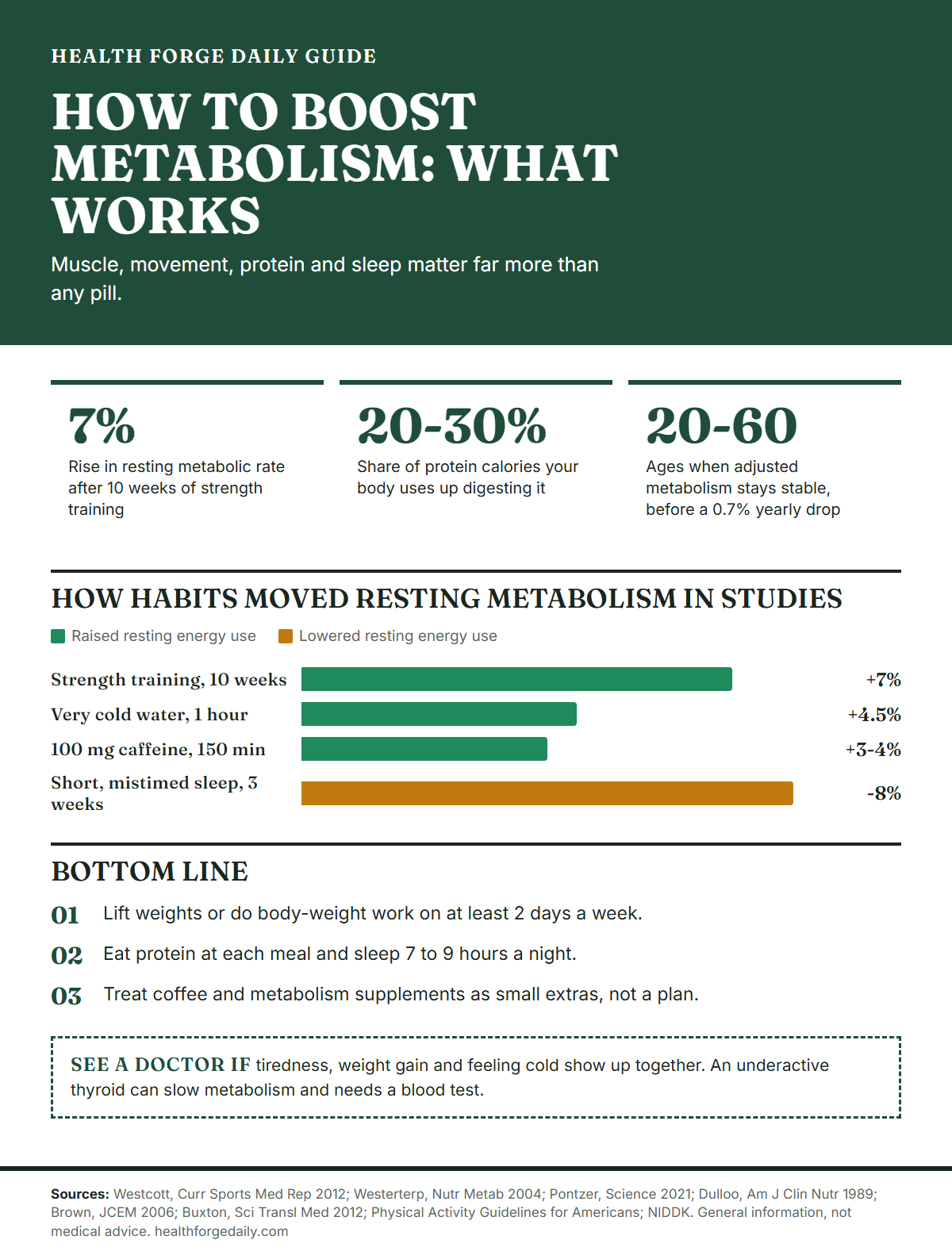
Build muscle with strength training, move more through the day, eat enough protein and sleep 7 to 9 hours. Ten weeks of resistance training raised resting metabolic rate by about 7% in research summarized by Westcott[5], which is more than any food or pill has shown.
| What metabolism is | The process your body uses to get or make energy from the food you eat[1]. |
|---|---|
| Biggest lever | Muscle. Ten weeks of strength training raised resting metabolic rate by 7% and added 1.4 kg of lean weight[5]. |
| Weekly activity target | 150 to 300 minutes of moderate activity, plus muscle-strengthening work on at least 2 days[4]. |
| Food effect | Digesting protein uses 20 to 30% of its calories, against 5 to 10% for carbohydrate and 0 to 3% for fat[7]. |
| Age | A study of 6,421 people found metabolism holds steady from 20 to 60, then falls about 0.7% a year[2]. |
| Supplements | NIH says there is little scientific evidence that weight-loss supplements work, and some can harm[14]. |
| Who should get checked | People with tiredness, weight gain and trouble tolerating cold, which can point to an underactive thyroid[15]. |
How to boost metabolism: 7 steps backed by research
Metabolism is the sum of the energy your body burns to stay alive, digest food and move. You cannot change your genes or age, but you can change how much muscle you carry, how much you move, what you eat and how well you sleep. The steps below are ordered by the size of the effect we found.
- Lift weights or do body-weight exercises on 2 or more days a week. Resistance training raised resting metabolic rate by 7% in 10 weeks[5], and the guidelines ask for at least 2 days[4].
- Get 150 to 300 minutes of moderate activity a week, such as brisk walking[4].
- Add movement outside workouts. Standing, walking and fidgeting drove two-thirds of the extra calories burned in an overfeeding study[6].
- Include protein at each meal. Your body spends more energy processing protein than carbohydrate or fat[7].
- Sleep 7 to 9 hours. Three weeks of short, mistimed sleep cut resting metabolic rate by 8% in a lab trial[12][3].
- Use coffee or tea for taste, not as a plan. The effect of caffeine is small and fades as you build tolerance[8][14].
- Lose weight slowly and keep lifting. Fast, large losses were followed by a lasting drop in resting metabolism in one NIH study[13].
How do you boost metabolism with exercise?
Strength training is the exercise with the clearest effect on resting metabolism, because it adds muscle that burns energy around the clock. A review by Westcott reported that 10 weeks of resistance training may raise resting metabolic rate by 7%, add 1.4 kg of lean weight and remove 1.8 kg of fat[5].
The same review notes that inactive adults lose 3% to 8% of their muscle mass per decade, along with a drop in resting metabolic rate[5]. Lifting is how you slow that loss. Free weights, machines, bands and push-ups all count.
Aerobic exercise burns calories while you do it. The Physical Activity Guidelines for Americans ask adults for 150 to 300 minutes of moderate activity each week, such as brisk walking or fast dancing, plus muscle-strengthening work on at least 2 days[4].
Daily movement counts too
Researchers call the energy you burn outside planned exercise non-exercise activity thermogenesis, or NEAT. In a 1999 Mayo Clinic study, 16 adults ate 1,000 extra calories a day for 8 weeks. Two-thirds of the rise in calories they burned came from NEAT, and it explained 10-fold differences in how much fat people gained[6].
Taking calls on your feet, walking after meals and breaking up long sitting spells all add to NEAT. Our guide on how to lose belly fat shows how activity and diet work together.
Can you boost metabolism with healthy foods?
Food raises your metabolism a little every time you eat, and protein raises it the most. Scientists call this diet-induced thermogenesis. A review by Westerterp put it at 20 to 30% of the calories in protein, 5 to 10% for carbohydrate and 0 to 3% for fat.
On a mixed diet it is about 10% of the energy you eat[7]. That means 100 calories of chicken, beans or yogurt cost more to process than 100 calories of butter. Westerterp also links protein to feeling full, which can help with eating less overall[7].
No single food burns enough calories to offset a large meal, and the claims made for “fat-burning” foods are mostly untested. Chili peppers are a good example: NIH says capsaicin has not been studied enough to know whether it helps with weight[14].
Does drinking water boost metabolism?
The evidence is mixed. A 2003 study of 14 adults reported that 500 ml of water raised metabolic rate by 30%[10]. A 2006 trial could not repeat that result: room-temperature water did not raise energy use at all, and very cold water raised it by only 4.5% for an hour[11].
Plain water is still worth drinking every day for hydration and general health. See our guide to how much water to drink a day for daily targets.
Does coffee boost metabolism?
Yes, a little, and for a short time. In a 1989 study, a single 100 mg dose of caffeine raised resting metabolic rate by 3% to 4% for 150 minutes. Repeated doses every 2 hours over a 12-hour day added about 150 calories in lean adults and 79 calories in adults who had lost weight[8].
That study ran in a lab, and it did not measure weight loss. NIH notes that regular caffeine users build tolerance, which may weaken any effect on body weight over time[14]. Caffeine is safe for most adults up to 400 to 500 mg a day, but it can cause jitters and poor sleep, and higher doses can cause a rapid heartbeat[14].
What about green tea?
Green tea contains caffeine and catechins, which are said to raise energy use. A 2012 Cochrane review of trials lasting 12 to 13 weeks found a pooled weight difference of just 0.04 kg in studies outside Japan, a result the authors called not likely to be clinically important[9]. Drinking green tea is safe, but green tea extract has been linked to liver damage in some people[14]. If you enjoy green tea, drink it as a beverage and skip concentrated extract pills.
Can sleep boost metabolism and energy?
Good sleep protects your metabolism more than it boosts it. NIDDK advises adults ages 18 to 64 to get 7 to 9 hours a night, and links short sleep to hunger, extra calories and weight gain[3]. Losing sleep can also lower the energy you burn at rest.
In a 2012 lab study, 21 healthy adults slept 5.6 hours per 24 hours for 3 weeks while their body clocks were thrown off, as in shift work. Their resting metabolic rate fell by 8% on average, and their blood sugar after meals rose[12].
Nine days of recovery sleep moved these numbers back toward normal, but not all the way[12]. The study combined short sleep with a disrupted body clock, so it does not show how much each part matters on its own.
Keep a regular sleep and wake time, limit caffeine late in the day[14], and talk to a doctor if you snore loudly or wake up tired after a full night in bed.
How to boost metabolism after 40, 50 and 60
Metabolism does not slow in your 30s, 40s or 50s the way many people think. A 2021 study in Science pooled 6,421 people from 29 countries, aged 8 days to 95 years. After adjusting for body size, energy use stayed stable from age 20 to 60, even during pregnancy, and then declined about 0.7% a year[2].
So weight gain in midlife is more often about less movement and less muscle than about a slower engine. Inactive adults lose 3% to 8% of their muscle per decade[5], which is why strength training matters more with every birthday.
For women, the advice is the same: lift on at least 2 days a week and keep moving[4]. The life-course study found no metabolic slowdown before 60 once body size was taken into account[2].
After 60, a gradual drop in energy use is normal[2]. Keep lifting, eat enough protein[7], and ask your doctor before starting a new program if you have heart, joint or balance problems.
Can you boost metabolism to lose weight?
Raising your metabolism helps a little, but cutting calories hard pushes it the other way. After a large, fast loss, your body burns fewer calories than expected for its new size. This is metabolic adaptation, and an NIH team showed it can last years[13].
The team followed 14 contestants from The Biggest Loser. They lost an average of 58.3 kg in 30 weeks, and their resting metabolic rate fell by 610 calories a day. Six years later, most of the weight was back, but resting metabolism stayed 704 calories a day below where it started[13].
Muscle keeps resting energy use up[5]. Slow loss while you keep lifting protects muscle. The table sums up the key studies.
| Study | Who and how long | What was tested | Result |
|---|---|---|---|
| Westcott review, 2012[5] | Adults, 10 weeks | Resistance training | Resting metabolic rate up 7%, lean weight up 1.4 kg |
| Levine, 1999[6] | 16 adults, 8 weeks | 1,000 extra calories a day | Two-thirds of extra burn came from daily movement |
| Dulloo, 1989[8] | Lean and post-obese adults, 1 day | 100 mg caffeine | Resting rate up 3% to 4% for 150 minutes |
| Cochrane, 2012[9] | Trials of 12 to 13 weeks | Green tea preparations | 0.04 kg difference outside Japan |
| Buxton, 2012[12] | 21 adults, 3 weeks | 5.6 hours sleep, disrupted clock | Resting rate down 8% |
| Fothergill, 2016[13] | 14 adults, 6 years | Rapid, large weight loss | Resting rate 704 calories a day below baseline |
Do supplements that boost metabolism work?
The NIH Office of Dietary Supplements says there is little scientific evidence that weight-loss supplements work. Many are expensive, some interact with medicines, and a few might be harmful. Products sold as metabolism boosters often rely on stimulants, so ask your health care provider before you try one[14].
Here is what NIH says about common ingredients in these products[14]:
- Caffeine may help you lose a little weight, but tolerance builds and labels do not always list it.
- Green tea extract may lead to a small loss and has been linked to liver damage.
- Capsaicin has not been studied enough to know if it helps.
- Bitter orange might burn slightly more calories but can cause chest pain, a faster heart rate and higher blood pressure.
Ephedra, a stimulant once common in these products, was banned from the U.S. market in 2004[14]. Our review of whether weight loss supplements work covers more ingredients. If you train hard, creatine and its side effects are worth reading about, since it supports strength work rather than burning fat.
When is a slow metabolism a medical problem?
An underactive thyroid, called hypothyroidism, is a well-known medical cause of a slow metabolism. Thyroid hormones control the way your body uses energy. Common signs include tiredness, weight gain, trouble tolerating cold, dry skin and a slow heart rate[15]. These signs are common in general, so they do not prove a thyroid problem.
Other conditions and medicines can also change how many calories you burn. NIDDK lists PCOS, Cushing’s syndrome, depression and long-term stress among health problems linked to weight gain[3].
Side effects and who should avoid metabolism boosters
Stimulant products and powders can raise your heart rate and blood pressure[14]. Avoid them if you have heart disease, high blood pressure or an anxiety disorder, or if you are pregnant, unless your doctor agrees.
Some medicines can make your body burn fewer calories, including some drugs for epilepsy, depression and diabetes, steroids and some blood pressure pills[3]. Do not stop a prescribed medicine to protect your metabolism. Ask your doctor whether another option would suit you better.
What doctors check first
If you have tiredness, weight gain and cold intolerance, a doctor can order a blood test to check your thyroid hormone levels[15]. They will also ask about your sleep, activity, diet and medicines, the everyday factors NIDDK links to weight[3]. If tests confirm hypothyroidism, treatment is levothyroxine, a prescribed thyroid hormone medicine that no supplement can replace[15]. A diagnosis can’t rest on symptoms alone, because many of them overlap with other conditions, so expect a test before any treatment starts.
Metabolism checklist
Use this list to check your week. Most items cost nothing and take little time, and the first two do the most for resting energy use. Work through them in order, add one new habit at a time, and keep the ones you can stick with for months.
- Schedule strength training on at least 2 days a week[4].
- Add up your weekly moderate activity and aim for 150 to 300 minutes[4].
- Stand up and walk for a few minutes every hour you sit[6].
- Put a protein food on your plate at each meal[7].
- Protect 7 to 9 hours of sleep[3].
- Keep caffeine under 400 mg a day and stop it by early afternoon if it hurts your sleep[14].
- Read supplement labels for hidden stimulants such as guarana, kola nut or bitter orange[14].
- See a doctor if tiredness, weight gain and feeling cold all show up together[15].
Find more guides in our metabolism and appetite section.
Bottom line
You can raise your metabolism, though only by modest amounts. Strength training and extra daily movement have the strongest evidence behind them. Eating enough protein and sleeping well help as well, while coffee gives a small bump that wears off within hours[5][6][7][8].
For most adults, two strength sessions a week are the better first step than any supplement, because they build the muscle that burns energy at rest and they cost nothing[4][5][14]. If you feel cold, tired and heavier without changing your habits, get your thyroid checked before you buy a metabolism booster.
Sources
- Metabolic Disorders. MedlinePlus, National Library of Medicine
- Daily energy expenditure through the human life course. Pontzer et al., Science, 2021
- Factors Affecting Weight and Health. NIDDK, NIH
- Top 10 Things to Know About the Second Edition of the Physical Activity Guidelines for Americans. ODPHP, U.S. Department of Health and Human Services
- Resistance training is medicine: effects of strength training on health. Westcott, Current Sports Medicine Reports, 2012
- Role of nonexercise activity thermogenesis in resistance to fat gain in humans. Levine et al., Science, 1999
- Diet induced thermogenesis. Westerterp, Nutrition and Metabolism, 2004
- Normal caffeine consumption: influence on thermogenesis and daily energy expenditure in lean and postobese human volunteers. Dulloo et al., American Journal of Clinical Nutrition, 1989
- Green tea for weight loss and weight maintenance in overweight or obese adults. Jurgens et al., Cochrane Database of Systematic Reviews, 2012
- Water-induced thermogenesis. Boschmann et al., Journal of Clinical Endocrinology and Metabolism, 2003
- Water-induced thermogenesis reconsidered: the effects of osmolality and water temperature on energy expenditure after drinking. Brown et al., Journal of Clinical Endocrinology and Metabolism, 2006
- Adverse metabolic consequences in humans of prolonged sleep restriction combined with circadian disruption. Buxton et al., Science Translational Medicine, 2012
- Persistent metabolic adaptation 6 years after The Biggest Loser competition. Fothergill et al., Obesity, 2016
- Dietary Supplements for Weight Loss: Fact Sheet for Consumers. NIH Office of Dietary Supplements
- Hypothyroidism (Underactive Thyroid). NIDDK, NIH
Frequently asked questions
How can I boost my metabolism fast?
There is no fast fix. Caffeine raises resting energy use by a few percent for a couple of hours, but tolerance builds. Lasting gains come from strength training, which raised resting metabolic rate by about 7% over 10 weeks in research.
What healthy snacks boost metabolism?
Snacks with protein, such as yogurt, eggs, nuts or beans, cost your body more energy to digest than sugary or fatty snacks. Protein can also keep you full longer. The effect is small, so total calories still matter most.
How can women boost metabolism?
Women can use the same steps as men: strength training on at least 2 days a week, regular moderate activity, protein at meals and good sleep. A large study found no drop in adjusted metabolism between ages 20 and 60.
Is there a free way to boost metabolism?
Yes. Body-weight exercises such as squats and push-ups build muscle at no cost, and walking adds daily movement. Sleeping 7 to 9 hours also protects resting energy use, while paid supplements have little scientific evidence behind them.
Do metabolism booster drinks and powders work?
Most rely on caffeine or green tea, which have small, short effects. NIH says there is little evidence that weight-loss supplements work, and labels do not always list stimulants. Check with a doctor first if you have heart or blood pressure problems.

Grace Whitaker is the health editor at Health Forge Daily. She reads supplement labels line by line, checks each ingredient and dose against published research, and tracks refund policies and customer complaints before a product gets a verdict. She is not a doctor, so every review points readers back to their own physician for medical decisions.
This article is for general information and is not medical advice. Supplements are not evaluated by the FDA and are not intended to diagnose, treat, cure or prevent any disease. Check with your doctor before you start any supplement.