Dizziness when you stand up is usually a brief drop in blood pressure that passes in seconds. Rising too fast, low fluids, heat and some medicines are the usual triggers. About 1 in 5 adults over 60 has orthostatic hypotension, which raises the risk of falls. Stand up in stages and review your medicines. Fainting, stroke signs or a racing heart need care right away.

Why do I get dizzy when I stand up? For most people, it is a short dip in blood pressure: for a moment, not enough blood flows back to the heart and up to the brain, and the feeling passes within seconds.[1][5] We read MedlinePlus, NHLBI, NINDS and NIA guidance, plus reviews and a randomized trial on orthostatic hypotension, to sort the everyday causes from the ones that need a doctor. Our page on how we review health evidence explains how we pick and check sources.
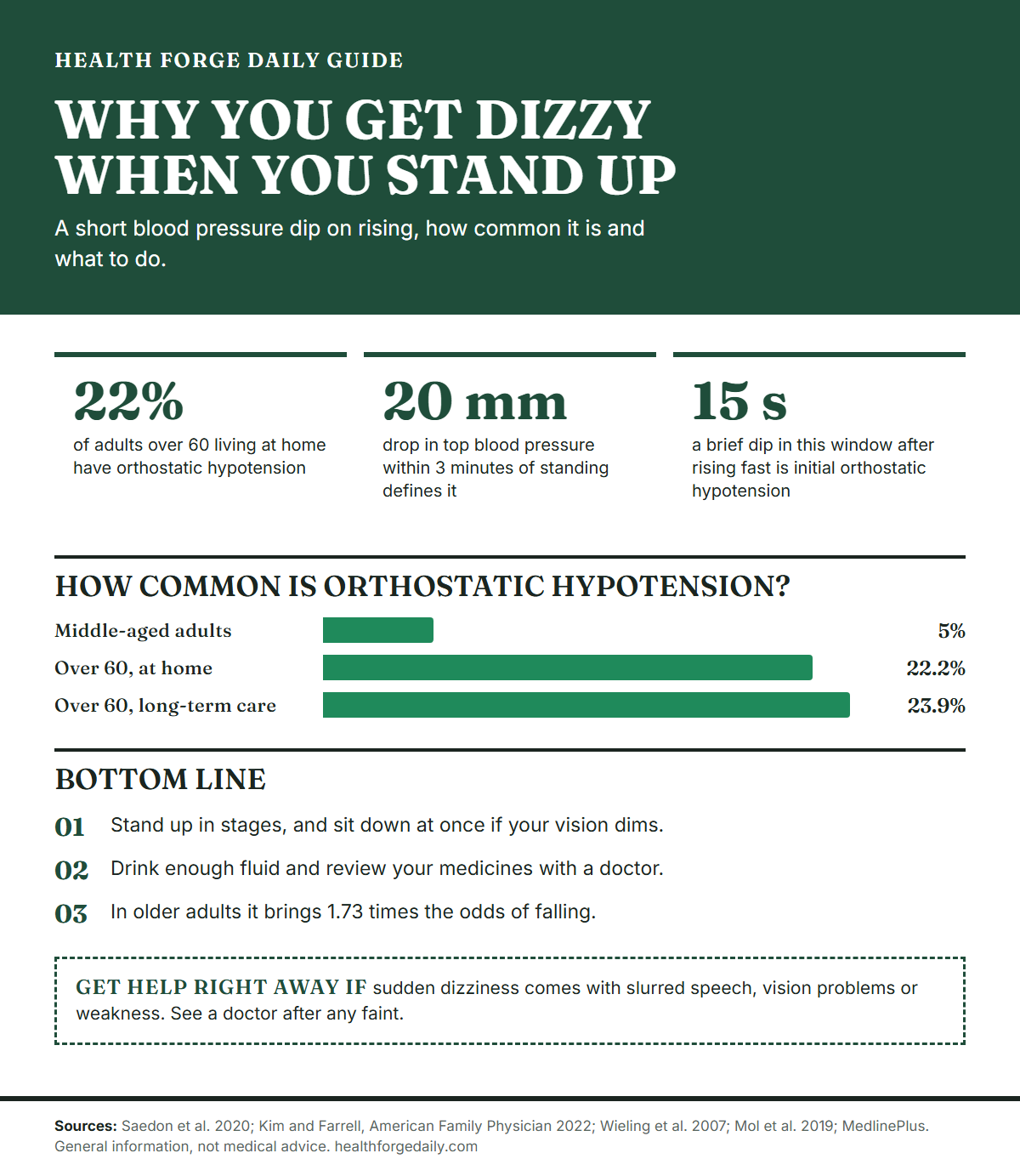
Brief lightheadedness on rising is common and usually harmless. It becomes a concern when it leads to fainting or falls. Orthostatic hypotension, a drop of 20 mm Hg or more in top blood pressure within 3 minutes of standing, affects about 1 in 5 adults over 60.[11][12]
| What it is | Lightheadedness when blood pressure dips on standing, called orthostatic or postural hypotension[12] |
|---|---|
| Everyday causes | Getting up too quickly, dehydration, heat, certain medicines[1][4] |
| Medical causes | Heart rhythm problems, diabetes, Parkinson’s disease, anemia, POTS[2][5][7] |
| How common | About 22% of adults over 60 living at home; about 5% of middle-aged adults[11][12] |
| Main risk | Falls: 1.73 times the odds in older adults with orthostatic hypotension[14] |
| First steps | Stand up slowly, drink enough fluid, review your medicines with a doctor[2][10] |
| Urgent sign | Sudden dizziness with slurred speech, vision problems or weakness[1][16] |
Why do I get dizzy when I stand up?
When you stand up, not enough blood flows back to the heart for a moment, so blood pressure dips and the brain briefly gets less blood. If your body corrects that slowly, you feel lightheaded, woozy or unsteady. MedlinePlus lists getting up too quickly, a sudden drop in blood pressure and dehydration among the common causes.[1][4][5]
Doctors call the lasting version orthostatic hypotension. It means a fall of 20 mm Hg or more in systolic (top) pressure, or 10 mm Hg or more in diastolic (bottom) pressure, within three minutes of standing.[12] Symptoms include lightheadedness, headache, blurred vision and an ache across the neck and shoulders that doctors call coat hanger pain.[12]
Some people have low blood pressure all the time with no symptoms, and that is normal for them. Low blood pressure is only a problem when it causes dizziness, fainting or, in extreme cases, shock.[3]
If the room spins instead, that is vertigo, a different symptom with different causes.[1] Our guide to vertigo treatment, causes and when to see a doctor covers that side.
Why do I get dizzy when I stand up too fast?
Standing up fast can cause initial orthostatic hypotension, a brief blood pressure drop within 15 seconds of rising that then recovers on its own. Researchers define it as a fall of more than 40 mm Hg systolic or 20 mm Hg diastolic, with symptoms such as lightheadedness or dimmed vision.[13]
Young and older people both get it. In a 2007 review, Wieling and colleagues reported that standing up is the trigger in 3 to 10% of episodes of loss of consciousness.[13] Because the drop is so short, a standard cuff reading taken minutes later can miss it.[13]
The cause seems to be a timing mismatch. As you rise, blood vessels in the working leg muscles widen, and the heart’s output takes a few seconds to catch up.[13] The feeling usually fades if you stand still or sit back down.[2]
Why do I see black and get dizzy when I stand up?
Seeing black, gray or white patches as you stand means your brain and eyes are briefly short of blood flow, an early warning sign of fainting. MedlinePlus says that when you are about to faint, you feel dizzy or lightheaded and your field of vision may white out or black out.[4]
Blurry vision is also a listed symptom of low blood pressure, along with confusion, nausea, tiredness and a racing or fluttering heart.[2] The safest move when your vision starts to fade is to sit or lie down at once. NHLBI notes that sitting down may relieve the symptoms.[2]
If you do faint, MedlinePlus advises staying lying down for 10 to 15 minutes. Most people recover completely, but you should still see your health care provider to find out why it happened.[4]
What causes dizziness when I stand up?
Most dizziness on standing comes from something that lowers blood volume or blood pressure, such as fluid loss, medicines, heat or a health condition. NHLBI lists dehydration, blood loss, diabetes, heart rhythm problems, pregnancy and medicines for high blood pressure, depression or Parkinson’s disease among the causes of low blood pressure.[2]
| Cause | Typical clue | Usual first step |
|---|---|---|
| Dehydration | Thirst, dark urine, tiredness, after vomiting, diarrhea or heavy sweating[6] | Drink fluids; urgent care if confused or fainting[6] |
| Blood pressure, depression or Parkinson’s medicines | Started after a new drug or a dose change[2] | Ask your doctor about the dose[2][12] |
| Anemia | Tiredness, paleness, shortness of breath[7] | A blood test to find the cause[7] |
| Low blood sugar | Shaky, hungry or confused, often with diabetes medicines[8] | 15 to 20 grams of fast sugar if under 70 mg/dL[8] |
| Nerve problems, as in diabetes or Parkinson’s | Repeated drops in pressure every time you stand[2][12] | Specialist assessment[12] |
| Heart rhythm problems | Palpitations or fainting[2][4] | A prompt medical check[4] |
Older adults have a higher risk, partly because they are more likely to take blood pressure medicines. Some also feel dizzy after a meal as well as on standing.[2] Diabetes raises the chance of orthostatic hypotension at every age.[12]
Why do I get dizzy when I stand up after bending over or squatting?
Rising from a squat or a bent-over position is a quick, active change in posture, and active rising is exactly what triggers initial orthostatic hypotension. Leg and belly muscles push blood toward the heart as you rise, then blood vessels in the legs widen, and blood pressure can dip for several seconds.[13]
There is a second possibility when the room spins. Benign paroxysmal positional vertigo (BPPV) causes a brief, intense spinning feeling when you bend down to look under something, tilt your head to look up or roll over in bed.[9] It happens when loose crystals in the inner ear drift into one of its canals, and it is the most common cause of vertigo.[1][9]
Lightheadedness that fades after a few seconds of standing points to blood pressure, while spinning set off by head position points to BPPV.[9][13] Our guide to vertigo exercises such as the Epley maneuver covers the inner ear side.
Why do I sometimes get dizzy when I stand up?
Occasional dizziness on standing usually follows a temporary trigger, such as not drinking enough, a hot day, a missed meal, a stomach bug or a new medicine. MedlinePlus lists heat, dehydration, standing up too quickly, certain medicines and a drop in blood sugar among the common causes of fainting.[4]
Dehydration is easy to miss. Fever, vomiting, diarrhea, heavy sweating and some medicines all drain fluid. Some older adults also lose their sense of thirst, so they do not drink enough.[6] Dizziness is a listed adult symptom, alongside dark urine and a dry mouth.[6]
Our guide to how much water you should drink a day covers daily fluid needs. After heavy sweating or a stomach bug, the article on electrolyte drinks and powders explains when plain water is enough.
If it happens after sitting for a long while, or mostly in the morning, note the time, what you drank and which medicines you took. Ask your doctor to check your blood pressure lying down and standing.[10]
Why do I get dizzy when I stand up and walk?
Dizziness that lasts while you walk, instead of fading in seconds, suggests your body is not keeping blood pressure or heart rate steady, as in lasting orthostatic hypotension or POTS. In POTS, heart rate rises by more than 30 beats per minute, or above 120, within 10 minutes of standing.[5]
POTS mainly affects people aged 15 to 50 and is more common in women. It often begins after a pregnancy, major surgery, puberty, trauma or a viral illness.[5] Other symptoms include palpitations, tiredness, blurred vision, headaches and trouble concentrating.[5]
Dizziness while walking also raises the risk of falls. A 2019 review pooled 50 studies with 49,164 older adults and found that those with orthostatic hypotension had 1.73 times the odds of falling.[14] NIA lists blood pressure that drops too much on standing as a fall risk factor.[10]
Unsteadiness that does not depend on posture at all can come from the inner ear, medicines or the brain, and needs a doctor’s exam.[9]
How common is dizziness when standing up?
Dizziness on standing is very common, and orthostatic hypotension affects about one in five older adults living at home. A 2020 meta-analysis of 20 community studies with 24,967 people over 60 put the rate at 22.2%, rising to 23.9% in long-term care.[11]
Rates are lower in younger adults. A 2022 review in American Family Physician gives about 5% for middle-aged adults and 20% for older adults.[12] Dizziness and balance problems in general become more common with age.[1][9]
| Study | Who | Design | Result |
|---|---|---|---|
| Saedon et al., 2020 | 24,967 adults over 60 at home; 2,694 in care | Meta-analysis | 22.2% at home and 23.9% in care had orthostatic hypotension[11] |
| Mol et al., 2019 | 49,164 older adults in 50 studies | Meta-analysis | 1.73 times the odds of falling with orthostatic hypotension[14] |
| Wieling et al., 2007 | Young and older adults | Review | Standing up triggered 3 to 10% of faints[13] |
| van Dijk et al., 2006 (PC-Trial) | 223 people with repeat fainting, mean age 38.6 | Randomized trial, 14 months | 31.6% fainted again with muscle-tensing training vs 50.9% without[15] |
How can I stop getting dizzy when I stand up?
Most people start with habits: rising in stages, drinking enough fluid and tensing the leg muscles when the dip starts. NIA advises standing up slowly because getting up too quickly can make blood pressure drop, and NHLBI says doctors may suggest changes to how you sit and stand.[2][10]
- Sit on the edge of the bed or chair for a moment, then stand up slowly.[10]
- Drink fluids through the day. For people with POTS, NINDS notes that at least 16 ounces (about two glasses) of water before getting up can give a temporary boost.[5]
- If you feel the dip, cross your legs and squeeze your thigh, buttock and belly muscles. In the PC-Trial, people trained in these moves fainted again less often: 31.6% against 50.9%.[15]
- Sit or lie down right away if your vision starts to dim.[2]
- Ask about compression stockings or waist-high compression garments, especially if you stand for long periods.[2][5]
- Take your full medicine list to your doctor, and do not stop a medicine on your own.[2][5]
- If you use insulin or other diabetes medicines, check your blood sugar when you feel shaky or dizzy.[8]
- Ask to have your blood pressure measured lying down and standing.[10]
NINDS notes that more salt and fluid can help people with POTS keep up blood volume. Agree on any salt change with your doctor first.[5]
When is dizziness on standing a sign of something serious?
Dizziness on standing needs prompt care when it comes with fainting, a racing heart, confusion or any sign of stroke. MedlinePlus says to get emergency help right away for sudden or severe dizziness with vision problems, slurred speech or weakness, because these can be signs of a more serious condition.[1]
See a doctor right away, or call 911, if you have:
- Sudden dizziness or loss of balance with trouble seeing or speaking, or numbness or weakness in the face, arm or leg.[16]
- Fainting, or a heart that feels like it is skipping, fluttering or racing.[2][4]
- Cold, sweaty skin, fast breathing, a blue skin tone or a weak, rapid pulse, which are signs of shock.[2]
- Signs of severe dehydration: confusion, fainting, no urination or a rapid heartbeat.[6]
- Very low blood sugar with confusion or trouble seeing or speaking.[8]
Book a regular appointment if dizziness on standing happens often, started after a new medicine or has caused a fall.[2][14] Mention pregnancy, diabetes or Parkinson’s disease, since each is linked to low blood pressure.[2]
How do doctors find the cause?
The main test measures your blood pressure and heart rate while you lie down and again after you stand. A common bedside version takes readings after five minutes lying down and three minutes after standing. If that is normal but suspicion stays high, a tilt table test is the next step.[12]
Doctors also review your medicines and may order blood, urine or imaging tests.[2] A tilt table test is common for people who faint often or may have POTS.[2][5]
Treatment starts with the cause. The first step is often adjusting a medicine that lowers blood pressure, followed by compression garments, physical maneuvers and diet changes.[12] When those are not enough, doctors may prescribe midodrine or droxidopa. For POTS, NINDS says fludrocortisone and midodrine can help in the short term, and beta blockers help some people.[5][12]
The standard care that NHLBI, NINDS and the American Family Physician review describe is fluids, medicine changes, compression and prescribed drugs. Supplements are not on that list.[2][5][12]
Your checklist for dizziness when standing
A few habits and a short log handle most everyday dizziness on standing and give your doctor something to work with. Try the list for a week. If the dizziness keeps coming back, bring your notes to the appointment, since the pattern and your medicine list are often the best clues to the cause.[12]
- Pause sitting up before you stand, every time.[10]
- Drink fluids steadily, and more on hot days or when you are sick.[6]
- Write down when the dizziness happens: after meals, in the morning, after squatting.[2][13]
- List every medicine, including any new drug or dose change.[2]
- Note whether you feel lightheaded or the room spins.[1]
- Practice leg crossing and muscle tensing so it is automatic when the dip starts.[15]
- Ask for a lying and standing blood pressure check.[10]
More on dizziness and balance problems is in our vertigo and balance articles.
Bottom line
Most dizziness when standing is a short blood pressure dip from rising too fast, low fluids or a medicine, and it fades within seconds.[1][13] It becomes a problem when it causes fainting or falls, or when it comes with stroke signs, which need emergency care.[1][14]
For most people, the best first step is to stand up in stages and review their medicines with a doctor, because a blood pressure drug is a common and fixable cause.[2][12] If it happens often, ask for a lying and standing blood pressure check before trying anything else.[10]
Sources
- Dizziness and Vertigo. MedlinePlus, National Library of Medicine
- Low Blood Pressure. National Heart, Lung, and Blood Institute, 2022
- Low Blood Pressure. MedlinePlus, National Library of Medicine
- Fainting. MedlinePlus, National Library of Medicine
- Postural Tachycardia Syndrome (POTS). National Institute of Neurological Disorders and Stroke
- Dehydration. MedlinePlus, National Library of Medicine
- Anemia: Symptoms. National Heart, Lung, and Blood Institute, 2022
- Low Blood Glucose (Hypoglycemia). National Institute of Diabetes and Digestive and Kidney Diseases
- Balance Disorders. National Institute on Deafness and Other Communication Disorders
- Falls and Fractures in Older Adults: Causes and Prevention. National Institute on Aging
- The Prevalence of Orthostatic Hypotension: A Systematic Review and Meta-Analysis. Saedon et al., Journals of Gerontology Series A, 2020
- Orthostatic Hypotension: A Practical Approach. Kim and Farrell, American Family Physician, 2022
- Initial orthostatic hypotension: review of a forgotten condition. Wieling et al., Clinical Science, 2007
- Orthostatic Hypotension and Falls in Older Adults: A Systematic Review and Meta-analysis. Mol et al., Journal of the American Medical Directors Association, 2019
- Effectiveness of physical counterpressure maneuvers in preventing vasovagal syncope: the PC-Trial. van Dijk et al., Journal of the American College of Cardiology, 2006
- Stroke. MedlinePlus, National Library of Medicine
Frequently asked questions
Why do I get dizzy sitting down?
Dizziness while you sit still is not caused by a change in posture, so look at other causes. Inner ear problems, migraines, dehydration, low blood sugar and heart rhythm problems can all cause it. See a doctor if it keeps happening.
Why do I get dizzy when I stand up and stretch?
None of the sources we read studied stretching itself. Rising and reaching overhead in one quick move is still an active stand, the trigger for a brief blood pressure dip. Stand first, wait a few seconds, then stretch.
Can dehydration make you dizzy when standing?
Yes. Losing fluid through sweating, vomiting, diarrhea or fever lowers blood volume, and MedlinePlus lists dizziness as an adult symptom of dehydration. Drink fluids, and get help right away if you also feel confused or faint.
Why do young people get dizzy when standing?
Young, healthy people can get a brief dip called initial orthostatic hypotension when they rise quickly. POTS, which mainly affects people aged 15 to 50 and more women than men, is another cause when a racing heart comes with it.
Should I worry if I get dizzy every time I stand up?
Dizziness every time you stand deserves a doctor visit. A lying and standing blood pressure check can show orthostatic hypotension, and a medicine review often finds a fixable cause. In older adults it also raises the risk of falls.

Grace Whitaker is the health editor at Health Forge Daily. She reads supplement labels line by line, checks each ingredient and dose against published research, and tracks refund policies and customer complaints before a product gets a verdict. She is not a doctor, so every review points readers back to their own physician for medical decisions.
This article is for general information and is not medical advice. Supplements are not evaluated by the FDA and are not intended to diagnose, treat, cure or prevent any disease. Check with your doctor before you start any supplement.