Halitosis is the medical name for bad breath that lasts. In most people it starts in the mouth: a study of 2,000 clinic patients found an oral cause in 76%, mostly tongue coating and gum disease. Daily brushing, cleaning between teeth and tongue cleaning help most. See a dentist first, then a doctor if your mouth is healthy and the smell stays.

Halitosis is the medical term for bad breath, and this guide explains what causes it, how to tell if you have it, and how to get rid of bad breath for good. We read the MedlinePlus and NIDCR pages, the American Dental Association advice, a 2019 Cochrane review of 44 trials and a study of 2,000 people seen at a breath clinic.[1][9][7] You can see how we pick and check sources on our how we review page.
The short answer: in most people the smell starts in the mouth, mainly from bacteria on the back of the tongue and around the gums, and in the Belgian clinic study 76% of patients had an oral cause.[7]
| What it is | An unpleasant smell on the breath that lasts; MedlinePlus lists it as the other name for bad breath[1][5] |
|---|---|
| How common | About 31.8% of teens and adults in pooled population studies[6] |
| Most common source | The mouth: tongue coating, gum disease, or both[7] |
| Other causes | Dry mouth, smoking, strong foods, sinus or throat infections, reflux, diabetes, kidney or liver disease[4][5] |
| First step | Brush twice a day, clean between teeth daily, clean the tongue, see a dentist[4][5] |
| Best evidence on products | Low to very low certainty for rinses, pastes, gums and tongue scrapers[9] |
| See a doctor | If good brushing and flossing do not help: a dentist first, then your doctor[5] |

What is halitosis?
Halitosis is a lasting, unpleasant smell on the breath, most often caused by bacteria that build up in the mouth. MedlinePlus says you can get bad breath if you do not brush and floss regularly, because bacteria that collect in the mouth and between the teeth make the odor.[1] Morning breath or garlic breath now and then is normal; doctors use the word for breath that stays bad most of the time.[5]
A 2018 review that pooled 13 population studies put the rate at 31.8% of adolescents and adults.[6] The American Dental Association notes that about 50 percent of adults have had bad breath at some point.[4]
MedlinePlus files the topic as bad breath, also called halitosis.[1] Dentists split it into types. “Genuine” halitosis can be measured by someone else. Pseudo-halitosis is when a person is sure their breath smells but an examiner cannot detect it. In the 2,000-patient clinic study, 16% of people fell into that second group.[7]
What causes bad breath?
Most bad breath comes from the mouth itself: a coated tongue, gum disease, dry mouth, food debris and tobacco. In the Leuven clinic study, tongue coating alone explained 43% of cases, gum disease 11%, and the two together another 18%.[7] Only 4% of patients had a cause in the ears, nose, throat or elsewhere in the body.[7]
Causes that start in the mouth
- Bacteria and tongue coating. Hundreds of kinds of bacteria live in the mouth. They feed on leftover food and leave a foul waste product behind.[4]
- Gum disease. Plaque that is not removed hardens into tartar and can lead to gum infection. Persistent bad breath is one of its listed symptoms.[3] A 2017 review found people with periodontitis had 3.16 times higher odds of halitosis, though all five studies were cross-sectional.[8]
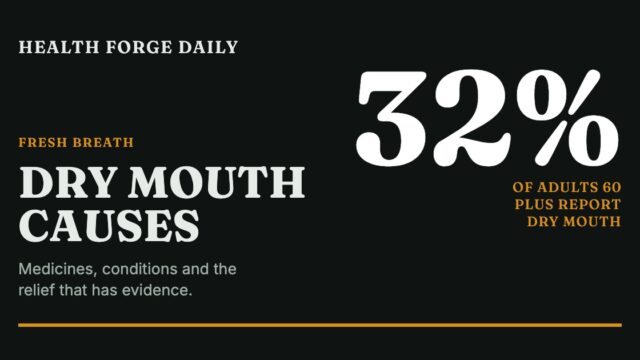
- Dry mouth. Saliva washes the mouth. When there is too little, bad breath is a common result.[2]
- Cavities and dentures. MedlinePlus lists cavities among mouth problems that cause bad breath, and the ADA advises cleaning removable dentures every night.[1][4]
- Tonsil stones. Trapped food can harden into smelly deposits in the tonsils.[5]
Causes from food and habits
Garlic, onions and coffee change the air you breathe out.[4] The compounds from garlic and onions get into the bloodstream, so the smell lasts until your body clears them, even after brushing.[5] Smoking dries the mouth, raises the risk of gum disease and dulls your own sense of smell, so smokers may not notice their breath.[4]
Causes elsewhere in the body
Sinus and throat infections, reflux, diabetes, and liver or kidney disease can all show up as bad breath.[4][5] Stomach infection may play a part too. A 2026 review of 24 studies and 5,872 patients found halitosis was more common in people with H. pylori infection (odds ratio 1.91), but the studies were observational, so this shows a link rather than proof of cause.[12]
What does bad breath smell like?
Mouth-related bad breath usually smells sour, like rotten eggs or stale coffee, while a few unusual smells point to illness elsewhere. Cleveland Clinic describes chronic bad breath as smelling fishy or like rotten eggs, and notes it can range from sour to oddly sweet.[5] Most of the time the smell comes from bacteria in the mouth and between the teeth.[1]
Some odors carry a warning. MedlinePlus notes that some diseases and medicines cause a specific breath odor.[1]
| Smell | Possible cause | What to do |
|---|---|---|
| Fruity | Ketoacidosis, which can happen with diabetes[5] | Urgent care, it is a medical emergency[5] |
| Foul, with mucus or coughed-up fluid | Nose, throat or lung infection, such as pneumonia[5] | See your doctor soon |
| Sour, with a sour taste | Acid reflux (GERD)[5] | Ask your doctor about reflux |
| Rotten egg or fishy | Bacteria on tongue and gums[5][7] | Better cleaning and a dental visit |
If you have diabetes or prediabetes, keep in mind that diabetes raises the risk of gum disease, and very low insulin can cause the fruity breath of ketoacidosis.[5] Our guide to prediabetes and A1C ranges explains how blood sugar is checked.
How can you tell if you have bad breath?
The most reliable home check is to ask someone you trust, because breathing into your own cupped hand rarely works. Cleveland Clinic gives a simple rule of thumb: if you have a bad taste in your mouth, others can probably smell your breath.[5] Your nose gets used to your own smell, so self-checks often miss it.
A few other signs help. A white or yellow coating on the back of the tongue is a common source in clinic studies.[7] Gums that bleed when you brush, or a constant bad taste, can be signs of gum disease.[3][4] A dry, sticky feeling in the mouth points to low saliva.[2]
Some people worry about a smell nobody else notices. In the Leuven clinic, most patients had come on their own, without a referral, and had been worried for an average of 7 years. Yet 16% had no smell an examiner could detect.[7] If people close to you say your breath is fine, a dentist can confirm it.
How do dentists diagnose halitosis?
Dentists diagnose halitosis by smelling the breath directly and examining the teeth, gums and tongue. This smell test is called an organoleptic test, and it is the main outcome measured in research.[5][9] Clinics may also use a portable meter that measures sulfur gases. The Leuven team used both a trained judge and a Halimeter for each of the 2,000 patients.[7]
If the cause is advanced gum disease, the dentist may refer you to a periodontist, a gum specialist.[5] If the mouth looks healthy, the next step is your primary care doctor.[4][5]
Your doctor will look for causes outside the mouth, such as sinus problems, reflux, diabetes, or liver or kidney disease.[4][5] Bring a list of what you take, since MedlinePlus notes that some medicines cause a specific breath odor.[1]
How to get rid of bad breath: a 7-step plan
To get rid of bad breath, clean the bacteria off your teeth, gums and tongue every day, keep your mouth moist, and have a dentist find any cause you cannot fix at home. This order follows ADA, NIDCR and Cleveland Clinic advice.[2][4][5] Give each step two weeks before judging it, since that is the shortest follow-up used in the treatment trials.[10]
- Brush twice a day. Brushing and cleaning between teeth removes the bacteria that cause the smell.[4]
- Clean between your teeth once a day. MedlinePlus lists skipping regular brushing and flossing as a cause of bad breath.[1]
- Clean your tongue. Use a scraper or your brush on the back of the tongue, where bacteria and food hide.[5]
- Clean dentures and retainers. Take removable dentures out at night and clean them well before wearing them again.[4]
- Keep saliva flowing. NIDCR suggests 8 to 12 cups of water a day, sugarless gum or candy, and a humidifier at night if your mouth is dry.[2]
- Cut back on tobacco and alcohol. Both dry out the mouth.[2]
- Book a dental cleaning. Some people build up plaque faster and simply need cleanings more often.[5]
For short-term help before a meeting, MedlinePlus says mouthwashes, mints or chewing gum may make your breath fresher.[1] Chewing crunchy foods such as carrots or apples also gets saliva moving.[4] These cover the smell for a while, and the bacteria come back unless you keep cleaning.
Match the fix to the cause
| If you notice | Likely source | First step |
|---|---|---|
| Coated tongue, smell worst in the morning | Tongue bacteria[7] | Daily tongue cleaning and brushing[5] |
| Bleeding or swollen gums | Gum disease[3] | Dental exam and cleaning[3] |
| Dry, sticky mouth, new medicine | Dry mouth[2] | Ask about a medicine change, sip water[2] |
| Smell after garlic or onion only | Food compounds[5] | Wait it out, mints mask it[5] |
| Stuffy nose or sinus pain | Sinusitis or another nose problem[1] | See your doctor[5] |
| Clean mouth but smell persists | Possible cause elsewhere[4] | Primary care visit[4] |
Do mouthwash, tongue scrapers and probiotics work?
Some rinses and probiotics lowered breath scores in short trials, but the overall evidence is weak and no single product has been shown to be best. The 2019 Cochrane review pooled 44 trials with 1,809 adults and rated the evidence low to very low certainty for every type of product tested.[9]
Mouthwash is the most tested option. A 2015 review of 12 trials lasting two weeks or more found the most data for rinses that combine chlorhexidine, cetylpyridinium chloride (CPC) and zinc, or zinc chloride with CPC, yet still graded the recommendation as weak.[10] The ADA calls over-the-counter mouthwash a temporary solution.[4] MedlinePlus adds that when a disease causes the smell, treating the disease is what may bring fresher breath.[1] If you use one, Cleveland Clinic suggests an alcohol-free antibacterial type.[5]
Tongue cleaning makes sense in theory, since the tongue is the top source. The trial data are thin: only 2 trials with 46 people compared it with no tongue cleaning, and Cochrane rated that evidence very uncertain.[9]
Probiotics were studied in a 2022 review of 7 randomized trials. Strains such as Lactobacillus salivarius, L. reuteri and Streptococcus salivarius may help in the short term (4 weeks or less), but the authors warned that limited data and bias lower confidence.[11] For a broader look at the strains, see our article on whether probiotics work for gut and mouth health.
| Review | Studies and people | Length | Result |
|---|---|---|---|
| Cochrane, all interventions (2019) | 44 trials, 1,809 adults[9] | 1 week to 3 months[9] | Low to very low certainty, no clear winner[9] |
| Rinses, pastes and tongue cleaning (2015) | 12 trials[10] | 2 weeks or more[10] | Zinc and CPC rinses had the most data, weak grade[10] |
| Tongue cleaning (Cochrane 2019) | 2 trials, 46 people[9] | 1 week or more[9] | Small change, very uncertain[9] |
| Probiotics (2022) | 7 randomized trials[11] | Up to and beyond 4 weeks[11] | Lower smell scores short term, limited data[11] |
When is bad breath a sign of something serious?
Bad breath is rarely serious on its own, but a lasting smell with no clear cause, or one paired with other symptoms, needs a medical check. Cleveland Clinic advises seeing a dentist if the smell lasts despite good hygiene, and a primary care provider if the mouth looks healthy.[5]
See a doctor right away if
- Your breath smells fruity and you have diabetes. This can signal ketoacidosis, a medical emergency.[5]
- You cough up foul-smelling fluid, which can happen with pneumonia.[5]
- You have a sore in the mouth or throat that does not heal, or trouble swallowing. Head and neck cancers can cause bad breath.[5]
Medicines and supplements
Hundreds of medicines can reduce saliva, including some for high blood pressure, depression and bladder control.[2] MedlinePlus also notes that some medicines cause their own breath odor.[1] Do not stop a prescribed medicine on your own. Ask your doctor whether a different dose or drug is possible.[2]
What doctors use first
Standard care starts with the cause. For plaque buildup, that means a professional cleaning and better home care, with special rinses only sometimes.[5] For gum disease, a dentist removes plaque and tartar.[3] If the mouth is healthy, a primary care provider looks for a cause elsewhere, and treating that disease may freshen the breath.[1][5] Probiotics and rinses are add-ons in research, not replacements for this care.[9][11] You can find more guides in our fresh breath section.
Practical checklist
- Ask one trusted person for an honest breath check.[5]
- Look at the back of your tongue in good light for a coating.[7]
- Brush twice and clean between teeth once every day.[4]
- Clean your tongue each night.[5]
- Drink water through the day and chew sugarless gum if your mouth is dry.[2]
- Write down your medicines and supplements before your appointment.[1][2]
- Book a dental cleaning if the smell lasts beyond two weeks of better care.[5][10]
Bottom line on halitosis
Halitosis affects close to a third of adults, and most cases start on the tongue or gums.[6][7] The fix is usually daily cleaning of teeth, gums and tongue, plus a dental visit.[4][5]
For most people a dentist is the better first step than any rinse or probiotic, because the product trials are short and low in certainty while a cleaning removes the source.[9] If your mouth checks out healthy and the smell stays, see your doctor to rule out sinus, stomach or metabolic causes.[1][4]
Sources
- Bad Breath. MedlinePlus, National Library of Medicine
- Dry Mouth. National Institute of Dental and Craniofacial Research
- Periodontal (Gum) Disease. National Institute of Dental and Craniofacial Research
- Bad Breath: 6 Causes (and 6 Solutions). American Dental Association, MouthHealthy
- Bad Breath (Halitosis). Cleveland Clinic, 2025
- Estimated prevalence of halitosis: a systematic review and meta-regression analysis. Silva et al., Clinical Oral Investigations, 2018
- Characteristics of 2000 patients who visited a halitosis clinic. Quirynen et al., Journal of Clinical Periodontology, 2009
- Is periodontitis associated with halitosis? A systematic review and meta-regression analysis. Silva et al., Journal of Clinical Periodontology, 2017
- Interventions for managing halitosis. Kumbargere Nagraj et al., Cochrane Database of Systematic Reviews, 2019
- Treatment of oral malodour: medium-term efficacy of mechanical and/or chemical agents. Slot et al., Journal of Clinical Periodontology, 2015
- Efficacy of probiotics in the management of halitosis: a systematic review and meta-analysis. Huang et al., BMJ Open, 2022
- Halitosis and Helicobacter pylori infection: a systematic review and meta-analysis. Xia et al., JGH Open, 2026
Frequently asked questions
What is the best treatment for chronic halitosis?
The best treatment depends on the cause. For most people that means a dental cleaning, daily tongue cleaning and better brushing and flossing. If the dentist finds no mouth problem, a doctor checks the sinuses, throat, stomach and blood sugar.
Why do I still have bad breath after brushing?
Brushing often misses the back of the tongue, where bacteria collect most. Gum pockets, dry mouth, tonsil stones and foods like garlic, whose compounds enter the blood, can also keep the smell going after you brush.
Can a stomach problem cause bad breath?
It can. Acid reflux can bring sour fluid into the mouth. Reviews also link H. pylori stomach infection with higher rates of bad breath, though those studies show a link and do not prove the infection is the cause.
Does mouthwash have side effects for bad breath?
Mouthwash mostly freshens breath for a short time and leaves any disease behind it in place. Rinses with alcohol can add to mouth dryness, so dentists often suggest an alcohol-free antibacterial rinse. Ask your dentist which type suits you.
Is halitosis the same as bad breath?
Yes. Halitosis is the medical term for bad breath. Doctors tend to use it for breath that stays bad most of the time, rather than the short-lived smell after garlic, onions or coffee that passes once the food clears.

Grace Whitaker is the health editor at Health Forge Daily. She reads supplement labels line by line, checks each ingredient and dose against published research, and tracks refund policies and customer complaints before a product gets a verdict. She is not a doctor, so every review points readers back to their own physician for medical decisions.
This article is for general information and is not medical advice. Supplements are not evaluated by the FDA and are not intended to diagnose, treat, cure or prevent any disease. Check with your doctor before you start any supplement.