A late period most often means ovulation came late or did not happen. Take a pregnancy test first if pregnancy is possible. Beyond that, the common causes are stress, weight or exercise changes, hormonal birth control, PCOS, thyroid problems and perimenopause. Cycles from 24 to 38 days count as regular. Three months with no period, when you are not pregnant, needs a doctor.
Why is my period late? Pregnancy is the most common natural reason a period stops, so a home test comes first.[5] After that, the usual causes are stress, weight change, hard training, hormonal birth control, thyroid problems, PCOS and the run-up to menopause. We read the HHS Office on Women’s Health pages, the NICHD amenorrhea guidance, an Endocrine Society guideline and five studies of real cycle data. Our how we review health evidence page explains how we pick and check sources.
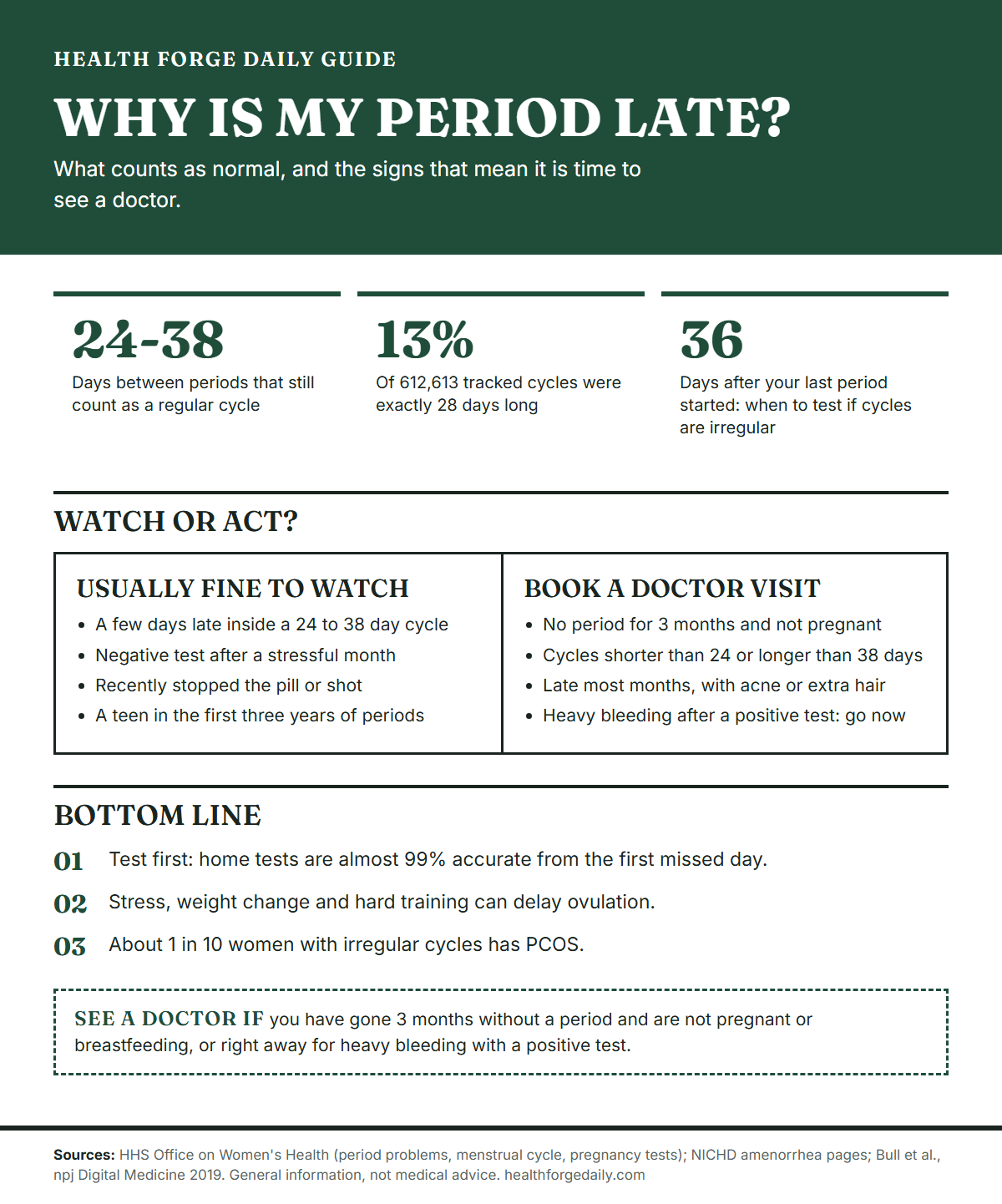
The short answer: a cycle anywhere from 24 to 38 days still counts as regular, so a period a few days past your app’s guess is often normal variation.[2] If you are not pregnant and have gone three months without a period, see a doctor.[1]
| Normal cycle | Every 24 to 38 days counts as regular; most cycles run about 28 days[2][4] |
|---|---|
| Most common cause | Pregnancy, followed by breastfeeding and menopause[5] |
| Other causes | Stress, weight change, hard exercise, birth control, thyroid problems, PCOS, some medicines[1][5] |
| First step | A home pregnancy test from the first day of the missed period, almost 99% accurate when used correctly[3] |
| Counts as missing | No period for three months in a row (amenorrhea), seen in 3% to 4% of women[1] |
| Doctor checks | Pregnancy test, thyroid (TSH), ovary hormones (FSH, LH), androgens, sometimes an ultrasound[6] |
| Get help fast | Unusual heavy bleeding with a positive test can mean a miscarriage or an ectopic pregnancy, which is an emergency[1] |
Why is my period late?
A late period means ovulation came later than usual or did not happen, and pregnancy is the most common natural reason. The menstrual cycle runs from the first day of one period to the first day of the next. Your period starts when estrogen and progesterone fall, on average about 12 days after ovulation.[2][11]
Anything that delays ovulation pushes the whole period back. NICHD lists natural causes, medicines and hormone conditions.[5]
| Cause | Typical clue | Source |
|---|---|---|
| Pregnancy | Sex without reliable birth control since your last period | [3][5] |
| Breastfeeding | Periods may stay away until weaning | [1] |
| Stress, low food intake, hard training | Recent exams, grief, a new training plan or weight loss | [16] |
| Hormonal birth control | Pill, shot, hormonal IUD, or recently stopping one | [5] |
| PCOS | Skipped periods, acne, extra hair growth, weight gain | [8] |
| Thyroid problems | Tiredness, weight gain, feeling cold (underactive thyroid) | [9] |
| Perimenopause | Age mid-40s or older, hot flashes, poor sleep | [10] |
Why is my period late for 2 or 3 days?
A period that is 2 or 3 days late is usually ordinary cycle-to-cycle variation, since cycles from 24 to 38 days all count as regular. Many people can only predict their start date within a few days.[2] A short delay on its own rarely points to a medical problem.
In one app study of 612,613 cycles from 124,648 users, the average cycle was 29.3 days, and only 13% of cycles were exactly 28 days long.[11] The app maker funded that study, so treat the exact figures with some caution.
A larger, independent US study of 165,668 cycles found that cycle length swings more at both ends of life. Variation was 46% higher in people under 20 and 45% higher at ages 45 to 49 than at ages 35 to 39.[12] Teens often take up to three years to settle into a steady pattern.[2]
If there is any chance of pregnancy, a test on the first day of the missed period is reasonable. If it is negative and you still have no period, test again in a few days.[3]
Why is my period late but my pregnancy test is negative?
A negative test with a late period means either you tested before the pregnancy hormone hCG was high enough, or something else delayed ovulation. The Office on Women’s Health says false negatives happen most when people test too early, because hCG builds up day by day after implantation.[3]
Implantation usually happens about 10 days after conception, and urine tests typically pick up a pregnancy two weeks or more after conception. A blood test at a clinic can find it earlier.[3] If your cycles are irregular, the agency suggests testing 36 days after the start of your last period or four weeks after sex.[3]
Read the result window at the time the box gives, up to 10 minutes. Any visible line or plus sign, however faint, most likely means pregnant.[3]
If repeat tests stay negative, the late period has another cause. Late ovulation after a stressful month, weight change and the hormone conditions below are the usual suspects.[1][5] Three months with no period and no pregnancy is the point to book a visit.[1]
Can stress delay periods?
Yes. Long-term, severe stress can affect the part of the brain that controls reproduction, so ovulation and the period can be delayed or stop. Doctors call the stopped-period version functional hypothalamic amenorrhea. The brain cuts back on GnRH, the hormone that starts each cycle.[1][5]
The Endocrine Society guideline describes this pattern as often tied to stress, weight loss, too much exercise, or a mix of them. It is a diagnosis of exclusion, so other causes have to be ruled out first.[16] If it lasts, it can lead to bone loss and trouble getting pregnant.[16]
Evidence on everyday stress is thinner. In a survey of 746 nurses in Taiwan, those who rated their job stress as high had 4.8 times the odds of irregular cycles.[14] Because it was a one-time survey, it cannot show that stress caused the change.
If stress is the likely driver, our guide on how to lower cortisol with research-backed steps covers sleep, exercise and other habits that were studied. NICHD lists stress reduction, with help from a counselor if needed, as a first-line step.[7]
Why is my period late on birth control?
Hormonal birth control, including some pills, the shot and hormonal IUDs, can make periods very light or stop them for as long as you use it. NICHD lists these methods as known causes of missed periods. It can also take a few months after stopping one for cycles to restart and become regular.[5]
If you skipped pills and then miss a period, take a pregnancy test. Birth control medicines do not affect home test results.[3]
Emergency contraception can also move your next period. In a small study of 14 women, taking levonorgestrel 1.5 mg three days before expected ovulation delayed the hormone surge and the next period. Taking it a day before ovulation made the cycle shorter instead.[15] If your period is late after emergency contraception, a pregnancy test is still the sensible check.
A few other medicines can delay periods too. Some antidepressants and blood pressure drugs raise prolactin, a hormone that blocks ovulation, and medicines for epilepsy or anxiety can make cycles irregular.[1][5] Do not stop a prescribed medicine on your own; ask the prescriber.
Why is my period late every month?
Periods that run late month after month usually point to a steady hormone pattern, most often PCOS, a thyroid problem, weight change or perimenopause. HHS counts cycles longer than 38 days, or cycles that vary by more than 20 days, as irregular. About 1 in 10 women with irregular cycles has PCOS.[1]
With PCOS, the ovaries make extra androgens and often do not release an egg on schedule. NICHD lists skipped periods, no periods and very heavy periods among its signs.[8] Our review of inositol for PCOS and what trials show about cycles covers one supplement that was studied for this.
An underactive thyroid can cause heavy or irregular periods, and nearly 5 in 100 Americans aged 12 and older have it.[9] An overactive thyroid can make periods lighter and less frequent.[1]
Large weight gains or losses can stop periods, and extra body fat makes estrogen that can throw the cycle off.[1] In the Apple study, people with a BMI of 40 or more had cycles 1.5 days longer on average.[12]
From the mid-40s, perimenopause makes cycles less regular. Most people start this change between 45 and 55, and menopause is confirmed only after 12 months with no period.[10] For symptom relief, see our guide to supplements for hot flashes during menopause.
What the cycle studies show
| Study | Who and how many | What was measured | Result |
|---|---|---|---|
| Bull, 2019[11] | 124,648 app users, 612,613 cycles | Cycle length | Mean 29.3 days; 13% exactly 28 days; app maker funded |
| Li, 2023[12] | 12,608 US people, 165,668 cycles | Variation by age and weight | 46% more variation under 20, 45% more at 45 to 49 |
| Edelman, 2022[13] | 3,959 US people | Cycle length after COVID-19 vaccine | 0.71 days longer after dose one, 0.91 after dose two |
| Lin, 2007[14] | 746 nurses in Taiwan | Job stress and cycles | 4.8 times the odds of irregular cycles; survey only |
| Okewole, 2007[15] | 14 women | Levonorgestrel 1.5 mg | Next period delayed when taken 3 days before ovulation |
What should I do when my period is late?
Start with a pregnancy test if pregnancy is possible, then track your dates and symptoms for the next one to three cycles. NICHD advises contacting a health care provider soon after a missed period, and a calendar of start dates and flow makes that visit far more useful.[2][6]
We built this table from the agency guidance above, sorted by situation.
| If this fits you | Sensible next step |
|---|---|
| Had sex in the last month and the period is 1 day late or more | Home pregnancy test; repeat in a few days if negative[3] |
| Cycles are irregular and you are unsure when to test | Test 36 days after your last period started, or four weeks after sex[3] |
| Positive test | See a doctor to confirm the pregnancy and plan next steps[3] |
| Stressful month, illness, travel or new hard training | Track the next cycle; ease the training load and eat enough[7] |
| Stopped the pill, shot or hormonal IUD | Allow a few months for cycles to return; check in if they do not[5] |
| Late most months, with acne or extra hair | Ask about PCOS testing[8] |
| No period for three months, not pregnant or breastfeeding | Book a doctor visit[1] |
Practical checklist
- Write down the first day of each period, plus how heavy it is and any pain.[2]
- Check the expiry date on a pregnancy test and read it within the time on the box.[3]
- List every medicine you take, including birth control and any recent emergency pill.[5]
- Note big changes in weight, food intake, exercise or stress over the past three months.[16]
- Note other signs such as hot flashes, new hair growth, acne, tiredness or feeling cold.[8][9]
- Browse our hormone balance guides for related conditions before your visit.
When should you see a doctor about a late period?
See a doctor if you have gone three months without a period and are not pregnant or breastfeeding, or if you have not had a first period by age 15. A period that stops for that long can mean your ovaries are making less estrogen, and that can have serious effects, including bone loss.[1][16]
Book an appointment sooner if you notice any of these:[1][10]
- Cycles shorter than 24 days or longer than 38 days
- Irregular periods after years of steady cycles
- Bleeding between periods or after sex more than once
- Any bleeding after a full year without periods
Get care right away for unusual heavy bleeding after a positive test. It can come from a miscarriage or an ectopic pregnancy, and an ectopic pregnancy is a medical emergency.[1] Bleeding through a pad or tampon every one to two hours, or feeling dizzy and weak with heavy bleeding, also needs a call to your doctor.[1]
What doctors check first
Expect questions about your cycle, sex life, weight, exercise, stress and medicines. If you are sexually active, the first test is a pregnancy test, followed by a physical and pelvic exam.[6] Blood work often checks thyroid-stimulating hormone (TSH), FSH and LH, androgens and sometimes AMH. A pelvic ultrasound looks at the uterus and ovaries.[6]
Some people also get a hormone challenge test, which means taking a hormone medicine for 7 to 10 days to see whether a bleed follows. The result tells the doctor whether low estrogen is behind the missing periods.[6]
How doctors treat it
Treatment depends on the cause. NICHD lists healthy weight, less stress and a lighter exercise load for lifestyle causes, birth control pills to restart a regular bleed, clomiphene to trigger ovulation in PCOS, and estrogen for primary ovarian insufficiency.[7] Scar tissue inside the uterus, which can follow a D&C, may need a small procedure to remove it.[7]
Thyroid and pituitary problems are treated directly, often with medicine. No supplement is a replacement for finding the cause, so get the tests first and talk through any supplement with your doctor afterward.[5][7]
Bottom line
A late period is common, and most cases trace back to pregnancy, a stressful stretch, weight or exercise changes, or birth control. A cycle that wanders a few days inside the 24 to 38 day range is still regular.[2]
For most people the better first step is a pregnancy test and a simple period diary, because together they answer the two questions any doctor will ask. If periods stay away for three months, or come late most months, get checked for PCOS, thyroid problems and the other causes above.[1][6]
Sources
- Period problems. Office on Women's Health, U.S. Department of Health and Human Services
- Your menstrual cycle. Office on Women's Health, U.S. Department of Health and Human Services
- Pregnancy tests. Office on Women's Health, U.S. Department of Health and Human Services
- Menstruation. MedlinePlus, National Library of Medicine
- What causes amenorrhea?. Eunice Kennedy Shriver National Institute of Child Health and Human Development
- How is amenorrhea diagnosed?. Eunice Kennedy Shriver National Institute of Child Health and Human Development
- What are the treatments for amenorrhea?. Eunice Kennedy Shriver National Institute of Child Health and Human Development
- What are the symptoms of PCOS?. Eunice Kennedy Shriver National Institute of Child Health and Human Development
- Hypothyroidism (Underactive Thyroid). National Institute of Diabetes and Digestive and Kidney Diseases
- What Is Menopause?. National Institute on Aging
- Real-world menstrual cycle characteristics of more than 600,000 menstrual cycles. Bull et al., npj Digital Medicine, 2019 (funded by Natural Cycles)
- Menstrual cycle length variation by demographic characteristics from the Apple Women's Health Study. Li et al., npj Digital Medicine, 2023
- Association Between Menstrual Cycle Length and Coronavirus Disease 2019 (COVID-19) Vaccination: A U.S. Cohort. Edelman et al., Obstetrics and Gynecology, 2022
- The impact of self-perceived job stress on menstrual patterns among Taiwanese nurses. Lin et al., Industrial Health, 2007
- Effect of single administration of levonorgestrel on the menstrual cycle. Okewole et al., Contraception, 2007
- Functional Hypothalamic Amenorrhea: An Endocrine Society Clinical Practice Guideline. Gordon et al., Journal of Clinical Endocrinology and Metabolism, 2017
Frequently asked questions
Why is my period late if I'm a virgin?
Without sex, pregnancy is off the list, so the usual causes are stress, weight change, hard exercise, illness or a hormone condition such as PCOS or a thyroid problem. Teens often have irregular cycles for the first few years.
Why is my period late but I have cramps?
Cramps without bleeding can simply mean your period is about to start after late ovulation. Early pregnancy can cause cramping too, so take a test. Cramps with heavy bleeding after a positive test need care right away.
Can a COVID vaccine make my period late?
Slightly. In a US study of 3,959 people, cycles were less than one day longer after each vaccine dose, and the length of bleeding did not change. A longer delay most likely has another cause.
Can losing weight or exercising more make my period late?
Yes. Eating too little for your activity level, fast weight loss or a hard new training plan can signal the brain to pause ovulation. Periods usually return once weight and food intake recover, but a long gap needs a doctor visit.
Can an early period have the same causes as a late one?
Often, yes. Stress, perimenopause, thyroid problems and emergency contraception can shift ovulation earlier or later. Cycles from 24 to 38 days count as regular, so a few days early is usually normal variation.

Grace Whitaker is the health editor at Health Forge Daily. She reads supplement labels line by line, checks each ingredient and dose against published research, and tracks refund policies and customer complaints before a product gets a verdict. She is not a doctor, so every review points readers back to their own physician for medical decisions.
This article is for general information and is not medical advice. Supplements are not evaluated by the FDA and are not intended to diagnose, treat, cure or prevent any disease. Check with your doctor before you start any supplement.