Sleep 7 to 8 hours, keep most exercise at an easy pace, practice meditation or slow breathing daily, and spend 20 to 30 minutes outdoors a few times a week. A 2024 review of 58 trials found mindfulness and relaxation lowered cortisol the most. Supplements have weaker evidence, and very high cortisol with physical signs needs a doctor.

This guide explains how to lower cortisol levels with steps that have been tested in people. We read the MedlinePlus and NIDDK pages on cortisol and Cushing’s syndrome, two NCCIH fact sheets, an NIMH stress fact sheet, and the trials and reviews listed at the end. Our process is set out on our how we review page.
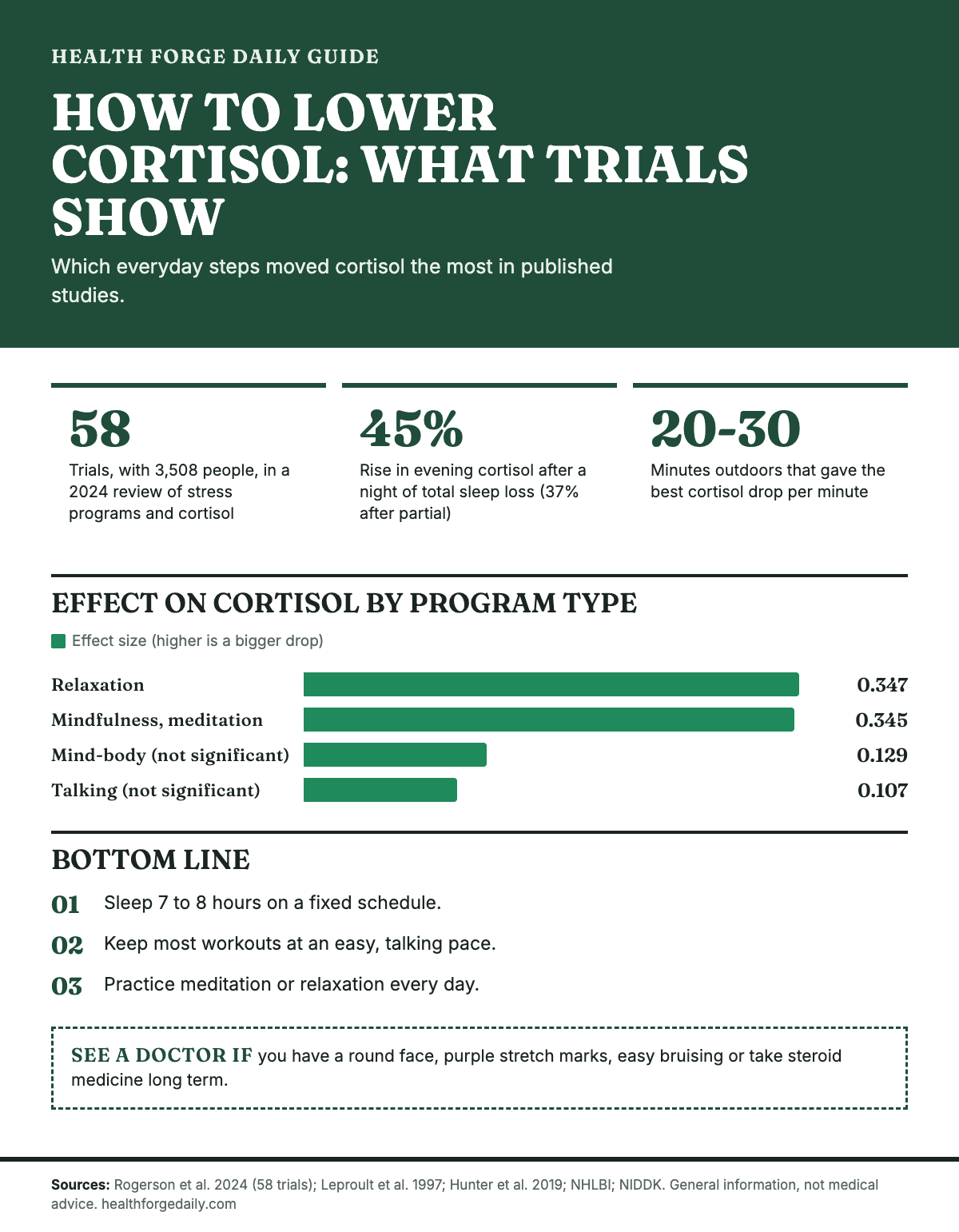
The short answer: sleep 7 to 8 hours, keep most exercise at an easy pace, practice meditation or relaxation most days, and spend 20 to 30 minutes outside, because a review of 58 trials found mindfulness and relaxation lowered cortisol more than other stress programs.[5][8][10]
| What it is | A hormone made by the adrenal glands that helps your body respond to stress and control blood sugar and blood pressure[1] |
|---|---|
| Normal pattern | Highest in the morning, much lower by around 4 p.m.[1] |
| Best evidence for lowering it | Mindfulness, meditation and relaxation programs, across 58 trials and 3,508 people[5] |
| Biggest everyday driver | Lost sleep raised evening cortisol by 37% to 45% the next day[7] |
| Supplements | Ashwagandha has small, maker-supplied trials and safety limits[11][12] |
| Who needs a doctor | Anyone with a round face, purple stretch marks, easy bruising or long-term steroid use[2] |
What is cortisol, and what counts as high cortisol?
Cortisol is a hormone your adrenal glands make to help you respond to stress, control inflammation, and manage blood sugar and blood pressure.[1] It rises and falls on a daily rhythm. Levels are normally highest in the morning and much lower by about 4 p.m.[1]
A short spike during a hard day is normal. It is how your body gets energy to a problem. The worry is cortisol that stays high for weeks or months.
A doctor checks cortisol with a blood test, a 24-hour urine collection, or a late-night saliva sample.[1] Results that are too high may point to Cushing’s syndrome, a condition with its own causes and treatment.[1][2] A single home saliva test cannot tell you much without a doctor reading it in context.
NIMH notes that long-term stress can affect sleep and the immune, digestive, heart and reproductive systems.[3] That is the real reason to bring stress hormones down: so the body spends less time in alarm mode.
Is high cortisol different in women and men?
The steps to lower everyday stress cortisol are the same for women and men. The medical side differs. Cushing’s syndrome affects about three times as many women as men, usually between ages 30 and 50.[2] In women it can cause irregular or missed periods and extra hair on the face and body. In men it can cause lower fertility, low sex drive and erectile problems.[2]
So if you are a woman searching how to reduce cortisol because of new period changes, or a man with new erection problems, start with a doctor visit, not a supplement.
How to lower cortisol levels: 7 steps with evidence
The steps with the best support are regular sleep, easy-paced exercise, daily meditation or relaxation, and short visits to green space. Each one below has a trial or a federal health agency behind it. Start with the first two, since they cost nothing and help most other steps work.
- Protect 7 to 8 hours of sleep. NHLBI advises adults to get 7 to 8 hours a day.[8] Even one short night raised evening cortisol in a sleep lab trial.[7]
- Keep a steady sleep routine. NIMH lists a regular sleep schedule as a core stress tip.[3] Go to bed and wake at about the same time each day.
- Practice 10 to 20 minutes of meditation or slow breathing daily. Mindfulness and relaxation had the largest effects on cortisol in a 2024 review of 58 trials.[5]
- Make most workouts easy. In one lab study, 30 minutes at a light pace did not raise cortisol, while hard sessions raised it sharply.[9]
- Get outside for 20 to 30 minutes, at least three times a week. That dose gave the best cortisol drop per minute in an 8-week study.[10]
- Cut back on excess caffeine and eat regular meals. Both are on NIMH’s list of everyday stress steps.[3]
- Reach out when stress builds up. NIMH suggests talking to friends, family or a professional, and keeping a journal.[3]
None of these steps need special products. If you want to track progress, notice your sleep, energy and mood over four to eight weeks rather than chasing a single lab number.
Does poor sleep raise cortisol?
Yes. In a University of Chicago sleep lab trial, partial and total sleep loss raised evening cortisol by 37% and 45% the following day.[7] The researchers also found the body’s normal evening quiet period for cortisol started at least one hour late.[7]
The study was small and only included young men. Still, the pattern is clear: short sleep keeps the stress system switched on later into the evening, which can make the next night harder too.
NHLBI says adults need 7 to 8 hours of sleep a day and warns that lost hours add up to a sleep debt.[8] If you lose 2 hours a night for a work week, that debt is 10 hours.
Practical fixes come first: a fixed wake time, a dark and cool room, and no screens in bed. If you have tried those and still struggle, our ranked guide to sleep supplements covers what the trials show for melatonin, magnesium and others. For magnesium in particular, see our page on magnesium glycinate for sleep.
What kind of exercise lowers cortisol?
Easy, low-intensity exercise is the type that does not push cortisol up. In a 2008 University of North Carolina study, 12 trained men did 30 minutes of cycling at three effort levels on separate days.[9]
At 40% of their maximum effort, cortisol rose only 5.7%. At 60% it rose 39.9%, and at 80% it rose 83.1%.[9] After the authors corrected for fluid shifts and time of day, the easy session actually lowered cortisol.[9]
This does not mean hard training is bad. A short cortisol rise during a tough workout is a normal response, and it fades afterward. It does mean that if you already feel run down and stressed, adding daily high-intensity sessions may not be the best first move.
A good mix for most people is brisk walking, easy cycling or swimming on most days, with one or two harder sessions a week. NIMH lists regular exercise among its main stress tips.[3]
Does meditation reduce cortisol?
Yes, modestly. Mindfulness and meditation programs lowered cortisol in pooled trials, with effects in the small to medium range. A 2024 review from the University of Leeds pooled 58 randomized trials with 3,508 people who did not have a medical illness.[5]
Mindfulness and meditation scored an effect size of 0.345, and relaxation training scored 0.347. Mind-body therapies such as yoga scored 0.129 and talking therapies 0.107, and those two results were not statistically significant.[5] Longer programs did not work better than shorter ones.[5]
An earlier review of 45 trials, all compared against an active control group, found meditation lowered cortisol, blood pressure and heart rate.[6]
| Study | Who and how many | What was done | Result |
|---|---|---|---|
| Rogerson 2024 review[5] | 58 trials, 3,508 people | Stress programs vs control | Mindfulness and relaxation lowered cortisol most |
| Pascoe 2017 review[6] | 45 trials | Meditation vs active control | Lower cortisol, blood pressure and heart rate |
| Leproult 1997[7] | Young men, sleep lab | Partial or total sleep loss | Evening cortisol up 37% to 45% |
| Hill 2008[9] | 12 trained men | 30 min exercise at 40%, 60%, 80% effort | Up 5.7%, 39.9% and 83.1% |
| Hunter 2019[10] | 36 city dwellers, 8 weeks | Time in nature, 3 times a week | 21.3% per hour drop in saliva cortisol |
| Chandrasekhar 2012[12] | 64 stressed adults, 60 days | Ashwagandha 600 mg a day | 27.9% drop vs 7.9% on placebo |
NCCIH says relaxation techniques are generally safe for healthy people. A few people report more anxiety or intrusive thoughts, and people with epilepsy or certain psychiatric conditions should check with a clinician first.[4]
Can time in nature lower cortisol?
Yes. Spending 20 to 30 minutes in a green outdoor space gave the most cortisol drop per minute in a University of Michigan study. Researchers asked 36 city residents to spend at least 10 minutes in nature, at least three times a week, for 8 weeks.[10]
Saliva cortisol fell 21.3% per hour beyond its normal daily decline of 11.7%.[10] Benefits kept building after 30 minutes, but more slowly. Sitting, strolling or walking all worked about the same for cortisol.[10]
The study had no control group that stayed indoors, so it shows a link, not proof. Even so, a park bench at lunch is cheap, safe and easy to repeat.
If you can pair this with step 4, an easy walk in a park covers two habits at once.
Do cortisol supplements or a cortisol detox work?
No supplement or detox plan has strong proof that it lowers cortisol, and products sold as a cortisol detox have no trials behind them. We found no published study testing a branded cortisol detox drink or kit.
Ashwagandha has the most data. NCCIH says some preparations may help with stress and insomnia, but the evidence on anxiety is unclear.[11] In one 60-day trial of 64 adults with chronic stress, 600 mg a day of root extract lowered blood cortisol by 27.9%, compared with 7.9% on placebo.[12] The extract came from its maker, and the trial was small.[12]
NCCIH says ashwagandha may be safe for up to 3 months. It can cause drowsiness, stomach upset and diarrhea, and rare cases of liver injury have been reported.[11] It should be avoided in pregnancy and while breastfeeding, and by people with thyroid or autoimmune conditions.[11] Our ashwagandha trials guide covers the other research on this herb.
L-theanine, an amino acid from tea, is covered in a separate guide on this site.
A “cortisol diet” also lacks direct trials. NIMH’s advice is simple: eat regular, healthy meals and avoid too much caffeine.[3]
When is high cortisol a sign of a medical problem?
Cortisol that stays very high for months can be Cushing’s syndrome, which needs a doctor and will not go away with lifestyle steps alone. The most common cause is long-term, high-dose glucocorticoid medicine such as prednisone, used for asthma, arthritis and lupus.[2] More than 10 million Americans take these medicines each year.[2]
Cushing’s from a tumor is rare, about 40 to 70 people per million.[2] Untreated, it can lead to heart attack, stroke and blood clots, and it can be fatal.[2]
See a doctor soon if you notice
- Weight gain with thin arms and legs[2]
- A round face or a fatty hump between the shoulders[2]
- Wide purple stretch marks on the belly, hips or breasts[2]
- Easy bruising[2]
- Periods that change or stop, or new erection problems[2]
- Thoughts of harming yourself: call or text 988 right away[3]
Never stop a steroid medicine on your own. Stopping suddenly can be dangerous, and doctors lower the dose slowly.[2] If you take any regular medicine, ask before starting a supplement.
What doctors use first
For everyday stress, doctors usually start with the habits above and, when needed, talk therapy or medicine for anxiety or depression.[3] For suspected Cushing’s syndrome, they order blood, urine or saliva cortisol tests, find the cause, and treat that cause.[1][2] A supplement is not a replacement for either path.
Bottom line
Practical checklist
- Set a fixed wake time and aim for 7 to 8 hours in bed.[8]
- Pick one daily practice: 10 minutes of meditation, slow breathing or guided relaxation.[5]
- Make most workouts easy enough to talk through.[9]
- Book three 20 to 30 minute outdoor breaks into your week.[10]
- Trim caffeine and keep regular meal times.[3]
- If you try a supplement, read the supplement label checklist first and stop after 3 months.[11]
- Book a doctor visit for any warning sign in the list above.[2]
Learning how to lower cortisol levels mostly means fixing sleep and adding a daily calm-down habit. The trial data favor mindfulness and relaxation over any pill, and they cost nothing.
For most people, a better first step than buying a cortisol supplement is two weeks of steady sleep plus 10 minutes of daily meditation, because those have the most consistent results. Browse more of our anxiety and stress guides for related topics.
Sources
- Cortisol Test. MedlinePlus, National Library of Medicine
- Cushing's Syndrome. NIDDK
- I'm So Stressed Out! Fact Sheet. National Institute of Mental Health
- Relaxation Techniques: What You Need To Know. NCCIH
- Effectiveness of stress management interventions to change cortisol levels: a systematic review and meta-analysis. Rogerson et al., Psychoneuroendocrinology, 2024
- Mindfulness mediates the physiological markers of stress: systematic review and meta-analysis. Pascoe et al., Journal of Psychiatric Research, 2017
- Sleep loss results in an elevation of cortisol levels the next evening. Leproult et al., Sleep, 1997
- How Much Sleep Is Enough?. NHLBI
- Exercise and circulating cortisol levels: the intensity threshold effect. Hill et al., Journal of Endocrinological Investigation, 2008
- Urban nature experiences reduce stress in the context of daily life based on salivary biomarkers. Hunter et al., Frontiers in Psychology, 2019
- Ashwagandha: Usefulness and Safety. NCCIH
- A prospective, randomized double-blind, placebo-controlled study of safety and efficacy of a high-concentration full-spectrum extract of ashwagandha root in reducing stress and anxiety in adults. Chandrasekhar et al., Indian Journal of Psychological Medicine, 2012
Frequently asked questions
How fast can you lower cortisol naturally?
Some changes show up within a day. Lost sleep raised evening cortisol the very next evening in a lab study, and a 20 to 30 minute visit to a park lowered saliva cortisol within the hour. Lasting change from meditation takes weeks of daily practice.
Is there a cortisol diet that works?
No eating plan has strong trial evidence for lowering cortisol on its own. Federal mental health guidance suggests regular, healthy meals and less caffeine as part of managing stress. Be wary of any cortisol detox diet that promises fast weight loss.
What is the treatment for high cortisol?
It depends on the cause. Stress-related cortisol is managed with sleep, exercise and relaxation habits. Cushing's syndrome is treated by a doctor, who may slowly lower steroid medicine or treat a tumor. Never stop steroid medicine on your own.
Can you get rid of cortisol completely?
No, and you would not want to. Your body needs cortisol to respond to stress, control blood sugar and blood pressure, and manage inflammation. The goal is a normal daily rhythm, with levels highest in the morning and lower by afternoon.
How do I know if my cortisol is high?
Only a test can tell. A doctor may order a blood test in the morning and afternoon, a 24-hour urine collection, or a late-night saliva test. Signs such as a round face, purple stretch marks and easy bruising are reasons to ask.

Grace Whitaker is the health editor at Health Forge Daily. She reads supplement labels line by line, checks each ingredient and dose against published research, and tracks refund policies and customer complaints before a product gets a verdict. She is not a doctor, so every review points readers back to their own physician for medical decisions.
This article is for general information and is not medical advice. Supplements are not evaluated by the FDA and are not intended to diagnose, treat, cure or prevent any disease. Check with your doctor before you start any supplement.