Most eye twitching is eyelid myokymia, a harmless flutter of the muscle that closes the lid. The National Eye Institute lists stress, dry eye, too much caffeine and lack of sleep as common triggers, and it usually fades without treatment within days to a few weeks. See an eye doctor if it lasts longer, forces your eye shut or spreads across your face.
Why is my eye twitching? For most people, the answer is a harmless flutter of the eyelid muscle set off by stress, tiredness, caffeine, dry eyes or long hours at a screen. We read the National Eye Institute pages on blepharospasm and dry eye, the StatPearls review of eyelid myokymia, a 2020 Cochrane review, an American Academy of Ophthalmology evidence report and a 2024 screen-time study, and built this guide from them. Our review process explains how we pick and check sources.
The short answer: a common eyelid twitch usually goes away on its own, often within days, and the National Eye Institute says to see an eye doctor if it lasts more than a few weeks or spreads to other parts of your face.[1]
| What it is | Small, rippling contractions of the muscle that closes the eyelid, called eyelid myokymia[2] |
|---|---|
| Usual triggers | Stress, dry eye, too much caffeine and lack of sleep[1] |
| Which eye | Usually one eye, and the lower lid more often than the upper lid[2] |
| How long it lasts | Seconds to hours at a time; sometimes on and off for a few weeks[2] |
| Best evidence for a link | Screen time: 6.88 vs 4.84 hours a day in people with twitching vs controls in one 2024 study[3] |
| Rare causes | Benign essential blepharospasm, which affects about 20,000 to 50,000 people in the United States[4], and hemifacial spasm[8] |
| See a doctor if | It lasts more than a few weeks, your eye closes fully, or other face muscles join in[1] |
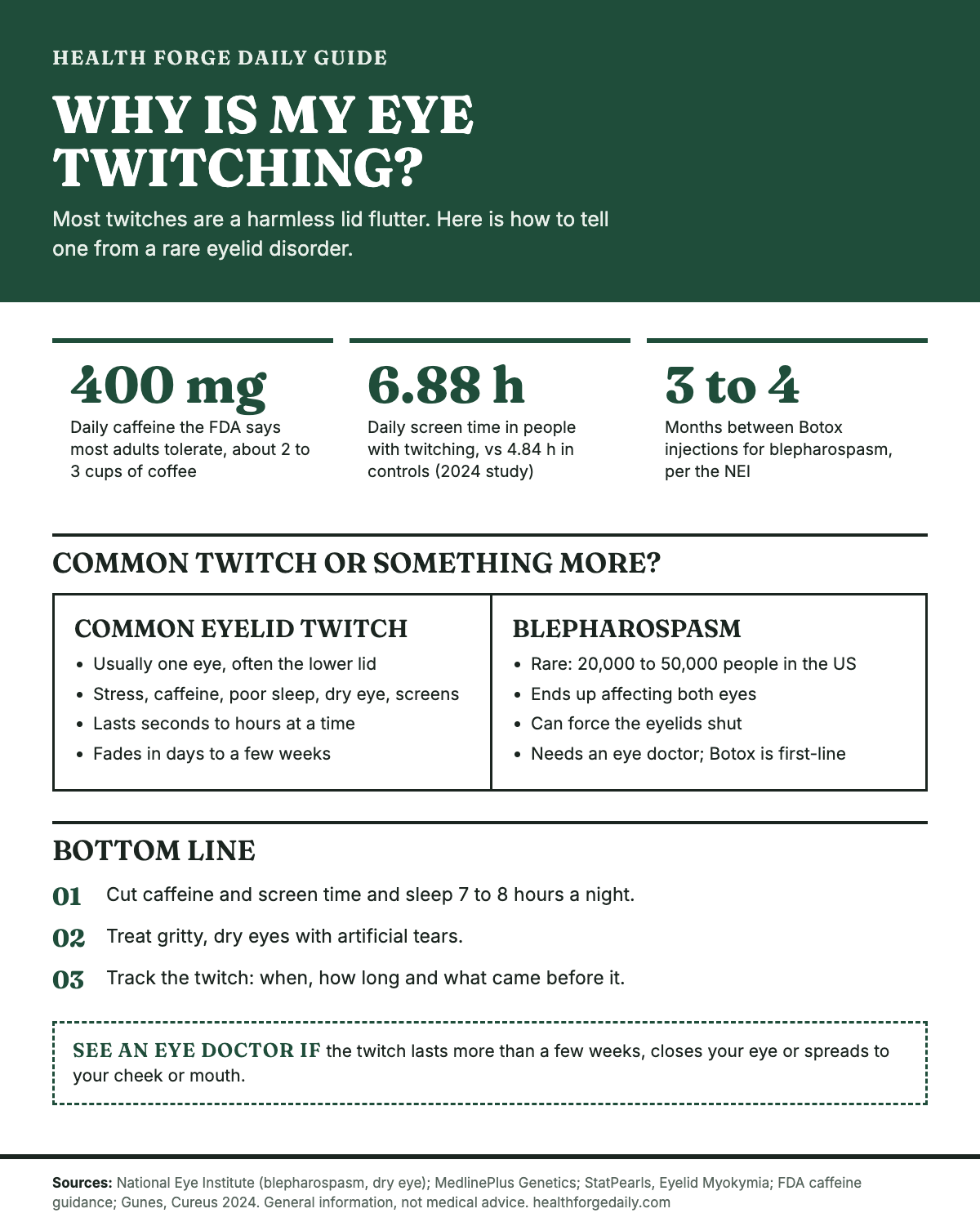
Why is my eye twitching?
Eyelid myokymia is the medical name for the ordinary eye twitch: spontaneous, gentle, rippling contractions of the orbicularis oculi, the muscle that closes your eyelid.[2] It is the most common type of facial twitch.
The twitch is self-limited. Episodes last seconds to hours and come and go. In some people they keep returning for several days or even a few weeks before stopping.[2]
The National Eye Institute lists the everyday triggers as stress, dry eye, too much caffeine and lack of sleep.[1] Most of the time no test is needed, and the fix is to find which of those triggers applies to you right now.
A few people have a different problem. Blepharospasm and hemifacial spasm are real movement disorders, and they look different from a lid flutter. We cover how to tell them apart further down.
What does it mean when your eye twitches?
Medically, an eye twitch usually means a small nerve and muscle circuit is overexcited, most often by fatigue, stress or caffeine.[4] Folk sayings link a left or right eye twitch to luck or news, and they have no medical basis.
MedlinePlus Genetics puts it plainly: benign essential blepharospasm “is different from the common and temporary eyelid twitching that can be caused by fatigue, stress, or caffeine.”[4]
A twitch can also be a side effect of some medicines, and it can show up alongside conditions such as Parkinson’s disease, Meige syndrome and Tourette syndrome.[1] In those cases there are usually other symptoms too. A twitch on its own, in a person who is otherwise well, rarely points to a hidden disease.
What causes eye twitching?
The most common causes of eye twitching are stress, poor sleep, caffeine, dry eye and long screen sessions, and they often stack together.[1][3] A week of late nights and extra coffee before a deadline is a typical setup.
| Cause | How common | What it looks like | Source |
|---|---|---|---|
| Stress and fatigue | Common | Lower lid flutter that comes and goes | NEI[1] |
| Too much caffeine | Common | Twitch plus jitters or poor sleep | NEI, FDA[1][12] |
| Dry eye | Common; about 16.4 million Americans | Gritty, burning eyes with the twitch | NEI[10] |
| Long screen time | Linked in one study | Twitch after long days on devices | Cureus 2024[3] |
| Benign essential blepharospasm | Rare | Both eyes, more blinking, lids may close | MedlinePlus Genetics[4] |
| Hemifacial spasm | Rare | Eye plus cheek or mouth on one side | J Neurol 2025[8] |
Cold weather and being female are listed as risk factors for a twitch that drags on for weeks.[2] Dry eye is worth checking because it is common and fixable. The NEI notes that heavy use of computers, tablets and phones can bring it on.[10]
The screen link comes from a 2024 case-control study of 103 people with twitching that lasted more than two weeks and 103 healthy controls. The twitching group spent 6.88 hours a day on screens, against 4.84 hours in the control group, and longer screen time tracked with longer twitching.[3] It was a single-clinic study, so it shows an association, not proof that screens cause the twitch.
Why does my left eye or right eye keep twitching?
A twitch in only the left eye or only the right eye is normal, because ordinary eyelid myokymia is usually one-sided.[2] The side tells you nothing special. The same triggers apply to both eyes.
StatPearls describes myokymia as likely to affect one eye and the lower lid more often than the upper lid. Rarely, the upper and lower lids on the same side twitch at once.[2]
What matters more is the pattern over time. Blepharospasm may begin in one eye but ends up affecting both eyes.[4] Hemifacial spasm stays on one side but spreads beyond the eyelid to muscles supplied by the facial nerve, such as the cheek and corner of the mouth.[8] If your twitch stays small, stays in one lid and fades within days or a few weeks, it fits the common pattern.
How do you stop eye twitching?
There is no instant off switch, but cutting caffeine, sleeping more, treating dry eye and taking screen breaks address the known triggers.[1][10] Most twitches settle as those triggers ease. Use the steps below as a two-week plan.
- Track it for three days. Note when it happens, how long, and what you had to drink and how you slept. Patterns show up fast.
- Trim caffeine. The FDA cites 400 mg a day, about two to three 12-ounce cups of coffee, as an amount most adults handle without negative effects.[12] If you are above that, or sensitive, cut back gradually.
- Protect your sleep. The NEI suggests about 7 to 8 hours a night for people with dry eye, and lack of sleep is itself a twitch trigger.[10][1] Our guide to sleep supplements ranked by evidence covers what helps and what does not, but habits come first.
- Break up screen time. Look away from the screen often and limit long sessions, as the NEI advises for dry eye.[10]
- Treat dry, gritty eyes. Artificial tears are the most common treatment for mild dry eye and do not need a prescription.[10]
- Cut down on wind, smoke and air conditioning blowing at your face, and consider a humidifier.[10]
- Lower the stress load where you can. The NEI lists stress management as a lifestyle step that may help.[1]
- Book an eye exam if the twitch lasts beyond a few weeks or changes pattern.[1]
Does low magnesium cause eye twitching?
The evidence does not show that low magnesium is a common cause of an ordinary eye twitch.[3] In the 2024 screen-time study, blood calcium, sodium, potassium and magnesium levels did not differ between people with twitching and healthy controls.[3]
Magnesium does matter for muscle and nerve function. The NIH Office of Dietary Supplements says extreme magnesium deficiency can cause numbness, tingling, muscle cramps and seizures.[11] That kind of deficiency is uncommon. It is more likely in people with gut diseases such as Crohn’s or celiac disease, type 2 diabetes, long-term heavy alcohol use, and in older adults.[11]
We found no trial testing magnesium supplements for eye twitching. If you already take magnesium for other reasons, our look at magnesium glycinate and how it compares explains the forms. Adults should keep supplemental magnesium at or under 350 mg a day, because higher doses can cause diarrhea, nausea and cramping.[11] Magnesium can also interfere with bisphosphonates and some antibiotics, so space them apart and ask a pharmacist.[11] Check the supplement facts label for the elemental magnesium per serving.
When is eye twitching a sign of something serious?
Eye twitching is more likely to need a doctor when it lasts beyond a few weeks, forces the eyelid shut, or spreads to other parts of the face.[1] Those features point toward blepharospasm or hemifacial spasm rather than a simple twitch.
Blepharospasm is the second most common focal dystonia, a movement disorder that starts in the brain.[5] It usually begins in mid to late adulthood with more frequent blinking, dry eyes and irritation from wind or bright light, then gradually worsens.[4] Women ages 40 to 60 are more likely to develop it, and women are affected more than twice as often as men.[1][4] Over time the lids can close on their own, which can cause functional vision loss even though the eyes are healthy.[5]
Hemifacial spasm causes involuntary contractions of muscles supplied by the facial nerve on one side of the face. It often stems from a blood vessel pressing on that nerve near the brainstem, which an MRI can show.[8]
See a doctor right away if
- Your eyelid closes completely during a twitch[1]
- Other muscles on one side of your face start to twitch[1]
- The twitching has lasted more than a few weeks[1]
- Your jaw or tongue also spasm, which can signal Meige syndrome[4]
- You started a new medicine and the twitching began soon after[1]
- Your eye is red, painful or your vision has changed along with the twitch[10]
What do doctors use first for twitching that will not stop?
For blepharospasm and hemifacial spasm, the standard first treatment is botulinum toxin injections into the eyelid muscles, repeated about every 3 to 4 months.[1] For a simple twitch, doctors usually start with the trigger list above and treat any dry eye.[1][10]
An eye doctor checks for blepharospasm as part of a full eye exam and asks about your medical and family history.[1] For hemifacial spasm, a high-resolution MRI looks for a vessel touching the facial nerve.[8] The NEI is clear that there is no cure for blepharospasm, though treatment controls symptoms well for many people.[1]
| Study | Who and how many | Treatment | Result |
|---|---|---|---|
| Cochrane review, 2020 | 3 RCTs, 313 adults with blepharospasm | Botulinum toxin A vs placebo | Severity fell 0.93 points on the Jankovic scale at 4 to 6 weeks; drooping lid risk rose (RR 4.02); effect lasted 10.6 weeks in one trial[6] |
| AAO evidence report, 2018 | 13 studies, 1,523 patients (1,143 blepharospasm, 380 hemifacial spasm) | Several botulinum toxin brands | Level I evidence for Botox, Xeomin and Meditoxin in blepharospasm; benefit held over at least 10 years in lower-level studies[7] |
| Meta-analysis, 2020 | 39 studies, 6,249 hemifacial spasm patients | Microvascular decompression surgery | 90.5% spasm-free at about 1.25 years; studies mostly retrospective[9] |
The Cochrane trials were all industry-funded and tested a single injection session, so long-term data come from weaker studies.[6][7] If injections fail, a surgery called myectomy, which removes some eyelid muscle, is an option.[1] Hemifacial spasm can also be treated with microvascular decompression, which moves the vessel off the nerve.[8][9] No supplement replaces any of these treatments.
Bottom line on eye twitching
Quick checklist
- Count your daily caffeine and stay near or under 400 mg[12]
- Aim for 7 to 8 hours of sleep for the next two weeks[10]
- Take regular screen breaks and use artificial tears if your eyes feel gritty[10]
- Write down when the twitch happens and how long it lasts
- Check new medicines with your pharmacist[1]
- Book an eye exam if it lasts more than a few weeks or spreads[1]
If you are asking why your eye is twitching, the likely answer is a tired, stressed or over-caffeinated eyelid muscle, and it should calm down once those triggers ease. The twitch is harmless, even if it bugs you for days.[2][4]
For most people, cutting back on caffeine and screens and sleeping more is a better first step than buying magnesium, because those triggers have direct support and supplements have none for this problem. A twitch that closes your eye or moves into your cheek is different, and it deserves a visit to an eye doctor. You can find more on eye comfort in our vision support guides.
Sources
- Blepharospasm. National Eye Institute, 2024
- Eyelid Myokymia (StatPearls). StatPearls Publishing, Jafer Chardoub and Patel, 2023
- Association Between Eyelid Twitching and Digital Screen Time, Uncorrected Refractive Error, Intraocular Pressure, and Blood Electrolyte Imbalances. Cureus, Gunes, 2024
- Benign essential blepharospasm. MedlinePlus Genetics, National Library of Medicine
- Dystonia. National Institute of Neurological Disorders and Stroke
- Botulinum toxin type A therapy for blepharospasm. Cochrane Database of Systematic Reviews, Duarte et al., 2020
- Chemodenervation for the Treatment of Facial Dystonia: A Report by the American Academy of Ophthalmology. Ophthalmology, Bilyk et al., 2018
- Hemifacial spasm: an update on pathophysiology, investigations and management. Journal of Neurology, Jesuthasan et al., 2025
- Spasm Freedom Following Microvascular Decompression for Hemifacial Spasm: Systematic Review and Meta-Analysis. World Neurosurgery, Holste et al., 2020
- Dry Eye. National Eye Institute, 2025
- Magnesium: Fact Sheet for Consumers. NIH Office of Dietary Supplements
- Spilling the Beans: How Much Caffeine is Too Much?. U.S. Food and Drug Administration
Frequently asked questions
Why is my eye twitching constantly?
A twitch that keeps coming back over several days is usually still eyelid myokymia, often fed by ongoing stress, poor sleep, caffeine or dry eye. It can last a few weeks. If it continues past that, closes your eye or spreads across your face, see an eye doctor.
Why does my eye twitch randomly?
The eyelid muscle can fire on its own when the nerve that controls it is overexcited. Fatigue, stress and caffeine lower that threshold, so twitches seem to come out of nowhere. Episodes often last seconds to hours and then stop without treatment.
How long does eye twitching last?
Most episodes last seconds to hours. A run of twitching can come and go for several days or even a few weeks before stopping. The National Eye Institute suggests seeing an eye doctor if it keeps going for more than a few weeks.
Can too much coffee make your eye twitch?
Yes, too much caffeine is one of the common triggers named by the National Eye Institute. The FDA cites 400 mg a day, about two to three 12-ounce cups of coffee, as an amount most adults tolerate. Sensitive people may react to less.
Is eyelid twitching the same as blepharospasm?
No. Ordinary eyelid twitching is common, usually affects one eye and fades on its own. Blepharospasm is a rare movement disorder that affects both eyes over time, gets worse gradually and can force the lids closed. It needs an eye doctor.

Grace Whitaker is the health editor at Health Forge Daily. She reads supplement labels line by line, checks each ingredient and dose against published research, and tracks refund policies and customer complaints before a product gets a verdict. She is not a doctor, so every review points readers back to their own physician for medical decisions.
This article is for general information and is not medical advice. Supplements are not evaluated by the FDA and are not intended to diagnose, treat, cure or prevent any disease. Check with your doctor before you start any supplement.