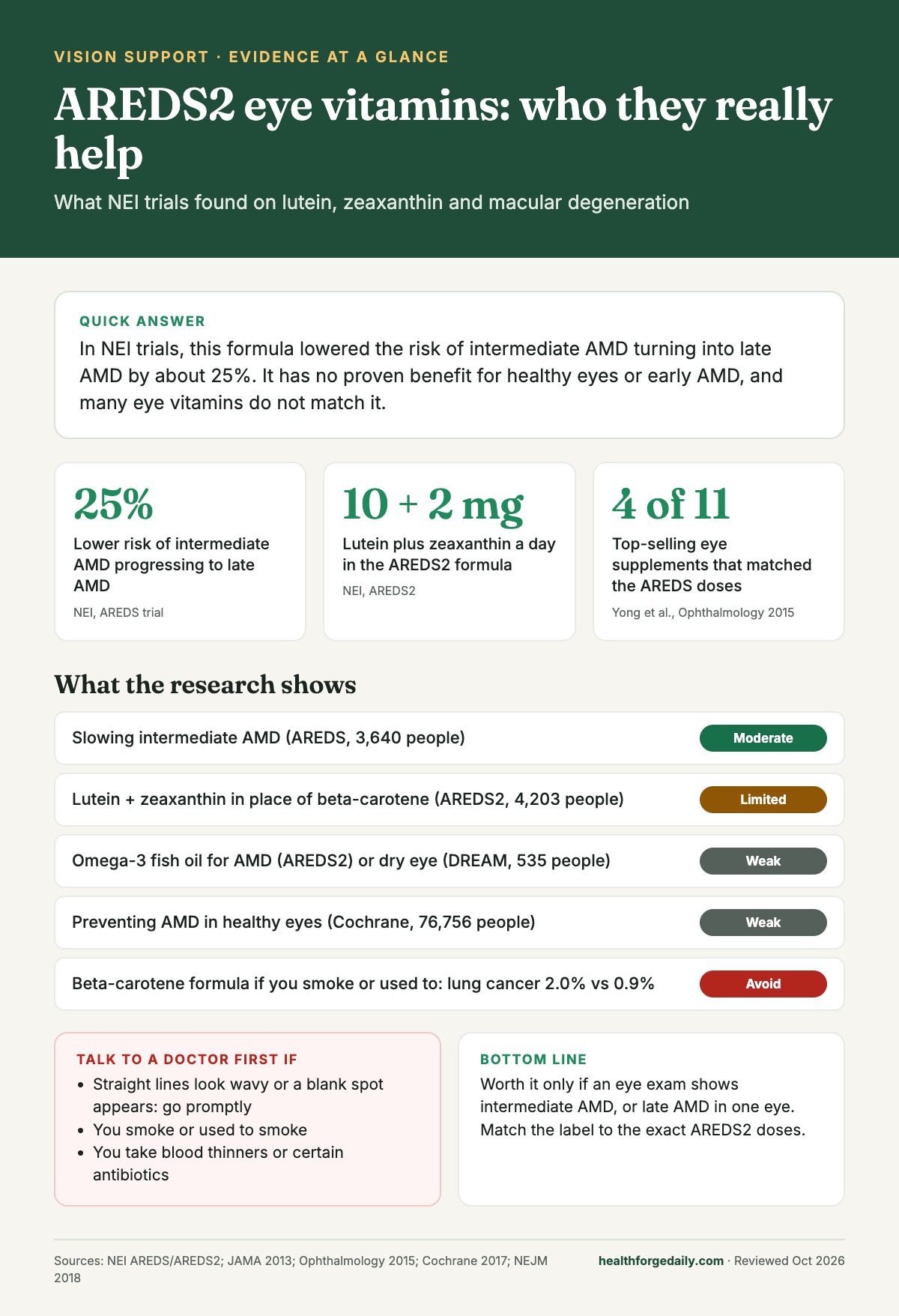
AREDS2 eye vitamins are a tested daily formula of vitamin C 500 mg, vitamin E 400 IU, zinc 80 mg, copper 2 mg, lutein 10 mg and zeaxanthin 2 mg. In National Eye Institute trials, the formula lowered the risk of intermediate AMD progressing to late AMD by about 25%. It has no proven benefit for healthy eyes or early AMD, and many eye vitamins do not match it.
We read the National Eye Institute (NEI) pages on age-related macular degeneration (AMD) and the AREDS trials, the AREDS and AREDS2 reports, two Cochrane reviews and the DREAM dry eye trial before writing this.
The AREDS2 formula lowered the chance that intermediate macular degeneration turns into late, sight-threatening disease by about 25%. It does nothing proven for healthy eyes or early AMD, and many products sold as eye vitamins do not match it.[2][3][11]
| What it is | A high-dose daily formula tested by the National Eye Institute in people with age-related macular degeneration (AMD)[2] |
|---|---|
| Exact formula | Vitamin C 500 mg, vitamin E 400 IU, zinc 80 mg, copper 2 mg, lutein 10 mg, zeaxanthin 2 mg[2] |
| Best evidence | About 25% lower risk of intermediate AMD progressing to late AMD[2][9] |
| Who it is for | Intermediate AMD in one or both eyes, or late AMD in one eye[1][3] |
| No proven benefit | Healthy eyes, early AMD, cataract, dry eye[3][10][12] |
| Safety | No significant serious side effects in the original AREDS trial; the older beta-carotene version raised lung cancer risk in former smokers[6][7] |
| Check first if | You take blood thinners or certain antibiotics, or you smoke or used to smoke[2][3][15] |
What are AREDS2 eye vitamins?
AREDS2 vitamins are a specific high-dose combination of two vitamins, two minerals and two plant pigments, tested by the NEI to slow macular degeneration. The name comes from the Age-Related Eye Disease Study 2.[2]
The AREDS2 formula is the original AREDS formula with one swap: beta-carotene was taken out and lutein plus zeaxanthin were put in.[2][8]
| Nutrient | AREDS formula | AREDS2 formula |
|---|---|---|
| Vitamin C | 500 mg | 500 mg |
| Vitamin E | 400 IU | 400 IU |
| Beta-carotene | 15 mg | None |
| Zinc | 80 mg | 80 mg |
| Copper (cupric oxide) | 2 mg | 2 mg |
| Lutein | None | 10 mg |
| Zeaxanthin | None | 2 mg |
Copper is added only to prevent the copper deficiency that high-dose zinc can cause.[2][3]
Lutein and zeaxanthin are carotenoids found in green leafy vegetables. Unlike beta-carotene, they are concentrated in the retina, where they may act as antioxidants.[3][4]
What is age-related macular degeneration?
AMD is an eye disease that blurs your central vision as aging damages the macula, the part of the retina that controls sharp, straight-ahead sight. It is a leading cause of vision loss in older adults, and about 11 million people in the United States have it.[1]
AMD does not cause complete blindness, because side vision is spared, but losing central vision makes reading, driving and recognizing faces harder.[1][4]
Risk rises with age, especially from 55 on. It is also higher with a family history of AMD, in white people and in people who smoke.[1] Not smoking, staying active and eating leafy greens and fish may lower your risk.[1]
What is the difference between dry and wet AMD?
Dry AMD is the common, slow form in which the macula thins; wet AMD is a less common late form in which abnormal blood vessels leak and damage the macula quickly. Most people with AMD have the dry type.[1]
Dry AMD moves through early, intermediate and late stages over several years, as yellow deposits called drusen build up under the retina.[1][4] There is no treatment for late dry AMD yet.[1]
Wet AMD affects about 10% of people with macular degeneration but causes most of the vision loss linked to it.[4] Any stage of dry AMD can turn wet, and wet AMD is always late stage, but it can be treated.[1]
Intermediate AMD means many medium drusen or at least one large one; only an eye exam can tell your stage.[2]
What are the symptoms of macular degeneration?
Early AMD has no symptoms. Later, central vision blurs, straight lines can look wavy and a dark or blank spot may appear. In intermediate AMD some people notice mild blur or trouble seeing in low light.[1]
In late AMD, many people see straight lines turn wavy or crooked, a blurry area near the center that grows, blank spots and colors that look less bright.[1]
How do you use an Amsler grid?
An Amsler grid is a square of lines with a center dot. The American Academy of Ophthalmology advises people with AMD to check it daily:[5]
- Wear your usual reading glasses and hold the grid 12 to 15 inches from your face in good light.[5]
- Cover one eye, look at the dot and notice any wavy, blurry, dark or blank areas. Repeat with the other eye.[5]
- If anything has changed, contact your eye doctor right away.[5]
What did the original AREDS trial find?
In people at high risk, the AREDS formula lowered the risk of progressing to advanced AMD by about 25% and the risk of central vision loss by 19%. AREDS began enrolling in 1992 and included 4,757 people aged 55 to 80 at 11 US clinics.[2]
The AMD trial followed 3,640 people for 6.3 years on average, comparing antioxidants (vitamins C and E plus beta-carotene), zinc plus copper, both, or placebo.[6]
People with only small drusen had just a 1.3% chance of progressing over 5 years, so they had little to gain.[6]
| Formulation | Lower risk of late AMD | Lower risk of vision loss |
|---|---|---|
| Antioxidants + zinc + copper (AREDS formula) | 25% | 19% |
| Zinc + copper only | 21% | 11% |
| Antioxidants only | 17% | 10% |
No formulation lowered the risk of cataract.[2]
The benefit held up over time. Ten years after enrollment, among those at highest risk, 34% of people originally assigned to the AREDS formula had progressed to advanced AMD, compared with 44% of those assigned to placebo.[2]
What changed in AREDS2, and why was beta-carotene removed?
AREDS2 tested adding lutein plus zeaxanthin or omega-3 fish oils, and dropping beta-carotene. Neither addition helped overall, but the swap made the formula safer.[2][7]
Launched in 2006, AREDS2 enrolled 4,203 people aged 50 to 85, all with intermediate AMD in both eyes, or intermediate in one and advanced in the other.[2] People were randomly assigned to lutein 10 mg plus zeaxanthin 2 mg, omega-3s (350 mg DHA plus 650 mg EPA), both, or placebo, on top of an AREDS-type formula.[2][7]
Over a median of 5 years, the chance of progressing to advanced AMD was 31% with placebo, 29% with lutein plus zeaxanthin, 31% with omega-3s and 30% with both. None of the differences was significant.[7]
A safety finding changed the formula: lung cancer occurred in 2.0% of people taking beta-carotene versus 0.9% of those who were not, mostly in former smokers.[7] About 91% of the people who developed lung cancer were former smokers, even though current smokers had been excluded from beta-carotene.[3]
In secondary analyses, the lutein and zeaxanthin formula without beta-carotene had an 18% lower risk of advanced AMD than the beta-carotene version. In people who ate the least lutein, adding it cut risk by 26%.[3]
A lower 25 mg zinc dose worked about the same, but that comparison had no placebo group, so the NEI still treats 80 mg as the gold standard.[2][3]
What did the 10-year AREDS2 follow-up show?
Over 10 years, beta-carotene nearly doubled lung cancer risk; lutein and zeaxanthin did not, and did slightly better for late AMD.[8]
After the trial, 3,882 participants took the AREDS2 formula for 5 more years. At 10 years, the odds of lung cancer were 1.82 for those first assigned beta-carotene and 1.15, not significant, for lutein and zeaxanthin.[8]
In a direct comparison, lutein and zeaxanthin were linked to a 15% lower risk of late AMD than beta-carotene (hazard ratio 0.85).[8]
Disclosure: NIH held a royalty-bearing license with Bausch and Lomb for the AREDS supplement until 2021.[8]
Who benefits from AREDS2 vitamins, and who does not?
The trials found a benefit for people with intermediate AMD in one or both eyes, or late AMD in one eye. They found no benefit for people with early AMD or no AMD.[3]
- Likely to benefit: intermediate AMD, which the formula may keep from turning late, or late AMD in one eye, where it may protect the other eye.[1]
- No proven benefit: early AMD. AREDS2 did not even enroll these people, because AREDS showed no benefit for them.[2]
- No proven benefit: healthy eyes. The NEI says nutritional supplements cannot prevent AMD.[3]
- Cannot restore vision: the formula does not give back vision that is already lost.[4]
For every 1,000 people with intermediate AMD taking these vitamins, about 78 fewer would progress to late AMD. For every 1,000 with early AMD, about 4 fewer would.[9]
A daily multivitamin is not a substitute, because the trial doses were much higher. Most AREDS2 participants took one alongside the formula.[3]
What do the main studies show?
| Question | Best evidence | Result | What it means |
|---|---|---|---|
| Slowing intermediate AMD | AREDS, 3,640 people, 6.3 years[2][6] | About 25% lower risk of advanced AMD with the full formula | The core finding behind both formulas |
| Adding lutein + zeaxanthin or omega-3s | AREDS2, 4,203 people, 5 years[7] | 29% to 31% progressed in every group, no significant difference | No extra benefit overall |
| Beta-carotene safety | AREDS2 and 10-year follow-up, 3,882 people[7][8] | Lung cancer 2.0% vs 0.9%; odds 1.82 at 10 years | Why AREDS2 dropped it |
| Pooled trials | Cochrane 2023, 26 studies, 11,952 people[9] | About 78 fewer cases of late AMD per 1,000 with intermediate AMD | Moderate-certainty evidence |
| Preventing AMD | Cochrane 2017, 5 trials, 76,756 people[10] | Vitamin E or beta-carotene did not prevent or delay AMD | No case for healthy eyes |
| Fish oil for dry eye | DREAM, 535 people, 12 months[12] | No better than an olive oil placebo | Not a dry eye fix |
Do most “eye vitamins” match the AREDS2 formula?
Often not. A 2015 study in the journal Ophthalmology examined 11 products from the 5 top-selling US eye supplement brands. Only 36% (4 of 11) contained the same doses as the AREDS or AREDS2 formula.[11]
None of the 4 products marketed for general eye health matched either formula. Every product claimed to “support,” “protect,” “help” or “promote” vision, and none said supplements have no proven benefit for preventing eye disease.[11]
A low-dose lutein gummy with a vague eye health claim is not the tested formula, and the trial results do not transfer to it.
Does lutein help if you do not have macular degeneration?
There is no trial evidence that lutein or zeaxanthin pills prevent AMD in healthy eyes. The 2017 Cochrane review of 5 trials in 76,756 people found vitamin E and beta-carotene do not prevent or delay AMD, and found no trial evidence for lutein and zeaxanthin.[10]
Food is a separate question. Earlier studies linked diets rich in green, leafy vegetables, a good source of lutein and zeaxanthin, to a lower risk of AMD.[3] Those studies show a link but cannot prove cause. Eating greens is low risk, while a lutein pill for healthy eyes is untested.
Does omega-3 fish oil help AMD or dry eye?
No to both, based on the best trials. In AREDS2, omega-3s added to the formula did not change the risk of advanced AMD, and the 10-year follow-up again found no effect.[7][8]
For dry eye, the NEI-funded DREAM trial gave 535 people with moderate to severe dry eye either 3,000 mg of fish-derived EPA and DHA or an olive oil placebo for 12 months. Symptom scores improved by 13.9 points with fish oil and 12.5 points with placebo, a difference that was not significant.[12]
The NEI lists artificial tears as the most common treatment for mild dry eye, with prescription drops such as cyclosporine or lifitegrast for more serious cases.[13] If you take fish oil for your heart, see our review of fish oil and heart health.
Are AREDS2 vitamins safe?
In the original AREDS trial, no formulation caused a statistically significant serious side effect, but the doses are high and some people should check with a doctor first.[6]
- Smokers and former smokers: choose AREDS2 and avoid the original AREDS formula with beta-carotene, which raised lung cancer risk.[2]
- Zinc: 80 mg is twice the 40 mg daily upper limit for adults. That limit does not apply to people taking zinc as medical treatment, but they should be under a doctor’s care.[15] Zinc can interact with quinolone and tetracycline antibiotics.[15] See our article on zinc and elderberry for colds before stacking zinc products.
- Vitamin E: the trials found no adverse effects at 400 IU a day. Bleeding risks were seen in other studies above 1,500 IU of natural or 1,100 IU of synthetic vitamin E.[3][14] Vitamin E can interact with blood thinners such as warfarin.[3][14]
When should you see an eye doctor right away?
See an eye doctor promptly if straight lines start to look wavy or crooked, or if you notice a new blurry, dark or blank spot in your central vision. The NEI calls wavy lines a warning sign for late AMD.[1]
- Sudden or quick loss of central vision: MedlinePlus says you need to be seen right away, preferably by a retina specialist.[4]
- Any change on your daily Amsler grid check.[5]
Wet AMD can be treated, and earlier treatment often leads to a better outcome.[4]
What are the standard medical options for AMD?
Treatment depends on the type and stage, and supplements are only one part of it. For early AMD there is no treatment beyond regular eye exams and healthy habits.[1]
- Dilated eye exams and OCT scans find AMD and track it. MedlinePlus advises a complete exam once a year for dry AMD.[1][4]
- Anti-VEGF injections into the eye and photodynamic therapy for wet AMD, which may stop further vision loss.[1]
- Low vision aids and vision rehab to help people with vision loss stay independent.[1][4]
An AREDS2 supplement does not replace any of these.
How do you check an AREDS2 label?
If your eye doctor says AREDS2 is right for you, compare the Supplement Facts panel against the tested doses. Add up the full daily serving.
- Vitamin C 500 mg and vitamin E 400 IU per day.[2]
- Zinc 80 mg and copper 2 mg. A 25 mg zinc version worked about the same in AREDS2, but 80 mg is the dose with a placebo comparison behind it.[2][3]
- Lutein 10 mg and zeaxanthin 2 mg.[2]
- No beta-carotene if you smoke or used to smoke.[2]
- Omega-3s are not part of the formula; they showed no benefit for AMD.[2]
- Skip products that promise to cure, treat or prevent eye disease, or that hide doses in a blend. See how to read a Supplement Facts label.
Our verdict: are AREDS2 eye vitamins worth it?
For the right person, yes. If an eye exam shows intermediate AMD, or late AMD in one eye, the AREDS2 formula is one of the few eye supplements backed by large NEI trials: about a 25% lower risk of progressing to late AMD, with the beta-carotene lung cancer risk removed.[2][8][9]
For everyone else, no. The trials found no benefit in early AMD or healthy eyes, most top-selling eye vitamins did not match the tested doses, and omega-3s helped neither AMD nor dry eye.[3][11][12] Get a dilated eye exam, check the label against the exact doses, and treat any new wavy lines as a reason to call your eye doctor. Browse more in vision support and ingredients, or see how we review supplements.
Sources
- Age-Related Macular Degeneration (AMD). National Eye Institute, National Institutes of Health, updated June 2021.
- AREDS/AREDS2 Clinical Trials: major findings. National Eye Institute, National Institutes of Health, updated October 2025.
- AREDS/AREDS2 Frequently Asked Questions. National Eye Institute, National Institutes of Health, updated November 2020.
- Age-related macular degeneration. MedlinePlus, US National Library of Medicine, reviewed July 2025.
- All About the Amsler Grid and Daily Vision Checks for AMD. American Academy of Ophthalmology, December 2025.
- A randomized, placebo-controlled, clinical trial of high-dose supplementation with vitamins C and E, beta carotene, and zinc for age-related macular degeneration and vision loss: AREDS report no. 8. Age-Related Eye Disease Study Research Group, Archives of Ophthalmology, 2001.
- Lutein + zeaxanthin and omega-3 fatty acids for age-related macular degeneration: the AREDS2 randomized clinical trial. Age-Related Eye Disease Study 2 Research Group, JAMA, 2013.
- Long-term Outcomes of Adding Lutein/Zeaxanthin and Omega-3 Fatty Acids to the AREDS Supplements on Age-Related Macular Degeneration Progression: AREDS2 Report 28. Chew EY et al., JAMA Ophthalmology, 2022.
- Antioxidant vitamin and mineral supplements for slowing the progression of age-related macular degeneration. Evans JR, Lawrenson JG, Cochrane Database of Systematic Reviews, 2023.
- Antioxidant vitamin and mineral supplements for preventing age-related macular degeneration. Evans JR, Lawrenson JG, Cochrane Database of Systematic Reviews, 2017.
- Ocular nutritional supplements: are their ingredients and manufacturers’ claims evidence-based?. Yong JJ, Scott IU, Greenberg PB, Ophthalmology, 2015.
- n-3 Fatty Acid Supplementation for the Treatment of Dry Eye Disease. Dry Eye Assessment and Management Study Research Group, New England Journal of Medicine, 2018.
- Dry Eye. National Eye Institute, National Institutes of Health.
- Vitamin E: Fact Sheet for Health Professionals. NIH Office of Dietary Supplements, updated March 2021.
- Zinc: Fact Sheet for Health Professionals. NIH Office of Dietary Supplements, updated September 2022.
Frequently asked questions
What is in AREDS2 eye vitamins?
The AREDS2 formula is vitamin C 500 mg, vitamin E 400 IU, zinc 80 mg, copper 2 mg, lutein 10 mg and zeaxanthin 2 mg a day. It is the original AREDS formula with beta-carotene replaced by lutein and zeaxanthin, according to the National Eye Institute.
Should I take AREDS2 if I do not have macular degeneration?
No proven reason to. The National Eye Institute says the AREDS formulas showed no benefit for people without AMD or with early AMD, and that nutritional supplements cannot prevent AMD. Regular dilated eye exams are the better step.
What is the difference between AREDS and AREDS2?
AREDS contains 15 mg of beta-carotene; AREDS2 replaces it with 10 mg of lutein and 2 mg of zeaxanthin. In AREDS2, beta-carotene was linked to more lung cancer in former smokers, so smokers and former smokers should use AREDS2.
Is lutein good for your eyes?
Lutein is concentrated in the macula, and diets rich in leafy greens are linked to lower AMD risk. As part of the AREDS2 formula it is a safer swap for beta-carotene. There is no trial evidence that lutein pills prevent AMD in healthy eyes.
What are the first symptoms of macular degeneration?
Early AMD usually has no symptoms. Later signs include blurry central vision, trouble seeing in low light, straight lines that look wavy and blank spots. Wavy lines are a warning sign for late AMD, so see an eye doctor right away if they appear.
Does fish oil help dry eyes?
Not in the best trial. In the NEI-funded DREAM study, 3,000 mg a day of fish oil for 12 months worked no better than an olive oil placebo for moderate to severe dry eye. Artificial tears are the usual first treatment.

Grace Whitaker is the health editor at Health Forge Daily. She reads supplement labels line by line, checks each ingredient and dose against published research, and tracks refund policies and customer complaints before a product gets a verdict. She is not a doctor, so every review points readers back to their own physician for medical decisions.
This article is for general information and is not medical advice. Supplements are not evaluated by the FDA and are not intended to diagnose, treat, cure or prevent any disease. Check with your doctor before you start any supplement.