Most people who wake at 3am do so because sleep gets lighter in the second half of the night, when stress, alcohol, a full bladder, night sweats or sleep apnea can rouse you. About a third of adults wake at night at least 3 times a week. If it happens most nights for 3 months, CBT-I is the first treatment doctors recommend.
Why do I wake up at 3am? We read the NHLBI insomnia pages, NINDS and NIA sleep guides, a survey of 8,937 American adults, and two large reviews of insomnia treatment to answer it. Our how we review health evidence page explains how we choose and check sources.
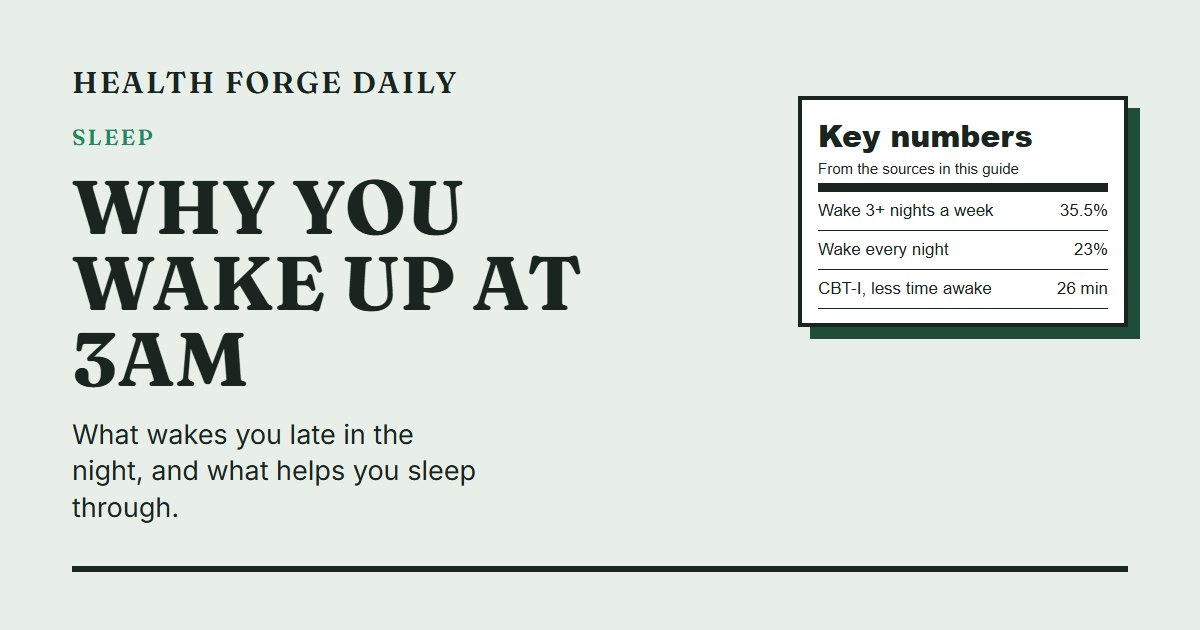
The short answer: sleep gets lighter in the second half of the night, so stress, a full bladder, alcohol, heat or a sleep disorder can wake you more easily then, and about 35.5% of adults wake up at night at least 3 nights a week.[2][3]
| What it is | Trouble staying asleep, the most common insomnia symptom in older adults[1] |
|---|---|
| How common | 35.5% of 8,937 adults woke at least 3 nights a week; 23% woke every night[3] |
| Why the second half of the night | Deep sleep comes mostly early; REM periods grow longer later[2] |
| Common triggers | Worry, clock watching, alcohol, noise, light, heat, needing to urinate[5][7] |
| When it counts as chronic | 3 or more nights a week for more than 3 months[4] |
| First treatment | Cognitive behavioral therapy for insomnia (CBT-I), a 6 to 8 week plan[13][14] |
| Supplements | Melatonin did not cut time awake during the night in a 12-study review[16] |
Why do I wake up at 3am?
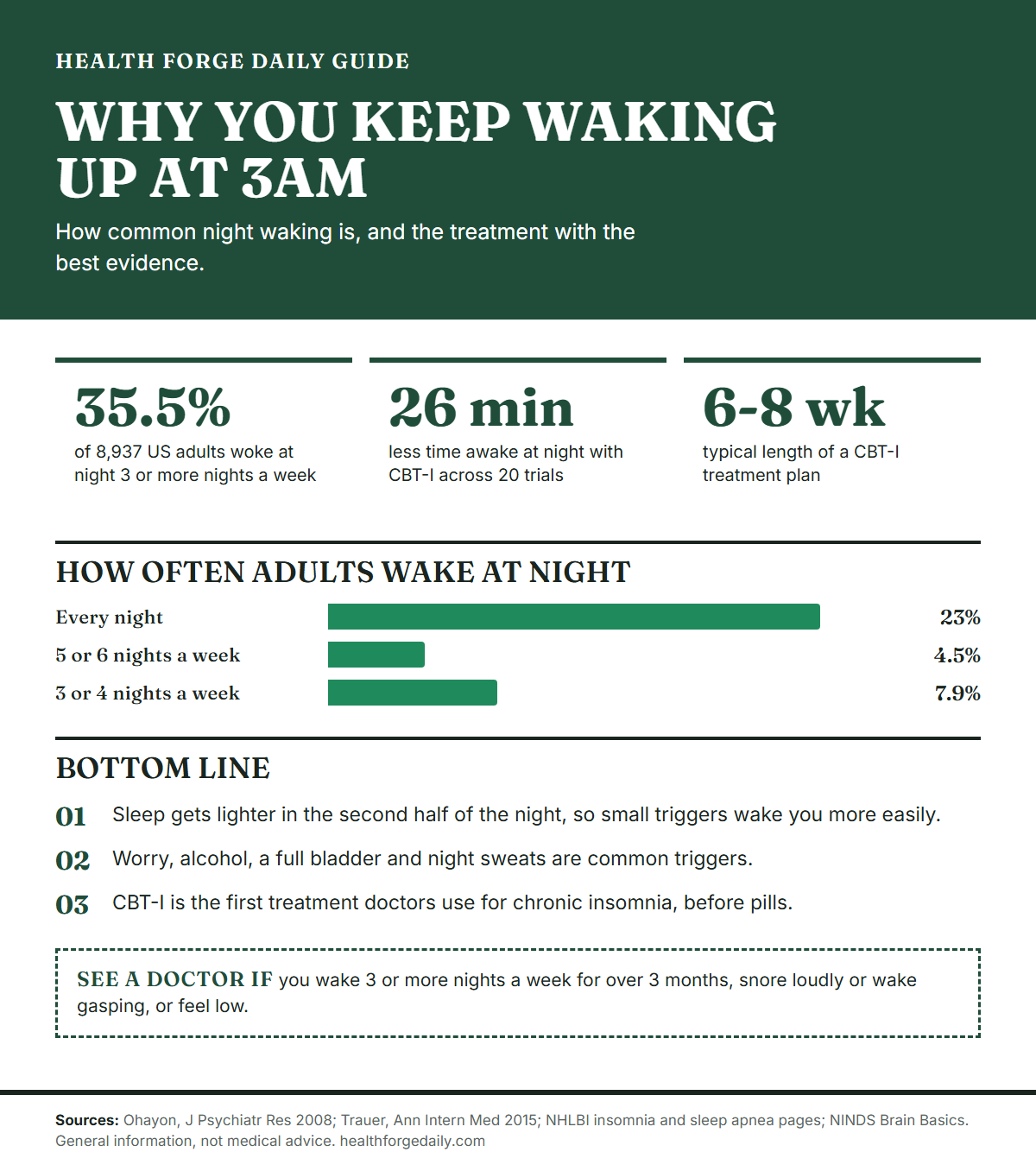
Waking at 3am usually happens because sleep is lighter in the second half of the night, so small triggers wake you more easily. NINDS explains that deep sleep comes in longer stretches early in the night, while REM periods grow longer later.[2] After an 11 p.m. bedtime, 3am falls in that lighter stretch.
Brief wake-ups between sleep cycles are normal, and most people do not remember them. The problem starts when you wake fully and cannot drift off again. NHLBI lists waking often during the night as the most common insomnia symptom, and waking too early without getting back to sleep as another common one.[1]
In a phone survey of 8,937 adults in Texas, New York and California, 35.5% said they woke during the night at least 3 nights a week: 23% every night, 4.5% on 5 or 6 nights and 7.9% on 3 or 4 nights. More than 90% of them had had the problem for over 6 months.[3]
Common causes and the clues that point to each
| Cause | Clues | Source |
|---|---|---|
| Stress and worry | Mind starts racing as soon as you wake; you check the clock | NHLBI[5] |
| Alcohol | Easy to fall asleep, restless after midnight | Review[10] |
| Full bladder | You wake needing the bathroom, often more than once | NHLBI[7] |
| Sleep apnea | Loud snoring, gasping, tired all day | NHLBI[7] |
| Night sweats | Waking hot or damp during the menopause transition | NIA[11] |
| Depression | Waking too early along with low mood or loss of interest | NIMH[12] |
Why do I wake up at 3am every night?
Waking at the same hour every night is often a pattern of insomnia, where the brain learns to expect a wake-up and stays alert once it comes. NHLBI defines chronic insomnia as trouble on 3 or more nights a week for more than 3 months that another health problem does not fully explain.[4]
A fixed body clock also plays a part. Your internal timing runs on a roughly 24-hour cycle, so a habit of waking at one hour tends to repeat. Worry about losing sleep then adds to it. NHLBI says that worrying about whether you will get enough sleep, and watching the clock, can raise your risk of insomnia or make it worse.[5]
Nightly waking is also more likely to come with other health problems. In the 8,937-person survey, people who woke every night more often had medical conditions, obesity and mental health disorders, and about 40% of those with night waking had other insomnia symptoms too.[3] That survey shows links, not causes, but it is a good reason to mention a nightly pattern to your doctor.
Why do I wake up at 3am with anxiety?
Stress hormones and a busy mind can both pull you out of light sleep, and anxiety then makes it hard to fall back asleep. NHLBI lists worry about work, school, money, relationships or a loss as risk factors for insomnia.[5] At 3am there is nothing to distract you, so those thoughts feel louder.
Body chemistry may add to it. Cortisol, the main stress hormone, is lowest early in the night and rises gradually during the later part of sleep, peaking 30 to 45 minutes after you wake.[6] That rise is normal. Whether it causes 3am wake-ups in anxious people has not been proven, so treat it as one possible piece of the picture. If you want to work on daytime stress, see our guide to research-backed ways to lower cortisol.
CBT-I includes a part that helps you feel less nervous about not being able to sleep, and NHLBI recommends it as the first treatment for long-term insomnia.[13]
Why do I wake up at 3am to pee?
Waking up to urinate at night is called nocturia, and it can come from drinking late, getting older, or a sleep disorder such as sleep apnea. NHLBI lists waking up often during the night to urinate as a symptom of sleep apnea, along with loud snoring, gasping and breathing that stops and starts.[7]
A 2023 systematic review found that nocturia rises as sleep apnea gets more severe. People with apnea may wake to urinate because they rouse easily or because the bladder fills more at night.[8] The review also noted that it is not yet clear how much apnea treatment fixes the night-time bathroom trips.[8]
Simple changes come first. NIA advises older adults to avoid drinking large amounts of liquid late in the day, and to avoid alcohol and caffeine late in the day.[9] If you still wake two or more times a night to urinate, ask your doctor to check your bladder, prostate, kidneys and sleep.
Why do I wake up at 3am after drinking?
Alcohol helps you fall asleep faster but breaks up sleep in the second half of the night, which is why drinkers often wake around 3am. A review of every known study in healthy volunteers found that at all doses, alcohol shortened the time to fall asleep, then increased sleep disruption in the second half of sleep.[10]
The same review found that alcohol delays the first REM period at every dose and lowers total REM sleep at moderate and high doses.[10] NHLBI explains the result in plain terms: alcohol makes sleep lighter than normal, so you are more likely to wake during the night.[13]
If you only wake at 3am on nights you drink, alcohol is the likely trigger. Try a few alcohol-free nights and compare. NIA advises older adults to avoid alcohol, even small amounts, for better sleep.[9]
Why do people wake up at 3am for no reason?
When there is no obvious trigger, the cause is often age, hormones, the bedroom itself, or low mood, and a sleep diary usually shows which one. NIA notes that as people age, sleep becomes shorter and lighter, they go to bed and wake earlier, and they may wake more often during the night.[9]
Hormones matter for women. NHLBI says insomnia is more common in women than in men, and hormone changes during pregnancy and menopause can disturb sleep.[5] Hot flashes at night are called night sweats, and they can wake you over and over.[11]
The room can be the problem too. Noise or light during the night and a bedroom that is too hot or too cold can disturb your sleep-wake cycle.[5] Low mood can also show up this way. NIMH lists waking too early in the morning as a sign of depression.[12]
Is there a spiritual meaning to waking up at 3am?
No scientific study links waking at 3am to a spiritual message, an energy meridian or a specific organ, so these ideas are beliefs, not medical explanations. The sleep research points to the light second half of the night and to common triggers such as stress, alcohol and a full bladder.[2][5]
If a spiritual practice such as prayer or quiet reflection helps you feel calm, there is no harm in it. Just do not let a symbolic reading stop you from checking for a treatable cause. Loud snoring, waking to urinate, night sweats and early-morning low mood all have real causes worth checking.[7][11][12]
What the research shows on waking at night
The best evidence on night waking comes from one large survey and two reviews of treatment trials, and it points to CBT-I as the approach with the clearest benefit. The survey shows how common the problem is. The trials show what shortens time awake, and the supplement review shows what does not.[3][15][16]
| Study | Who and how many | What it found |
|---|---|---|
| Ohayon, 2008, survey[3] | 8,937 US adults | 35.5% woke 3+ nights a week; 23% every night |
| Trauer, 2015, meta-analysis[15] | 20 trials, 1,162 adults with chronic insomnia | CBT-I cut time awake after falling asleep by about 26 minutes; no harms reported |
| Melatonin review, 2022[16] | 12 studies, 2,666 people with insomnia | Faster sleep onset; no change in time awake during the night |
| Ebrahim, 2013, review[10] | All known studies in healthy volunteers | Alcohol increased sleep disruption in the second half of the night |
The survey was observational, so it cannot show that any condition causes waking. The CBT-I trials left out people with other medical, sleep or mental health disorders, so results may be smaller for them.[3][15]
What should you do when you wake up at 3am?
The goal at 3am is to stay calm and keep the brain from linking the bed with being awake, which is the core idea behind CBT-I. These steps come from NHLBI and MedlinePlus advice. Repeat them each time you wake.[13][17]
- Do not look at the clock. Clock watching feeds worry about lost sleep.[5]
- Keep the lights low and leave your phone alone. Light and screens can disrupt your sleep-wake cycle.[5]
- Lie still and breathe slowly for a while. Relaxation practice is part of CBT-I.[13]
- If you are still awake after about 20 minutes, get up and do something relaxing somewhere else.[17]
- Go back to bed only when you feel sleepy.[13]
- Get up at your usual time the next morning, even after a bad night.[13]
- Skip long daytime naps, and do not nap after 3 p.m.[5][17]
- Write the wake-up time and any trigger in a sleep diary for your doctor.[4]
For help at the start of the night as well, read our steps to fall asleep fast.
When should you see a doctor about waking at 3am?
See a doctor if you wake at night on 3 or more nights a week for more than 3 months, or sooner if poor sleep is affecting your days. That is the NHLBI threshold for chronic insomnia.[4] Your doctor may ask you to keep a sleep diary, and may order a sleep study if apnea is possible.[4][7]
See a doctor right away if:
- You have thoughts of death or suicide. Call or text the 988 Suicide and Crisis Lifeline at 988.[12]
- Someone sees you stop breathing in your sleep, or you wake gasping.[7]
- You are so sleepy in the day that it affects driving, focus or reaction time.[7]
- Night waking comes with low mood, loss of interest or changes in appetite.[12]
Check your medicines too. NHLBI notes that some cold and allergy medicines can disrupt sleep.[13] If you are thinking about a sleep supplement, talk to your doctor first if you are pregnant, take a blood thinner or have epilepsy, and read our guide to melatonin side effects.[16]
What do doctors use first for waking up at night?
Doctors use cognitive behavioral therapy for insomnia (CBT-I) as the first treatment for long-term trouble staying asleep, before sleep medicines. The American College of Physicians recommends CBT-I as the initial treatment for all adults with chronic insomnia, a strong recommendation.[14] NHLBI describes it as a 6 to 8 week plan.[13]
CBT-I combines several parts: changing unhelpful thoughts about sleep, going to bed only when sleepy, a set time in bed, and relaxation.[13] In 20 trials with 1,162 adults, it cut time awake after falling asleep by about 26 minutes, and the gains held up over time.[15]
Medicines come second. The ACP advises doctors and patients to decide together about short-term medicines only when CBT-I alone has not worked.[14] Supplements are weaker still. Melatonin mostly helps people fall asleep, not stay asleep, and there is very little research on magnesium.[16] Our ranking of sleep supplements ranked by the evidence covers the details.
Your 3am waking checklist
A two-week sleep diary plus a few habit changes will show most people what is waking them and whether they need a doctor. Note the time you wake, what woke you and how long you stayed up. Then work through the list below and bring your notes to any appointment.[4]
- Keep the same bedtime and wake time every day, weekends included.[9][17]
- Keep the bedroom cool, dark and quiet.[17]
- Stop drinking alcohol for a week and compare your nights.[10]
- Cut back on liquids late in the day.[9]
- Avoid large meals within 2 to 3 hours of bedtime.[9]
- Ask a bed partner whether you snore loudly or stop breathing.[7]
- Track night sweats, low mood or bathroom trips in your diary.[7][11][12]
More guides on rest and recovery are in our sleep health articles.
Bottom line
Most 3am wake-ups happen because sleep is lighter late in the night, and stress, alcohol, a full bladder, heat or a sleep disorder tips you awake.[2][5][10] Waking now and then is common: in one large survey, more than a third of adults woke at night several times a week.[3]
For most people who wake most nights, CBT-I is a better first step than a supplement, because it is the only option here with trial evidence for cutting time awake.[14][15][16] If you snore loudly, wake often to urinate or feel low, see a doctor first, since those causes need their own treatment.[7][12]
Sources
- Insomnia: Symptoms. National Heart, Lung, and Blood Institute, 2022
- Brain Basics: Understanding Sleep. National Institute of Neurological Disorders and Stroke
- Nocturnal awakenings and comorbid disorders in the American general population. Ohayon, Journal of Psychiatric Research, 2008
- Insomnia: What Is Insomnia?. National Heart, Lung, and Blood Institute, 2022
- Insomnia: Causes and Risk Factors. National Heart, Lung, and Blood Institute, 2022
- Cortisol Detection Methods and the Hormone's Role in Evaluating Circadian Rhythm Disruption. International Journal of Molecular Sciences, 2025
- Sleep Apnea: Symptoms. National Heart, Lung, and Blood Institute, 2025
- Nocturia and obstructive sleep apnea syndrome: a systematic review. Di Bello et al., Sleep Medicine Reviews, 2023
- Sleep and Older Adults. National Institute on Aging
- Alcohol and sleep I: effects on normal sleep. Ebrahim et al., Alcoholism: Clinical and Experimental Research, 2013
- Hot Flashes: What Can I Do?. National Institute on Aging
- Depression. National Institute of Mental Health
- Insomnia: Treatment. National Heart, Lung, and Blood Institute, 2022
- Management of Chronic Insomnia Disorder in Adults: ACP Clinical Practice Guideline. Qaseem et al., Annals of Internal Medicine, 2016
- Cognitive Behavioral Therapy for Chronic Insomnia: A Systematic Review and Meta-analysis. Trauer et al., Annals of Internal Medicine, 2015
- Sleep Disorders and Complementary Health Approaches. National Center for Complementary and Integrative Health
- Healthy Sleep. MedlinePlus, National Library of Medicine
Frequently asked questions
Why do I wake up between 2 and 3am?
The hours between 2 and 3am fall in the lighter second half of the night for most bedtimes, when REM periods get longer. Stress, alcohol, heat or a full bladder can wake you more easily then than in the deep sleep of the early night.
Is waking up at 3am normal?
Waking briefly at night is common. In a survey of 8,937 adults, 35.5% woke at least 3 nights a week. It becomes a problem when you cannot get back to sleep, feel tired in the day, or it lasts more than 3 months.
Why do I wake up at 3am and can't go back to sleep?
Once you are fully awake, worry and clock watching keep the brain alert. NHLBI lists both as insomnia risk factors. Keep lights low, avoid the clock, and if you are still awake after about 20 minutes, get up and do something relaxing.
Can melatonin stop me waking at 3am?
Probably not. A 2022 review of 12 studies with 2,666 people found melatonin helped people fall asleep faster but did not reduce time awake during the night. CBT-I has better evidence for staying asleep.
Does waking at 3am mean something is wrong with my liver?
No research links waking at 3am to the liver or any single organ. The idea comes from traditional body clock beliefs. Common, checkable causes include alcohol, stress, sleep apnea, night sweats and needing to urinate.

Grace Whitaker is the health editor at Health Forge Daily. She reads supplement labels line by line, checks each ingredient and dose against published research, and tracks refund policies and customer complaints before a product gets a verdict. She is not a doctor, so every review points readers back to their own physician for medical decisions.
This article is for general information and is not medical advice. Supplements are not evaluated by the FDA and are not intended to diagnose, treat, cure or prevent any disease. Check with your doctor before you start any supplement.