To treat neuropathy in feet, start by finding and correcting the cause, such as high blood sugar or low vitamin B12, which can let nerves recover. For pain, doctors use duloxetine, pregabalin, gabapentin or a tricyclic, not opioids. Check your feet every day, and ask about a capsaicin patch or spinal cord stimulation if medicines fall short.
This guide covers how to treat neuropathy in feet, from the first doctor visit to the medicines, devices and daily foot care that ease symptoms and protect numb skin. We read the NINDS and NIDDK neuropathy pages, MedlinePlus, the 2022 American Academy of Neurology guideline, the 2020 ASCO chemotherapy guideline, and trials on duloxetine, capsaicin patches, spinal cord stimulation and exercise, following how we review health evidence.[1][2][4][5][7]
In short, find and correct the cause, such as high blood sugar or low vitamin B12, use a nerve pain medicine from one of the four classes the AAN recommends, and check your feet every day. Opioids are not recommended.[1][5][3]
| What it is | Damage to the peripheral nerves; there are more than 100 types, and most start in the feet[1] |
|---|---|
| Most common cause | Diabetes; up to half of people with diabetes have peripheral neuropathy[2][4] |
| First step | Find and correct the cause, which in some cases lets nerves recover[1][4] |
| Pain medicines | TCAs, SNRIs such as duloxetine, gabapentinoids such as pregabalin, or sodium channel blockers[5] |
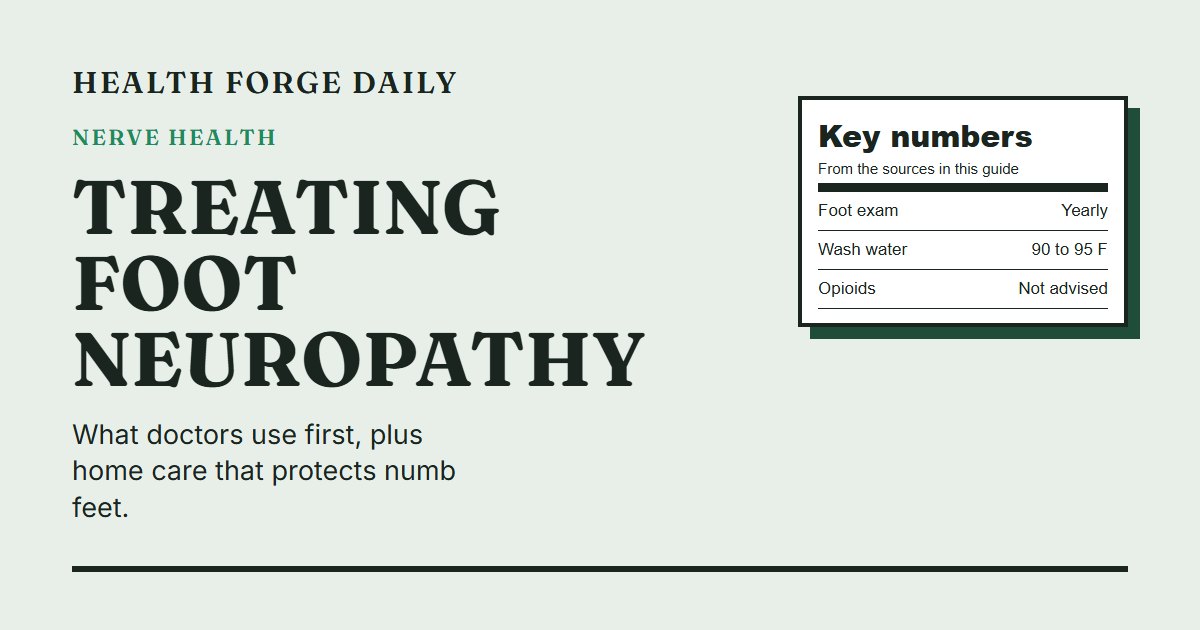
| Daily foot care | Check both feet every day, wash in water of 90 to 95 F, and wear shoes and socks[3] |
| What to avoid | Opioids for nerve pain, and vitamin B6 above the 100 mg daily upper limit[5][14] |
| Call a doctor | Any foot sore or blister that is not healing after a few days[3] |

How to treat neuropathy in feet: where do you start?
Start by finding the cause. When the cause of neuropathy is corrected, the nerves can sometimes recover and regrow on their own, NINDS says. That is why a doctor checks blood sugar, vitamin B12, thyroid and kidney function before picking a pain medicine.[1][2]
Diabetes is the leading cause in the U.S., and about two thirds of people with diabetes have mild to severe nerve problems.[1] Other causes include heavy alcohol use, kidney and liver disease, low vitamin B12, toxins, some infections and medicines such as chemotherapy.[1][4]
Your doctor asks about symptoms and tests your feet with a tuning fork and a thin nylon filament, and blood tests rule out thyroid problems, kidney disease or low B12.[2] Nerve conduction tests or a skin biopsy may follow when the cause is unclear.[1]
If diabetes is the cause, steady blood sugar is the base for every other step. Our chart of normal blood sugar levels and A1C targets shows the ranges doctors aim for. Pain medicines ease symptoms, but NIDDK notes they do not change the nerve damage itself.[2]
What medications treat foot neuropathy?
The American Academy of Neurology (AAN) tells doctors to offer one of four drug classes for painful diabetic neuropathy: tricyclic antidepressants (TCAs), SNRIs, gabapentinoids or sodium channel blockers. Common choices include duloxetine, nortriptyline, gabapentin and pregabalin. If the first class fails, doctors switch to another.[5][1]
In the AAN’s 2022 review, gabapentinoids, SNRIs and sodium channel blockers had similar, medium-sized effects on pain. TCAs looked stronger, but the panel had low confidence in that estimate.[5] The guideline says opioids should not be used for this pain, and NINDS agrees.[5][1]
For small painful areas, NINDS lists lidocaine patches and capsaicin cream.[1] Over-the-counter pills such as acetaminophen and ibuprofen may not work well for most nerve pain and carry their own side effects.[2]
Each medicine has side effects, so the AAN asks doctors to weigh your other health conditions, not only how well a drug works. It also asks them to screen for mood and sleep problems.[5]
What the research shows
| Treatment and study | Who was studied | How long | Result |
|---|---|---|---|
| Four drug classes, AAN guideline 2022 | Trials in painful diabetic neuropathy, 2008 to 2020 | Review | Similar medium effects on pain; opioids not advised[5] |
| Duloxetine 60 mg, Smith 2013 | 231 adults with chemotherapy neuropathy | 5 weeks | 59% reported less pain vs 38% on placebo[8] |
| Capsaicin 8% patch, Simpson 2017 | 369 adults with painful diabetic neuropathy | 12 weeks after one patch | Pain fell 27.4% vs 20.9% with placebo[10] |
| 10-kHz spinal cord stimulation, Petersen 2021 | 216 adults whose pain resisted medicines | 6 months | 79% vs 5% had at least half their pain relieved[11] |
| Supervised exercise, Kluding 2012 | 17 adults with diabetic neuropathy, no control group | 10 weeks | Pain and symptom scores fell[12] |
| Alpha-lipoic acid, NCCIH summary | 2022 review of 8 studies, 1,500 people | Varied | 3 studies found benefit, 5 did not[15] |
Our infographic grades this evidence. Moderate means several pooled trials with a small, consistent effect. Limited means some trials that are small or open-label, Weak means pilot studies only, and Avoid means no benefit plus a safety problem.
Can you treat foot neuropathy naturally at home?
Home care protects numb feet and may ease pain, though it does not repair nerve damage. Daily foot checks are the most important home habit, because people with neuropathy can miss a cut or blister that turns into an ulcer. Gentle exercise, good shoes and steady blood sugar help too.[3][2]
- Look at both feet every day, including the soles and between the toes. Use a mirror or ask someone to help.[3]
- Wash your feet in warm water of 90 to 95 F, tested with a thermometer or your elbow. Do not soak them.[3]
- Dry well and put talcum powder or cornstarch between the toes to keep that skin dry.[3]
- Trim nails straight across, or have a foot doctor do it if you cannot see, feel or reach your feet.[3]
- Wear shoes and socks at all times, and check inside each shoe before you put it on.[3]
- Keep heating pads, hot water bottles and heaters away from your feet.[3]
- Move most days with activities that are easy on the feet, such as walking, swimming, yoga or cycling.[3]
In a 2012 pilot study, 17 adults with diabetic neuropathy who did 10 weeks of supervised aerobic and strength training reported less pain and fewer symptoms, though the study had no control group.[12] Physical therapy can build strength and balance, and NINDS says acupuncture, massage and tai chi may help some people.[2][1]
How do you treat foot neuropathy at night?
Nerve pain is often worse at night, and even the touch of bedsheets can hurt, a problem called allodynia. A bed cradle that lifts sheets off your feet, socks in bed and a steady pain medicine plan can help. Tell your doctor if pain keeps waking you, because sleep problems shape the treatment plan.[1][2][3][5]
NIDDK lists the bed cradle as a simple tool for this.[2] Socks keep cold feet warm without the burn risk of a heating pad or hot water bottle, which numb feet may not feel.[3]
In the capsaicin patch trial, sleep quality improved along with pain after a single 30-minute treatment.[10] The AAN guideline also asks doctors to screen people with painful neuropathy for sleep and mood disorders.[5]
Night trips to the bathroom carry a fall risk when your feet are numb. NCI advises getting up slowly, moving rugs out of your path, and adding rails and bathmats.[6]
How do you treat foot neuropathy from chemo?
Duloxetine is the only medicine with enough evidence to recommend for painful chemotherapy-induced neuropathy, according to the 2020 ASCO guideline, and even its benefit is limited. No drug is recommended to prevent it. If neuropathy becomes intolerable, oncologists may delay, lower, switch or stop the chemotherapy drug.[7]
The main duloxetine trial enrolled 231 patients with painful neuropathy after paclitaxel, other taxanes or oxaliplatin. After 5 weeks, ending on 60 mg a day, 59% reported less pain, compared with 38% on placebo.[8]
Symptoms often fade with time, but not for everyone. A pooled analysis of 31 studies and 4,179 patients found neuropathy in 68.1% of people in the first month after chemotherapy and 30.0% at 6 months or later.[9] NINDS notes it may continue long after treatment ends.[1]
ASCO advises against acetyl-L-carnitine for prevention.[7] NCI suggests sturdy soft-soled shoes, daily checks for cuts, and asking your care team about acupuncture, massage, physical therapy or yoga.[6]
What devices treat foot neuropathy?
Three device-style options have evidence: TENS units, a prescription capsaicin 8% patch applied in a clinic, and implanted spinal cord stimulators for severe pain that medicines do not control. They are added on top of treating the cause and protecting your feet, and none of them replaces those steps.[1][10][11]
TENS sends a gentle electrical current through pads placed on the skin near the painful area. NINDS says it may be prescribed together with other treatments.[1]
The capsaicin 8% patch is much stronger than store creams and is put on by a clinician. In a 12-week trial of 369 adults with painful diabetic neuropathy, one 30-minute treatment cut pain by 27.4%, compared with 20.9% for a placebo patch, a modest gain.[10]
Spinal cord stimulation uses a small implanted device. In the SENZA-PDN trial of 216 adults whose pain had not responded to medicines, 79% of those given 10-kHz stimulation had at least half their pain relieved at 3 months, against 5% on usual care alone.[11] The trial was open-label, two authors worked for the device maker, and 2% needed the device removed because of infection.[11]
Do podiatrists treat foot neuropathy?
Yes, for the foot side of the problem. A podiatrist, or foot doctor, checks for wounds, trims thick nails, treats corns and calluses, and helps prevent ulcers, while your primary care doctor looks for the cause and manages pain medicine. NIDDK advises a full foot exam at least once a year.[2][3]
Doctors who treat foot neuropathy often work as a team. Your doctor may send you to a podiatrist, and NIDDK lists the foot doctor as part of the diabetes care team.[2][3] People with chemotherapy neuropathy can ask their oncology team for a referral to a specialist.[6]
See a foot doctor for nail trims if your nails are thick, yellowed or growing into the skin.[3] When motor nerves are affected, NINDS notes that braces and orthopedic shoes can improve walking and help prevent foot injuries.[1]
See a doctor right away if
NIDDK says to call your health care provider right away about any of these foot problems, because numb skin can hide how serious they are.[3]
- A cut, blister or sore on your foot is not healing after a few days[3]
- Skin on your foot is red, warm or painful[3]
- A callus has dried blood inside it[3]
- Any part of the foot turns black and smelly, a sign of possible gangrene[3]
- Numbness, weakness or dizziness starts after a new medicine or a chemotherapy dose[1][6]
Do supplements help neuropathy in feet?
Vitamin B12 is worth taking for nerve symptoms only when a blood test shows you are low, and no supplement has been shown to repair nerve damage in the feet. NIDDK says diabetes experts have made no special recommendations about supplements for neuropathy, so treat them as add-ons to discuss with your doctor.[13][2]
Low B12 can cause numbness and tingling in the hands and feet, even without anemia, and early treatment helps avoid permanent damage.[13] Metformin and acid-blocking medicines can lower B12.[13][2] Our guide to vitamin B12 deficiency symptoms and testing explains the blood tests.
Vitamin B6 can do harm in large amounts. Taking 1 to 6 grams a day for 12 to 40 months can cause severe sensory neuropathy, and the adult upper limit is 100 mg a day.[14] Check the label of any nerve-support blend for its B6 dose.
For alpha-lipoic acid, NCCIH says it might reduce diabetic nerve pain, but reviews conflict: a 2022 review of 8 studies with 1,500 people found improvement in only 3.[15] Our review of alpha-lipoic acid for neuropathy pain walks through those trials.
What should you try first for neuropathy in your feet?
Most people should start with a doctor visit that checks blood sugar, B12, thyroid and kidney function, since fixing the cause is the step that can let nerves recover. A nerve pain medicine from an AAN-recommended class comes next, and devices are for pain that medicines leave behind.[1][2][5]
Daily foot checks and steady blood sugar run alongside every one of these steps.[2][3] If your pain is worst at night or started with chemotherapy, the sections above cover the extra options for those cases.
Practical checklist
- Ask for blood tests for glucose or A1C, B12, thyroid and kidney function[2]
- Ask which of the four recommended medicine classes fits your other conditions[5]
- Check both feet every day and get a full foot exam at least once a year[2][3]
- Wear shoes and socks, and keep heating pads off your feet[3]
- Read supplement labels and stay under 100 mg a day of vitamin B6[14]
- Ask about physical therapy if your balance or strength is slipping[2]
Bottom line
For most people, steady blood sugar, a B12 check and a recommended class of nerve pain medicine do more than any supplement, and opioids are not part of the plan.[1][5] If pain still disrupts sleep or walking after a fair trial of medicine, ask whether a capsaicin 8% patch or spinal cord stimulation fits your case.[10][11]
Daily foot care deserves the same attention as pain relief, since an unnoticed sore is how neuropathy leads to the loss of a toe or foot.[2][3] You can find related reading in our nerve health guides.
Sources
- Peripheral Neuropathy. NINDS, National Institutes of Health
- Peripheral Neuropathy (diabetic neuropathies). NIDDK, National Institutes of Health
- Diabetes and Foot Problems. NIDDK, National Institutes of Health
- Peripheral Nerve Disorders. MedlinePlus, National Library of Medicine
- Oral and Topical Treatment of Painful Diabetic Polyneuropathy: Practice Guideline Update Summary. American Academy of Neurology, Neurology, 2022
- Nerve Problems (Peripheral Neuropathy) and Cancer Treatment. National Cancer Institute
- Prevention and Management of Chemotherapy-Induced Peripheral Neuropathy: ASCO Guideline Update. Loprinzi et al., Journal of Clinical Oncology, 2020
- Effect of duloxetine on pain, function, and quality of life in chemotherapy-induced painful peripheral neuropathy. Smith et al., JAMA, 2013
- Incidence, prevalence, and predictors of chemotherapy-induced peripheral neuropathy: a systematic review and meta-analysis. Seretny et al., Pain, 2014
- Capsaicin 8% Patch in Painful Diabetic Peripheral Neuropathy: A Randomized, Double-Blind, Placebo-Controlled Study. Simpson et al., Journal of Pain, 2017
- Effect of High-frequency (10-kHz) Spinal Cord Stimulation in Patients With Painful Diabetic Neuropathy. Petersen et al., JAMA Neurology, 2021
- The effect of exercise on neuropathic symptoms, nerve function, and cutaneous innervation in people with diabetic peripheral neuropathy. Kluding et al., Journal of Diabetes and Its Complications, 2012
- Vitamin B12: Fact Sheet for Health Professionals. NIH Office of Dietary Supplements
- Vitamin B6: Fact Sheet for Health Professionals. NIH Office of Dietary Supplements
- Diabetes and Dietary Supplements. NCCIH, National Institutes of Health
Frequently asked questions
Can neuropathy in feet be cured?
Sometimes. NINDS says neuropathy can resolve as nerves recover once the cause is corrected, such as low B12 or a medicine. Damage from long-standing diabetes often lasts, so treatment then aims to ease pain and protect the feet from injury.
How do you treat neuropathy in feet and hands?
The plan is the same for both. Doctors look for the cause and use the same nerve pain medicines. NCI also advises checking hands and feet daily for cuts, using potholders in the kitchen and taking care with knives and sharp objects.
How do you treat neuropathy in feet and legs?
When numbness or weakness spreads up the legs, physical therapy for strength and balance matters more, and braces or orthopedic shoes can help with walking. Blood sugar control and pain medicines stay the same, and preventing falls becomes a main goal.
Should you soak your feet if you have neuropathy?
No. NIDDK advises washing your feet every day in warm water of 90 to 95 F but not soaking them, because soaking dries the skin. Test the water with a thermometer or your elbow, since numb feet cannot judge heat.
Do over-the-counter pain relievers help foot neuropathy?
Often not much. NIDDK notes that acetaminophen and ibuprofen may not work well for most nerve pain and can cause side effects. Prescription nerve pain medicines, lidocaine patches or capsaicin are more likely to help, so ask your doctor.

Grace Whitaker is the health editor at Health Forge Daily. She reads supplement labels line by line, checks each ingredient and dose against published research, and tracks refund policies and customer complaints before a product gets a verdict. She is not a doctor, so every review points readers back to their own physician for medical decisions.
This article is for general information and is not medical advice. Supplements are not evaluated by the FDA and are not intended to diagnose, treat, cure or prevent any disease. Check with your doctor before you start any supplement.