The main signs of depression are a sad, anxious or empty mood, or a loss of interest in things you used to enjoy, lasting most of the day, nearly every day, for at least two weeks. Tiredness, sleep and appetite changes, trouble focusing and feelings of guilt are common. If you have thoughts of suicide, call or text 988.

The signs of depression usually show up as a low or empty mood, or a loss of interest in things you used to enjoy, that lasts most of the day, nearly every day, for at least two weeks. We read the National Institute of Mental Health (NIMH) depression booklet, the MedlinePlus and National Institute on Aging pages, the US Preventive Services Task Force screening review, recent CDC survey data and the newest exercise reviews. Our review process explains how we choose and check sources.
If you or someone you know is thinking about suicide, call or text 988 to reach the 988 Suicide and Crisis Lifeline, which is free, confidential and open 24/7. If someone is in immediate danger, call 911.[1][9]
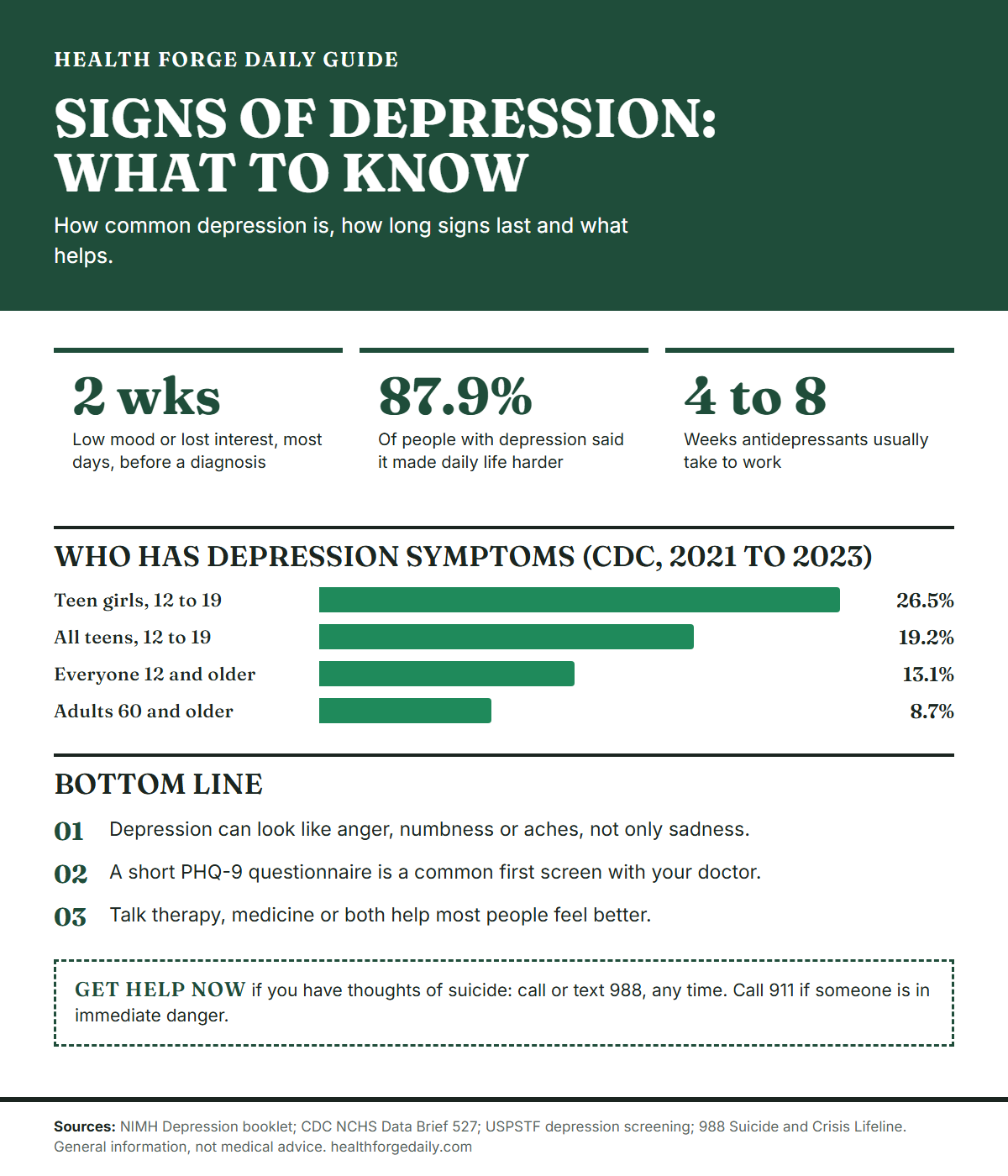
The short answer: depression is common and treatable. About 13.1% of Americans age 12 and older had depression symptoms in a recent two-week window, and 87.9% of them said it made work, home or social life harder.[6]
| What it is | A mood disorder that changes how you feel, think and handle sleep, eating and work[1] |
|---|---|
| Core sign | Low mood or loss of interest most of the day, nearly every day, for at least 2 weeks[1][4] |
| How common | 13.1% of people age 12 and older in 2021 to 2023 survey data; highest in teens (19.2%)[6] |
| First check | A short questionnaire such as the PHQ-2 or PHQ-9, then a talk with a provider[7] |
| Main care | Talk therapy, antidepressant medicine, or both[1][4] |
| Supplements | The FDA has not approved any natural product for depression[1] |
| Urgent help | Call or text 988 any time; call 911 in immediate danger[1][9] |
What are the signs of depression?
The signs of depression are lasting changes in mood, thinking, body and behavior that get in the way of daily life. The most common are a sad, anxious or empty mood, feeling hopeless, losing interest in hobbies, tiredness, trouble sleeping and changes in appetite.[1] Not everyone has all of them. Some people have only a few.[1]
People often notice the physical or behavioral changes before the emotional ones, so the table below sorts the signs by type.
| Type | What it can look like |
|---|---|
| Emotional | Sad, anxious or empty mood; hopelessness; guilt or worthlessness; irritability[1] |
| Thinking | Trouble concentrating, remembering or making decisions; thoughts of death or suicide[1] |
| Physical | Fatigue; sleeping too much or too little; appetite or weight change; aches, headaches, cramps or stomach problems with no clear cause[1][4] |
| Behavioral | Pulling away from family and friends; more alcohol or drug use; risk taking; letting duties slide[1] |
Depression can also make other illnesses, such as diabetes, heart disease and chronic pain, harder to manage, and the reverse is true too.[1]
When do signs of depression start to count as depression?
A diagnosis needs symptoms most of the day, nearly every day, for at least two weeks, and one of them must be low mood or loss of interest.[1][4] Several other lasting symptoms are also needed. A bad few days after a loss or a hard week at work is a normal part of life and usually passes.[1]
Persistent depressive disorder has milder symptoms that last for at least two years.[1] Seasonal affective disorder tends to start in late fall and lift in spring.[1]
You do not need to meet every rule to get help. NIMH notes that people with only a few symptoms may still benefit from treatment.[1] If the changes last or keep coming back, a visit with a health care provider is a reasonable next step.
Can you have depression without sadness?
Yes. Some people with depression feel numb, flat or irritable rather than sad. The diagnosis can rest on loss of interest or pleasure alone, without a sad mood.[1] Older adults in particular may describe a lack of feeling instead of sadness.[3]
For others the main signs are physical: a racing heart, a tight chest, ongoing headaches or stomach trouble.[1] In some cultures depression mostly shows up as aches and pains.[3] Depression can go unnoticed for months when it shows up this way.
Thoughts of suicide are not required for a diagnosis. Many people with depression never have them, and the condition still deserves care.[1]
What are the signs of depression in men?
Men with depression often look angry, irritable or restless rather than sad.[1][4] They may report physical problems, such as headaches or digestive trouble, and see a doctor for those instead of their mood.[1]
Men are also more likely to use alcohol or drugs to cope.[1] Risk taking, acting on impulse and pulling away from people can also stand out.[1]
Because men may be less likely to talk about low mood or seek help, their depression is more likely to go undiagnosed and untreated.[1] In federal survey data, 6.2% of men had a major depressive episode in 2021, compared with 10.3% of women.[5] Among people with depression, 33.2% of males had counseling or therapy in the past year, compared with 43.0% of females.[6]
What are the signs of depression in women?
Women share the same core signs, but some types of depression are tied to hormone changes across life. Pregnancy, the weeks after birth, the menstrual cycle and menopause can each bring on a depressive episode in some people.[1]
- Perinatal depression happens during pregnancy or after childbirth and is more than the short-lived “baby blues.”[1]
- Premenstrual dysphoric disorder is a more severe form of PMS in the weeks before a period.[1]
- Perimenopausal depression can bring strong irritability, anxiety, sadness or loss of enjoyment.[1]
The USPSTF recommends depression screening for all adults, and names pregnant and postpartum people specifically.[7]
What are the signs of depression in teens?
In teens, depression often looks like irritability, falling grades and pulling away from friends, not only sadness.[2] NIMH’s teen checklist asks about feeling empty or worthless, losing interest in activities, getting easily frustrated or angry, and changes in eating or sleep.[2]
Teens may act out or sleep much more than usual.[4] Younger children may seem cranky, cling to a parent, refuse school or say they feel sick.[1] Teens with depression often have anxiety, an eating disorder, ADHD or substance use too.[1]
In CDC survey data from 2021 to 2023, 19.2% of people ages 12 to 19 had depression symptoms, and the rate among teenage girls was 26.5%.[6] If a teen’s mood has changed for a few weeks or longer, NIMH advises them to talk to a trusted adult, such as a parent, teacher or school counselor.[2]
What are the signs of depression in older adults?
Depression is common in later life, but it is not a normal part of aging.[3] In older adults, the main sign may be emotional numbness, loss of interest, moving or talking more slowly, or a stronger focus on physical complaints.[3]
Several things raise the risk at this age, including stroke or cancer, caregiver stress, sleep problems, loneliness and too little physical activity.[3] Memory and thinking problems can stand out in severe depression, and dementia can cause some of the same symptoms, so a full check by a doctor matters.[1][3]
The NIA advises talking with a doctor if several signs last more than two weeks.[3] In CDC data, 8.7% of adults 60 and older had depression symptoms, the lowest rate of any age group.[6]
How do doctors screen for depression?
Most screening uses the PHQ-2 or PHQ-9, short questionnaires about how often you had each symptom over the past two weeks.[7][8] The PHQ-9 scores nine symptoms from 0 (not at all) to 3 (nearly every day).[8]
In the original 2001 study of 6,000 clinic patients, a PHQ-9 score of 10 or higher picked out major depression with 88% sensitivity and 88% specificity. Scores of 5, 10, 15 and 20 mark mild, moderate, moderately severe and severe symptoms.[8]
The USPSTF review found the PHQ-9 at a cutoff of 10 correctly flagged 85% of people with major depression and 85% of those without it. The two-question PHQ-2 caught more cases (91%) but also flagged more people who did not have depression.[7] A positive screen is a starting point. A provider then asks follow-up questions, does a physical exam and may order lab tests, because thyroid problems, viruses and some medicines can cause the same symptoms.[1][4] Low vitamin B12 is another cause worth ruling out; see our guide to vitamin B12 deficiency symptoms and testing.
What causes depression and who is at risk?
Depression comes from a mix of genetic, biological, environmental and psychological factors, and sometimes there is no clear cause.[1][4] Having a close relative with depression raises your risk, and trauma or stressful life events can raise it further.[4]
Other risk factors the USPSTF lists include a past episode of depression or another mental health condition and a history of serious illness.[7] Long-term conditions such as diabetes, cancer and heart disease often occur alongside depression.[4] Some medicines can add to symptoms as side effects.[1]
Ongoing stress plays a part for many people. Our article on how to lower cortisol levels covers steps for daily stress that are safe to try alongside care.
In 2021, the rate of a major depressive episode was highest in adults ages 18 to 25, at 18.6%.[5]
How is depression treated, and what should you expect?
Depression is usually treated with talk therapy, antidepressant medicine, or both, and most people improve with care.[1][3] For milder depression, therapy is often tried first. People with moderate or severe depression are usually offered medicine from the start.[1]
Cognitive behavioral therapy and interpersonal therapy have the strongest evidence, and both work in person or by video.[1] Antidepressants usually take 4 to 8 weeks to work, and sleep, appetite and focus often improve before mood does.[1] Finding the right fit can take more than one try.[4]
Do not stop a medicine without talking to your provider, and watch people under 25 closely for new suicidal thoughts during the first weeks or after a dose change.[1][4] When two or more medicines have not helped, options include esketamine nasal spray and brain stimulation treatments such as ECT and rTMS.[1]
Does exercise help with depression?
Exercise may reduce depression symptoms by a moderate amount, though the trials are of mixed quality. A 2026 Cochrane review pooled 57 trials with 2,189 adults and rated the evidence low certainty.[10]
| Review | Size | Main finding | Caveat |
|---|---|---|---|
| Cochrane, Clegg, 2026 | 57 trials, 2,189 adults vs control | Moderate drop in symptoms (SMD -0.67)[10] | Low certainty; smaller effect in the best trials[10] |
| Same review | 10 trials vs therapy; 5 vs medicine | Little to no difference from therapy or medicine[10] | Few, small trials; long follow-up rare[10] |
| BMJ, Noetel, 2024 | 218 studies, 14,170 people | Walking or jogging, yoga and strength training helped most[11] | Only one study at low risk of bias[11] |
The BMJ review also found that more intense exercise gave larger effects.[11] NIMH says even 30 minutes of walking a day can lift mood.[1] For mild symptoms, exercise is a fair add-on to therapy. It should not replace care for moderate or severe depression.
Do supplements help depression?
The FDA has not approved any natural product for depression, and NIMH advises talking to a provider before trying one.[1] St. John’s wort has been studied the most. NCCIH says it may help mild or moderate depression over up to 12 weeks, but it is unclear for severe depression.[12]
St. John’s wort can interact in dangerous, sometimes life-threatening ways with many medicines, and it can weaken birth control pills, some antidepressants and the transplant drug cyclosporine.[12] It may also be unsafe in pregnancy.[12]
Vitamin D is another supplement people ask about, and NIMH says the findings are inconsistent.[1] Our vitamin D benefits guide covers what the research does and does not show.
When should you see a doctor about signs of depression?
See a health care provider if low mood or lost interest lasts two weeks or more, or if symptoms keep you from your usual activities.[1][3] Bring notes on when symptoms began, how often they happen and what they stop you from doing.[1]
Get help right away if:
- You or someone you know has thoughts of suicide or self-harm: call or text 988, or chat at 988lifeline.org.[9][1]
- Someone is in immediate danger or has made a suicide attempt: call 911 or go to an emergency room.[1][3]
- A person has stopped eating or drinking, or has hallucinations or false beliefs.[1]
- Mood suddenly worsens or suicidal thoughts appear after starting or changing an antidepressant.[1]
If you see signs in someone else, encourage them to see a provider, offer patient support, and help with rides or reminders for appointments.[1]
Your next-steps checklist
- Write down your symptoms, when they started and how they affect sleep, work and relationships.[1]
- Ask your doctor about a PHQ-9 and about blood tests to rule out thyroid or other medical causes.[1][7]
- Tell your provider about every medicine and supplement you take, especially St. John’s wort.[12]
- Keep a regular bedtime and wake time, eat regular meals and aim for a daily walk.[1]
- Talk with someone you trust, and put off big life decisions until you feel better.[1]
- Save 988 in your phone in case things get worse.[9]
More on mood and health is in our mental wellbeing articles.
Bottom line
The core signs of depression are a low or empty mood, or a loss of interest, that lasts most days for two weeks or more. In men, teens and older adults it may show up as anger, falling grades, numbness or aches instead of sadness.[1][3]
For most people, the better first step is a visit with a primary care provider and a PHQ-9, because that also checks for medical causes and opens the door to therapy or medicine, both of which help most people.[1][7] Exercise is a sound add-on. Supplements are not a substitute, and St. John’s wort needs a medicine check first.[10][12]
Sources
- Depression. National Institute of Mental Health, 2024
- Teen Depression: More Than Just Moodiness. National Institute of Mental Health, 2022
- Depression and Older Adults. National Institute on Aging
- Depression. MedlinePlus, National Library of Medicine
- Major Depression. National Institute of Mental Health, 2021 data
- Depression Prevalence in Adolescents and Adults: United States, August 2021 to August 2023. CDC National Center for Health Statistics, Data Brief 527, 2025
- Screening for Depression and Suicide Risk in Adults. US Preventive Services Task Force, 2023
- The PHQ-9: validity of a brief depression severity measure. Kroenke and colleagues, Journal of General Internal Medicine, 2001
- 988 Suicide and Crisis Lifeline. 988 Lifeline, SAMHSA
- Exercise for depression. Clegg and colleagues, Cochrane Database of Systematic Reviews, 2026
- Effect of exercise for depression: systematic review and network meta-analysis of randomised controlled trials. Noetel and colleagues, BMJ, 2024
- St. John's Wort. National Center for Complementary and Integrative Health
Frequently asked questions
What are the simple signs of depression?
The simplest signs are a sad or empty mood, or losing interest in things you enjoy, most of the day for two weeks or more. Tiredness, sleep changes, appetite changes and trouble focusing often come with them.
What are the signs of depression and anxiety together?
Depression and anxiety often occur together. Signs can include an anxious or empty mood, restlessness, feeling on edge, poor sleep and trouble concentrating. A provider can sort out which condition is driving the symptoms and treat both.
Can you have depression without knowing it?
Yes. Depression can show up as tiredness, aches, irritability or numbness rather than sadness, so people sometimes blame stress or a physical problem. A short questionnaire like the PHQ-9 at a doctor visit can help bring it to light.
What are the signs depression is improving?
With treatment, sleep, appetite, energy and focus often improve first, and mood lifts later. Antidepressants usually take 4 to 8 weeks to work, so give a plan time and review progress with your provider.
Is there a quiz for signs of depression?
The PHQ-9 is a widely used nine-question screen about the past two weeks. It can flag likely depression, but it does not diagnose it. Share your answers with a provider, who will ask more questions and check for other causes.

Grace Whitaker is the health editor at Health Forge Daily. She reads supplement labels line by line, checks each ingredient and dose against published research, and tracks refund policies and customer complaints before a product gets a verdict. She is not a doctor, so every review points readers back to their own physician for medical decisions.
This article is for general information and is not medical advice. Supplements are not evaluated by the FDA and are not intended to diagnose, treat, cure or prevent any disease. Check with your doctor before you start any supplement.