Protein shakes help with weight loss when they replace a meal and lower total calories. In 23 trials, meal replacement plans led to about 1.4 kg more weight loss at one year, and up to 6.1 kg with strong coaching. Aim for 20 to 30 grams of protein and little added sugar per shake. People with kidney disease or diabetes should plan shakes with a doctor.
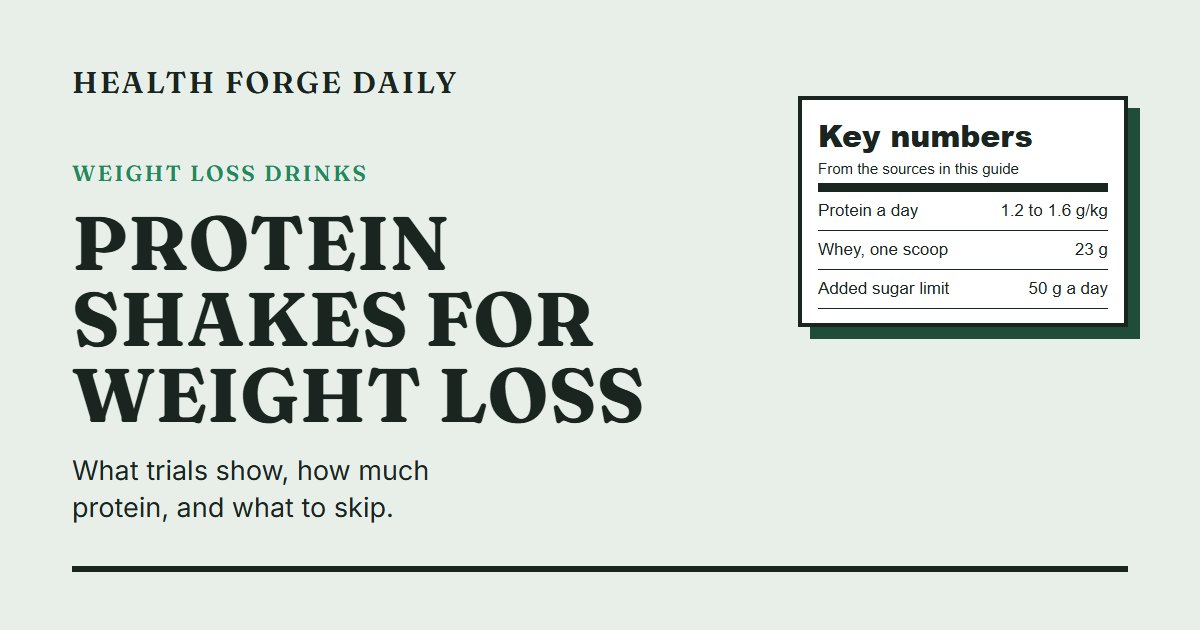
Protein shakes for weight loss can help, but only as part of a lower-calorie eating plan. We read the NIDDK weight treatment pages, FDA guidance on supplements and added sugars, USDA food data, and eight meta-analyses and trials on high-protein diets, meal replacements and whey. Our review process explains how we pick and check sources.
The short answer: in 23 trials with 7,884 adults, diets that used meal replacement shakes lost about 1.4 kg more at one year than other diets, and up to 6.1 kg more when people also got strong coaching[5].
| What they are | Drinks made from whey, milk, soy or pea protein, sold as powders or ready-to-drink bottles. Most powders are sold as dietary supplements, which FDA does not review before sale[12]. |
|---|---|
| How they may help | Higher-protein, calorie-controlled diets led to slightly more fat loss and kept more lean mass than standard-protein diets[2]. |
| Typical protein target | Researchers suggest at least 1.2 to 1.6 grams of protein per kilogram of body weight a day for adults[4]. |
| Best evidence | A 2019 meta-analysis of 23 randomized trials: meal replacement plans beat other diets at one year[5]. |
| Main safety issues | Added sugar, lactose in dairy proteins, and trace heavy metals in some powders[13][15][11]. |
| Who should ask first | People with chronic kidney disease, who may need moderate protein, and people with diabetes who use insulin[16][17]. |

Do protein shakes for weight loss actually work?
A protein shake works for weight loss only when it lowers your total calories, usually by replacing a meal or a higher-calorie snack. Trials show a small but real benefit. In a 2012 meta-analysis of 24 trials, high-protein diets with the same calories led to 0.79 kg more weight loss than standard-protein diets[2].
The same review found 0.87 kg more fat loss and 0.43 kg more lean mass kept. People in those trials followed their diets for about 12 weeks on average[2]. Those are modest numbers, and they came from controlled diets where calories were set in advance.
Protein does make some people feel fuller. Greater fullness with high-protein diets showed up in 3 of 5 studies that measured it[2]. A 2015 review found that protein meals raised fullness and satiety hormones, but people did not reliably eat less at their next meal[3].
The same review named the real driver: people who stuck to the higher-protein plan lost more weight, and those who did not stick to it saw little change[3]. A shake can make a lower-calorie plan easier to follow, but the shake itself does not burn fat.
How much protein do you need to lose weight?
Many researchers suggest adults aim for at least 1.2 to 1.6 grams of protein per kilogram of body weight a day while trying to lose weight. That target sits above the amount needed to avoid deficiency. Most Americans already eat enough protein, so a shake is a convenience, not a requirement[4][14].
Your need depends on your age, sex, health and how active you are[14]. Body weight sets the scale. Here is what the 1.2 to 1.6 g/kg range looks like in grams[4]:
| Body weight | Low end (1.2 g/kg) | High end (1.6 g/kg) |
|---|---|---|
| 60 kg (132 lb) | 72 g | 96 g |
| 75 kg (165 lb) | 90 g | 120 g |
| 90 kg (198 lb) | 108 g | 144 g |
| 110 kg (243 lb) | 132 g | 176 g |
Spread across three meals, the low end for a 75 kg adult works out to about 30 grams per meal. One scoop of whey powder supplies roughly 23 grams[18]. People with kidney disease should not use these targets without their care team[16].
Should a protein shake replace a meal or be a snack?
The strongest weight loss evidence is for shakes that replace one or two meals a day, not shakes added on top of normal eating. Meal replacement plans beat other diets in every comparison of a 2019 review, with a mean gap of 1.44 kg at one year in the main analysis[5].
Adding a shake on top of normal meals can backfire. In a small 2000 trial, 15 adults drank about 450 calories a day of soda for four weeks and did not cut back on food to make up for it, so they gained weight[10]. The drink in that study was soda rather than protein, though it suggests that calories you drink can slip past your appetite.
Key studies at a glance
| Study | Who and how many | Length | Result |
|---|---|---|---|
| Astbury, 2019 meta-analysis | 23 trials, 7,884 adults with overweight | 1 year | Meal replacements: 1.44 kg more lost than other diets; 6.13 kg more with enhanced support[5] |
| Yan, 2025 meta-analysis | 70 studies | Varied | 3.35 kg more weight and 2.77 kg more fat lost; full replacement beat partial[6] |
| Wycherley, 2012 meta-analysis | 24 trials, 1,063 adults | About 12 weeks | High-protein diets: 0.79 kg more weight lost, 0.43 kg more lean mass kept[2] |
| Sepandi, 2022 meta-analysis | 35 trials, 1,902 adults on whey | Varied | 0.74 kg more lean mass; best with strength training and fewer calories[7] |
| Look AHEAD, 2009 | 5,145 adults with type 2 diabetes | 1 year | Lifestyle group lost 8.6% versus 0.7%; meal replacement use tracked with success[9] |
Most of these trials paired shakes with coaching. Support made the gap bigger: 2.22 kg with support against other supported diets, and 6.13 kg with enhanced support[5].
What are the best protein shakes for weight loss for females and males?
The same rules pick a good shake for women and men: about 20 to 30 grams of protein, little or no added sugar, and calories that fit the meal it replaces. We found no trial showing that shakes marketed to women work better. Protein needs scale with body weight and activity, so smaller adults need fewer grams[4][14].
A 60 kg woman at 1.2 g/kg needs about 72 grams a day, while a 90 kg man at the same rate needs about 108 grams[4]. In whey trials, sex was one of the factors that changed results, but the pooled data did not set separate doses[7].
If you want to lose fat and build muscle together, strength training matters more than the label. Whey raised lean mass by about 0.74 kg across 35 trials, with the biggest gains in people who lifted weights and cut calories[7]. Our guide to creatine benefits and side effects covers another supplement often paired with lifting.
Whey and plant blends both supply protein. Mass gainers are a poor fit because they are built to add calories, and they showed the highest heavy metal hazard scores in a 2020 analysis[11].
How do you make protein shakes for weight loss at home?
A simple homemade protein shake uses one protein base, one liquid and a small amount of fruit, which keeps it near 160 to 250 calories. We worked out the numbers below from USDA FoodData Central records, so you can see exactly where the protein and calories come from[18].
| Shake | Ingredients | Protein | Calories |
|---|---|---|---|
| Classic whey | 30 g whey powder, 1 cup skim milk, half a banana (60 g) | 33 g | 250 |
| Greek yogurt | 170 g nonfat plain Greek yogurt, 1 cup skim milk, half a banana | 27 g | 248 |
| Light whey | 30 g whey powder, water and ice, half a banana | 24 g | 159 |
| Dairy-light | 30 g whey powder, 1 cup unsweetened soymilk, half a banana | 31 g | 239 |
Per 100 grams, the USDA lists whey-based protein powder at 78.1 grams of protein and 352 calories, and nonfat Greek yogurt at 10.3 grams of protein and 61 calories[18]. Brands vary, so check your own label for the scoop size.
How to blend it
- Pick the shake that fits the meal you are replacing, not one you add to a full day.
- Measure the powder with a kitchen scale for the first week, since scoops differ in size.
- Add the liquid first, then the powder, then frozen fruit and ice.
- Blend for 30 to 45 seconds until smooth.
- Skip honey, syrup and juice, which add sugar without protein[13].
- Pair the shake with a vegetable or a piece of fruit if you still feel hungry an hour later.
Are protein shakes for weight loss safe for diabetics?
People with type 2 diabetes have used meal replacement shakes in large trials, and those plans lowered both weight and blood sugar. A 2023 meta-analysis of 17 trials with 2,112 people found meal replacements cut HbA1c by 0.46 points and weight by 2.43 kg more than standard diabetes diets[8].
Full meal replacement led to more weight loss than partial replacement, at 6.57 kg against 1.58 kg[8]. In the Look AHEAD study of 5,145 adults with type 2 diabetes, people who used more meal replacement products lost more weight in the first year[9].
Carbohydrates in a shake still raise blood glucose. NIDDK advises people with diabetes to choose drinks with little or no added sugar and to plan carbs with their care team, especially if they take insulin[17]. Check total carbohydrate on the label, and test your blood sugar after a new shake.
A shake can fit inside a diabetes plan, while medicine and any dose changes stay with your clinician[17].
What are the side effects, and who should avoid protein shakes?
Before you start a daily shake, check for added sugar, lactose and any kidney problems. Dairy-based powders can contain lactose, the sugar in milk, which causes gas, diarrhea and bloating in people who cannot digest it[15]. Unsweetened soy or pea protein can avoid that problem.
People with chronic kidney disease are a special case. NIDDK says some people with CKD may need moderate amounts of protein so waste does not build up in the blood[16]. For healthy kidneys, a 2016 review found no evidence linking higher-protein diets to kidney disease[4].
Product testing has also turned up heavy metals. One earlier report found elevated levels in 40% of 133 protein powders tested, but a 2020 risk model using those numbers found no added health risk at one to three servings a day[11]. Choosing third-party-tested products still makes sense, because FDA does not approve supplements before they are sold[12].
Ask a doctor first if you:
- have kidney disease or reduced kidney function[16]
- take insulin or other diabetes medicine[17]
- are pregnant, breastfeeding, or under 18
- take medicines or other supplements your clinician should review[19]
- have a history of eating disorders
What do doctors recommend first for weight loss?
Doctors usually start with lifestyle changes: a calorie-aware eating plan, more activity and regular support, with a first goal of losing about 5% of body weight over 6 months. For a 200-pound person, that is 10 pounds. Shakes can fit inside that plan as one tool[1].
NIDDK says strong programs include 14 or more counseling sessions over 6 months, an eating plan based on your needs, at least 150 minutes of moderate activity a week, and regular tracking of food, activity and weight[1]. When lifestyle changes are not enough, a clinician may add weight loss medicine or, for some people, surgery[1].
Before you join a program, NIDDK suggests asking about total costs, including meal replacements and supplements[19]. If you are weighing pills as well, read our look at whether weight loss supplements work. For waist-focused goals, our guide on how to lose belly fat separates proven habits from hype.
What should you check on a protein shake label?
A good weight loss shake label shows enough protein to matter, little added sugar, and a calorie count that matches the meal or snack it replaces. The FDA Daily Value for added sugars is 50 grams a day on a 2,000-calorie diet, so a shake with 20 grams uses 40% of that limit[13].
- Protein: about 20 to 30 grams per serving, close to the 23 grams in a scoop of plain whey[18].
- Added sugars: as low as you can find; check the Added Sugars line, not only Total Sugars[13].
- Calories: under about 250 for a meal replacement shake, matching the homemade recipes above[18].
- Protein source: whey or milk protein if you digest dairy well; soy or pea if lactose bothers you[15].
- Product type: skip mass gainers, which carry extra calories and had the highest metal scores[11].
- Testing: look for a third-party testing seal, since FDA does not check supplements before sale[12].
- Store brands at Walmart, Costco or local pharmacies: compare the same numbers, since price and branding do not change the math.
Browse more guides in our weight loss drinks section.
Bottom line
Protein shakes can help with weight loss when they replace a meal and keep total calories down. The best trials show one to six extra kilograms lost over a year, with bigger results when people also had coaching[5]. Higher protein also helps protect lean mass during a diet[2].
For most people, a simple homemade shake that replaces breakfast or lunch is the better first step than a pricey branded product, because the protein and calories are easy to control and you avoid added sugar[18][13]. If you have kidney disease or diabetes, plan it with your doctor first.
Sources
- Treatment for Overweight and Obesity. NIDDK, NIH
- Effects of energy-restricted high-protein, low-fat compared with standard-protein, low-fat diets: a meta-analysis (Wycherley et al.). American Journal of Clinical Nutrition, 2012
- The role of protein in weight loss and maintenance (Leidy et al.). American Journal of Clinical Nutrition, 2015
- Protein requirements beyond the RDA: implications for optimizing health (Phillips, Chevalier and Leidy). Applied Physiology, Nutrition, and Metabolism, 2016
- A systematic review and meta-analysis of the effectiveness of meal replacements for weight loss (Astbury et al.). Obesity Reviews, 2019
- The effect of total and partial meal replacements on obesity: a systematic review and meta-analysis (Yan et al.). Critical Reviews in Food Science and Nutrition, 2025
- Effect of whey protein supplementation on weight and body composition indicators: a meta-analysis (Sepandi et al.). Clinical Nutrition ESPEN, 2022
- Efficacy and safety of meal replacement in patients with type 2 diabetes (Ye et al.). Journal of Clinical Endocrinology and Metabolism, 2023
- One-year weight losses in the Look AHEAD study: factors associated with success (Wadden et al.). Obesity, 2009
- Liquid versus solid carbohydrate: effects on food intake and body weight (DiMeglio and Mattes). International Journal of Obesity, 2000
- A human health risk assessment of heavy metal ingestion among consumers of protein powder supplements (Bandara et al.). Toxicology Reports, 2020
- Dietary Supplements. U.S. Food and Drug Administration
- Added Sugars on the Nutrition Facts Label. U.S. Food and Drug Administration
- Dietary Proteins. MedlinePlus, National Library of Medicine
- Lactose Intolerance. MedlinePlus, National Library of Medicine
- Healthy Eating for Adults with Chronic Kidney Disease. NIDDK, NIH
- Diabetes Diet, Eating, and Physical Activity. NIDDK, NIH
- FoodData Central: whey protein powder (173180), skim milk (171270), nonfat Greek yogurt (330137), banana (173944), unsweetened soymilk (175215). USDA Agricultural Research Service
- Choosing a Safe and Successful Weight-loss Program. NIDDK, NIH
Frequently asked questions
Can protein shakes make you gain weight?
Yes, if you drink them on top of your usual meals. A shake adds 150 to 250 calories or more, and a small trial found people did not eat less to make up for calories they drank. Mass gainer powders are built to add weight.
Are protein shakes from Walmart or Costco good for weight loss?
They can be. Store brands use the same proteins as pricier ones, so compare the label: about 20 to 30 grams of protein, little added sugar, and calories that fit the meal you replace. Look for a third-party testing seal too.
How many protein shakes a day for weight loss?
Most meal replacement trials used one or two shakes a day in place of meals. A heavy metal risk model found no added risk at up to three servings a day, but more shakes leave less room for vegetables, fruit and fiber.
Is whey or plant protein better for weight loss?
Both can work. Whey has the most trial data, including gains in lean mass across 35 trials. Soy or pea protein suits people who are lactose intolerant or avoid dairy. Total calories and sticking with the plan matter more than the protein type.
Should I drink a protein shake before or after a workout to lose weight?
Timing matters less than your daily totals. Weight loss depends on calories over weeks, and lean mass gains in whey trials came from strength training plus enough daily protein. Drink the shake when it best replaces a meal or snack for you.

Grace Whitaker is the health editor at Health Forge Daily. She reads supplement labels line by line, checks each ingredient and dose against published research, and tracks refund policies and customer complaints before a product gets a verdict. She is not a doctor, so every review points readers back to their own physician for medical decisions.
This article is for general information and is not medical advice. Supplements are not evaluated by the FDA and are not intended to diagnose, treat, cure or prevent any disease. Check with your doctor before you start any supplement.