An NAD supplement, usually nicotinamide riboside (NR) or nicotinamide mononucleotide (NMN), reliably raises NAD in blood. One 8-week trial found a 142% rise at 1,000 mg of NR a day. Proof of real health gains is thin: a 2025 meta-analysis found no muscle benefit in older adults. Short trials found no more side effects than placebo, but long-term safety is unknown.
An NAD supplement is a pill that tries to raise your body’s level of NAD, a coenzyme your cells use to turn food into energy. We read the two NIH niacin fact sheets, FDA guidance and eight human trials and reviews of nicotinamide riboside (NR) and nicotinamide mononucleotide (NMN), using the steps in how we review supplements.
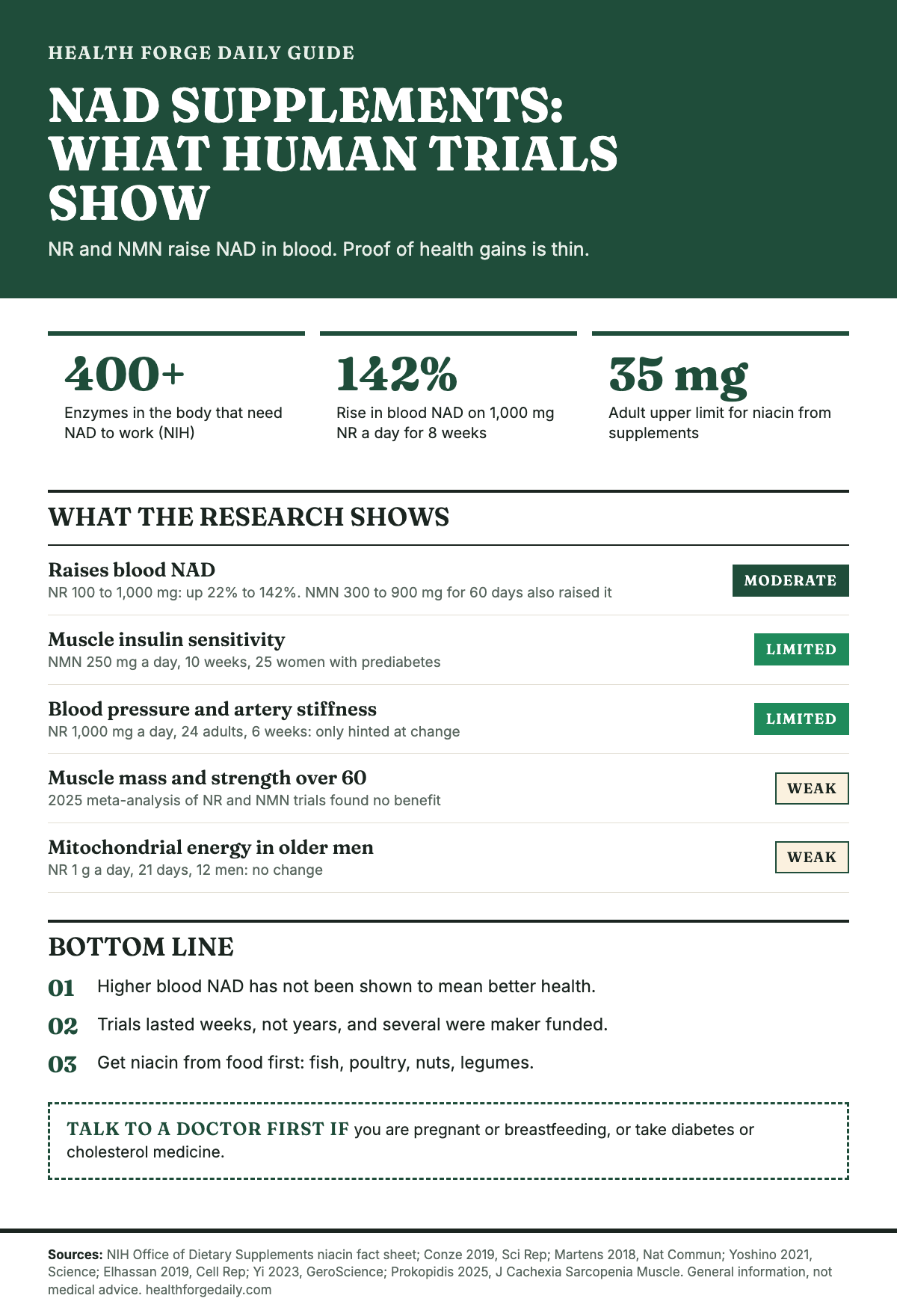
The short answer: NR and NMN reliably raise NAD in blood, by up to 142% at 1,000 mg a day in one 8-week trial[5], but proof that this makes people healthier, stronger or younger is still thin.
| What it is | NAD (nicotinamide adenine dinucleotide) is the active coenzyme form of niacin, vitamin B3. More than 400 enzymes need it[1]. |
|---|---|
| Common forms | Nicotinamide riboside (NR), nicotinamide mononucleotide (NMN), nicotinamide and nicotinic acid, all NAD precursors[1][11]. |
| Used for | Marketed for energy and healthy aging. Studied for blood NAD levels, insulin sensitivity, muscle and blood pressure[4][6][10]. |
| Trial amounts | NR 100 to 1,000 mg a day; NMN 250 to 900 mg a day[5][7][9]. |
| Best evidence | Raises blood NAD within 2 weeks[5]. A 2025 meta-analysis found no benefit for muscle mass or strength in older adults[10]. |
| Safety | Well tolerated for up to 8 to 10 weeks in trials, with no flushing reported for NR[5][9]. Long-term data are missing. |
| Who should avoid | Pregnant or breastfeeding people, and anyone on diabetes or cholesterol medicine, unless a doctor agrees[1][2]. |
What is NAD, and what does it do for the body?
NAD is a coenzyme made from niacin (vitamin B3) that helps cells turn the carbohydrates, fats and protein in food into usable energy. The NIH Office of Dietary Supplements says all tissues convert absorbed niacin into NAD, and more than 400 enzymes depend on it, more than for any other vitamin-derived coenzyme[1].
NAD also supports enzymes that keep DNA stable, control which genes switch on and help cells signal to each other[1]. The NIH consumer fact sheet puts it simply: niacin helps turn the food you eat into the energy you need, and it matters for how your cells develop and work[2].
You will see the names NAD, NAD+ and NADH. NAD+ is the form that accepts electrons during energy production, and NADH is the form that carries them. The NIH notes NAD is needed in most of the redox reactions that move energy around the cell[1]. The interest in supplements comes from animal research suggesting NAD levels fall with age, which researchers then tested in people[6][8].
What is an NAD supplement?
An NAD supplement usually does not contain NAD itself; it contains a precursor the body converts into NAD. The two most studied are nicotinamide riboside (NR) and nicotinamide mononucleotide (NMN). Plain niacin and nicotinamide are older, cheaper precursors[1][11].
The NIH counts NR as a form of niacin[1]. A patented crystal form of NR chloride, sold as Niagen, was used in several of the trials below[4][5]. NMN sits one step closer to NAD in the same pathway.
Other products sell NADH tablets or NAD by IV drip or injection. We did not find a strong human trial for those forms in the sources we read, so this guide sticks to oral NR and NMN. As with every supplement, the FDA does not have the authority to approve these products before they are sold[3].
What are the benefits of NAD supplements?
The one benefit shown again and again is a higher NAD level in blood; health benefits beyond that are small, mixed or untested. In an 8-week trial in overweight adults, NR at 100, 300 and 1,000 mg a day raised whole blood NAD by 22%, 51% and 142%, and the rise held to the end of the study[5].
A crossover trial in healthy adults aged about 65 gave 500 mg of NR twice a day for 6 weeks. NAD in immune cells rose about 60% compared with placebo, but the authors could only flag blood pressure and artery stiffness as ideas for larger trials[4].
In 12 older men, 1 g of NR a day for 21 days raised the NAD metabolome in muscle and lowered some inflammation markers. It did not change how well the muscle mitochondria produced energy[8]. Other trials in this guide found the same pattern: more NAD, with little change in how the body works.
What did the main trials find?
| Study | Who and how many | Dose and length | Result |
|---|---|---|---|
| Conze, 2019[5] | Overweight adults; maker funded | NR 100, 300 or 1,000 mg, 8 weeks | Blood NAD up 22%, 51% and 142%; no flushing |
| Martens, 2018[4] | 24 healthy adults aged about 65 | NR 1,000 mg, 6 weeks | Immune cell NAD up about 60%; function changes only hinted |
| Elhassan, 2019[8] | 12 older men | NR 1,000 mg, 21 days | Muscle NAD up; mitochondrial function unchanged |
| Yoshino, 2021[6][7] | 25 women with prediabetes | NMN 250 mg, 10 weeks | Muscle insulin sensitivity improved |
| Yi, 2023[9] | 80 healthy adults; maker funded | NMN 300, 600 or 900 mg, 60 days | Blood NAD up; walking distance up; HOMA-IR unchanged |
| Brakedal, 2022[12] | 30 people with new Parkinson’s disease | NR 1,000 mg, 30 days | Brain NAD rose in some; mild change; phase I only |
| Prokopidis, 2025[10] | Meta-analysis of trials in adults over 60 | NR or NMN, various | No benefit for muscle mass, grip or gait speed |
Are there NAD benefits for women?
The best study in women found that 250 mg of NMN a day for 10 weeks improved how well muscle responded to insulin in postmenopausal women with prediabetes. The trial enrolled 25 women who were overweight or had obesity, and used the gold-standard clamp test to measure insulin action[6][7].
The finding covers one group and one measure. The trial did not test energy, weight, skin, hormones or menopause symptoms, which is what most NAD benefits for women ads promise. Two authors also hold patent interests in NMN[6].
If blood sugar is your concern, the proven first steps are covered in our guide to prediabetes and how to lower your A1C. Most other trials mixed men and women and did not report separate results for women[4][5][9].
Do NAD supplements help with aging, muscle or energy?
For muscle and physical function in older adults, a 2025 meta-analysis concluded that current evidence does not support NMN or NR. It pooled randomized trials in people with an average age of 60.9 to 83 and found no significant effect on muscle mass, grip strength or walking speed[10].
One industry-run NMN trial in 80 healthy middle-aged adults reported longer six-minute walks at 300, 600 and 900 mg a day over 60 days. Insulin resistance did not change, and the authors work for NMN makers[9].
On cholesterol and blood sugar, a 2022 meta-analysis of 40 studies with 14,750 participants found that NAD precursors lowered triglycerides and LDL. Nearly all of that came from prescription-style nicotinic acid, which also raised blood sugar. NR and nicotinamide showed no significant effect on blood fats[11].
No trial we read measured feeling more energetic as a main outcome. If tiredness is the problem, low vitamin B12 is a common, testable cause worth ruling out; see our vitamin B12 deficiency symptoms guide.
How much NAD should you take?
There is no official dose for NR or NMN; trials used 100 to 1,000 mg of NR and 250 to 900 mg of NMN a day. NAD rose at every dose tested, but a bigger rise has not been shown to bring a bigger health benefit[5][7][9].
In the NMN trial, blood NAD was highest in the 600 and 900 mg groups, and the two doses gave similar results[9]. The NIH upper limit of 35 mg a day for adults applies to niacin from supplements and fortified foods, not to NR or NMN, which have no set limit[1].
Trial doses by group
| If you are | Amount studied | What we would do |
|---|---|---|
| A healthy adult curious about NAD | NR 300 mg a day raised blood NAD 51%[5] | Start low, give it 8 weeks, and judge by how you feel, not by marketing. |
| An older adult hoping to keep muscle | NR or NMN at various doses[10] | Spend the money on protein and strength training first; pooled trials found no muscle benefit. |
| A woman with prediabetes | NMN 250 mg a day, 10 weeks[7] | Treat it as experimental; ask about proven care first. |
| Someone taking diabetes or cholesterol medicine | No trial in this group read | Talk to your doctor before starting[1]. |
| Pregnant or breastfeeding | No trial data in the sources we read | Skip it unless your doctor says otherwise. |
NAD benefits and side effects: are NAD supplements safe?
In trials lasting up to 10 weeks, NR and NMN caused no more side effects than placebo, and the NR trial reported no flushing. NR at up to 1,000 mg a day also did not raise LDL cholesterol in the 8-week study[5]. NMN up to 900 mg a day showed no safety problems in lab tests over 60 days[9].
Plain niacin is different. Supplements with 30 mg or more of nicotinic acid can make the skin on the face, arms and chest turn red, burn, tingle and itch, and the NIH lists high blood sugar and liver problems among the risks of long-term high doses[2]. Nicotinamide does not cause flushing[1].
The NIH fact sheet notes that niacin can interact with certain medicines[1]. Nobody has tested NR or NMN for years at a time, and most trials were small. Several were funded by the companies that sell the ingredient[5][9].
Talk to a doctor before an NAD supplement if you:
- Are pregnant or breastfeeding
- Take medicine for diabetes, since NAD precursors as a group raised blood sugar in the 2022 meta-analysis[11]
- Take cholesterol medicine or have liver disease or gout[1][2]
- Have a long-term illness or take several medicines, since most trials enrolled healthy adults[4][9]
What do doctors recommend first for energy and healthy aging?
Doctors look first for a cause of tiredness, then lean on diet, activity and sleep, which have far stronger evidence than any NAD pill. Most people already get enough niacin from food. The NIH lists poultry, beef, pork, fish, some nuts, legumes and grains, and enriched breads and cereals as good sources[2].
Adults need 16 mg of niacin a day for men and 14 mg for women, and your body turns it into NAD on its own[1]. For older adults worried about muscle, the 2025 review suggested future trials should test combined approaches, such as pairing supplements with exercise[10].
A blood test can check for common, fixable causes of fatigue such as low B12 or low vitamin D; our guide to vitamin D benefits covers who is most likely to run low. If poor sleep is the issue, our page on magnesium glycinate looks at what the evidence says. You can find related guides in our energy and longevity section.
How do you choose an NAD supplement?
Choose a product that names the exact precursor and dose on the label, ideally a form and amount that matches a published trial. Because the FDA does not approve supplements before sale, the label and any third-party testing are your main protection[3].
- Check that the label names NR or NMN and the milligrams per serving, then compare it with the 100 to 1,000 mg used in trials[5][9]. Our label checklist shows what to look for.
- Look for a third-party seal such as USP or NSF for purity.
- Count all your niacin sources so you know your total from a B complex or multivitamin[1].
- Be wary of claims to reverse aging or add years to your life; no human study we read showed that.
- Avoid blends that hide NR or NMN amounts inside a “proprietary” mix.
- Note your starting energy, sleep and any side effects, and stop after 8 to 12 weeks if nothing changes.
Bottom line on NAD supplements
NR and NMN raise NAD in blood within weeks[5][9]. The harder question is whether that changes anything you can feel or measure, and so far the answer for muscle, energy and aging is mostly no or not yet[8][10].
For most people, eating niacin-rich foods, staying active and checking for common causes of fatigue is the better first step, because those have stronger evidence and cost less. If you still want to try an NAD supplement, choose a trial-tested form and dose, and tell your doctor, especially if you take diabetes or cholesterol medicine.
Sources
- Niacin: Fact Sheet for Health Professionals. NIH Office of Dietary Supplements
- Niacin: Fact Sheet for Consumers. NIH Office of Dietary Supplements
- Questions and Answers on Dietary Supplements. US Food and Drug Administration
- Chronic nicotinamide riboside supplementation is well-tolerated and elevates NAD+ in healthy middle-aged and older adults. Martens et al., Nature Communications, 2018
- Safety and metabolism of long-term administration of NIAGEN (nicotinamide riboside chloride) in healthy overweight adults. Conze et al., Scientific Reports, 2019 (ChromaDex funded)
- Nicotinamide mononucleotide increases muscle insulin sensitivity in prediabetic women. Yoshino et al., Science, 2021
- Effect of NMN supplementation on cardiometabolic function (NCT03151239). ClinicalTrials.gov trial record
- Nicotinamide riboside augments the aged human skeletal muscle NAD+ metabolome and induces transcriptomic and anti-inflammatory signatures. Elhassan et al., Cell Reports, 2019
- The efficacy and safety of NMN supplementation in healthy middle-aged adults. Yi et al., GeroScience, 2023 (industry authors)
- The effect of nicotinamide mononucleotide and riboside on skeletal muscle mass and function: a systematic review and meta-analysis. Prokopidis et al., J Cachexia Sarcopenia Muscle, 2025
- Effects of NAD+ precursor supplementation on glucose and lipid metabolism in humans: a meta-analysis. Zhong et al., Nutrition and Metabolism, 2022
- The NADPARK study: a randomized phase I trial of nicotinamide riboside supplementation in Parkinson's disease. Brakedal et al., Cell Metabolism, 2022
Frequently asked questions
What is NAD used for?
Inside the body, NAD helps more than 400 enzymes turn food into energy and keep DNA stable. As a supplement, NR and NMN are sold for energy and healthy aging, but human trials mainly show higher blood NAD levels, not proven health gains.
Is NADH the same as NAD?
They are two forms of the same coenzyme. NAD+ picks up electrons during energy production and becomes NADH, which passes them on. Most supplement trials tested NR or NMN, which the body converts into NAD, rather than NADH tablets.
Can you get NAD from food?
Not directly, but your body makes NAD from niacin in food. Poultry, beef, pork, fish, nuts, legumes and enriched cereals all supply niacin, and most adults get the 14 to 16 mg they need each day from diet.
Do NAD supplements make you live longer?
No human study we read measured lifespan. Trials lasted weeks, not years, and a 2025 review found NR and NMN did not help older adults keep muscle. Claims that NAD pills reverse aging go beyond the current evidence.
How long does it take an NAD supplement to work?
Blood NAD rose within 2 weeks of starting nicotinamide riboside in an 8-week trial. Any change you can feel is less certain, so most trials ran 6 to 10 weeks. Stop if nothing changes after 8 to 12 weeks.

Grace Whitaker is the health editor at Health Forge Daily. She reads supplement labels line by line, checks each ingredient and dose against published research, and tracks refund policies and customer complaints before a product gets a verdict. She is not a doctor, so every review points readers back to their own physician for medical decisions.
This article is for general information and is not medical advice. Supplements are not evaluated by the FDA and are not intended to diagnose, treat, cure or prevent any disease. Check with your doctor before you start any supplement.