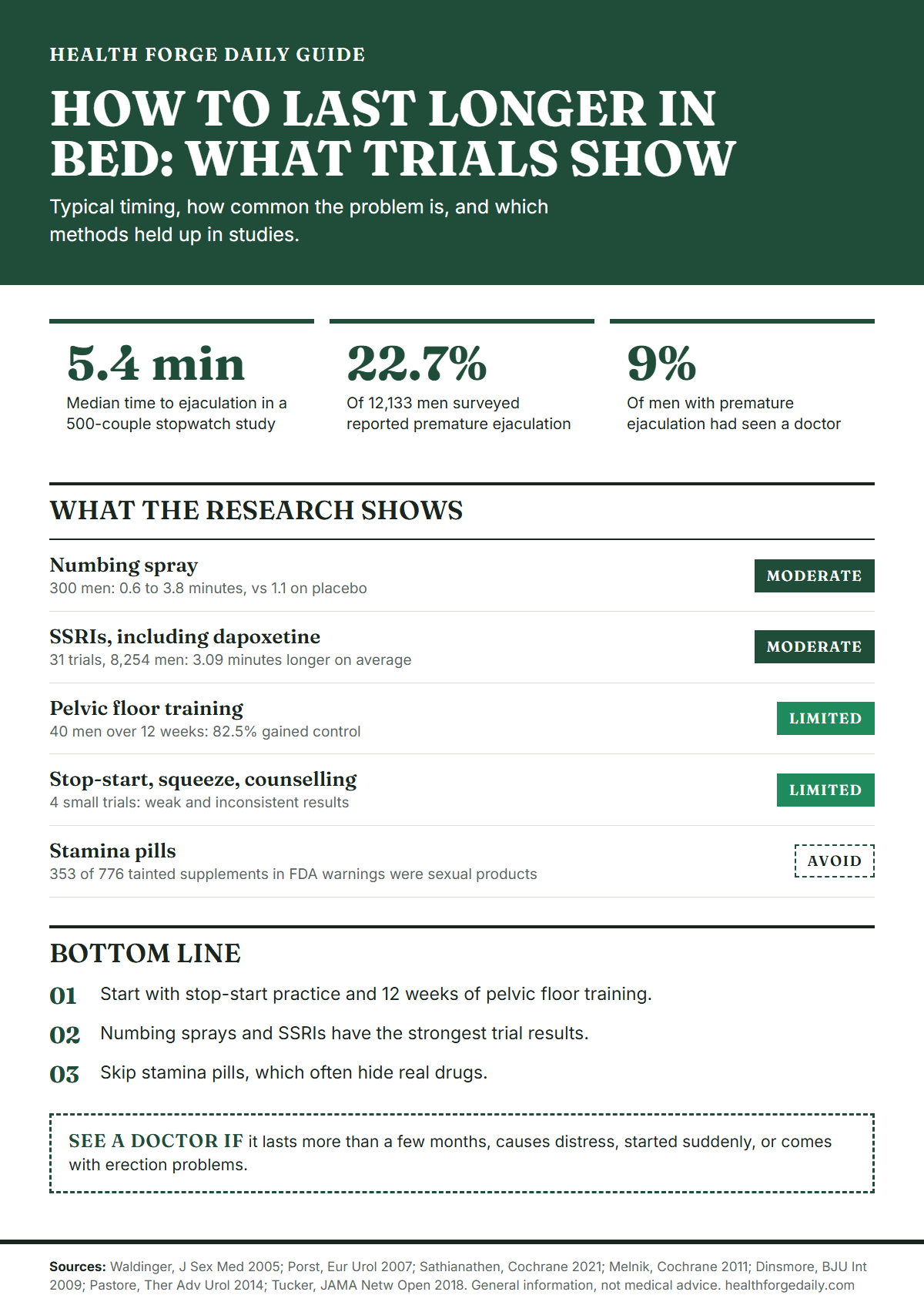
Most men last a median of about 5.4 minutes, and premature ejaculation means finishing within about 1 to 3 minutes with poor control and distress. Start with the stop-start and squeeze techniques and 12 weeks of pelvic floor training. If those fail, numbing sprays and SSRIs from a doctor have the strongest trial results. Skip stamina pills, which FDA warnings show often hide real drugs.
How to last longer in bed is one of the most searched sex questions men ask, so we checked what holds up in stopwatch trials. We read two Cochrane reviews, the International Society for Sexual Medicine definition, the 2025 European urology guideline, the NHS and MedlinePlus pages, an FDA warning list and eight clinical trials and reviews. Our health evidence review method explains how we pick and grade sources.
Most men last a median of about 5.4 minutes, and practice-based methods, numbing sprays and prescription SSRIs can each add a few minutes for men who finish within 1 to 3 minutes.[1][2][6]
| What the problem is called | Premature ejaculation (PE): ejaculating within about 1 minute (lifelong) or about 3 minutes (acquired), with poor control and distress.[2] |
|---|---|
| Typical time | A median of 5.4 minutes in a 500-couple stopwatch study across five countries.[1] |
| How common | 22.7% of 12,133 men in one survey, and only 9% had seen a doctor about it.[3] |
| Try first without medicine | Stop-start and squeeze practice, pelvic floor training, a thick condom, masturbating 1 to 2 hours before sex.[5][11] |
| Best evidence | SSRIs and topical numbing agents, the only options rated moderate to high certainty in a 2025 umbrella review.[13] |
| Main safety issue | Of 776 supplements named in FDA warnings from 2007 to 2016, 353 (45.5%) were sold for sexual enhancement and hid real drugs.[15] |
How long do most men last in bed?
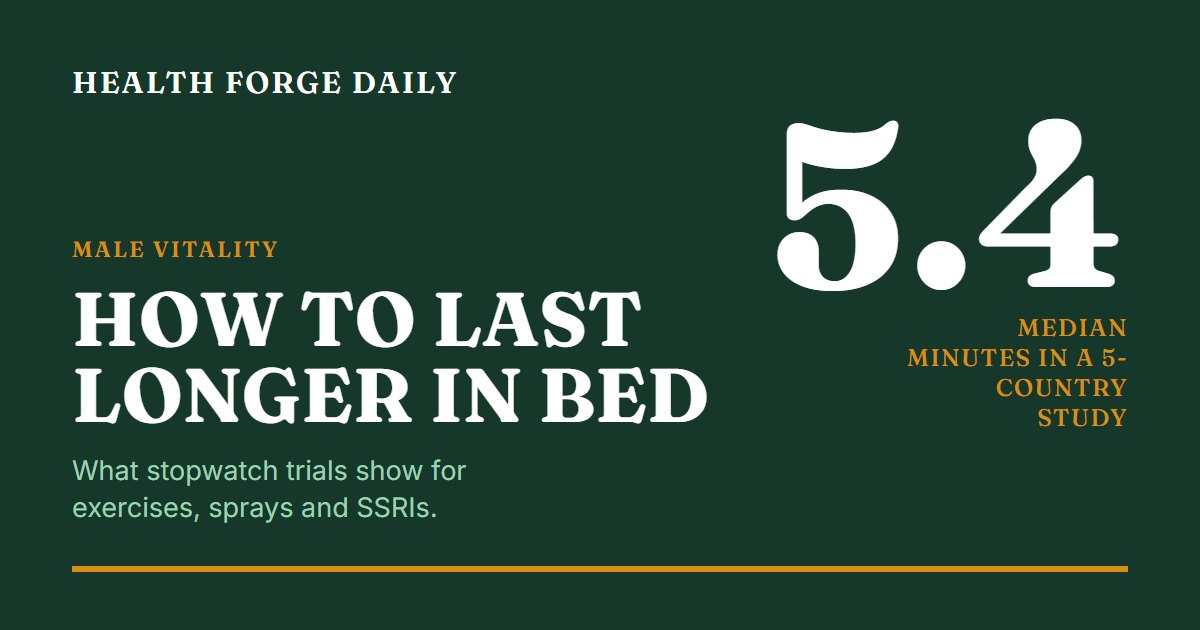
In the largest stopwatch study, the median time from penetration to ejaculation was 5.4 minutes. Researchers timed 500 couples in the Netherlands, the UK, Spain, Turkey and the US over four weeks. Times ranged from under 1 minute to 44 minutes, so normal covers a wide spread.[1]
Timing also shortens with age. The median fell from 6.5 minutes in men aged 18 to 30 to 4.3 minutes in men over 51.[1] Neither condom use nor circumcision changed the median time in that study.[1]
A few minutes of intercourse is common, and a short time on its own does not mean something is wrong. What matters more is whether you feel in control and whether you and your partner are happy.
The International Society for Sexual Medicine (ISSM) treats time as only one part of the picture. Lack of control and personal distress are the other two parts of its definition.[2]
When is it premature ejaculation?
The ISSM defines premature ejaculation as finishing within about 1 minute of penetration since your first sexual experience, or a bothersome drop to about 3 minutes or less later in life. Both forms also need a near-constant inability to delay and real distress, frustration or avoidance of sex.[2]
Lifelong PE starts with a man’s first sexual experiences. Acquired PE shows up after years of normal timing. Men with acquired PE tend to be older and more often have erection problems, other illnesses and heart risk factors.[2]
The NHS lists physical causes such as prostate problems, an overactive or underactive thyroid and recreational drug use. Psychological causes include depression, stress, relationship problems and performance anxiety, often at the start of a new relationship.[5]
It is common. In the PEPA survey of 12,133 men in the US, Germany and Italy, 22.7% reported PE, and the rate did not change much with age after 24.[3] Only 9% had talked to a doctor about it.[3] Occasional quick finishes are normal and are not a cause for concern, the NHS says.[5]
How to last longer in bed without medicine
The stop-start and squeeze techniques train you to notice the point of no return and back off before it. The NHS recommends them along with a thick condom, a position where your partner is on top, and masturbating an hour or two before sex. They take practice, and results build over weeks.[5]
A practical order to try them in:[5][11]
- Practice alone first. Masturbate until you feel close, then stop and let the urge fade.[5]
- Add the squeeze. Near the point of no return, squeeze the head of the penis for 10 to 20 seconds, let go and wait 30 seconds before going on.[5]
- Start pelvic floor training. Tighten and relax the muscles at the base of the pelvis several times a week, for 12 weeks.[11]
- Use the technique during sex, pausing as often as you need.[5]
- Try your partner on top, so they can pull away when you are close.[5]
- Try a thicker condom to dull sensation, or masturbate 1 to 2 hours before planned sex.[5]
- If nothing changes after a few months, see your doctor.[4]
Few good trials have tested these methods. A Cochrane review found only four small randomized trials of talk and behavior therapies and called the evidence weak and inconsistent.[10] In one of those trials, behavior therapy added about 408 seconds compared with a waiting list.[10]
Do pelvic floor exercises help you last longer?
Pelvic floor training means tightening and relaxing the muscles at the base of the pelvis that also help control ejaculation. In a 2014 Italian study of 40 men with lifelong PE, 12 weeks of training helped 33 of them (82.5%) gain control. Their average time rose from 39.8 to 146.2 seconds.[11]
The program in that study was supervised. Men had three 60-minute clinic sessions a week that combined muscle exercises, electrical stimulation and biofeedback. Home exercises alone may not match it.[11]
A smaller randomized study from the same group compared training with the drug dapoxetine. After 12 weeks, 11 of 19 men (57%) in the training group could control ejaculation, with an average time of 126.6 seconds. The dapoxetine groups did a little better on time.[12]
These results are promising but limited. Both studies were small and came from one research team, and only 13 of the 33 responders came back for the 6-month check, where gains held at about 113 seconds.[11] Training is low cost and has no drug side effects, so it is a sensible first step while you wait to see a doctor.
Do numbing sprays and condoms help you last longer?
Topical anesthetics such as lidocaine and prilocaine reduce sensation in the head of the penis, which delays ejaculation. In a phase 3 trial of 300 men, a lidocaine-prilocaine spray used 5 minutes before sex raised average time from 0.6 to 3.8 minutes, compared with 1.1 minutes on placebo.[8]
Side effects were mostly local. About 2.6% of men and 3.1% of partners reported problems such as numbness or burning, and no whole-body effects were seen.[8] The NHS notes that the drug can pass to a partner and reduce their sensation, so a condom or washing off before sex helps.[5]
A 2025 randomized study of 273 Turkish men compared three numbing options. Lidocaine spray gave the largest gain, then EMLA cream, then benzocaine condoms. Condoms had the fewest side effects.[9]
In the 2025 umbrella review, topical anesthetics were one of only two treatments with moderate to high certainty evidence. They also had the highest side effect risk ratio, at 4.1 compared with placebo.[13] The NHS adds that condoms work best when combined with a local anesthetic.[5]
What last longer in bed meds do doctors prescribe?
SSRIs are antidepressants that also delay ejaculation, and they are the main prescription option for premature ejaculation. A 2021 Cochrane review of 31 trials with 8,254 men found that SSRIs helped about 202 more men per 1,000 feel their symptoms improved than placebo did.[6]
Time to ejaculation rose by an average of 3.09 minutes, though the review rated that result low certainty. SSRIs also led to 173 more men per 1,000 having a side effect, and 30 more per 1,000 stopping because of one.[6]
Dapoxetine is a short-acting SSRI made for PE and licensed in the UK. It is taken 1 to 3 hours before sex, no more than once a day.[5] In two US trials with 2,614 men, average time rose from about 0.9 minutes to 2.78 minutes on 30 mg and 3.32 minutes on 60 mg, against 1.75 minutes on placebo.[7]
Daily SSRIs such as paroxetine, sertraline and fluoxetine are also used, along with clomipramine, and paroxetine is prescribed off-label.[5][13] Full effects usually take 1 to 2 weeks.[5] When erection problems are also present, the NHS notes that sildenafil-type ED drugs may help with PE as well.[5]
Which methods have the strongest evidence?
SSRIs and numbing agents have the best-tested results, while behavior and pelvic floor methods rest on small studies. A 2025 umbrella review of 44 meta-analyses covering 65 trials found that only 6 trials had a low risk of bias, so even the best numbers come with caveats.[13]
| Study | Who and how many | Method and length | Result |
|---|---|---|---|
| Sathianathen, Cochrane 2021[6] | 8,254 men in 31 trials | SSRIs vs placebo | 202 more per 1,000 improved; 3.09 minutes longer (low certainty) |
| Pryor, Lancet 2006[7] | 2,614 men with moderate to severe PE | Dapoxetine 30 or 60 mg, 12 weeks | About 0.9 to 3.32 minutes on 60 mg vs 1.75 on placebo |
| Dinsmore, BJU Int 2009[8] | 300 men with lifelong PE | Lidocaine-prilocaine spray, 3 months | 0.6 to 3.8 minutes vs 1.1 on placebo |
| Pastore, Ther Adv Urol 2014[11] | 40 men with lifelong PE | Pelvic floor training, 12 weeks | 82.5% gained control; 39.8 to 146.2 seconds |
| Melnik, Cochrane 2011[10] | 4 small trials | Behavior and talk therapy | Weak and inconsistent evidence |
| Raisi, J Sex Med 2025[13] | 65 trials in 44 meta-analyses | All drug options | Paroxetine largest gain, 5.64 minutes |
The umbrella review rated only topical anesthetics and paroxetine as moderate to high certainty. Tramadol, a prescription opioid painkiller, also lengthened time but had a side effect risk ratio of 2.4.[13]
Do last longer in bed pills, supplements or foods work?
No dietary supplement or food has good trial evidence for lasting longer in bed, and many sexual enhancement pills hide real drugs. A 2018 JAMA Network Open study of FDA warnings found 776 tainted supplements from 2007 to 2016, and 353 of them (45.5%) were sold for sexual enhancement.[15]
The most common hidden drug in those sexual products was sildenafil, the active drug in Viagra, found in 47% of them. Some products came back with new hidden drugs after an earlier warning.[15]
The study authors warn that these hidden drugs can cause serious harm through overuse or by clashing with other medicines and health conditions.[15] You cannot dose a drug safely when it is not on the label.
We found no trial showing that any food lengthens time to ejaculation. Herbs our readers ask about, such as tongkat ali for testosterone and libido and shilajit and its heavy metal risks, were studied for hormones and desire, not for ejaculation timing.
Who should be careful, and when should you see a doctor?
See a health care provider if quick finishing lasts more than a few months or causes distress for you or your partner. Many men never ask: only 9% of men with PE in the PEPA survey had seen a doctor, and most of them had to raise it themselves.[3][4]
Prescription options come with side effects. On 60 mg dapoxetine, 20.1% of men had nausea, and dizziness, headache and diarrhea were also common.[7] The NHS says dapoxetine is not recommended for some men with heart, kidney or liver problems, and it can interact with other antidepressants.[5]
Daily SSRIs can cause nausea, diarrhea and heavy sweating, which usually ease after 2 to 3 weeks.[5] Never combine an SSRI prescribed for PE with another antidepressant or a stamina pill unless your doctor approves it.
See a doctor soon if:
- the problem started suddenly after years of normal timing, since a thyroid or prostate problem can be the cause[5]
- you also have erection problems, low desire or low mood[3]
- you have blood in your semen[5]
- you feel unwell after taking a stamina or sexual enhancement product[15]
What doctors use first
The 2025 European Association of Urology guideline uses the ISSM definition. For lifelong PE it names medicine as the first-line treatment. For acquired PE the first goal is to treat the cause, such as erection problems or a thyroid issue.[14]
In practice, that means an SSRI or a numbing spray for most men with lifelong PE, often alongside behavior techniques.[5][14] Psychosexual counselling, with your partner if you have one, can help with anxiety and relationship stress.[5] If stress is part of the picture, our guide to L-theanine trials for stress and sleep covers what that supplement can and cannot do.
Your checklist for lasting longer
- Time a few encounters honestly before deciding there is a problem; the median is about 5.4 minutes.[1]
- Practice stop-start and squeeze alone several times a week.[5]
- Give pelvic floor training a full 12 weeks, the length of the trial program.[11]
- Try a thicker condom, and talk with your partner about pacing.[5]
- Skip stamina pills, whether sold online or in stores.[15]
- Bring a list of your medicines to your doctor before asking about SSRIs or sprays.[5]
More guides on sexual health and hormones are in our male vitality section.
What is the bottom line on how to last longer in bed?
Most men last around 5 minutes, and true premature ejaculation means about 1 to 3 minutes with poor control and distress. Practice methods and pelvic floor training are low risk, while SSRIs and numbing sprays have the strongest trial results.[1][2][13]
For most men, a few weeks of stop-start practice and pelvic floor training is the better first step, because it costs nothing and has no side effects. If that fails, a numbing spray or an SSRI from your doctor is a safer bet than any stamina pill.[6][8][15]
Sources
- A multinational population survey of intravaginal ejaculation latency time. Waldinger et al., J Sex Med, 2005
- An evidence-based unified definition of lifelong and acquired premature ejaculation (ISSM). Serefoglu et al., Sex Med, 2014
- The Premature Ejaculation Prevalence and Attitudes (PEPA) survey. Porst et al., Eur Urol, 2007
- Sexual Problems in Men. MedlinePlus, National Library of Medicine
- Ejaculation problems. NHS, 2023
- Selective serotonin re-uptake inhibitors for premature ejaculation in adult men. Sathianathen et al., Cochrane Database Syst Rev, 2021
- Efficacy and tolerability of dapoxetine in treatment of premature ejaculation. Pryor et al., Lancet, 2006
- PSD502 improves ejaculatory latency, control and sexual satisfaction when applied topically 5 min before intercourse. Dinsmore and Wyllie, BJU Int, 2009
- Comparative efficacy of EMLA cream, lidocaine spray, and benzocaine condoms in treating lifelong premature ejaculation. Hamarat et al., World J Urol, 2025
- Psychosocial interventions for premature ejaculation. Melnik et al., Cochrane Database Syst Rev, 2011
- Pelvic floor muscle rehabilitation for patients with lifelong premature ejaculation. Pastore et al., Ther Adv Urol, 2014
- A prospective randomized study to compare pelvic floor rehabilitation and dapoxetine for lifelong premature ejaculation. Pastore et al., Int J Androl, 2012
- Efficacy and safety of pharmacological treatments in patients with premature ejaculation: an umbrella review. Raisi et al., J Sex Med, 2025
- European Association of Urology Guidelines on Male Sexual and Reproductive Health: 2025 Update. Salonia et al., Eur Urol, 2025
- Unapproved Pharmaceutical Ingredients Included in Dietary Supplements Associated With US FDA Warnings. Tucker et al., JAMA Netw Open, 2018
Frequently asked questions
Does masturbating before sex help you last longer?
It may. The NHS lists masturbating an hour or two before planned sex as one of the things you can try yourself. It is a simple, free step that carries no risk, though no large trial has measured how much time it adds.
Can premature ejaculation go away on its own?
Occasional quick finishes are common and often pass, especially early in a new relationship when anxiety runs high. Lasting problems usually need practice or treatment. If it continues for more than a few months or causes distress, see a doctor.
Is premature ejaculation linked to erectile dysfunction?
Often, yes. Men who develop premature ejaculation later in life are more likely to have erection problems, and guidelines say to treat the underlying cause first. When both are present, ED drugs such as sildenafil may help with timing too.
Does a condom or circumcision change how long you last?
In a 500-couple stopwatch study, neither condom use nor circumcision changed the median time to ejaculation. Thicker condoms made to reduce sensation, or condoms with a numbing agent, are a different matter and may add a little time.
How fast do last longer in bed pills from a doctor work?
Dapoxetine works from the first dose when taken 1 to 3 hours before sex. Daily SSRIs such as paroxetine or sertraline may help within days, but full effects usually take 1 to 2 weeks of regular use.

Grace Whitaker is the health editor at Health Forge Daily. She reads supplement labels line by line, checks each ingredient and dose against published research, and tracks refund policies and customer complaints before a product gets a verdict. She is not a doctor, so every review points readers back to their own physician for medical decisions.
This article is for general information and is not medical advice. Supplements are not evaluated by the FDA and are not intended to diagnose, treat, cure or prevent any disease. Check with your doctor before you start any supplement.