To improve gut health, raise fiber slowly toward 22 to 34 grams a day, eat a wider range of plants, and add fermented foods such as yogurt or kefir. Exercise regularly, sleep 7 to 9 hours, and use antibiotics only when needed. Probiotic supplements are optional for most people. See a doctor for bleeding, weight loss or lasting pain.

This guide explains how to improve gut health with habits that have research behind them. We read federal pages from NIDDK, NCCIH, NHLBI and MedlinePlus, the USDA fiber tables, and five human studies on diet, exercise and antibiotics. Our review process explains how we pick and check sources.
The short answer: eat more fiber from a wider range of plants, working toward the 22 to 34 grams a day that NIDDK recommends for adults[1], then add fermented foods, regular exercise, enough sleep and careful antibiotic use.
| What it means | A gut that digests food comfortably and hosts a varied community of microbes. Researchers have no agreed single test for it[5]. |
|---|---|
| Main lever | Dietary fiber. Adults should get 22 to 34 grams a day, depending on age and sex[1]. |
| Good food sources | Beans, lentils, berries, pears, broccoli and whole grains, at 3 to 8 grams of fiber per serving[3]. |
| Best trial evidence | A 2021 randomized study of 36 adults: fermented foods raised microbe diversity and lowered 19 of 93 inflammatory proteins[4]. |
| Common side effect | Adding fiber too quickly can cause gas, bloating and cramps[2]. |
| Who should be careful | People with serious illness or weak immune systems face higher risk from probiotic supplements[11]. |
How to improve gut health naturally: 7 steps
Improving gut health mostly means feeding your gut microbes more fiber from more kinds of plants, then keeping the rest of your routine steady. No single food or pill does the job. The steps below are listed in the order we would try them, starting with the one that has the strongest support.
- Raise fiber toward 22 to 34 grams a day, a few grams at a time[1].
- Count plant types each week and aim for more variety than last week[6].
- Add one serving of a fermented food, such as yogurt, kefir or sauerkraut, and build up slowly[4].
- Drink enough liquids so the extra fiber works better[1].
- Exercise on most weeks, and keep it going, since gut changes faded when people stopped[7].
- Sleep 7 to 9 hours a night[8].
- Use antibiotics only when a clinician prescribes them, and take them exactly as directed[10].
A probiotic supplement is not on this list as a first step. We explain why in the probiotic section below.
What foods improve gut health?
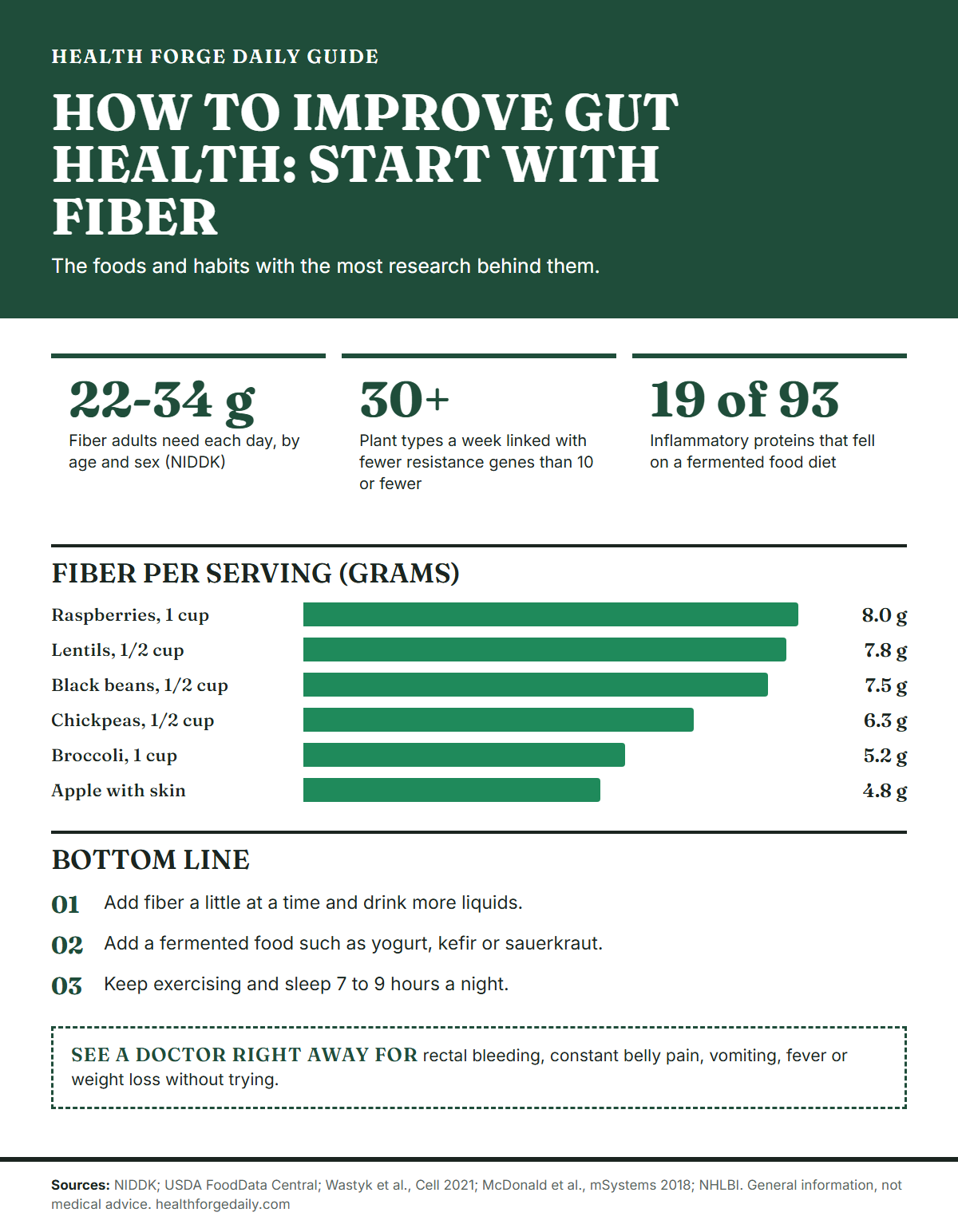
The foods with the best support for gut health are high-fiber plants: beans, lentils, berries, pears, vegetables and whole grains. Fiber is the part of plants your body cannot digest, so it reaches the large intestine, where bacteria feed on it. Most Americans do not eat enough of it[2].
A 2018 review pooled 64 controlled studies with 2,099 healthy adults. Extra fiber raised the levels of Bifidobacterium and Lactobacillus, two groups of bacteria often linked with a healthy gut[5]. It did not change overall diversity, so fiber by itself may not make your gut bacteria more varied[5].
The USDA table below shows standard servings that carry real amounts of fiber[3]. Our list of high fiber foods with easy meal ideas goes further, with full meals that reach the daily target.
| Food | Serving | Fiber |
|---|---|---|
| Raspberries | 1 cup | 8.0 g[3] |
| Lentils, cooked | 1/2 cup | 7.8 g[3] |
| Black beans, cooked | 1/2 cup | 7.5 g[3] |
| Chickpeas, cooked | 1/2 cup | 6.3 g[3] |
| Sweet potato, cooked | 1 cup | 6.3 g[3] |
| Pear | 1 medium | 5.5 g[3] |
| Broccoli, cooked | 1 cup | 5.2 g[3] |
| Apple with skin | 1 medium | 4.8 g[3] |
| Chia seeds | 1 tablespoon | 4.1 g[3] |
| Almonds | 1 ounce | 3.5 g[3] |
How do you add fiber without bloating?
Add fiber slowly and drink more fluids, because a sudden jump in fiber is a common cause of gas, bloating and cramps. MedlinePlus gives exactly this warning[2]. NIDDK says to add fiber a little at a time so your body gets used to the change, and to drink plenty of liquids to help it work[1].
No official source sets a week-by-week schedule. A sensible approach is to add one new high-fiber food, keep it for several days, and only then add another. If a food clearly makes you uncomfortable, swap it for another item from the table above.
Some people cannot reach their target with food alone. A fiber supplement is one option to discuss with a clinician, and our guide to psyllium husk benefits for digestion looks at the research on one common choice.
A sample day with about 29 grams of fiber
This plan uses only USDA values and lands inside the adult range[1][3]. It also counts five different plants toward your weekly variety.
| Meal | Food | Fiber |
|---|---|---|
| Breakfast | 1/2 cup oat bran with 1 cup raspberries | 10.9 g[3] |
| Lunch | 1/2 cup cooked lentils in soup or salad | 7.8 g[3] |
| Snack | 1 medium apple with skin | 4.8 g[3] |
| Dinner | 1 cup cooked broccoli with your usual main | 5.2 g[3] |
| Total | 5 plant types | 28.7 g |
If you eat far less fiber than this today, start with breakfast alone for a week, then add the next meal.
Does eating more kinds of plants help your gut?
Eating a wider range of plants is linked with a different gut microbe profile, though the evidence comes from observation, not trials. The American Gut Project collected samples from over 10,000 volunteers. People who ate more than 30 types of plants a week, compared with those who ate 10 or fewer, had fewer antibiotic resistance genes in their gut microbes[6].
That study was not a trial. The volunteers chose to join, and people who eat 30 plants a week may differ in many other ways. So use the number as a rough goal, since the study never tested it as a cut-off[6].
Plant types include vegetables, fruit, beans, whole grains, nuts, seeds, herbs and spices. Swapping white rice for barley one night, or adding a handful of seeds to yogurt, raises your count without much effort. Many of the same foods appear on an anti-inflammatory diet with meal ideas, so one shopping list can serve both goals.
Do fermented foods improve gut health?
Fermented foods are the habit with the most direct trial support for raising gut microbe diversity in healthy adults. In a 2021 Stanford study, 36 adults were randomized to a high-fermented-food diet or a high-fiber diet for 10 weeks, inside a 17-week protocol[4].
The fermented group went from 0.4 to 6.3 servings a day. Their microbe diversity rose steadily, and 19 of 93 inflammatory proteins in the blood went down, including IL-6[4]. The fiber group raised intake from 21.5 to 45.1 grams a day, but diversity stayed stable over the short study[4].
The study defined a serving as 6 ounces of yogurt, kefir or kombucha, or 1/4 cup of kimchi or sauerkraut[4]. Six servings a day is a lot. One or two a day is a more realistic start, and it gives you room to see how your stomach responds.
Keep the limits in mind. The trial was small and measured markers in the blood and stool. It did not show that fermented foods lower the risk of any disease[4].
| Study | Who and how long | What changed | Limit |
|---|---|---|---|
| Wastyk 2021, fermented foods | 18 adults, 10-week diet | Diversity rose; 19 of 93 inflammatory proteins fell[4] | Small, markers only |
| Wastyk 2021, fiber | 18 adults, 21.5 to 45.1 g fiber a day | Diversity stable; microbe enzymes shifted[4] | Short time frame |
| So 2018 review | 64 studies, 2,099 healthy adults | More Bifidobacterium and Lactobacillus[5] | No change in diversity |
| American Gut 2018 | Over 10,000 volunteers | 30+ plants a week linked with fewer resistance genes[6] | Observational |
| Allen 2018, exercise | 32 sedentary adults, 6 weeks | More short-chain fatty acids in lean adults[7] | Effects faded after stopping |
| Dethlefsen 2011, antibiotics | 3 adults, 10 months | Diversity dropped within 3 to 4 days[9] | Very small |
Can exercise and sleep improve gut health?
Regular exercise changed gut bacteria in a small trial, and the changes lasted only while people kept training. In a 2018 study, 32 previously inactive adults did supervised endurance exercise 3 days a week for 6 weeks, working up from 30 to 60 minutes a session[7].
Lean participants made more short-chain fatty acids, which gut bacteria produce from fiber. Participants with obesity did not show the same rise. When the group went back to an inactive routine, most of the changes reversed[7]. So choose a kind of exercise you will still be doing in six months.
Sleep has less direct evidence for gut bacteria in people. Even so, adults are advised to sleep 7 to 9 hours a night, and those who sleep less than 7 hours may have more health problems[8]. Better sleep is worth chasing for its own sake, and it often makes the other steps, such as cooking at home and exercising, easier to keep up.
How to improve gut health after antibiotics?
After antibiotics, go back to the same habits: fiber, plant variety and fermented foods, while you finish the full course as prescribed. Antibiotics can disrupt gut bacteria quickly. In one detailed study of 3 adults followed for 10 months, diversity dropped within 3 to 4 days of starting ciprofloxacin[9].
The same study found that recovery after each course was often incomplete[9]. Keep taking an antibiotic you need, and avoid the ones you do not.
MedlinePlus notes that antibiotics do not work on viral infections such as colds and flu, and that diarrhea is a common side effect. It also advises against saving antibiotics for later or sharing them with others[10]. Call your clinician if diarrhea is severe or continues, since a serious infection called C. diff can follow antibiotic use[10].
Should you take a probiotic for gut health?
A probiotic is optional for most healthy people, and the best evidence covers one situation: diarrhea linked to antibiotics. A 2017 review of 17 studies with 3,631 outpatients found that taking probiotics with antibiotics was linked with about half the risk of antibiotic-associated diarrhea, though study quality was only moderate[11].
NCCIH points out that different strains can have different effects, and that probiotic supplements do not need FDA approval before they are sold[11]. Some products have contained microbes not listed on the label[11]. People who are seriously ill or have a weak immune system should check with a clinician first[11].
We cover strains, doses and trial results in detail in our article on whether probiotics work for gut health. For everyday gut health, we would start with food.
When do gut symptoms need a doctor?
See a doctor if gut symptoms do not improve with self-care, and get care right away for bleeding, constant belly pain, vomiting, fever or weight loss you cannot explain. NIDDK lists these as warning signs alongside constipation[12]. Do not use a probiotic or diet change as a reason to put off a visit[11].
See a doctor right away if you have[12]:
- Bleeding from the rectum or blood in your stool
- Constant pain in your abdomen
- Being unable to pass gas, or vomiting
- Fever or lower back pain with gut symptoms
- Weight loss without trying
A family history of colon or rectal cancer is also a reason to talk to a doctor about ongoing symptoms[12].
What a doctor will usually check first
Doctors start by asking about your diet, fluids, activity and medicines, because low fiber, too little liquid and too little movement are common causes of constipation[12]. Standard first advice is to raise fiber gradually and drink more liquids[1]. A supplement does not replace that conversation, and it should not replace testing when symptoms point to another condition.
If you are pregnant, take regular medicines, or have a long-term illness, ask before making large diet changes or starting any supplement[11].
Gut health checklist
- Track your fiber for three days and compare it with 22 to 34 grams[1].
- Add one high-fiber food at a time and drink more liquids[1][2].
- Keep a weekly tally of plant types and try to beat it[6].
- Pick one fermented food you like and eat a serving most days[4].
- Schedule exercise on at least 3 days a week[7].
- Protect 7 to 9 hours for sleep[8].
- Ask whether an antibiotic is truly needed, then finish it as directed[10].
- Check a probiotic label for the exact strain, and talk to your clinician before you buy[11].
Browse more guides in our probiotics and digestion section.
Bottom line
The habits with the best support are plain ones: more fiber, more kinds of plants, some fermented food, steady exercise and enough sleep[1][4][7]. The research is early in places, and most studies measured gut bacteria rather than long-term health.
For most people, adding fiber slowly is the better first step than buying a supplement, because it costs little, matches federal advice and feeds the bacteria you already have[1][5]. If symptoms persist or any warning sign appears, see a doctor instead of trying another product.
Sources
- Eating, Diet, and Nutrition for Constipation. NIDDK, NIH
- Dietary Fiber. MedlinePlus, National Library of Medicine
- Food Sources of Dietary Fiber. USDA and HHS, Dietary Guidelines 2020-2025, FoodData Central data
- Gut-microbiota-targeted diets modulate human immune status (Wastyk et al.). Cell, 2021
- Dietary fiber intervention on gut microbiota composition in healthy adults: a systematic review and meta-analysis (So et al.). American Journal of Clinical Nutrition, 2018
- American Gut: an open platform for citizen science microbiome research (McDonald et al.). mSystems, 2018
- Exercise alters gut microbiota composition and function in lean and obese humans (Allen et al.). Medicine and Science in Sports and Exercise, 2018
- How Much Sleep Is Enough?. NHLBI, NIH
- Incomplete recovery and individualized responses of the human distal gut microbiota to repeated antibiotic perturbation (Dethlefsen and Relman). PNAS, 2011
- Antibiotics. MedlinePlus, National Library of Medicine
- Probiotics: Usefulness and Safety. NCCIH, NIH
- Symptoms and Causes of Constipation. NIDDK, NIH
Frequently asked questions
Will gut health improve naturally?
Often, yes. Gut bacteria respond to what you feed them, so steady changes in fiber, plant variety and fermented foods can shift them. After antibiotics, recovery was often incomplete in a small study, so supportive eating habits are worth keeping up for weeks.
How can I improve my gut health quickly?
There is no fast fix. In the Stanford fermented food trial, diversity rose steadily over a 10-week diet. Adding fiber too fast backfires with gas and bloating, so build up over a few weeks rather than overhauling your diet at once.
Will improving gut health help my skin or eczema?
Research on the gut and skin is still early, and we found no strong trials showing that diet changes for gut health clear eczema or acne. Skin conditions are best handled with a dermatologist, alongside a healthy diet.
How do you improve gut health without dairy?
Choose dairy-free fermented foods such as sauerkraut, kimchi, kombucha or plant-based yogurts with live cultures. Beans, lentils, berries, whole grains, nuts and seeds supply fiber without any dairy at all.
Does gut health change with age?
Needs shift with age. NIDDK notes that older adults sometimes do not get enough fiber because they lose interest in food. A dietitian can help plan meals with the right amount of fiber for your age and health.

Grace Whitaker is the health editor at Health Forge Daily. She reads supplement labels line by line, checks each ingredient and dose against published research, and tracks refund policies and customer complaints before a product gets a verdict. She is not a doctor, so every review points readers back to their own physician for medical decisions.
This article is for general information and is not medical advice. Supplements are not evaluated by the FDA and are not intended to diagnose, treat, cure or prevent any disease. Check with your doctor before you start any supplement.