The best cold sore treatment is an antiviral started at the first tingle. A 1-day course of valacyclovir or one dose of famciclovir shortened outbreaks by about 1 to 2 days in trials, and over-the-counter docosanol cream by about 18 hours. Untreated cold sores clear in 7 to 14 days. See a doctor for sores near the eye or a weak immune system.
To put this cold sore treatment guide together, we read the 2026 Cochrane review of 87 trials, the drug labels for docosanol and valacyclovir on DailyMed, three randomized trials, and patient guidance from the American Academy of Dermatology (AAD), MedlinePlus and the NIH dental institute. Our review process explains how we pick and check sources.
Antiviral medicine started at the first tingle shortens a cold sore by about half a day to 2 days, and the 1-day prescription pills give the biggest gains in trials.[6][7][8]
| What it is | A cluster of small fluid-filled blisters on or around the lips, caused by herpes simplex virus type 1 (HSV-1)[1][5] |
|---|---|
| How long it lasts untreated | About 7 to 14 days in healthy people[3] |
| Over-the-counter option | Docosanol 10% cream (Abreva and store brands), 5 times a day from the first tingle, ages 12 and up[10] |
| Prescription options | Valacyclovir 2 grams every 12 hours for 1 day, famciclovir 1500 mg once, or acyclovir or penciclovir cream[3][8][9] |
| Best evidence | A 2026 Cochrane review of 87 trials: antivirals cut healing time by about 1 day[6] |
| Safety | Side effects are uncommon; with valacyclovir the most common are headache, nausea and stomach pain[6][9] |
| See a doctor first if | The sore is near an eye, you have eczema or a weak immune system, or you get 6 or more a year[3] |
What is the best cold sore treatment?
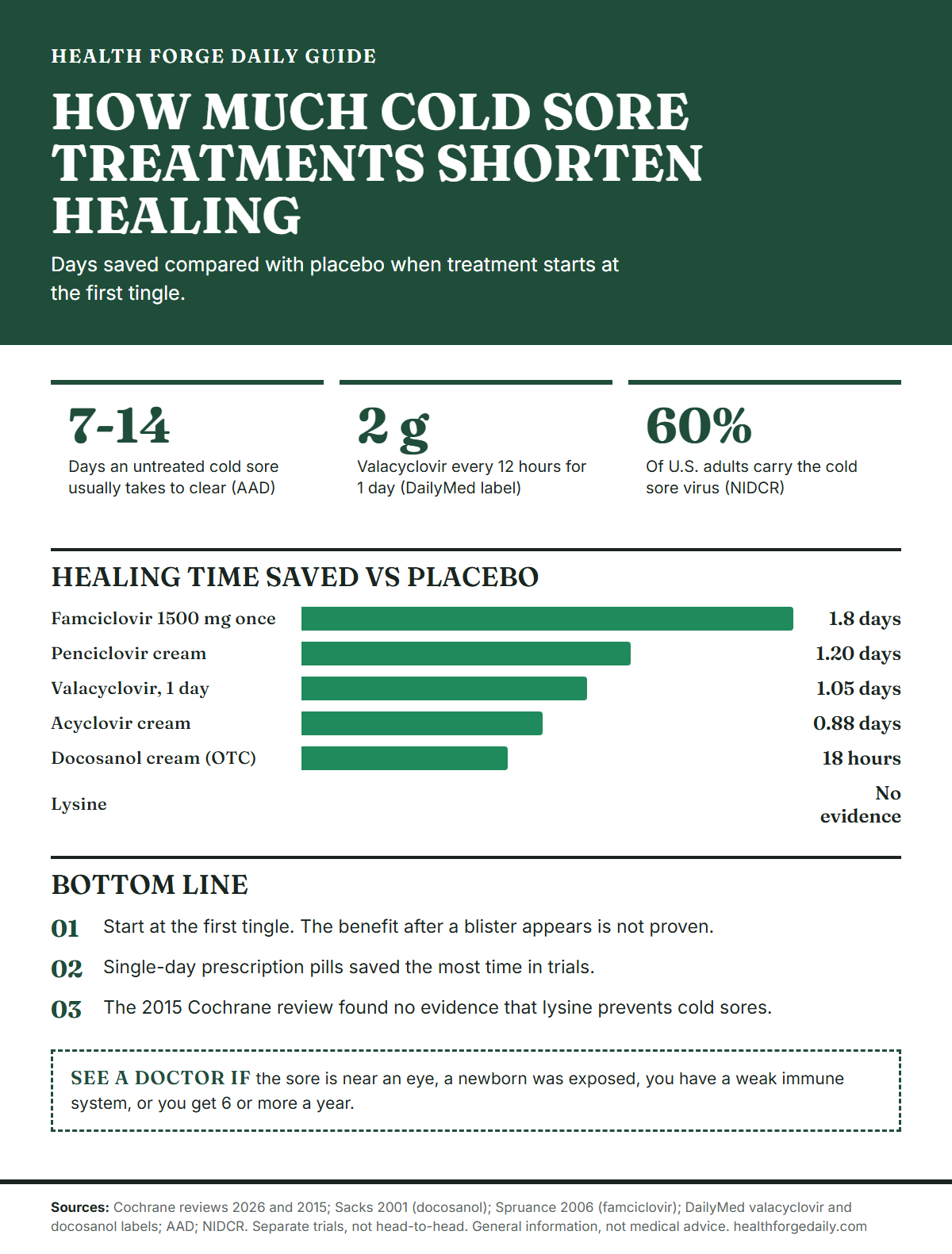
The best cold sore treatment is an antiviral started at the first tingle, before a blister shows. In trials, a single day of valacyclovir or one dose of famciclovir shortened outbreaks by about 1 to 2 days. Docosanol cream, sold without a prescription, shortened them by about 18 hours.[6][7][8][9]
None of these options removes the virus. MedlinePlus states there is no cure, and cold sores usually clear on their own in a few weeks.[1] Treatment buys you a shorter, less painful outbreak, and it works best when you start early.
The 2026 Cochrane review pooled 87 randomized trials with 22,631 people. It found that acyclovir cream shortened healing by 0.88 days, penciclovir cream by 1.20 days, and oral valacyclovir by 1.05 days compared with placebo. Oral acyclovir showed a 0.86-day difference that was not statistically clear.[6] The reviewers noted that no one has agreed how much shorter an outbreak must be to matter to patients.[6]
| Study | Who and how many | Treatment | Result vs placebo |
|---|---|---|---|
| Sacks, 2001[7] | 737 adults at 21 sites | Docosanol 10% cream, 5 times a day | Healed in a median 4.1 days, 18 hours sooner |
| Spruance, 2006[8] | 701 people | Famciclovir 1500 mg once, within 1 hour of tingling | Healed in 4.4 days vs 6.2 days |
| Valacyclovir label trials[9] | 1,856 adults and teens aged 12+ | Valacyclovir 2 grams twice on day 1 | Outbreaks about 1 day shorter |
| Cochrane review, 2026[6] | 87 trials, 22,631 people | Acyclovir cream, penciclovir cream, oral valacyclovir | 0.88, 1.20 and 1.05 days shorter |
| Koytchev, 1999[12] | 66 people at 1 center | Lemon balm 1% extract cream, 4 times a day for 5 days | Lower day-2 symptom score (4.03 vs 4.94) |
What are the stages of a cold sore, and how long does it take to heal?
A cold sore moves from tingling to redness, then blisters, then an open sore, then a crust that falls off. In healthy people the whole cycle usually takes 7 to 14 days without treatment.[3] The AAD says most clear within two weeks in healthy people.[2]
Medicine works best on the early stages, which researchers name like this:[5][7]
- Tingle (prodrome): burning, itching or tingling on the lip before anything shows.[5]
- Redness and a small bump: the skin swells and turns pink or red.[7]
- Blisters: a patch of small fluid-filled blisters forms on or near the lip border.[5]
- Open sore: the blisters break and weep, and the fluid is contagious.[4]
- Crust and healing: a scab forms and falls off. You stay contagious until every sore has scabbed.[2]
In the docosanol trial, people started treatment during the tingle or redness stage.[7] On the valacyclovir label, the benefit of starting after a bump, blister or open sore has appeared has not been shown.[9] An outbreak can also bring fever, tiredness and swollen glands.[5]
Does Abreva work as an over-the-counter cold sore treatment?
Abreva’s active ingredient, docosanol 10% cream, shortened healing by about 18 hours in a 737-person trial. Median healing time was 4.1 days with docosanol, and treated people also lost their tingling, burning and pain a little sooner than those using a placebo cream.[7]
That trial, published in 2001, ran two identical studies at 21 sites. People applied the cream 5 times a day until the crust fell off. Side effects were mild and similar to placebo. About 40% of treated outbreaks stopped before a full blister formed, versus 34% on placebo, but that gap could have been chance.[7]
How to use it, from the store-brand label:[10]
- Adults and children 12 and older. Under 12, ask a doctor.
- Apply at the first tingle, rub in gently, and repeat 5 times a day until healed.
- Wash your hands before and after each use, and do not share the tube.
- Do not use it in or near the eyes, and avoid putting it inside the mouth.
- Stop and ask a doctor if the sore gets worse or has not healed within 10 days.
Store brands at CVS, Walgreens and Walmart sell the same 10% docosanol under their own names. Plain lip balms sold for cold sores can soothe and protect the skin, but unless they list an antiviral drug, they have no healing-time data like this.[1][10]
Is Valtrex or acyclovir better for cold sores?
For most adults, a 1-day course of valacyclovir (Valtrex) has better evidence than acyclovir pills. The Cochrane review found that valacyclovir cut healing by 1.05 days, while oral acyclovir showed no clear benefit in the one small trial it could pool.[6] Famciclovir taken once also performed well.[8]
These are prescription pills, and they are what dermatologists reach for when a cold sore needs more than cream.[3] Here is how each one is used:
- Valacyclovir: 2 grams every 12 hours for 1 day, for adults and teens 12 and older. In two trials with 1,856 people, outbreaks were about 1 day shorter. A second day of pills added nothing.[9]
- Famciclovir: 1500 mg as a single dose. In a 701-person trial, people took it within 1 hour of tingling and healed in 4.4 days instead of 6.2, about 1.8 days sooner.[8]
- Acyclovir: comes as a cream, pills and a tablet that sticks to the gum (Sitavig). The cream shortened healing by 0.88 days in pooled trials.[3][6]
- Penciclovir cream (Denavir): shortened healing by 1.20 days in pooled trials.[3][6]
Many doctors write the prescription ahead of time, so you can keep the pills at home and take them the moment you feel the tingle. For people who get 6 or more cold sores a year, the AAD notes a low daily dose can cut the number of outbreaks.[3] The 2015 Cochrane prevention review agreed that long-term antiviral pills reduced repeat outbreaks.[11]
How do you get rid of a cold sore fast?
The fastest route is to start an antiviral within an hour or two of the first tingle and keep the sore clean and protected. Most people in the valacyclovir trials started within 2 hours of symptoms.[9] The AAD notes that nothing clears a cold sore overnight.[4]
What to do, based on the drug labels and AAD advice:
- Learn your warning sign. Burning, itching or tingling on the lip usually comes before the blister.[5]
- Start treatment right away: docosanol cream, or the prescription pill your doctor gave you in advance.[8][9][10]
- Apply creams with a clean cotton swab. Dabbing keeps the virus off the tube and off your fingers.[3]
- Wash your hands after touching the sore or putting on medicine.[2]
- Keep your lips moist with petroleum jelly, and use a lip balm with SPF 30 or higher outdoors.[3][4]
- Use a numbing ointment if pain gets in the way of eating. MedlinePlus lists numbing, softening and drying ointments for comfort.[1]
- Leave the scab alone and avoid kissing or sharing cups until every sore has crusted over.[2]
- Throw out the lip balm, lipstick and toothbrush you used during the outbreak once it heals.[3][4]
Does lysine or lemon balm help cold sores?
Lysine has no proven benefit for cold sores, and lemon balm cream has only one small, older trial behind it. The 2015 Cochrane review of 32 trials with 2,640 people looked for evidence that lysine prevents cold sores and found none.[11]
Lysine pills are often suggested at the pharmacy anyway. We plan a separate article on the lysine studies; for now, the best review found no reliable effect.[11]
Lemon balm (Melissa officinalis) was studied in a 1999 trial of 66 people with at least four outbreaks a year. A 1% extract cream used 4 times a day for 5 days gave a lower combined symptom score on day 2: 4.03 versus 4.94 on placebo.[12] One small, single-center trial is a weak signal. Lemon balm may help with comfort, though that study never compared it with an antiviral.
If you are interested in immune-related supplements more broadly, our article on whether elderberry and zinc shorten colds walks through a similar mix of hopeful and weak evidence. More options sit in our viral support section.
What triggers cold sores, and how do you stop them spreading?
Sun, stress, poor sleep, dry or chapped lips, cold or hot weather, and pressure from dental work can all wake the virus up. The AAD suggests keeping a simple log of what happened before each outbreak so you can spot your own pattern.[4]
The virus is very common. NIDCR says around 60% of U.S. adults carry it, and MedlinePlus says HSV-1 infects more than half of Americans by their 20s.[1][5] Many never get a sore.[5]
Ways to cut down on outbreaks, from AAD guidance:[3][4]
- Wear lip balm with SPF 30 or higher all year, reapplied every two hours outdoors.
- Find a stress outlet you will stick with, such as exercise or time outside.
- Protect sleep, since being short on sleep triggers outbreaks for some people.
- Tell your dentist or skin clinic before lip fillers, lasers or dental work.
Sun protection has mixed trial results. Sunscreen prevented sores triggered by lab UV light in two trials, but one trial in real sunlight found no clear effect.[11] It is cheap and harmless, so it is still worth using. General health matters too, and our guide to vitamin D benefits and how much you need covers one nutrient often discussed for immune health.
To protect others until every sore has scabbed, do not kiss anyone, especially children. Do not share lip balm, towels, razors, cups or food, and stay away from newborns and anyone with a weak immune system.[2] Wash towels and pillowcases you used during the outbreak.[4]
When should you see a doctor for a cold sore?
See a doctor if a cold sore is near your eye, lasts longer than 2 weeks, or comes back 6 or more times a year. The AAD also advises care for anyone with eczema, many sores or a lot of pain, or a weak immune system from illness or medicine.[3]
Get medical help right away if:
- You have a sore, redness or irritation near or in an eye. Spreading the virus to the eye can cause blindness.[5]
- A newborn baby has been in close contact with someone who has a cold sore. Infection in a newborn can be very serious.[2]
- You have a weak immune system from cancer, HIV, chemotherapy, a transplant or immune-lowering drugs.[3]
- A child with eczema has been exposed, or the sores spread over a wide area.[2][3]
- You have a high fever along with the sores.[5]
For children, ask a doctor before using docosanol under age 12; valacyclovir for cold sores is approved from age 12.[9][10] Young children with fever blisters may drool, lose their appetite and run a fever for several days.[5]
Side effects of antiviral pills are usually mild. In trials, valacyclovir’s most common ones were headache, nausea and stomach pain.[9] Tell your doctor about kidney problems and other medicines, and say if you are pregnant, so they can choose the right drug and dose. A doctor can usually diagnose a cold sore by looking at it, and can swab it if unsure.[3] A sore inside the cheek or on the tongue is more likely a canker sore, which is not contagious.[5]
Bottom line
Cold sores go away on their own, and treatment only trims a day or two. When a sore hurts or sits in the middle of your face, a day or two can matter. The best evidence supports antivirals started at the first tingle: docosanol cream over the counter, or valacyclovir or famciclovir pills by prescription.[6][7][8]
For most people who get cold sores more than once or twice a year, asking a doctor for a 1-day pill prescription to keep at home is the better first step, because pills taken early shortened outbreaks more than creams did in trials. Skip lysine for now, and treat lemon balm as optional comfort.[6][8][11][12]
Sources
- Cold Sores. MedlinePlus, National Library of Medicine
- Cold sores: Overview. American Academy of Dermatology, 2024
- Cold sores: Diagnosis and treatment. American Academy of Dermatology, 2024
- Cold sore remedies dermatologists recommend. American Academy of Dermatology, 2024
- Fever Blisters and Canker Sores. National Institute of Dental and Craniofacial Research, NIH
- Interventions for treatment of herpes labialis (cold sores on the lips). Cochrane Database of Systematic Reviews, 2026
- Clinical efficacy of topical docosanol 10% cream for herpes simplex labialis: a multicenter, randomized, placebo-controlled trial. Journal of the American Academy of Dermatology, 2001
- Single-dose, patient-initiated famciclovir: a randomized, double-blind, placebo-controlled trial for episodic treatment of herpes labialis. Journal of the American Academy of Dermatology, 2006
- Valacyclovir hydrochloride tablets, prescribing information. DailyMed, National Library of Medicine, 2026
- Docosanol 10% cream, Drug Facts label. DailyMed, National Library of Medicine
- Interventions for prevention of herpes simplex labialis (cold sores on the lips). Cochrane Database of Systematic Reviews, 2015
- Balm mint extract (Lo-701) for topical treatment of recurring herpes labialis. Phytomedicine, 1999
Frequently asked questions
Is a cold sore still contagious after it scabs?
The AAD says you are contagious until all the sores have scabbed over. Until then, avoid kissing and sharing cups or lip balm, and wash your hands after touching the sore. Treating a cold sore does not stop you from spreading the virus.
Can you use cold sore cream inside your mouth?
No. The docosanol label says to avoid applying it directly inside the mouth. Sores inside the cheeks or on the tongue are often canker sores, which are not caused by the herpes virus and are not contagious. Ask a dentist or doctor about mouth sores.
What cold sore treatment is safe for kids?
Docosanol cream and valacyclovir are labeled for ages 12 and up. For younger children, ask a pediatrician before using any cold sore medicine. Call the doctor if a young child has a fever, drools, or will not eat or drink.
Does cold sore medicine work if you start it late?
Cold sore medicine works best at the first tingle. The valacyclovir label says the benefit of starting after a bump, blister or open sore appears has not been shown. Late treatment may still ease discomfort, but expect less effect on healing time.
Does cold sore medicine expire?
Yes. Check the expiration date on the tube or bottle before you rely on it, and replace expired products. Store docosanol cream at room temperature and do not freeze it, as the label directs. Throw out any tube you touched to an open sore.

Grace Whitaker is the health editor at Health Forge Daily. She reads supplement labels line by line, checks each ingredient and dose against published research, and tracks refund policies and customer complaints before a product gets a verdict. She is not a doctor, so every review points readers back to their own physician for medical decisions.
This article is for general information and is not medical advice. Supplements are not evaluated by the FDA and are not intended to diagnose, treat, cure or prevent any disease. Check with your doctor before you start any supplement.