This article contains affiliate links. If you buy through them we may earn a commission at no extra cost to you. It never changes what we report. How we make money.
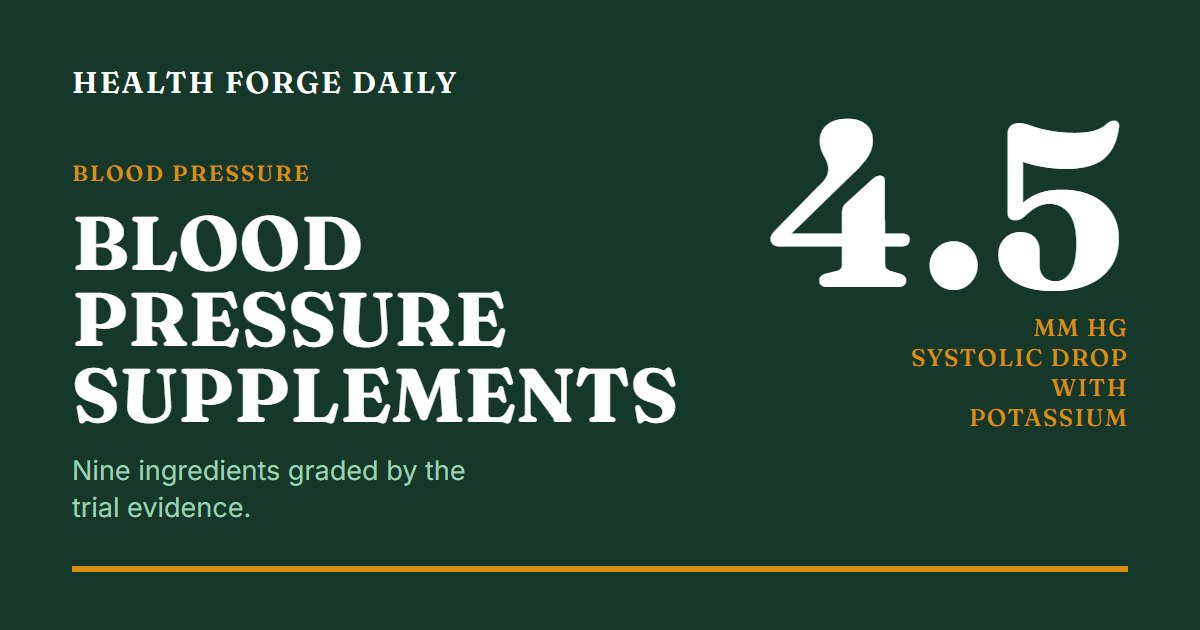
Blood pressure supplements give small effects at best. Potassium has the strongest record, lowering systolic pressure 4.48 mm Hg across 25 trials, followed by magnesium and fish oil at about 1.5 to 2 mm Hg. Garlic, beetroot and black seed have thinner trials, hibiscus and CoQ10 show little, and licorice raises blood pressure. Check with your clinician first, especially about potassium.
| # | Pick | Best for | Evidence |
|---|---|---|---|
| 1 | Potassium | People who eat few fruits and vegetables | Moderate |
| 2 | Magnesium | People who want a well-tolerated mineral | Moderate |
| 3 | Fish oil (omega-3) | People with untreated high blood pressure | Moderate |
| 4 | Garlic | People who can handle the smell | Limited |
| 5 | Beetroot and nitrate | People curious about a food-based option | Limited |
| 6 | Black seed | People who want an herb with some data | Limited |
| 7 | Hibiscus | Tea drinkers, not capsule buyers | Weak |
| 8 | CoQ10 | People who already take it for another reason | Weak |
| 9 | Licorice root | No one with high blood pressure | Avoid |
We read the NHLBI and MedlinePlus pages on high blood pressure, the NIH fact sheets on potassium and magnesium, NCCIH pages on garlic and licorice, and seven trial reviews to grade the most common blood pressure supplements by ingredient. We ranked ingredient types, not brands, and we did not test any products.
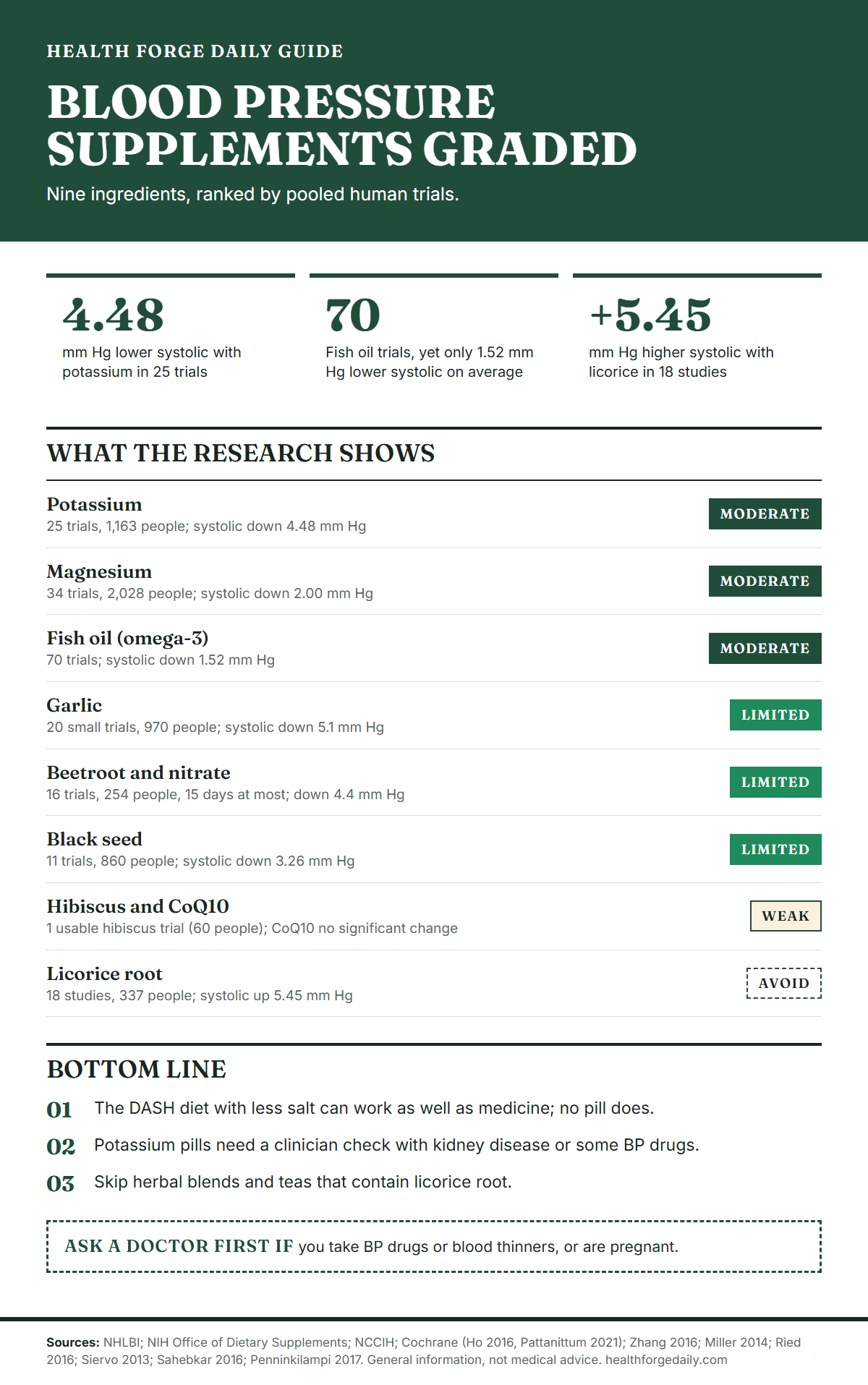
A few ingredients lower blood pressure by about 2 to 5 mm Hg in trials, which is smaller than the effect of diet changes or medicine, and one common herb, licorice, raises it[1][4][6][15].
| What they are | Minerals, fish oils, herbs and food extracts sold to support healthy blood pressure. The FDA does not review them for safety or effectiveness before sale[3]. |
|---|---|
| Used for | High blood pressure, which is 130/80 mm Hg or higher and usually causes no symptoms[2]. |
| Best evidence | Potassium: 25 trials in 1,163 people with high blood pressure, systolic pressure down 4.48 mm Hg[4]. |
| Largest trial pool | Fish oil (EPA and DHA): 70 trials, systolic pressure down 1.52 mm Hg overall[7]. |
| Raises blood pressure | Licorice with glycyrrhizin: systolic pressure up 5.45 mm Hg in 18 studies[15]. |
| Who should wait | People with kidney disease, people on blood pressure medicines or blood thinners, and anyone pregnant, until they have asked a clinician[3][4][8]. |
Do blood pressure supplements work?
Some blood pressure supplements lower readings a little, but none matches medicine or a full diet change. Potassium, magnesium and fish oil each beat placebo in pooled trials, usually by 2 to 5 mm Hg systolic. NHLBI says the DASH diet with less salt can work as well as medicines[1][4][6][7].
A drop of 2 mm Hg is real but small. Stage 1 high blood pressure starts at 130/80 mm Hg, and stage 2 at 140/90 mm Hg, so a supplement alone rarely moves someone back into the normal range[2].
Most of the trials were also short, often 3 months or less. They measured blood pressure, not heart attacks or strokes. That gap matters, since lowering blood pressure is meant to prevent those events[6][10][11].
How did we grade the evidence?
We graded each ingredient by the number, size and quality of its human trials, using four plain grades. We did not score brands, and no company paid for a grade. Our full method is on the how we review supplements page.
- Moderate: several pooled trials, small consistent effect.
- Limited: some trials, small or low quality.
- Weak: pilot studies only, or reviews found no benefit.
- Avoid: no evidence plus a safety problem.
A Moderate grade does not mean a product works for you. It means the trials agree that the average effect is real but modest. We gave extra weight to Cochrane reviews and NIH fact sheets, and we noted reviews written by authors with industry or consulting ties[3][7].
1. Potassium: people who eat few fruits and vegetables
Potassium has the strongest case of any blood pressure supplement, with the largest drops in people who already have high blood pressure. A 2017 review of 25 trials in 1,163 people found systolic pressure fell 4.48 mm Hg and diastolic 2.96 mm Hg[4].
Those trials used 1,173 to 4,692 mg a day for 4 to 15 weeks, far more than store pills hold. Most potassium-only supplements contain up to 99 mg[4]. A Cochrane review of the six best trials found no significant drop, which keeps the grade at Moderate[4].
Potassium pills also carry a real risk. Potassium can build up to dangerous levels in people with kidney disease or in people who take ACE inhibitors, ARBs or potassium-sparing diuretics[4]. So ask a clinician, and get a blood test, before you take a potassium pill.
2. Magnesium: people who want a well-tolerated mineral
Magnesium lowers blood pressure by about 2 mm Hg on average, a small but consistent effect across many trials. A 2016 review of 34 trials in 2,028 people found a median 368 mg a day for 3 months cut systolic pressure 2.00 mm Hg and diastolic 1.78 mm Hg[6].
The NIH Office of Dietary Supplements calls the effect marginal[5]. The same review found that 300 mg a day for one month was enough to raise blood magnesium and lower pressure[6].
The upper limit for magnesium from supplements is 350 mg a day for adults, and the risk of toxicity rises with kidney failure[5]. Our guide to magnesium glycinate benefits and how it compares covers the forms that are gentler on the stomach.
3. Fish oil (omega-3): people with untreated high blood pressure
Fish oil has the biggest pool of trials, 70 in all, but the average drop is only 1.52 mm Hg systolic. The effect was larger in people with untreated high blood pressure, at 4.51 mm Hg systolic and 3.05 mm Hg diastolic[7].
The review counted EPA and DHA from capsules and food. Diastolic pressure fell only at 2 grams or more a day[7]. Two of the authors worked for consulting firms, so we read the result as solid on direction and modest on size[7].
Fish oil is usually taken for heart health more broadly. Our report on fish oil for heart health and what the omega-3 trials show covers the heart attack and stroke results.
4. Garlic: people who can handle the smell
Garlic may lower blood pressure a little in people who already have high readings, but the trials are small. NCCIH says limited evidence suggests garlic supplements may reduce blood pressure to a small extent in people with high blood pressure[8].
A 2016 review of 20 trials with 970 people found systolic pressure fell 5.1 mm Hg overall and 8.7 mm Hg in 10 trials of people with high blood pressure[9]. That review had one author, from an integrative medicine institute, and the trials were small, so we grade garlic Limited.
Side effects include breath and body odor, stomach pain, gas and nausea. Garlic supplements may raise the risk of bleeding, which matters before surgery and for people on blood thinners or aspirin[8].
5. Beetroot and nitrate: people curious about a food-based option
Beetroot juice and nitrate lowered systolic pressure by 4.4 mm Hg in short trials, but nobody has shown the effect lasts. A 2013 review pooled 16 trials with 254 adults, with only 7 to 30 people in each trial[10].
The trials ran from 2 hours to 15 days. Diastolic pressure barely moved, at 1.1 mm Hg, which was not statistically significant[10]. The authors said the findings need testing in long-term trials and in people at higher risk.
That makes beetroot a reasonable food to add to a vegetable-rich plate. It is not proof that a beet powder capsule will control blood pressure over months.
6. Black seed (Nigella sativa): people who want to try an herb with some data
Black seed lowered blood pressure by about 3 mm Hg systolic in a pooled review, but the trials were short and varied. A 2016 review of 11 trials in 860 people found drops of 3.26 mm Hg systolic and 2.80 mm Hg diastolic after about 8.3 weeks[11].
The trials mixed people with high and normal blood pressure, and the results differed widely between studies[11]. No long trial has checked heart outcomes.
For the full trial record, including blood sugar results, see our review of black seed oil benefits for blood pressure and sugar.
7. Hibiscus: tea drinkers, not capsule buyers
Hibiscus, also called roselle, does not have reliable evidence for lowering blood pressure. A 2021 Cochrane review found only one trial that met its standards, with 60 people who had type 2 diabetes, and called the evidence insufficient[12].
That one trial used 5,600 mg of roselle extract for 8 weeks. The reviewers rated their confidence in the result as very low because of dropouts and uneven groups[12].
Hibiscus tea is a pleasant drink and a fine swap for sugary ones. On the current record, it earns a Weak grade as a blood pressure supplement.
8. CoQ10: people who already take it for another reason
CoQ10, a popular heart supplement, did not lower blood pressure in a meaningful way in the best trials. A 2016 Cochrane review pooled two trials with 50 people and found a 3.68 mm Hg systolic change that was not statistically significant[13].
The reviewers called it moderate-quality evidence that CoQ10 has no clinically significant effect on blood pressure[13]. Earlier, smaller studies looked better, but they did not hold up under stricter rules.
CoQ10 is usually well tolerated. If you already take it for another reason, there is no strong case to add it for blood pressure alone.
9. Licorice root: no one with high blood pressure
Licorice that contains glycyrrhizin raises blood pressure, so it belongs on the avoid list. A 2017 review of 18 studies in 337 people found systolic pressure rose 5.45 mm Hg and diastolic 3.19 mm Hg, while blood potassium fell, even at modest doses[15].
NCCIH warns that glycyrrhizin can cause irregular heartbeat and cardiac arrest, especially in large amounts or over long periods. Even small amounts have caused severe effects in people with high blood pressure, heart or kidney conditions, or a salty diet[14].
Check “proprietary blend” labels for licorice root. Deglycyrrhizinated licorice (DGL) has the glycyrrhizin removed and might be safe for up to 4 months[14].
How do blood pressure lowering supplements compare in trials?
Across the reviews we read, the average systolic drop ranged from about 1.5 to 5 mm Hg, and only licorice moved pressure up. Larger effects showed up in people who already had high blood pressure[4][7][9][15].
| Ingredient | Trials and people | Systolic change | Grade |
|---|---|---|---|
| Potassium | 25 trials, 1,163 people[4] | -4.48 mm Hg | Moderate |
| Magnesium | 34 trials, 2,028 people[6] | -2.00 mm Hg | Moderate |
| Fish oil | 70 trials[7] | -1.52 mm Hg | Moderate |
| Garlic | 20 trials, 970 people[9] | -5.1 mm Hg | Limited |
| Beetroot and nitrate | 16 trials, 254 people[10] | -4.4 mm Hg | Limited |
| Black seed | 11 trials, 860 people[11] | -3.26 mm Hg | Limited |
| CoQ10 | 2 trials, 50 people[13] | -3.68 mm Hg, not significant | Weak |
| Licorice | 18 studies, 337 people[15] | +5.45 mm Hg | Avoid |
Garlic shows a bigger number than magnesium but sits a grade lower, because its trials were fewer and smaller. Beetroot trials lasted 15 days at most[9][10].
Which supplement fits your situation?
The right choice depends on your kidneys, your medicines and what your diet is missing, so start with the situation, not the product. Use the table below to plan questions for your clinician, not to choose a dose on your own[3].
| If you | Consider first | Why |
|---|---|---|
| Eat few fruits, vegetables or beans | More potassium from food | Food carries far more potassium than 99 mg pills[4] |
| Take an ACE inhibitor, ARB or spironolactone | No potassium pills or salt substitutes without a blood test | Risk of high potassium[4] |
| Have kidney disease | Ask before potassium or magnesium | Both can build up[4][5] |
| Take a blood thinner or aspirin | Skip garlic pills unless cleared | Bleeding risk[8] |
| Rarely eat fish | Fish meals or a fish oil talk | Small, consistent effect[7] |
| Use herbal teas or blends | Check for licorice root | It raises pressure[15] |
Are blood pressure supplements safe with Eliquis or other medicines?
Some are not. Garlic may raise bleeding risk with anticoagulants such as apixaban (Eliquis), and potassium can build up with several blood pressure drugs. NCCIH advises talking with your provider before using garlic or other herbs if you take anticoagulants or aspirin[8].
Potassium is the bigger risk for people on ACE inhibitors such as benazepril, ARBs such as losartan, or potassium-sparing diuretics such as spironolactone. These drugs hold potassium in the body[4]. Salt substitutes can carry 440 to 2,800 mg of potassium per teaspoon[4].
Supplements also have not been tested in most pregnant women, and large amounts of licorice in pregnancy are unsafe[3][14]. Our review of nattokinase trials on blood pressure and clots covers another enzyme people on blood thinners ask about.
Are there supplements for low blood pressure?
No supplement has good evidence for raising low blood pressure, and NHLBI does not list any as a treatment. Low blood pressure means a reading below 90/60 mm Hg, and some people have it all the time without problems[16].
When treatment is needed, NHLBI lists drinking more fluids, medicines that raise blood pressure, or adjusting medicines that lower it. Blood pressure drugs are a common cause in older adults[16].
Dizziness, fainting, confusion or blurry vision when you stand up are reasons to call your provider rather than buy a product[16].
What do doctors use first for high blood pressure?
Doctors start with heart-healthy habits such as diet, activity and less alcohol, and many people also need one or more medicines. NHLBI says the DASH eating plan combined with lower salt can be as effective as medicines in lowering high blood pressure[1].
A treatment plan may include lifestyle changes alone or with medicines, guided by your overall heart risk[1]. Because high blood pressure usually has no symptoms, regular readings are the only way to know whether a plan is working[2].
A supplement can sit on top of that plan if your clinician agrees. It should never replace a prescribed drug, and you should not lower a dose on your own. For more on readings, diet and medicines, see our blood pressure guides.
How do you check a blood pressure supplement label?
Read the Supplement Facts panel for the amount of each ingredient, then compare it with the doses used in trials. Companies do not have to prove safety or effectiveness to the FDA before they sell a supplement in stores or online[3].
- Bring your readings and the bottle to your clinician before you start[1][3].
- Check potassium per serving; most pills hold 99 mg or less, far below trial doses[4].
- Keep magnesium from supplements at or under 350 mg a day unless your clinician advises more[5].
- Look for licorice root or glycyrrhizin in blends and teas, and skip them[14].
- Flag garlic, fish oil and herbal blends if you take a blood thinner or aspirin[8].
- Be wary of claims to replace medicine or to fix blood pressure in days[3].
- Recheck your blood pressure after a few weeks and share the log[2].
Are blood pressure supplements worth it?
For most people, blood pressure supplements are a small add-on at best, and food changes give more for less money. Potassium, magnesium and fish oil have the steadiest trial records, but their average effects are a few mm Hg[4][6][7].
If you want to try one, start by eating more potassium-rich foods and ask your clinician whether a magnesium supplement makes sense for you. Leave licorice blends on the shelf, and do not count on hibiscus or CoQ10 to move your numbers[1][12][13][15].
Sources
- High Blood Pressure: Treatment. NHLBI, NIH
- High Blood Pressure. MedlinePlus, National Library of Medicine
- Using Dietary Supplements Wisely. NCCIH, NIH
- Potassium: Fact Sheet for Health Professionals. NIH Office of Dietary Supplements, 2022
- Magnesium: Fact Sheet for Health Professionals. NIH Office of Dietary Supplements, 2026
- Effects of Magnesium Supplementation on Blood Pressure: A Meta-Analysis of Randomized Double-Blind Placebo-Controlled Trials. Zhang et al., Hypertension, 2016
- Long-chain omega-3 fatty acids EPA and DHA and blood pressure: a meta-analysis of randomized controlled trials. Miller et al., American Journal of Hypertension, 2014
- Garlic. NCCIH, NIH
- Garlic Lowers Blood Pressure in Hypertensive Individuals: An Updated Meta-analysis and Review. Ried, Journal of Nutrition, 2016
- Inorganic nitrate and beetroot juice supplementation reduces blood pressure in adults: a systematic review and meta-analysis. Siervo et al., Journal of Nutrition, 2013
- Effects of supplementation with Nigella sativa (black seed) on blood pressure: a systematic review and meta-analysis. Sahebkar et al., Journal of Hypertension, 2016
- Roselle for hypertension in adults. Pattanittum et al., Cochrane Database of Systematic Reviews, 2021
- Blood pressure lowering efficacy of coenzyme Q10 for primary hypertension. Ho et al., Cochrane Database of Systematic Reviews, 2016
- Licorice Root: Usefulness and Safety. NCCIH, NIH
- The association between consistent licorice ingestion, hypertension and hypokalaemia: a systematic review and meta-analysis. Penninkilampi et al., Journal of Human Hypertension, 2017
- Low Blood Pressure. NHLBI, NIH
Frequently asked questions
What are the best natural blood pressure supplements?
Potassium, magnesium and fish oil have the most consistent trial support, each lowering systolic pressure by roughly 1.5 to 4.5 mm Hg on average. Garlic, beetroot and black seed have smaller or shorter trials. None replaces medicine or the DASH diet.
Are blood pressure supplements with potassium safe?
Potassium pills are usually 99 mg or less, but people with kidney disease, or who take ACE inhibitors, ARBs or potassium-sparing diuretics, can build up dangerous potassium levels. Salt substitutes carry far more. Ask for a blood test before you start.
Can pregnant women take blood pressure supplements?
Most supplements have not been tested in pregnant women, and large amounts of licorice in pregnancy are unsafe. High blood pressure in pregnancy needs care from your prenatal provider, so ask them before you take any supplement or herbal tea.
Are store-brand blood pressure supplements any different?
The FDA does not review any supplement, store brand or name brand, for safety or effectiveness before sale. Compare the ingredient amounts on the Supplement Facts panel with trial doses, and look for licorice root in herbal blends.
Can supplements replace blood pressure medicine?
No. The largest supplement effects in trials were a few mm Hg, while NHLBI says many people need medicine, often alongside the DASH diet and less salt. Never stop or lower a prescribed dose without talking to your clinician first.

Grace Whitaker is the health editor at Health Forge Daily. She reads supplement labels line by line, checks each ingredient and dose against published research, and tracks refund policies and customer complaints before a product gets a verdict. She is not a doctor, so every review points readers back to their own physician for medical decisions.
This article is for general information and is not medical advice. Supplements are not evaluated by the FDA and are not intended to diagnose, treat, cure or prevent any disease. Check with your doctor before you start any supplement.