Black seed oil, from Nigella sativa seeds, showed small benefits in pooled trials. Systolic blood pressure fell about 3 mmHg, adults with overweight lost about 2 kg more than placebo, and fasting sugar and cholesterol improved slightly. Most trials were small and short. It can cause skin rashes and may interact with warfarin and other drugs, so talk to a doctor first.
We read 12 sources on black seed oil benefits before writing this: the Memorial Sloan Kettering herb monograph, the NIH LactMed entry, five meta-analyses of randomized trials and three single trials in people with asthma, rheumatoid arthritis and male infertility.[1][2] We did not test any product ourselves.
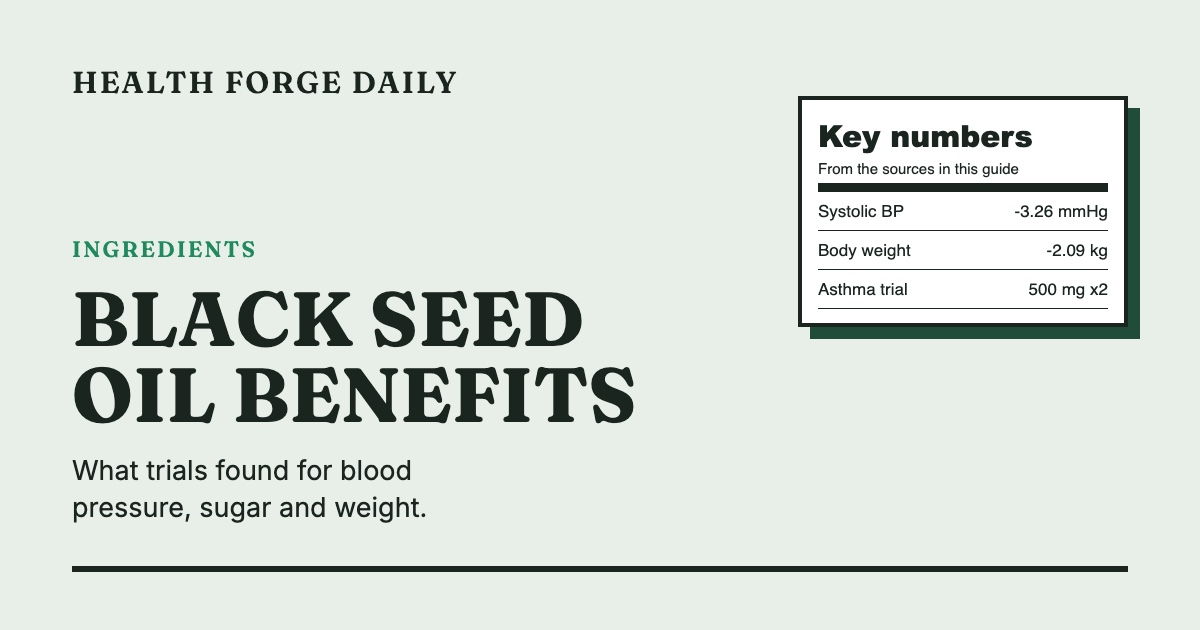
The short answer: in pooled trials, black seed oil and powder lowered systolic blood pressure by about 3 mmHg and body weight by about 2 kg, with small gains in blood sugar and cholesterol, but most trials were small and short.[3][7]
| What it is | Oil pressed from the seeds of Nigella sativa, also called black cumin, black caraway or kalonji[1] |
|---|---|
| Main studied use | Blood pressure, blood sugar, cholesterol and weight, as an add-on to usual care[11] |
| Amounts used in trials | 200 to 4,600 mg a day, for 1 to 48 weeks[11] |
| Best evidence | 11 trials with 860 people: systolic pressure fell 3.26 mmHg more than control[3] |
| Common safety issue | Skin rash (contact dermatitis) when the oil is put on the skin[2] |
| Who should avoid it | People on warfarin or drugs cleared by CYP2D6 or CYP3A4 unless a doctor agrees; pregnancy and breastfeeding lack safety data[1][2] |

What is black seed oil?
Black seed oil is the fixed oil pressed from the small black seeds of Nigella sativa, a flowering plant grown across India, the Middle East and Europe. The seeds are a cooking spice, and the oil has a long history in traditional medicine in India, Arabia and Europe.[1]
Its best-known compound is thymoquinone. Memorial Sloan Kettering (MSKCC) lists thymoquinone as one of the chief constituents of the oil, with antioxidant and anti-inflammatory effects in lab and animal studies.[1]
Lab results often fail to carry over to people, so the sections below rely on human trials and pooled reviews.
You may see the same plant sold as black cumin seed oil, blackseed oil, kalonji oil or Ethiopian black seed oil. These names describe the same species. We found no trial that compared oil from one country with oil from another, so a label that says Ethiopian only tells you where the seeds were grown.
What is black seed oil good for?
Black seed oil has the most human data for blood pressure, blood sugar, cholesterol and body weight, and smaller single trials for asthma and rheumatoid arthritis. MSKCC sums it up as small clinical studies suggesting it may help control high blood pressure, asthma, diabetes and rheumatoid arthritis.[1]
The largest review so far pooled 82 studies with 5,026 people. It found improvements in weight, waist size, blood pressure, fasting sugar, lipids and inflammation markers, and called the seed a promising add-on, not a stand-alone treatment.[11]
We graded each use with plain words. Moderate means several pooled trials with a small, fairly consistent effect. Limited means some trials, but small, short or very mixed. Weak means animal or lab work only.
| Use | Who and how many | Result | Strength |
|---|---|---|---|
| Blood pressure | 11 trials, 860 adults, about 8 weeks | Systolic down 3.26 mmHg, diastolic down 2.80 mmHg vs control[3] | Moderate |
| Body weight | Network review of 111 trials, 6,171 adults | About 2.09 kg more weight loss than placebo[7] | Moderate |
| Cholesterol | 34 studies, 2,278 adults | Lower total and LDL cholesterol and triglycerides, higher HDL[5] | Limited |
| Blood sugar | 30 trials in adults | Lower fasting sugar and HbA1c, no change in insulin[6] | Limited |
| Asthma | 80 adults, 500 mg twice daily, 4 weeks | Better asthma control score, lung function not significantly changed[8] | Limited |
| Cancer | Lab and animal studies | Not shown to work in humans[1] | Weak |
Asthma and allergies
In a 2017 double-blind trial, 80 adults with asthma took 500 mg of black seed oil capsules or placebo twice a day for 4 weeks on top of their usual inhalers.[8] The oil group scored 21.1 on the Asthma Control Test versus 19.6 for placebo, and blood eosinophils fell. Lung function rose a little, but that change was not statistically significant.[8]
Ten people dropped out of each group, and the trial ran just one month. The result justifies a longer trial. It gives no reason to drop an inhaler.
Is oil of oregano with black seed oil better?
Many products pair oregano oil with black seed oil, and searches for that combination are common. We found no human trial that tested the two oils together, so any claim that the pair works better than either one alone has no support in the sources we read. The black seed data in this guide come from black seed products used on their own.[11]
Does black seed oil lower blood pressure and cholesterol?
Pooled trials show black seed lowers blood pressure by about 3 mmHg systolic and under 3 mmHg diastolic, a small drop. A 2016 review in the Journal of Hypertension combined 11 trials with 860 people and found systolic pressure fell 3.26 mmHg and diastolic 2.80 mmHg more than in control groups over about 8 weeks.[3]
A 2023 update found almost the same numbers: 3.06 mmHg systolic and 2.69 mmHg diastolic.[4] The trials disagreed with each other a great deal, though, with heterogeneity scores of 84.7% and 97.3%.[4]
In the 2016 review, seed powder lowered pressure more than the oil, and a higher dose did not give a bigger drop in systolic pressure.[3] MSKCC also calls the blood pressure data conflicting.[1]
For cholesterol, a 2024 review of 34 studies and 2,278 adults found lower total cholesterol, LDL and triglycerides, and higher HDL.[5] The review reported standardized effect sizes, not milligrams per deciliter, so it is hard to say how many points a typical person would drop. If cholesterol is your main goal, our guide to fish oil for heart health and omega-3 trials covers a supplement with far larger trials.
Does black seed oil lower blood sugar or help with weight loss?
Black seed lowered fasting blood sugar and HbA1c in pooled trials, and it produced about 2 kg of extra weight loss in adults with overweight. A 2024 review of 30 randomized trials found lower fasting sugar and HbA1c, but no change in insulin levels or insulin resistance scores.[6]
Those results were very mixed from trial to trial, with heterogeneity above 92%, and the authors asked for longer, better-designed studies.[6] MSKCC also describes the diabetes studies as small.[1]
On weight, a 2023 network review compared 18 supplements across 111 trials and 6,171 adults with overweight or obesity.[7] Black seed produced 2.09 kg more weight loss than placebo, with moderate certainty, which the authors called a small improvement. Psyllium and spirulina sat in the same small-effect group.[7]
Two kilograms is about 4.4 pounds over months of use. Diet and activity changes usually do more. If you already take diabetes medicine, black seed may add to its sugar-lowering effect, so check with your doctor first. Our review of berberine for blood sugar and who should avoid it covers a similar question for another popular supplement.
What are the black seed oil benefits for women and men?
For women, the clearest trial is in rheumatoid arthritis; for men, it is a small trial in infertility. Neither proves a broad benefit for either sex, and most of the blood pressure, sugar and weight trials enrolled both men and women.[11]
In a 2016 trial, 43 women aged 20 to 50 with mild to moderate rheumatoid arthritis took 1 gram of black seed oil a day, split into two doses, or placebo for 2 months.[9] The oil group had lower hs-CRP, a lower disease activity score and fewer swollen joints than the placebo group.[9] Women stayed on their usual arthritis care, and the trial was short.
MSKCC also notes small studies of oil on the skin for breast pain linked to the menstrual cycle and for urinary leakage in menopausal women.[1] The NIH LactMed database says black seed is used to raise breast milk supply in some countries, but no valid human trials support that use.[2]
For men, a 2014 trial gave 68 infertile men either 2.5 mL of black seed oil or liquid paraffin twice a day for 2 months.[10] Sperm count, motility, shape and semen volume improved in the oil group compared with placebo, and no side effects were reported.[10] This was one small trial in one country, and it says nothing about testosterone or fertility in healthy men.
How much black seed oil did studies use?
No official daily dose exists for black seed oil, so the safest guide is the amounts used in trials. Across 82 studies, doses ranged from 200 to 4,600 mg a day for 1 to 48 weeks.[11] The table below lists the amounts from the specific trials in this guide.
| Group studied | Form and amount | Length |
|---|---|---|
| Adults with asthma | 500 mg oil capsule, twice a day[8] | 4 weeks |
| Women with rheumatoid arthritis | 1 gram oil a day, in two doses[9] | 2 months |
| Infertile men | 2.5 mL oil, twice a day[10] | 2 months |
| Blood pressure trials | Powder or oil; average course about 8.3 weeks[3] | About 8 weeks |
| All cardiometabolic trials | 200 to 4,600 mg a day[11] | 1 to 48 weeks |
As a worked example, a 1,000 mg daily intake, taken as one 500 mg capsule twice a day, matches the asthma trial and sits at the low end of the range used in the larger reviews.[8][11] Taking more did not lower systolic pressure further in the 2016 blood pressure review, so taking more gave no extra benefit there.[3]
Is black seed oil good for you? Side effects and who should avoid it
Black seed oil is generally well tolerated in short trials, and the most reported problem is an allergic skin rash from putting it on the skin. LactMed lists allergic contact dermatitis, and MSKCC describes allergic reactions to pure oil used on the skin.[1][2]
MSKCC adds that high doses damaged the liver and kidneys in rats, while human data are lacking.[1] Long-term safety in people is unknown because most trials lasted only weeks.
Medicines and interactions
- Black seed blocks the liver enzymes CYP2D6 and CYP3A4, which clear many common drugs. The clinical effect is unknown.[1]
- Thymoquinone interfered with warfarin activity in research. Anyone on warfarin should speak to their prescriber first.[1]
- Because black seed may lower blood pressure and blood sugar, it could add to the effect of medicines for those conditions.[3][6]
Pregnancy and breastfeeding
No data exist on whether black seed passes into breast milk or on its safety for infants.[2] MSKCC notes that a seed compound reduced uterine muscle contractions in research.[1] With no safety data, skip it during pregnancy and breastfeeding unless your doctor says otherwise.
See a doctor right away if
- You get a spreading rash, swelling of the face or trouble breathing after using the oil.[2]
- Your asthma gets worse; do not stop your inhaler to try black seed.[8]
- You notice dark urine, yellow skin or eyes, or much less urine than usual.[1]
What do doctors use first?
For high blood pressure, doctors start with heart-healthy lifestyle changes alone or with medicines, not supplements. The National Heart, Lung, and Blood Institute says a treatment plan may include heart-healthy lifestyle changes alone or with medicines, and that a provider may use a risk calculator to guide the choice.[12]
For diabetes, asthma and rheumatoid arthritis, the trials in this guide tested black seed as an extra on top of standard care, never as a replacement.[8][9][11] Diet changes do some of the same work. Our turmeric benefits and curcumin research guide looks at another spice studied for inflammation.
Checklist before you buy
- Ask your doctor or pharmacist first if you take warfarin, blood pressure pills or diabetes medicine.[1]
- Check the label for the plant name Nigella sativa and the amount per capsule or teaspoon. Our supplement label guide shows what to look for.
- Remember that supplement makers do not have to prove safety or effectiveness before selling a product.[2]
- Stay within the amounts used in trials, such as 500 mg twice a day.[8]
- Patch-test a small amount before putting the oil on your skin.[2]
- Recheck your blood pressure or blood sugar after 8 weeks, the typical trial length.[3]
You can read how we choose and grade studies on our how we review page, and find related guides in our ingredients section.
Bottom line
The trials point to small, real changes: about 3 mmHg off systolic pressure, about 2 kg of extra weight loss and modest shifts in sugar and cholesterol.[3][7] Most studies were short, small and very mixed, and long-term safety in people is unknown.[1][4]
For most people with high blood pressure or blood sugar, proven lifestyle changes and prescribed medicine are the better first step, because their effects are larger and better tested. Black seed oil is a reasonable thing to discuss with your doctor as an add-on, especially if you take no drugs that interact with it.[12]
Sources
- Nigella sativa: Purported Benefits, Side Effects and More. Memorial Sloan Kettering Cancer Center, About Herbs
- Black Seed (Drugs and Lactation Database, LactMed). NICHD, National Institutes of Health, 2025
- A systematic review and meta-analysis of randomized controlled trials investigating the effects of supplementation with Nigella sativa (black seed) on blood pressure. Sahebkar et al., Journal of Hypertension, 2016
- Antihypertensive effects of Nigella sativa supplementation: an updated systematic review and meta-analysis of randomized controlled trials. Kavyani et al., Phytotherapy Research, 2023
- Effects of Nigella sativa supplementation on lipid profiles in adults: an updated systematic review and meta-analysis. Rounagh et al., Clinical Nutrition ESPEN, 2024
- The effect of Nigella sativa supplementation on glycemic status in adults: an updated systematic review and meta-analysis. Shirvani et al., Prostaglandins and Other Lipid Mediators, 2024
- Comparative effects of nutraceuticals on body weight in adults with overweight or obesity: a network meta-analysis of 111 randomized clinical trials. Shahinfar et al., Pharmacological Research, 2023
- Nigella sativa supplementation improves asthma control and biomarkers: a randomized, double-blind, placebo-controlled trial. Koshak et al., Phytotherapy Research, 2017
- Immunomodulatory effect of Nigella sativa oil on T lymphocytes in patients with rheumatoid arthritis. Kheirouri et al., Immunological Investigations, 2016
- Effects of Nigella sativa L. seed oil on abnormal semen quality in infertile men: a randomized, double-blind, placebo-controlled clinical trial. Kolahdooz et al., Phytomedicine, 2014
- Does Nigella sativa supplementation improve cardiovascular disease risk factors? A GRADE-assessed systematic review and dose-response meta-analysis of 82 randomized controlled trials. Jafari et al., Pharmacological Research, 2025
- High Blood Pressure: Treatment. National Heart, Lung, and Blood Institute
Frequently asked questions
What does black seed oil do for the body?
In trials, black seed oil and powder slightly lowered blood pressure, fasting blood sugar, cholesterol and body weight. Lab studies show antioxidant and anti-inflammatory effects from its main compound, thymoquinone, but most human trials were small and lasted only weeks.
Is black seed oil the same as black cumin seed oil?
Yes. Black cumin, black caraway, black seed and kalonji are common names for Nigella sativa. Black cumin seed oil, blackseed oil and kalonji oil all come from the same plant, though products differ in strength and quality.
Is Ethiopian black seed oil better?
We found no trial comparing black seed oil from Ethiopia with oil from other regions. The label tells you where the seeds were grown. It does not show that the oil is stronger or works better for any health goal.
Can I take black seed oil every day?
Trials gave it daily for 1 to 48 weeks at 200 to 4,600 mg a day, and short courses were generally well tolerated. Long-term safety is unknown, so check with a doctor before daily use, especially if you take prescription medicine.
How long does black seed oil take to work?
Blood pressure trials averaged about 8 weeks, and the asthma trial lasted 4 weeks. If you try it with your doctor's approval, recheck your numbers after about 2 months rather than expecting changes in days.

Grace Whitaker is the health editor at Health Forge Daily. She reads supplement labels line by line, checks each ingredient and dose against published research, and tracks refund policies and customer complaints before a product gets a verdict. She is not a doctor, so every review points readers back to their own physician for medical decisions.
This article is for general information and is not medical advice. Supplements are not evaluated by the FDA and are not intended to diagnose, treat, cure or prevent any disease. Check with your doctor before you start any supplement.