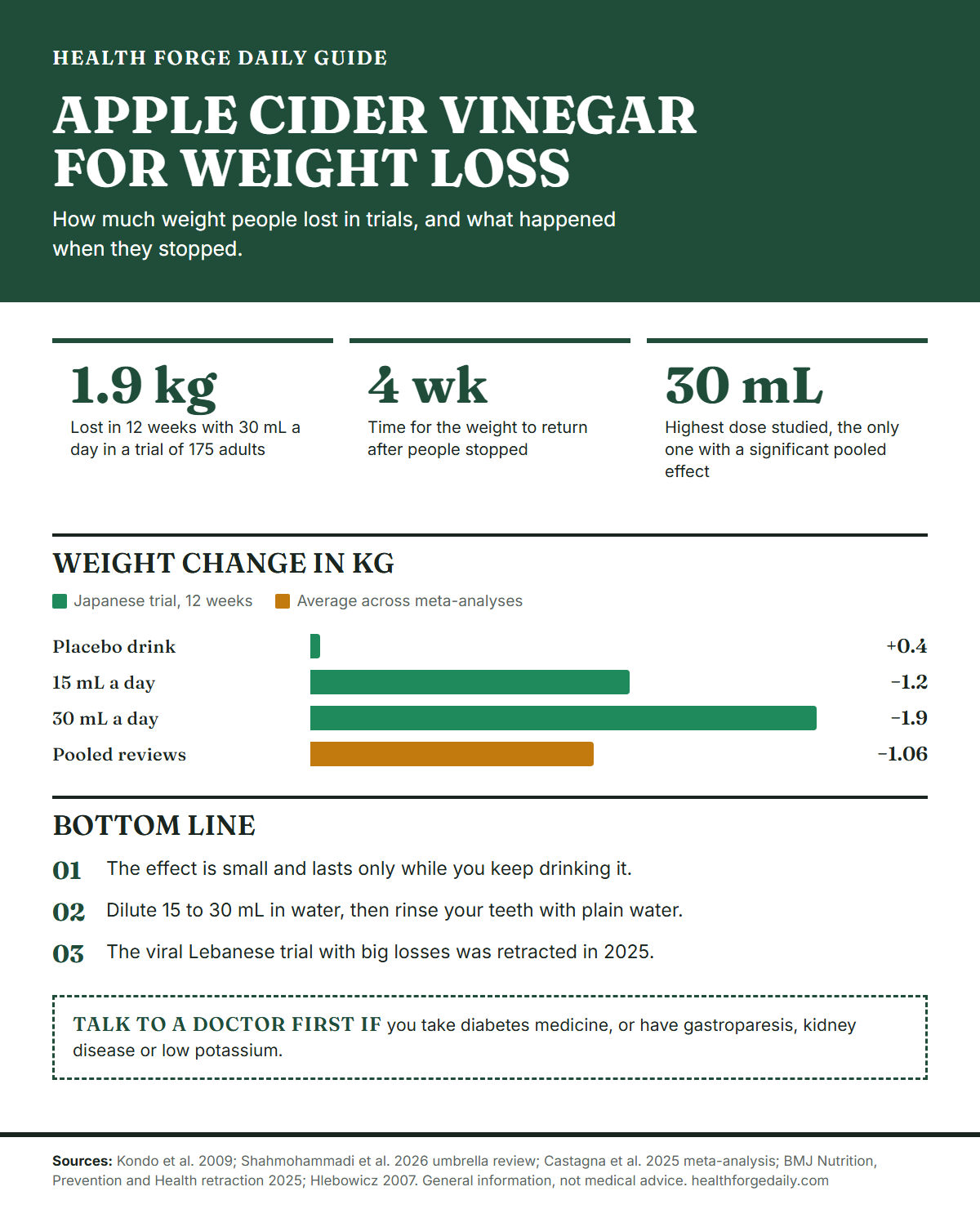
Apple cider vinegar can trim a little weight, though the effect is small. In the main 12-week trial, adults drinking 30 mL a day diluted in water lost about 1.9 kg, and most of it returned within 4 weeks of stopping. Pooled reviews find about 1 kg on average. Dilute it, keep to 30 mL or less, and pair it with a real eating plan.

Apple cider vinegar for weight loss has a small amount of trial support, and the effect is modest. We read the NIDDK and NCCIH weight pages, the NIH Office of Dietary Supplements fact sheet, four meta-analyses, an umbrella review, the main 12-week trial in full, and the safety reports. Our review process explains how we pick and check sources.
The short answer: in the best-known trial, adults who drank 30 mL of vinegar a day for 12 weeks lost about 1.9 kg, and most of it came back within 4 weeks of stopping[1].
| What it is | Fermented apple juice. Its main active part is acetic acid; 15 mL of vinegar held about 750 mg of acetic acid in one trial[1]. |
|---|---|
| Claimed use | Weight loss, appetite control and blood sugar. Reviews call the evidence for these effects insufficient[6]. |
| Amounts studied | 5 to 30 mL a day, diluted in water, for 4 to 12 weeks[2]. |
| Best evidence | An umbrella review of 10 meta-analyses found an average loss of about 1.06 kg[3]. |
| Main side effects | Nausea, tooth enamel wear and throat irritation from tablets[8][12][11]. |
| Who should avoid it | People with gastroparesis, low potassium, or reflux, and anyone on diabetes medicine without a doctor’s advice[9][10][5]. |
Does apple cider vinegar for weight loss work?
It helps a little, and only while people keep taking it. Pooled trials show apple cider vinegar lowers body weight by about 1 kg on average, a small effect next to diet changes or medicine. That figure comes from an umbrella review that rated the body weight result as high certainty[3].
Other reviews are less upbeat. A 2021 meta-analysis of 16 studies with 910 people found no change in BMI or body fat from acetic acid drinks[4]. A 2025 meta-analysis of 25 trials with 1,320 adults also found no significant change in BMI[5].
The people studied matter too. The trials enrolled adults with overweight, obesity or type 2 diabetes, with an average BMI between about 26.5 and 32[2]. There is little data on people at a healthy weight who want to lose a few pounds.
A Danish systematic review said the evidence for the health effects of apple vinegar is insufficient because high-quality research is missing[6].
The likely result is a small, short-term drop on the scale, far below the 5% loss over 6 months that NIDDK suggests as a first goal[13]. If you are weighing ACV against pills and powders, our guide on whether weight loss supplements work covers the wider evidence.
What do apple cider vinegar weight loss studies show?
The studies are small, short and mixed. Most trials enrolled fewer than 130 people and ran 4 to 12 weeks, so no study shows long-term weight loss. The largest and best-reported trial came from Japan, and it was run by researchers at a vinegar company[1][2].
| Study | Who and how long | Daily dose | Result |
|---|---|---|---|
| Kondo, Japan, 2009 | 175 adults with BMI 25 to 30, 12 weeks | 15 or 30 mL in a 500 mL drink | 30 mL group lost 1.9 kg; placebo gained 0.4 kg[1] |
| Khezri, Iran, 2018 | 44 adults with overweight or obesity, 12 weeks | 30 mL plus a calorie-restricted diet | More weight lost than diet alone[2] |
| Roshan, Iran, 2021 | 96 adults with overweight or obesity, 4 weeks | 30 mL in 250 mL water | Weight fell more than with water[2] |
| Castagna meta-analysis, 2025 | 10 trials, 789 people | 5 to 30 mL | Small drop; only 30 mL a day reached significance[2] |
| Valdes meta-analysis, 2021 | 16 trials, 910 people | 750 to 3,600 mg acetic acid | No change in BMI or body fat[4] |
| Abou-Khalil, Lebanon, 2024 | 120 young people, 12 weeks | 5, 10 or 15 mL | Retracted in 2025[7] |
Why the biggest numbers need caution
The Lebanese trial in the last row went viral for large weight losses, then BMJ retracted it because its analyses could not be replicated and the data showed implausible values[7].
The 2025 Castagna meta-analysis included that trial, and its authors estimated an average loss near 7.4 kg[2]. With a retracted study in the pool, we treat that estimate with caution and lean on the smaller 1 kg figure[3].
Dose seems to matter a little. In the same meta-analysis, 5 to 15 mL a day did not reach significance for weight, while 30 mL did[2]. The Japanese trial showed the same pattern: the 15 mL group lost 1.2 kg and the 30 mL group lost 1.9 kg over 12 weeks[1].
How might apple cider vinegar affect appetite and blood sugar?
Vinegar seems to slow the stomach and blunt blood sugar after meals. Acetic acid, the sour part of vinegar, delays gastric emptying, which can make a meal feel more filling for longer. In 10 people with type 1 diabetes, 30 mL of ACV cut the stomach emptying rate from a median of 27% to 17%[9].
In a UK study of 16 healthy adults, vinegar did reduce hunger and food intake, but nausea ratings went up at the same time[8].
The least pleasant drink cut appetite the most. The authors concluded that promoting vinegar as a natural appetite suppressant does not seem appropriate, since feeling queasy explained much of the effect[8].
A slower stomach is also not always a good thing. In the type 1 diabetes study, the authors warned that the extra delay might make blood sugar harder to control after meals[9].
Blood sugar results look a bit stronger than weight results. A 2025 meta-analysis found fasting glucose fell by about 21 mg/dL in ACV trials, mostly in people with diabetes[5]. If blood sugar is your main concern, our review of berberine for blood sugar compares another option with more glucose data.
How to use apple cider vinegar for weight loss: a drink recipe
The studied recipe is 15 to 30 mL of apple cider vinegar, about 1 to 2 tablespoons, diluted in a large glass of water once a day. Doses above 30 mL a day were not part of the pooled trials, so there is no evidence that more works better[1][2].
- Start with 15 mL (1 tablespoon). That was the low dose in the Japanese trial, and it still lowered weight a little[1].
- Mix it into 250 to 500 mL of water. The trials used drinks of this size, never straight vinegar[1][2].
- Skip honey and juice if calories matter. The Japanese trial flavored its drinks with a no-calorie sweetener[1].
- Move up to 30 mL only if 15 mL sits well. The 30 mL dose was the only one with a significant weight effect in the pooled trials[2].
- Rinse your mouth with plain water afterward. Vinegar pulled minerals out of tooth enamel in lab tests[12].
- Keep your eating plan. In the Khezri trial, ACV was added to a calorie-restricted diet[2].
- Weigh yourself once a week, as weight programs advise[13].
- Stop if you get heartburn, nausea or throat pain[8][11].
Judge it after 12 weeks at most, the longest any trial ran. In that trial, weight came back once people stopped[1].
Are apple cider vinegar capsules and gummies for weight loss worth it?
Probably not. No trial in the main reviews tested ACV gummies for weight loss, and the trials that showed a small effect used liquid vinegar diluted in water. One trial in the 2025 meta-analysis used effervescent tablets, which is a different product from a chewy gummy[2].
Product quality varies too. After a reported throat injury from an ACV tablet, researchers tested 8 tablet brands. They found big differences in size, acidity and acid content, and doubted that some even contained apple cider vinegar[11].
The NIH Office of Dietary Supplements notes that supplements do not need FDA review before sale, and makers are responsible for their own safety and label claims[15].
A gummy that delivers a fraction of a tablespoon is unlikely to match the 15 to 30 mL doses in the trials[1]. If you still prefer one, pick a brand with third-party testing and treat any weight claim on the label with doubt.
What are the side effects, and who should avoid apple cider vinegar?
Most people tolerate small diluted amounts. A systematic review of 13 human studies judged the risk of side effects inconsiderable at the amounts and in the ways usually recommended. Problems show up with large amounts, undiluted vinegar, tablets, or certain health conditions[6].
- Nausea and stomach upset: vinegar raised nausea ratings in a feeding study[8].
- Tooth enamel: several vinegars dissolved up to about 20% of enamel minerals in lab tests[12].
- Throat injury: reported with ACV tablets[11].
- Low potassium: a case report linked large amounts of cider vinegar to low potassium and bone loss[10]. Potassium keeps your heartbeat regular[16].
- Slow stomach emptying: ACV made gastroparesis worse in people with type 1 diabetes[9].
Talk to your doctor first if you take insulin or other diabetes medicine, since ACV lowered fasting glucose in trials[5]. Ask too if you have kidney disease or take a medicine that changes potassium[16].
The main trial excluded pregnant women and people who got heartburn from vinegar, so there is no safety data for them[1].
What do doctors recommend first for weight loss?
Doctors start with lifestyle changes and add medicine or surgery when needed. NIDDK says a safe first goal is losing 5% of body weight over 6 months, which is 10 pounds for a 200-pound person. Programs that work usually include 14 or more counseling sessions over 6 months[13].
They also include an eating plan, at least 150 minutes a week of moderate activity, and regular feedback. When lifestyle changes are not enough, a doctor may prescribe weight-loss medicine[13].
Weight-loss surgery may be an option for people with a BMI of 35 or higher[13]. The ODS fact sheet lists prescription medicines and bariatric surgery as treatments, alongside lifestyle change[15].
NCCIH warns that most supplements sold for fast weight loss do not keep weight off long term, and some are dangerous. It advises talking with your health care provider before starting[14]. ACV is sold as a food, and in the trials it acted as a small add-on at best.
If your goal is a smaller waist, our guide on how to lose belly fat covers the diet and exercise steps with the best evidence. ACV did reduce waist size slightly in one meta-analysis[2].
Checklist before you try apple cider vinegar
Run through this list before your first glass. The checklist keeps you at the doses the trials used and flags the people who should talk to a doctor before they start. Each item ties back to a study or an NIH page cited above[1][12][9].
- Dose: 15 mL to start, 30 mL a day at most, always diluted[1][2].
- Form: liquid vinegar over tablets or gummies, since tablet contents varied widely[11].
- Teeth: rinse with plain water after each drink[12].
- Medicines: ask your doctor if you take diabetes medicine or anything that affects potassium[5][16].
- Stomach: skip it if you have gastroparesis or get heartburn from vinegar[9][1].
- Time limit: reassess after 12 weeks, the longest trial length[2].
- Plan: pair it with an eating and activity plan, the treatment doctors use first[13].
Browse related guides in our ACV and GLP-1 support section.
Bottom line
Apple cider vinegar may trim about 1 to 2 kg over 12 weeks when people drink 15 to 30 mL a day, and the weight tends to return once they stop[1][3]. Several reviews found no effect on BMI at all, and the most hyped trial was retracted[4][7].
For most people, a calorie-controlled eating plan with regular activity is the better first step, because it is what NIDDK recommends and its results are larger[13]. If you enjoy a diluted glass of ACV and it agrees with your stomach, it is a low-cost extra, as long as you do not expect it to do the work for you.
Sources
- Vinegar intake reduces body weight, body fat mass, and serum triglyceride levels in obese Japanese subjects (Kondo et al.). Bioscience, Biotechnology, and Biochemistry, 2009
- Effect of apple cider vinegar intake on body composition in humans with type 2 diabetes and/or overweight: a meta-analysis of RCTs (Castagna et al.). Nutrients, 2025
- Vinegar consumption and health: an umbrella review of meta-analyses of randomized controlled trials (Shahmohammadi et al.). Food Science and Nutrition, 2026
- Effect of dietary acetic acid supplementation on plasma glucose, lipid profiles, and body mass index: a meta-analysis (Valdes et al.). Journal of the Academy of Nutrition and Dietetics, 2021
- The effects of apple cider vinegar on cardiometabolic risk factors: a meta-analysis of clinical trials (Tehrani et al.). Current Medicinal Chemistry, 2025
- Safety and side effects of apple vinegar intake and its effect on metabolic parameters and body weight: a systematic review (Launholt et al.). European Journal of Nutrition, 2020
- Retraction: Apple cider vinegar for weight management in Lebanese adolescents and young adults with overweight and obesity. BMJ Nutrition, Prevention and Health, 2025
- Influence of the tolerability of vinegar as an oral source of short-chain fatty acids on appetite control and food intake (Darzi et al.). International Journal of Obesity, 2014
- Effect of apple cider vinegar on delayed gastric emptying in patients with type 1 diabetes mellitus: a pilot study (Hlebowicz et al.). BMC Gastroenterology, 2007
- Hypokalemia, hyperreninemia and osteoporosis in a patient ingesting large amounts of cider vinegar (Lhotta et al.). Nephron, 1998
- Esophageal injury by apple cider vinegar tablets and subsequent evaluation of products (Hill et al.). Journal of the American Dietetic Association, 2005
- In vitro study on dental erosion caused by different vinegar varieties using an electron microprobe (Willershausen et al.). Clinical Laboratory, 2014
- Treatment for Overweight and Obesity. NIDDK, NIH
- Weight Control. NCCIH, NIH
- Dietary Supplements for Weight Loss: Fact Sheet for Health Professionals. NIH Office of Dietary Supplements
- Potassium. MedlinePlus, National Library of Medicine
Frequently asked questions
Can apple cider vinegar help you lose weight in 1 week?
No trial measured a one-week result. The trials ran 4 to 12 weeks, and in the main Japanese study weight began to drop from week 4. Before-and-after claims for a single week are not backed by any published study.
Can apple cider vinegar help you lose belly fat?
A little, in short trials. A 2025 meta-analysis found a small drop in waist size, and a Japanese trial saw less visceral fat after 12 weeks with 15 to 30 mL a day. Diet and activity changes have a much larger effect on belly fat.
Do apple cider vinegar weight loss reviews and Reddit posts mean much?
Not much. Personal stories cannot separate vinegar from other changes people make at the same time. The trial most often shared online, from Lebanon, was retracted in 2025 because its results could not be replicated and its data looked implausible.
Does the weight stay off if you stop drinking apple cider vinegar?
Not in the main trial. In the 12-week Japanese study, body weight and BMI went back to their starting values within 4 weeks after people stopped drinking vinegar. Any benefit seems to last only while you keep taking it.
Is it safe to drink apple cider vinegar every day?
For most adults, 15 to 30 mL diluted in water looks low risk in short trials. Large amounts were linked to low potassium in one case report. Check with a doctor if you have diabetes, gastroparesis, kidney disease or take potassium-affecting medicine.

Grace Whitaker is the health editor at Health Forge Daily. She reads supplement labels line by line, checks each ingredient and dose against published research, and tracks refund policies and customer complaints before a product gets a verdict. She is not a doctor, so every review points readers back to their own physician for medical decisions.
This article is for general information and is not medical advice. Supplements are not evaluated by the FDA and are not intended to diagnose, treat, cure or prevent any disease. Check with your doctor before you start any supplement.