To relieve lower back pain, stay active instead of resting in bed, put heat on the sore area, sleep on your side with a pillow between your knees, and add walking and exercise as the pain allows. Most people find relief within 6 weeks. Exercise has the strongest trial support, while acetaminophen did no better than placebo for acute pain.
This guide on how to relieve lower back pain is built from what we read and checked: the NIAMS back pain pages, MedlinePlus, NCCIH, the AAOS and ACOG patient guides, the American College of Physicians guideline, five Cochrane reviews and two large randomized trials.[1][2][3][4][8] We follow the rules in how we review health evidence, and when a popular fix has no trial behind it, we say so.
The short answer: keep moving instead of resting in bed, put heat on the sore area, and add exercise as the pain allows. Most people find relief within 6 weeks.[2][9][10]
| How common it is | About 8 in 10 people get back pain at some point[3][4] |
|---|---|
| Usual course | Acute pain lasts days to a few weeks; chronic pain lasts more than 12 weeks[1] |
| Best first steps | Stay active, avoid bed rest, use heat or cold packs[2][8] |
| Best evidence | Exercise cut chronic pain by about 15 points on a 100-point scale across 249 trials[11] |
| Pain pills | NSAIDs give a small benefit; acetaminophen did no better than placebo[13][14] |
| Get help now | Leg weakness, loss of bladder or bowel control, fever, or pain after a fall[1][5] |
How to relieve lower back pain at home: 7 steps
Home care for lower back pain means staying active, easing pain with heat, and avoiding the positions and loads that aggravate it. They keep you moving while the back settles, which it usually does on its own within a few weeks. Start with the first four on day one and add the rest as you can.[2][5]
- Skip bed rest. NIAMS advises against it, and MedlinePlus warns that more than 1 or 2 days in bed can make the pain worse.[2][3]
- Use heat. In 2 trials with 258 people, heat wraps reduced pain after 5 days.[9]
- Raise your activity a little each day. Increase it gradually as you can tolerate it, and limit only the moves that cause pain.[2]
- Break up long sitting. Get up, move around and switch positions often.[2]
- Lift with your legs. Use your leg and abdominal muscles, and make extra trips instead of carrying heavy loads.[2]
- Take a pain reliever only if you need one. NSAIDs such as ibuprofen give a small benefit; read the label first.[13][5]
- Start gentle exercise once the worst passes. Exercise has the strongest evidence for back pain that keeps coming back.[11]
How can you relieve lower back pain fast?
Heat, gentle movement and a change of position usually bring the fastest relief. A heated blanket eased acute pain right after use in one trial of 90 people. Lying down also helps many people; the AAOS notes that most find reclining improves low back pain.[9][5]
When pain strikes suddenly, try this order. Lie on your back with a pillow under your knees, or on your side with a pillow between them.[2] Put a warm pack on the sore area. After 15 to 20 minutes, get up and take a short, slow walk.
Pills are often slower than people expect. In the PACE trial of 1,652 people with acute low back pain, recovery took a median of 17 days with regular acetaminophen and 16 days with placebo.[14] NSAIDs did a little better than placebo in pooled trials, but the gain was small.[13] Ice is popular, yet a Cochrane review found too little evidence to judge cold for back pain.[9]
Which exercises and stretches relieve lower back pain?
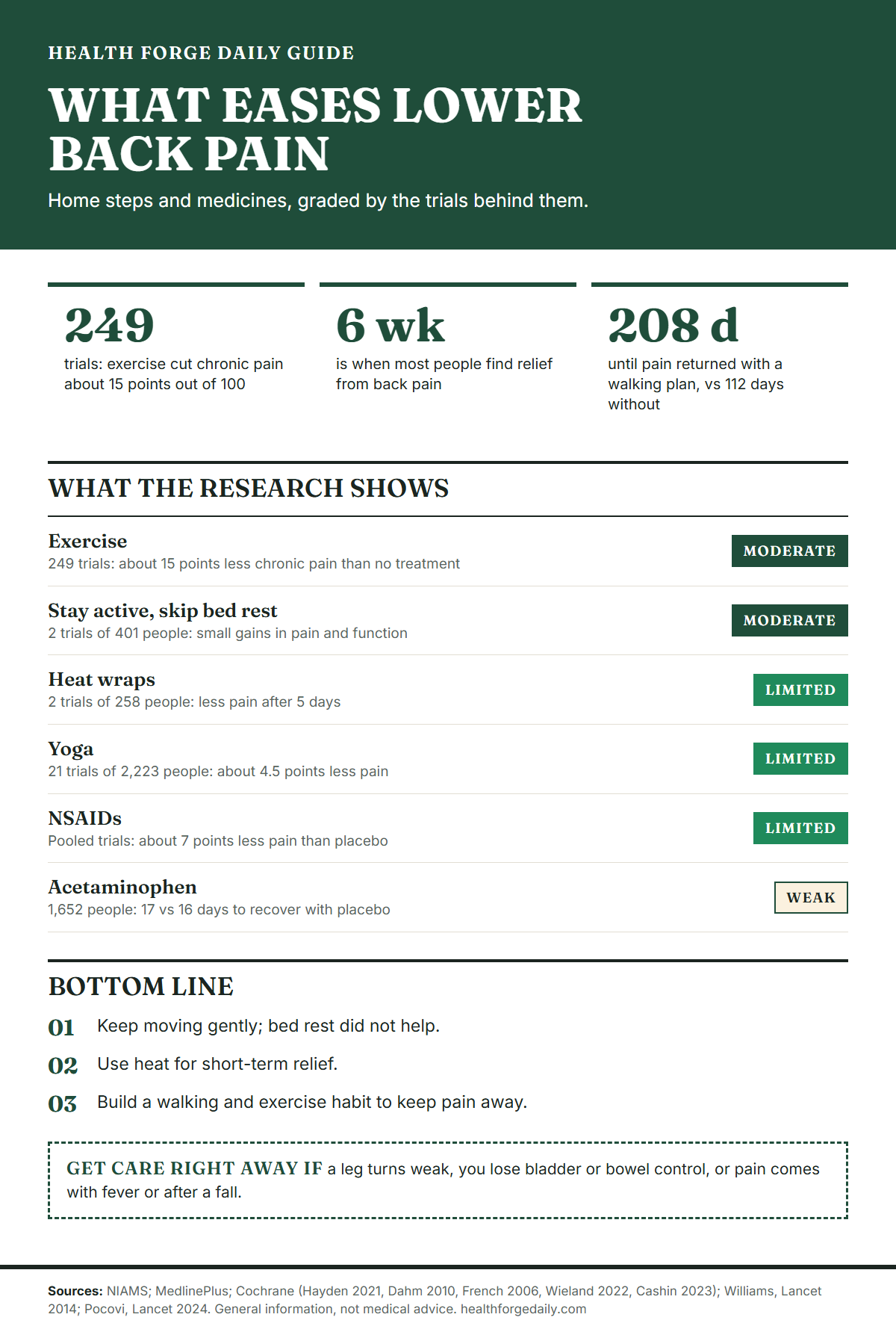
Exercise is the best-supported treatment for back pain that lasts more than 12 weeks. A 2021 Cochrane review of 249 trials found that exercise reduced pain by about 15 points on a 100-point scale compared with no treatment or usual care, a change the authors called clinically important.[11]
No single routine came out on top. The American College of Physicians lists general exercise, motor control exercise, tai chi and yoga as first choices for chronic low back pain.[8] The AAOS describes stretching, strength work and cardio as the active part of physical therapy.[5]
Yoga is a fair option, though the gain is modest. A 2022 Cochrane review of 21 trials with 2,223 people found yoga eased pain by about 4.5 points out of 100 at 3 months, which the authors judged clinically unimportant. Its main side effect was more back pain, in 43 per 1,000 people.[12]
Walking counts too. In the WalkBack trial, 701 adults who had just recovered from back pain followed a walking and education program. They went a median of 208 days before the pain came back, against 112 days without it.[15] Check with a doctor or physical therapist before starting any new routine.[2]
A simple start is a short walk on most days, plus a few gentle stretches that feel comfortable, building up slowly as NIAMS advises. Stop any move that sends pain down a leg. A physical therapist can tailor a routine to your back.[2][5]
Which treatments have the best evidence?
Exercise and staying active have the strongest support, heat has fair short-term support, and most pills give small effects at best. The table pulls the main findings from the reviews and trials we read. Scores are on a 0 to 100 pain scale unless noted.[11][10][9][13]
| Treatment | Who and how many | Result | Our read |
|---|---|---|---|
| Exercise[11] | 249 trials, chronic pain | About 15 points less pain than no treatment | Best supported |
| Staying active vs bed rest[10] | 2 trials, 401 people, acute pain | Small gains in pain and function | Skip bed rest |
| Heat wrap[9] | 2 trials, 258 people | Less pain after 5 days | Useful short term |
| Yoga[12] | 21 trials, 2,223 people | About 4.5 points less pain at 3 months | Small benefit |
| Walking program[15] | 701 adults after recovery | 208 vs 112 days until pain returned | Good for prevention |
| NSAIDs[13] | Pooled trials, acute pain | About 7 points less pain than placebo | Small benefit |
| Acetaminophen[14] | 1,652 people, acute pain | 17 vs 16 days to recover with placebo | No better than placebo |
Muscle relaxants gave a small benefit for acute pain in Cochrane reviews but raised the risk of side effects by about half.[13] The AAOS adds that they can make you drowsy.[5] Traction has no scientific evidence behind it.[5]
How do you relieve lower back pain while sleeping?
The position NIAMS suggests is on your side with a small pillow between your knees. If you sleep on your back, place a pillow under your knees instead. Try to avoid sleeping on your stomach, which many people find arches the lower back.[2]
Many people with back pain feel worse in the morning. NIAMS lists morning stiffness that eases with activity as a common pattern.[1] A few minutes of gentle movement after getting up, or a warm shower, can loosen things before the day starts.
Sleep itself matters. NIAMS notes that chronic poor sleep, depression or anxiety can make back pain more frequent and more severe, and it lists regular sleep among the habits that support recovery.[1][2] If poor sleep is part of your picture, our guide to magnesium glycinate and what the sleep research shows covers one supplement people ask about, with the limits of the evidence.
How can you relieve lower back pain during pregnancy?
Backache is one of the most common pregnancy problems, especially in the later months. ACOG blames the growing uterus, which shifts your center of gravity and weakens the stomach muscles, plus a hormone that loosens the pelvic joints. The pain usually fades after birth, though it lingers for months in many women.[6]
ACOG suggests these steps:[6]
- Wear low-heeled, but not flat, shoes with good arch support.
- When standing for a long time, rest one foot on a stool or box.
- Sleep on your side with your knees bent and a pillow between them.
- Use a heating pad on its lowest setting, wrapped in a towel, for a limited time.
- Try a belly support garment, walking or swimming.
Call your ob-gyn if the pain is severe or lasts more than two weeks. Back pain with fever, burning when you urinate, or vaginal bleeding needs a prompt call, because it can be a sign of a urinary infection or preterm labor.[6]
How do you relieve lower back pain from constipation?
Lower back pain together with constipation is a reason to see a doctor right away, according to NIDDK. It lists lower back pain alongside rectal bleeding, constant belly pain, vomiting, fever and weight loss as warning signs that need a prompt visit, rather than a home remedy.[7]
We found no trial that tests home remedies for back pain linked to constipation, so we will not suggest one. NIDDK notes that disorders of the brain and spine can cause constipation, one reason the pairing deserves a check.[7]
For ordinary constipation without those signs, NIDDK lists low fiber, too little fluid and too little physical activity among the common causes.[7] The same daily walk that helps your back also counts as activity. Narcotic pain medicines, sometimes given for back pain, can also cause constipation.[7]
When should you see a doctor for lower back pain?
See a doctor if back pain does not improve after a few weeks, and go right away for the warning signs below. MedlinePlus advises a call if the pain is severe or has not improved after three days. Back pain is called chronic once it lasts more than 12 weeks.[1][3]
Get care right away if back pain comes with:[1][5][7]
- Weakness, pain or numbness in your legs
- Loss of bladder or bowel control, or trouble urinating
- Fever, or weight loss you did not intend
- A fall or other injury
- Constipation with rectal bleeding or constant belly pain
Some groups need extra care with home treatment. Back pain in pregnancy can signal preterm labor or infection.[6] NIAMS lists osteoporosis fractures, kidney stones or infections, and in rare cases tumors as other causes.[1] If you have kidney disease, stomach ulcers or take a blood thinner, ask a pharmacist or doctor before taking an NSAID.
What do doctors use first for lower back pain?
Doctors start with treatments that do not involve drugs, because most acute back pain improves over time whatever is done. The 2017 American College of Physicians guideline recommends heat, massage, acupuncture or spinal manipulation for acute pain, and NSAIDs or muscle relaxants if medicine is wanted.[8]
For chronic pain, the same guideline puts exercise, rehabilitation programs, mindfulness-based stress reduction, tai chi and yoga first. Opioids come last, only after other options fail.[8] Most people do not need X-rays or MRI scans; NIAMS says tests are used to rule out a specific cause.[2]
NCCIH rates the evidence for acupuncture, massage and spinal manipulation in acute pain as low quality. It says topical cayenne preparations reduce pain, and that a 2018 review of 8 vitamin D studies with 747 people found no benefit.[4]
No supplement replaces this care. Our turmeric benefits guide on what curcumin research shows and our anti-inflammatory diet guide with foods and meal ideas cover what those approaches have and have not been studied for. NIAMS adds that keeping a healthy weight reduces strain on the back.[2] More articles sit in our back and neck pain section.
Your lower back pain relief checklist
Use this list for the first few weeks of a flare and to lower the odds of the next one. Each item comes from NIAMS, MedlinePlus, the AAOS or the trials in this guide, and none of them needs special equipment.[2][3][5][15]
- Stay out of bed during the day, even on bad days.[3]
- Apply a warm pack to the sore area for short sessions.[9]
- Stand up and move whenever you have been sitting for a long stretch.[2]
- Sleep on your side with a pillow between your knees.[2]
- Walk most days once you can, and build up slowly.[15]
- Add a strength or stretching routine, ideally with a physical therapist.[2][11]
- Use a pain reliever only as the label directs, for a short time.[13]
- Call a doctor if pain is not better after a few weeks, or right away for red flags.[1][5]
Bottom line
Lower back pain is common and usually short-lived. About 8 in 10 people get it at some point, and most find relief within 6 weeks.[3][2] Movement, heat and good sleep positions ease the pain while that happens, and bed rest adds nothing, so the main job is to keep going gently.[9][10]
For most people, a daily walk plus a simple exercise routine is a better first step than a new pill, because exercise has the strongest trial support and acetaminophen did no better than placebo.[11][14][15] If pain spreads down a leg, weakens it, or affects your bladder or bowels, skip the home plan and get seen.
Sources
- Back Pain: Symptoms, Types, and Causes. NIAMS, 2023
- Back Pain: Diagnosis, Treatment, and Steps to Take. NIAMS, 2023
- Back Pain. MedlinePlus, National Library of Medicine
- Low-Back Pain and Complementary Health Approaches: What You Need To Know. NCCIH
- Low Back Pain. American Academy of Orthopaedic Surgeons, OrthoInfo
- Back Pain During Pregnancy. American College of Obstetricians and Gynecologists
- Symptoms and Causes of Constipation. NIDDK, 2018
- Noninvasive Treatments for Acute, Subacute, and Chronic Low Back Pain: A Clinical Practice Guideline From the American College of Physicians. Annals of Internal Medicine, 2017
- Superficial heat or cold for low back pain. Cochrane Database of Systematic Reviews, 2006
- Advice to rest in bed versus advice to stay active for acute low-back pain and sciatica. Cochrane Database of Systematic Reviews, 2010
- Exercise therapy for chronic low back pain. Cochrane Database of Systematic Reviews, 2021
- Yoga for chronic non-specific low back pain. Cochrane Database of Systematic Reviews, 2022
- Pharmacological treatments for low back pain in adults: an overview of Cochrane Reviews. Cochrane Database of Systematic Reviews, 2023
- Efficacy of paracetamol for acute low-back pain: a double-blind, randomised controlled trial. The Lancet, 2014
- Effectiveness and cost-effectiveness of an individualised, progressive walking and education intervention for the prevention of low back pain recurrence (WalkBack). The Lancet, 2024
Frequently asked questions
How do you relieve lower back pain on the right side?
Most one-sided back pain comes from muscles or joints and responds to heat, gentle movement and side sleeping. NIAMS also lists kidney stones and infections as causes, so pain with fever, burning urine or blood in the urine needs a doctor.
How do you relieve severe lower back pain?
Lie in a position that eases it, apply heat, and take an over-the-counter pain reliever as the label directs. Severe pain after a fall, or with leg weakness or bladder trouble, needs urgent care. MedlinePlus advises a call if it is not better in three days.
How do you relieve lower back pain from a strain?
A strain is an injury to a muscle or tendon. Keep moving gently, use heat or cold packs, and raise activity as the pain allows. Most strains settle within a few weeks, so see a doctor if yours is not improving.
How do you relieve lower back pain from being overweight?
NIAMS says extra weight puts stress and strain on the back and advises keeping a healthy weight. Regular walking and strength exercise help on both fronts, since exercise is also the best-supported treatment for chronic low back pain in trials.
How do you relieve lower back pain after a hip replacement?
We found no trials on back pain after hip replacement or hysterectomy. Follow your surgeon's activity plan and ask them before using heat, stretches or new pain relievers, because the right approach depends on the operation and your recovery stage.

Grace Whitaker is the health editor at Health Forge Daily. She reads supplement labels line by line, checks each ingredient and dose against published research, and tracks refund policies and customer complaints before a product gets a verdict. She is not a doctor, so every review points readers back to their own physician for medical decisions.
This article is for general information and is not medical advice. Supplements are not evaluated by the FDA and are not intended to diagnose, treat, cure or prevent any disease. Check with your doctor before you start any supplement.
