Mild cognitive impairment (MCI) means memory or thinking problems beyond what is normal for your age, while you can still manage daily life. It affects about 1 in 10 people in their early 70s. Each year 10 to 20% of people over 65 with MCI develop dementia, but some return to normal, so check for treatable causes such as medicines, sleep apnea, depression, thyroid problems and low B12.
Mild cognitive impairment is a stage where memory or thinking slips are clearly worse than expected for your age, yet you can still run your own life. We read the National Institute on Aging pages on MCI and memory, the 2018 American Academy of Neurology guideline, MedlinePlus, the US Preventive Services Task Force screening statement and four large trials before writing this.[1][2]
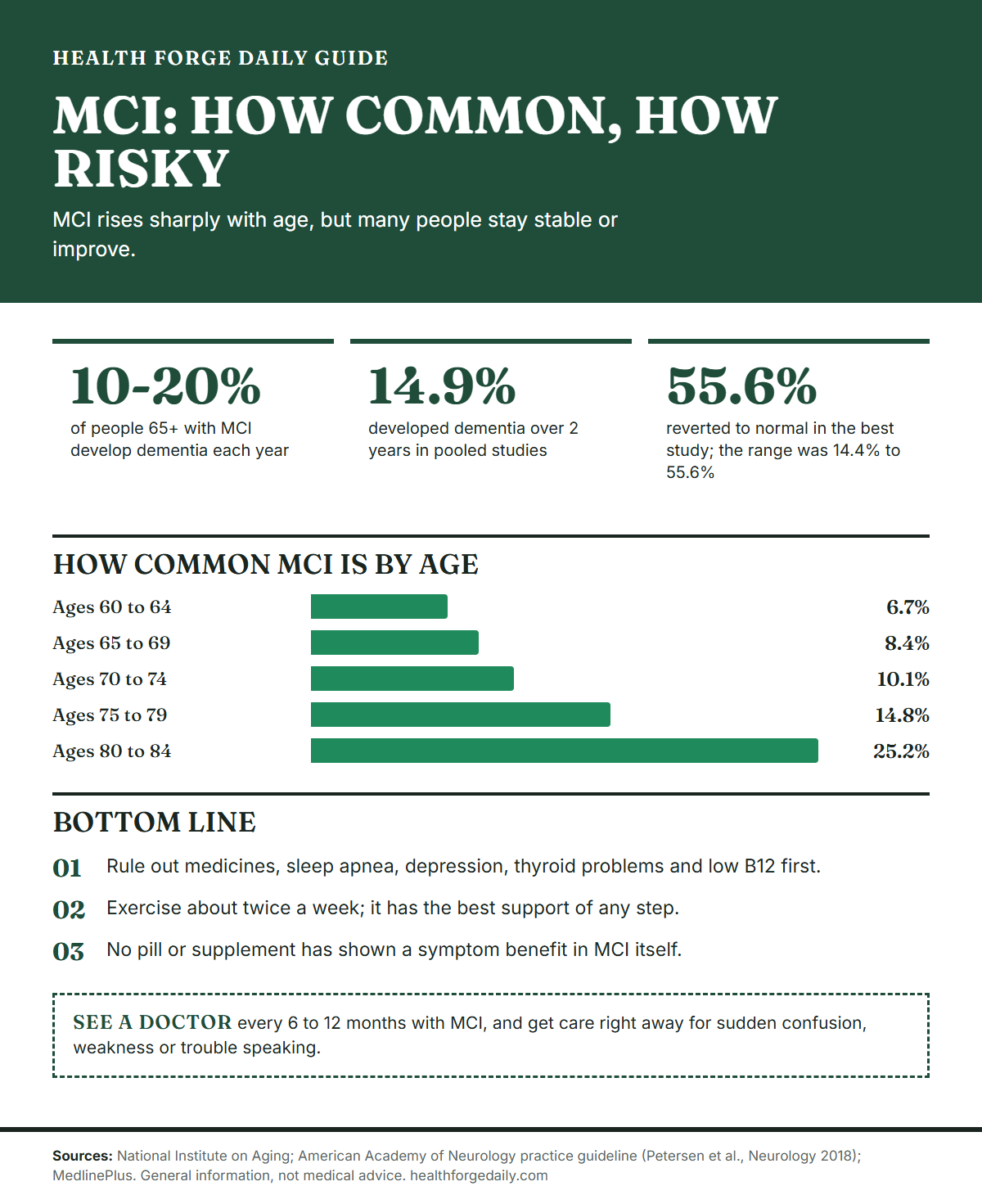
MCI raises the risk of dementia, though many people with it never get there. About 10 to 20% of people 65 and older with MCI develop dementia in a given year, and some people return to normal thinking on later testing.[1][2]
| What it is | More memory or thinking problems than others your age, with daily life still intact[1][3] |
|---|---|
| How common | 6.7% at ages 60 to 64, rising to 25.2% at ages 80 to 84[2] |
| Risk of dementia | 10 to 20% a year after 65; 14.9% over 2 years in pooled studies[1][2] |
| Causes to rule out | Medicine side effects, sleep apnea, depression, thyroid problems, low vitamin B12[2][4] |
| Best-supported step | Regular exercise, about twice a week[2] |
| Drugs and supplements | No pill has shown a symptom benefit in MCI itself[2] |
| Follow-up | A checkup every 6 to 12 months[1][3] |
What is mild cognitive impairment?
Mild cognitive impairment (MCI) means a person has more memory or thinking problems than other adults their age, but can still take care of themselves and do their normal activities.[1][3] It sits between the small changes of normal aging and the larger losses of dementia.
Doctors split it into two broad types. In amnestic MCI, memory is the main problem. In nonamnestic MCI, other skills slip more, such as language, judging space and distance, or planning and organizing.[2]
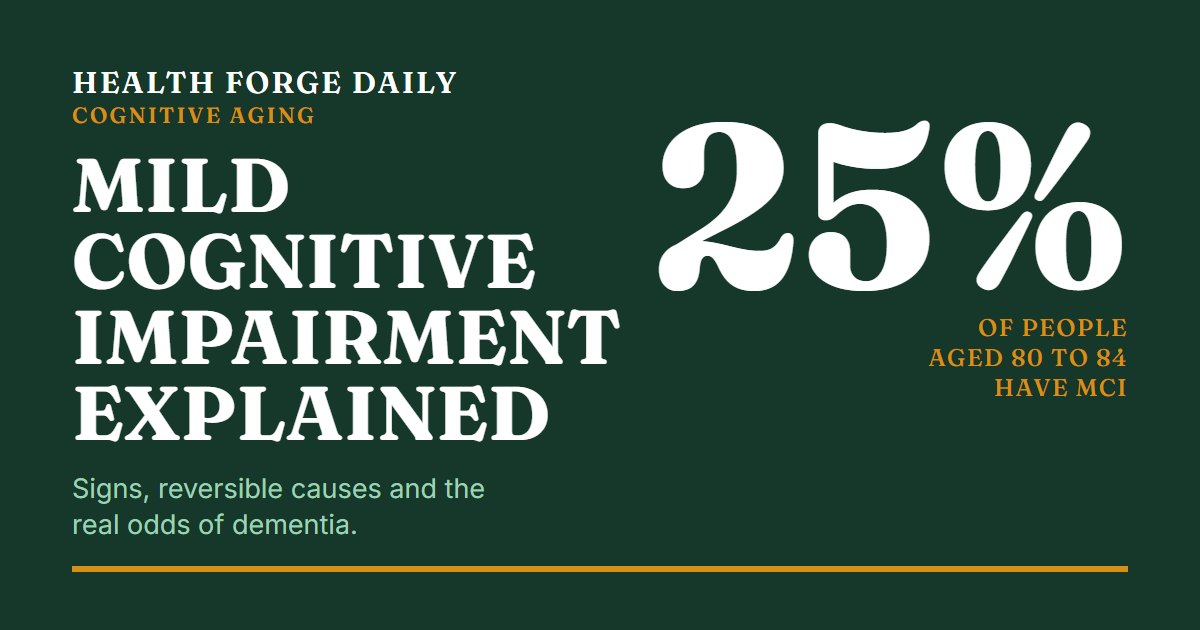
MCI is common, and it becomes more common with each decade. The AAN guideline pooled studies and found it in 6.7% of people aged 60 to 64, 8.4% at 65 to 69, 10.1% at 70 to 74, 14.8% at 75 to 79 and 25.2% at 80 to 84.[2] That last figure is roughly 25%, or one in four. Diabetes, depression and stroke may also raise the risk.[1]
What are the symptoms of mild cognitive impairment?
The most common signs are losing things often, forgetting appointments or events, and having more trouble finding words than others your age.[1] Friends or family may notice before the person does. The problems are real but small enough that bills still get paid and meals still get made.
The NIA also links MCI with movement difficulties and a weaker sense of smell.[1] Its list of signs that it may be time to talk with a doctor includes:
- Asking the same questions over and over[4]
- Getting lost in places you used to know well[4]
- Having trouble following recipes or directions[4]
- Needing more lists and reminders than before[1]
None of these signs alone proves MCI. Stress, poor sleep and some medicines cause the same lapses, which is why a proper check matters more than a self-quiz.[4]
Mild cognitive impairment vs normal aging: how can you tell?
Normal aging brings occasional slips that do not get steadily worse; MCI brings slips that are frequent enough for you or others to notice a change from your own past self.[1][4] Forgetting a name and recalling it later is typical of age. Missing several appointments in a month is a reason to get checked.
| Sign | Normal aging | MCI | Dementia |
|---|---|---|---|
| Memory | Now and then forgets a name, recalls it later | Forgets events and appointments more often than peers | Forgets recent events and does not recall them |
| Daily tasks | No change | Still independent, may need lists or more time | Needs help with bills, cooking or self-care |
| Who notices | Usually only the person | The person and often family | Family more than the person |
| Course | Stable | May stay the same, improve or worsen | Gets worse over time |
The table follows the NIA’s comparison and its description of MCI.[1][4]
Mild cognitive impairment vs dementia: what is the difference?
The dividing line is independence: people with MCI can manage their own daily life, while dementia means thinking problems are severe enough to interfere with it.[3][4] MCI can be an early stage of Alzheimer’s disease, but it is not the same diagnosis.
People searching “MCI vs Alzheimer’s” are often asking whether the label means Alzheimer’s is coming. The answer is maybe. More people with MCI than without it go on to develop Alzheimer’s or a related dementia, yet many do not, and some improve.[1] When doctors want to know whether Alzheimer’s is the cause, they can order a PET scan or a spinal fluid test that looks for amyloid, a protein linked to the disease.[5]
What causes mild cognitive impairment, and which causes are reversible?
There is no single cause of MCI, and some of the conditions behind it can be treated, so a doctor’s first job is to look for them.[1][3] The AAN guideline tells clinicians to check for medication side effects, sleep apnea, depression and other medical conditions.[2]
The NIA lists these causes of memory problems that are not dementia:[4]
- Thyroid, kidney or liver problems
- Side effects of medicines
- Depression and anxiety
- Alcohol or drug misuse
- Sleep problems
- Low vitamin B12 and poor nutrition
- Head injury, blood clots, tumors or infections in the brain
Low B12 is easy to overlook because a simple blood test is needed to find it. Our guide to vitamin B12 deficiency symptoms and testing covers the other signs and who is at risk. When the cause is a medicine or a treatable condition, the AAN advises stopping thinking-impairing drugs where possible and treating the problem.[2]
How is mild cognitive impairment diagnosed?
There is no single test for MCI; a doctor combines your history, a report from someone who knows you well, a short thinking test and checks for other causes.[2] The AAN says validated assessment tools should be used, and that no one instrument is better than the rest.[2]
A typical workup may include:
- Questions about when the problems began and how they affect daily life
- A pen-and-paper or tablet memory and thinking test
- A review of every medicine and supplement you take
- Questions about mood, sleep, snoring and alcohol
- Blood tests or scans when the doctor suspects another cause
On medical records in the US, MCI without a known cause is coded G31.84 in ICD-10-CM, listed as “mild cognitive impairment of uncertain or unknown etiology.”[10] Routine screening of older adults with no symptoms is not settled. The USPSTF found the evidence insufficient to weigh its benefits and harms.[6] Once you have symptoms, that statement does not apply, and a visit is reasonable.
Does mild cognitive impairment always lead to dementia?
No. MCI raises the risk of dementia, but many people stay stable for years and some return to normal thinking.[1][2] In people 65 and older, an estimated 10 to 20% with MCI develop dementia each year. Compared with peers of the same age, their risk over 2 to 5 years was about 3.3 times higher.[1][2]
How fast it progresses depends on the cause. MCI from a medicine, low B12 or depression may lift once that is treated. MCI from early Alzheimer’s tends to move forward.
| Source | Who | Time | Result |
|---|---|---|---|
| NIA estimate | Adults 65+ with MCI | 1 year | 10 to 20% develop dementia[1] |
| AAN pooled studies | Adults over 65 with MCI | 2 years | 14.9% developed dementia[2] |
| AAN pooled studies | MCI vs same-age peers | 2 to 5 years | Dementia risk 3.3 times higher[2] |
| AAN Class I studies | People with MCI | Varied | 14.4% to 55.6% reverted to normal[2] |
People who revert to normal still carry a higher risk later, so follow-up should continue.[2]
How do you treat mild cognitive impairment?
There is no standard treatment or approved medication for MCI itself, so care focuses on fixing any reversible cause, exercise, managing heart and blood vessel risks, and regular checkups.[1][2]
What doctors use first, in rough order:
- Treat the cause if one is found, such as a thyroid problem, depression or a sedating medicine[2]
- Prescribe regular exercise; the AAN backs about twice a week, based on 6-month trials[2]
- Control blood pressure and limit alcohol[4]
- Recheck thinking every 6 to 12 months[1][3]
The Alzheimer’s drugs called cholinesterase inhibitors have not slowed progression from MCI, and the AAN says clinicians may choose not to offer them.[2] Lecanemab and donanemab are a different case. They are FDA-approved for early Alzheimer’s, including MCI caused by the disease, and slowed decline over 18 months in trials. They need amyloid confirmed by PET or spinal fluid, and they can cause swelling or bleeding in the brain, so patients get repeat MRI scans.[5]
In the SPRINT MIND trial of 9,361 adults with high blood pressure, aiming for a top number under 120 instead of under 140 lowered new MCI from 18.3 to 14.6 cases per 1,000 person-years over a median of 5.11 years. The drop in probable dementia was not statistically significant.[7]
Do supplements help mild cognitive impairment?
No supplement has shown a benefit for thinking in MCI, and the AAN says no drug or dietary agent has proven symptom benefit.[2] The NIA warns that pills and brain games promising better memory may be unsafe, a waste of money, or both.[4]
Two large trials tested popular picks directly. In a Cochrane review, vitamin E did not change the chance of moving from MCI to Alzheimer’s dementia over 36 months in a trial of 516 people.[8] In the GEM trial, 3,069 adults aged 75 and older, 482 of them with MCI, took 120 mg of ginkgo extract twice a day or a placebo for a median of 6.1 years. Ginkgo had no effect on progression to dementia in the MCI group.[9] We cover that trial in more depth in what large trials found on ginkgo biloba for memory, and the smaller early studies in our review of lion’s mane mushroom research for memory.
Taking B12 makes sense when a blood test shows you are low. That corrects a deficiency and has no proven effect on MCI itself.[4]
How to manage mild cognitive impairment day to day
Living well with MCI means keeping your body and routines strong, using memory aids early, and planning ahead while decisions are still easy to make.[1][4] These steps follow NIA and AAN advice:
- Move most days, and aim for at least two exercise sessions a week[2]
- Sleep seven to eight hours, and mention snoring or daytime sleepiness to your doctor[4][2]
- Keep blood pressure in the range your doctor sets[7]
- Limit alcohol[4]
- Use one calendar, one pill organizer and a fixed spot for keys and phone[1]
- Stay social and keep up hobbies you enjoy[4]
- Bring a family member to visits and write questions down beforehand
- Name a health care proxy and sort out finances while choices are easy to make
| If | Then |
|---|---|
| Memory slips began after a new medicine | Ask the prescriber whether it can be changed[2] |
| You snore loudly or wake up tired | Ask about a sleep apnea evaluation[2] |
| You feel low or have lost interest in things | Get screened for depression[2] |
| Your diet has been poor or limited for a while | Ask whether a B12 test makes sense[4] |
| Testing points to Alzheimer’s | Ask a specialist whether amyloid testing and newer drugs fit you[5] |
When should you see a doctor right away?
Slow, mild memory changes call for a routine appointment, but sudden changes in thinking need same-day care. Some causes on the NIA list, such as blood clots, infections or bleeding in the brain, can be serious.[4] People on lecanemab or donanemab should report new symptoms promptly, because these drugs can cause swelling or bleeding in the brain.[5]
Call 911 or get care right away if you notice:
- Sudden confusion, or trouble speaking or understanding speech[11]
- Sudden numbness or weakness of the face, arm or leg, especially on one side[11]
- Sudden trouble seeing, walking or keeping your balance[11]
- New memory problems after a fall, head injury or concussion[4]
- Confusion that comes on with a fever or illness, since brain infections are on the NIA list[4]
Also tell your doctor about every supplement you take, since the NIA warns that some memory products may be unsafe.[4] You can read how we choose and check sources on our how we review page, and find related guides in our cognitive aging section.
Bottom line
Mild cognitive impairment is a real, measurable change, but it often has a cause worth hunting for, and many people never go on to dementia. About 10 to 20% of people over 65 with MCI progress each year, while some studies saw more than half return to normal.[1][2]
For most people, the best first step is a full medical review of medicines, sleep, mood, thyroid and B12, followed by regular exercise and good blood pressure control. That plan has more research behind it than any supplement, and it usually costs less.[2][7]
Sources
- What Is Mild Cognitive Impairment?. National Institute on Aging
- Practice guideline update summary: Mild cognitive impairment. American Academy of Neurology, Neurology, 2018
- Mild Cognitive Impairment. MedlinePlus, National Library of Medicine
- Memory Problems, Forgetfulness, and Aging. National Institute on Aging
- How Is Alzheimer's Disease Treated?. National Institute on Aging
- Cognitive Impairment in Older Adults: Screening. US Preventive Services Task Force, 2020
- Effect of Intensive vs Standard Blood Pressure Control on Probable Dementia (SPRINT MIND). JAMA, 2019
- Vitamin E for Alzheimer's dementia and mild cognitive impairment. Cochrane Database of Systematic Reviews, 2017
- Ginkgo biloba for prevention of dementia: a randomized controlled trial (GEM). JAMA, 2008
- ICD-10-CM Browser Tool: G31.84. CDC National Center for Health Statistics, FY2026
- Stroke. MedlinePlus, National Library of Medicine
Frequently asked questions
What is the ICD-10 code for mild cognitive impairment?
In ICD-10-CM, the US version used on medical records and insurance claims, mild cognitive impairment without a known cause is coded G31.84. The official label is mild cognitive impairment of uncertain or unknown etiology. Your doctor picks the code that fits your diagnosis.
Can mild cognitive impairment get better?
Yes, for some people. Studies in the American Academy of Neurology guideline found that 14.4% to 55.6% of people with MCI tested normal at follow-up. Improvement is more likely when a cause such as a medicine, depression or poor sleep is found and treated.
Is mild cognitive impairment the same as Alzheimer's disease?
No. MCI describes a level of memory or thinking trouble, and Alzheimer's is one possible cause of it. Others include medicine side effects, depression and sleep problems. Amyloid PET scans or spinal fluid tests can show whether Alzheimer's changes are present.
How often should someone with MCI see a doctor?
The National Institute on Aging and MedlinePlus advise a checkup with a doctor or specialist every 6 to 12 months. These visits track whether thinking is stable, better or worse, and catch new causes or changes in medicines early.
Should older adults without symptoms be tested for MCI?
The US Preventive Services Task Force found the evidence insufficient to judge the benefits and harms of screening adults 65 and older who have no symptoms. If you or your family notice changes, that is different, and a medical visit is reasonable.

Grace Whitaker is the health editor at Health Forge Daily. She reads supplement labels line by line, checks each ingredient and dose against published research, and tracks refund policies and customer complaints before a product gets a verdict. She is not a doctor, so every review points readers back to their own physician for medical decisions.
This article is for general information and is not medical advice. Supplements are not evaluated by the FDA and are not intended to diagnose, treat, cure or prevent any disease. Check with your doctor before you start any supplement.